
Introduction
Your go-to-market team is growing. You've hired your first AEs, marketing is running campaigns, and customer success is trying to keep pace — but something is off. Leads fall through cracks between handoffs. CRM data doesn't match what reps say is in their pipeline. Forecasting feels more like guesswork than analysis.
This is the operational gap that kills early-stage revenue momentum. Fractional RevOps exists specifically to close it.
Picking the wrong provider — or stalling on the decision — costs you pipeline velocity, burns budget, and leaves your sales team without the operational foundation to convert opportunities into revenue.
This guide breaks down what fractional RevOps actually delivers, when it's the right move for B2B SaaS startups, and what separates providers who create measurable results from those who don't.
TL;DR
- Fractional RevOps gives early-stage B2B SaaS companies senior revenue operations expertise without the cost or long-term commitment of a full-time hire
- Works best post-product-market fit, when a growing GTM motion outpaces your operational infrastructure
- The right provider delivers embedded execution with clear, measurable deliverables — not slide decks
- Key evaluation factors: scope of services, engagement flexibility, stage-specific experience, and time to first deliverable
- RevOps infrastructure only generates revenue when paired with sales talent who can execute within it
What Is Fractional RevOps?
Fractional RevOps is the model of engaging a senior revenue operations professional (or a small team) on a part-time or project basis. The scope covers the alignment of sales, marketing, and customer success systems, without the cost or long-term commitment of a full-time hire.
The critical distinction: this is an embedded operational role, not an advisory one. A fractional RevOps professional attends your pipeline reviews, maintains your CRM, and builds the reporting infrastructure your team uses daily.
Core Functions It Covers
A strong fractional RevOps engagement typically spans:
- CRM implementation and hygiene — building and maintaining clean, reliable data structures
- Pipeline reporting and forecasting — creating dashboards your team actually trusts
- Lead routing and scoring — ensuring the right leads reach the right reps at the right time
- Attribution modeling — connecting marketing spend to actual revenue outcomes
- GTM process alignment — establishing shared definitions across sales and marketing
A well-scoped engagement leaves behind documented systems your team owns: the processes, CRM configurations, and reporting structures that keep working after the contract ends.
Fractional RevOps vs. Full-Time Hire vs. Consultant
The right model depends on where your team is. Here's how they compare:
| Model | Strength | Limitation |
|---|---|---|
| Full-time hire | Deep institutional knowledge | High cost — Director base averages $101,253; VP total comp reaches $317K median — plus 3-6 month ramp and headcount risk |
| RevOps consultant | Point-in-time project delivery | No ongoing ownership; team still has to implement recommendations |
| Fractional engagement | Strategic depth plus hands-on execution | Capped hours mean scope must be managed carefully |
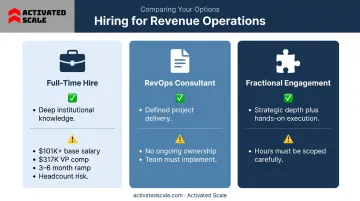
For early-stage teams, the fractional model delivers what the other two can't: a practitioner who builds the system and keeps it running, at a fraction of the full-time cost.
When Does Fractional RevOps Make Sense for a B2B SaaS Startup?
The Right Stage
The clearest fit is companies that have found product-market fit and are actively building a GTM motion — typically Seed to Series A. The commercial team is growing, but operational infrastructure hasn't kept pace.
According to ChartMogul's 2024 practitioner guidance, SaaS companies should consider RevOps as soon as they have a sales leader and one to two sales reps. Waiting longer creates what they call a "scalability trap" — where growth is tied directly to continued headcount addition rather than operational efficiency.
Common signals that you've hit this threshold:
- Marketing and sales are working from different data sets
- Deals die without clear explanation or documented loss reason
- Forecasting is based on gut feel, not pipeline health metrics
- No shared definition of what constitutes a qualified lead
- Attribution between marketing spend and closed revenue is unclear
The Cost Argument
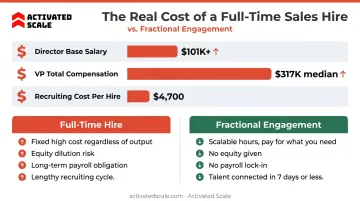
Bringing on a full-time senior RevOps leader carries real financial weight. Key benchmarks:
- Director-level base pay: averages over $100K annually
- VP-level total compensation: $317K at the median
- Recruiting costs: roughly $4,700 per hire before the role even starts
A fractional engagement scales hours up or down based on actual need, with no equity dilution and no long-term payroll obligation.
Gartner's 2021 forecast predicted that 75% of the highest-growth companies would deploy a RevOps model by 2025. Building sales capacity without operational infrastructure to support it leaves growth exposed — and harder to recover at Series B.
When Fractional RevOps Is NOT the Right Move
It's the wrong choice when:
- The company has fewer than 10-15 employees and hasn't established a repeatable GTM motion
- There's no CRM or formal sales process in place yet
- The founding team is still validating whether there's a real market
Fractional RevOps builds on an existing commercial motion — if that motion doesn't exist yet, the engagement has nothing to work with.
Key Factors to Consider When Choosing a Fractional RevOps Solution
Selecting the wrong provider (mismatched in scope, stage experience, or engagement model) delays results and often costs more than expected. Here's what to evaluate.
Scope of Services
A fractional RevOps provider should cover the full operational stack:
- CRM administration and data hygiene
- Pipeline reporting and stage design
- Lead routing and scoring logic
- Attribution modeling
- Forecasting infrastructure
- GTM process alignment across sales and marketing
Narrow scope means patching gaps with additional vendors , which adds cost and complexity. Ask specifically which operational KPIs the provider has moved before: pipeline velocity, forecast accuracy, sales cycle length, and stage-by-stage conversion rates are the right metrics to discuss.
Engagement Model Flexibility
The difference between embedded and arms-length engagement matters enormously for early-stage teams. If there's no internal RevOps staff to implement recommendations, an arms-length consultant leaves you with a document and a gap.
Look for:
- Attendance at pipeline reviews and team syncs
- Ownership of CRM maintenance, not just configuration
- Flexibility to scale hours up during a product launch or new market entry, and back down without penalty
Stage-Specific Experience
Early-stage RevOps work is structurally different from mid-market or enterprise. Small teams, fast pivots, minimal documentation, and no RevOps history are the norm — that's the baseline, not a red flag.
Ask candidates for specific examples of building RevOps infrastructure from scratch. Optimizing a system that already works requires a different skill set than creating one where nothing exists.
Speed to Value
Expect tangible early outcomes within 30 to 60 days: cleaned CRM data, functional reporting dashboards, defined pipeline stages. A 3-6 month ramp before anything is usable is closer to a full-time hire timeline, and it undercuts the core advantage of going fractional.
Ask every candidate to walk through their 30/60/90 day plan before the engagement starts. No early milestones outlined means no urgency to deliver them.
Tech Stack Compatibility
Generic RevOps strategy without platform-specific execution leaves your team implementing recommendations they may not have the skills to execute. Confirm hands-on experience with the specific tools in your stack (HubSpot, Salesforce, or whatever you're running).
Also verify integration experience across your full revenue tech stack: outbound tools, marketing automation, and reporting platforms.
Sales Execution Integration
RevOps infrastructure alone doesn't generate revenue. The operational system a fractional provider builds only delivers ROI when sales talent is capable of working within it.
For startups without an established sales team, this gap is particularly costly. Activated Scale addresses it directly: vetted fractional salespeople (SDRs, AEs, Sales Operations professionals) are matched in 7 days or less and plug into your RevOps framework from day one.
Red Flags to Watch Out For When Evaluating Providers
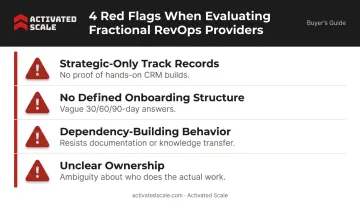
Not every fractional RevOps provider is built for early-stage execution. Watch for these warning signs:
Strategic-only track records. If a provider can't point to specific CRM configurations they built, forecasting models they implemented, or pipeline structures they designed for previous clients, their offering is closer to consulting than embedded RevOps.
No defined onboarding structure. A credible provider should present a clear 30/60/90-day plan with named deliverables and review checkpoints before the engagement starts. Vague answers to "what does your first month look like?" signal poor operational discipline.
Dependency-building behavior. The goal of any fractional engagement should be transferring knowledge and capability to your team over time. Providers who obscure their processes, resist documentation, or make themselves hard to replace are creating lock-in — not partnership.
RevOps Co-op's published hiring guidance explicitly flags vague timelines, no documentation plan, and uncertainty about who will do the work as red flags to screen for.
How Activated Scale Can Help Bridge the RevOps-to-Revenue Gap
Fractional RevOps builds the operational foundation. Clean data, structured pipeline, aligned processes — these are the inputs that make a sales motion predictable. But the system only produces revenue when skilled salespeople execute within it.
Activated Scale provides vetted, US-based fractional B2B sales professionals drawn from top-tier companies including Salesforce, Oracle, MongoDB, Datadog, and Zendesk. The roster spans the full commercial team:
- SDRs/BDRs for top-of-funnel pipeline generation
- Account Executives for managing and closing deals within structured pipelines
- Sales Operations professionals who work directly within CRM systems and RevOps frameworks
- Fractional VPs of Sales who can set GTM strategy and guide team execution
- Customer Success Managers for post-sale retention and expansion
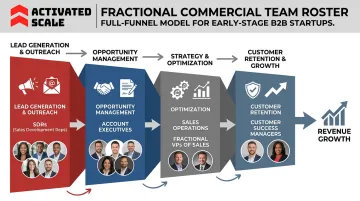
For early-stage teams evaluating risk, the try-before-you-buy model lets companies test a sales professional before any full-time commitment; talent can be connected in as little as 7 days; and 80% of clients retain Activated Scale talent for 5 or more months — a sign that fit happens quickly and holds.
Activated Scale is Techstars-backed, has served 200+ companies, and includes clients like Roboflow, Tango, and Kognitos among its roster.
Together, fractional RevOps and fractional sales execution address the two barriers that stall early-stage growth most often: operational chaos and insufficient sales capacity. Pairing them — rather than waiting to solve one before tackling the other — is what moves companies to revenue milestones faster and with less risk than traditional full-time hiring.
Frequently Asked Questions
What is fractional RevOps and how does it differ from a full-time hire?
Fractional RevOps delivers embedded revenue operations expertise on a part-time or project basis without the salary, equity, or ramp time of a full-time hire. Coverage spans CRM management, pipeline reporting, and GTM alignment, with the flexibility to scale hours up or down based on actual need.
What does a fractional RevOps engagement typically cost compared to hiring in-house?
Director of Revenue Operations base salaries average $101,253; VP-level total compensation reaches a $317K median, plus roughly $4,700 in recruiting costs. Fractional engagements cost a fraction of that, vary by scope and weekly hours, and carry no equity dilution or long-term payroll obligation.
When is the right time for a B2B SaaS startup to bring in fractional RevOps support?
When a startup has product-market fit and a growing GTM motion but no operational infrastructure to support it. That means no consistent CRM data, no reliable pipeline reporting, and misaligned sales and marketing processes. ChartMogul's guidance puts this trigger at the point when a sales leader and one or two reps are in place.
What is the difference between a fractional RevOps provider and a RevOps consultant?
A consultant delivers a defined project output (an audit, a process design, a tool recommendation) and exits. A fractional RevOps provider stays embedded on an ongoing basis, attending pipeline reviews, maintaining systems, and iterating on processes as the business evolves. The distinction is ongoing ownership versus point-in-time delivery.
How quickly should a fractional RevOps engagement deliver measurable results?
Strong providers typically deliver early, tangible outcomes such as cleaned CRM data, functional reporting dashboards, and defined lead stages within the first 30 to 60 days. Any engagement requiring a longer ramp before visible results should be evaluated carefully against the business's cost tolerance and need for speed.
How do fractional RevOps and fractional sales talent work together?
Fractional RevOps builds the operational system: pipeline structure, attribution, forecasting, and sales-marketing alignment. Fractional sales talent then executes within that system to generate meetings and revenue. Early-stage startups benefit most when both are in place simultaneously.