The problem is that sales recruiting fees aren't standardized. A founder who walks in without context can easily pick the wrong fee model, overbuild budget for a junior role, or under-invest on a leadership hire that actually matters.
This guide breaks down realistic fee ranges, the five main pricing models, what drives costs up, and the hidden expenses most first-time buyers miss — so you can budget with confidence.
Key Takeaways
- Contingency agencies charge 15–30% of first-year base salary; retained search runs 25–35%
- Senior roles (VP Sales, CRO) carry the highest fees — often $60K–$100K+ in dollar terms
- Fee model matters as much as percentage: it determines timing, exclusivity, and candidate quality
- Hidden costs — guarantee gaps, ownership clauses, vacancy losses — routinely exceed the headline fee
- Fractional and contract-to-hire models reduce upfront risk for early-stage companies with tighter hiring budgets
How Much Does a Sales Recruiting Agency Cost?
There's no single price. What you'll pay depends on the fee model, the seniority of the role, and the agency's positioning — generalist, sales-specialist, or fractional marketplace.
The most widely cited reference point comes from SHRM's guidance on working with executive search firms, which places contingency fees at roughly 20–25% of first-year cash compensation and retained search at approximately 33%. These percentages are the starting point, but the dollar amounts vary dramatically based on the role.
Entry-Level Sales Roles (SDRs, BDRs, Inside Sales Reps)
SDR and BDR searches typically fall at the lower end of the contingency range — 15–20% of first-year base salary. Glassdoor puts broad US SDR total pay around $103K, which puts a contingency fee in the $15K–$21K range at those percentages.
Standard contingency engagements at this level typically cover:
- Sourcing and initial candidate screening
- A vetted shortlist delivered to the hiring team
They generally exclude onboarding support, extended performance guarantees past 60–90 days, and any coverage if a hire doesn't stick after the guarantee window closes.
Best for: Early-stage startups making their first SDR or BDR hire who need a vetted shortlist without a large upfront commitment.
Mid-Market Sales Roles (Account Executives, Sales Managers)
AE and Sales Manager searches attract higher fees — typically 18–25% — because the talent pool is narrower and ramp expectations are longer. The Bridge Group's 2024 B2B SaaS AE benchmark report puts median AE OTE at $190K, with a 53:47 base-to-variable split. At 20–25%, that's a $38K–$47.5K fee if the contract uses OTE as the fee base. That's why how the fee base is defined in the actual contract matters as much as the percentage itself.
Best for: Seed-to-Series A companies building a quota-carrying team who need curated candidates, not just volume.
Executive and Leadership Roles (VP Sales, CRO)
VP of Sales and CRO searches almost always follow a retained model with milestone payments. Glassdoor data puts US VP of Sales total pay near $306K and CRO near $596K — which means a 25–33% retained fee translates to $75K–$100K+ for a VP search and well over $150K for a CRO search in dollar terms.
Those fees reflect the depth of work involved: passive candidate outreach, market mapping, and an exclusive agency commitment for the duration of the search. A mis-hire at this level can set back growth by months — which is why the premium is worth scrutinizing carefully before signing.
Best for: Series A and beyond, where a sales leader needs to set strategy and build team structure — not just hit a personal quota.
Sales Recruiting Agency Fee Models Explained
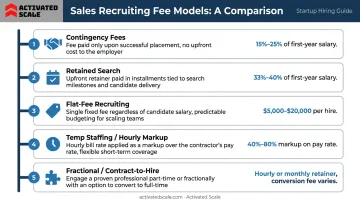
The model type often determines total cost, payment timing, and the quality of attention your search receives. There are five main structures:
Contingency Fees
You pay only when the agency successfully places a candidate — typically 15–30% of first-year base salary. Zero upfront cost is the main appeal. The trade-off: contingency recruiters work multiple clients simultaneously, so harder-to-fill or less urgent roles get deprioritized. If another client's search is easier, that's where the recruiter's time goes.
Retained Search Fees
Payment comes in three milestone installments: kickoff, shortlist delivery, and placement. Total cost runs 25–35% of first-year compensation, and the agency works exclusively on your search. This model makes sense for VP Sales and CRO searches where you need deep market mapping and a dedicated recruiter — not someone fitting your search between six others.
Flat-Fee Recruiting
A fixed dollar amount per hire rather than a percentage. For high-salary roles, flat fees can be significantly more cost-effective — a $20K flat fee on a VP of Sales search beats a $75K+ percentage-based fee on the same role. The catch: scope, milestones, and refund terms need to be defined explicitly in the contract.
Temp Staffing and Hourly Markup
In temporary staffing, the agency employs the worker and bills you a marked-up rate — typically 35–50% above the worker's hourly pay. This is structurally different from placement fees. You're not paying a one-time hiring fee; you're paying an ongoing bill rate that includes the agency's margin. SIA data on US staffing gross margins (roughly 23–25%) gives a rough sense of the economics, though sales staffing markups aren't publicly benchmarked separately.
Fractional and Contract-to-Hire Models
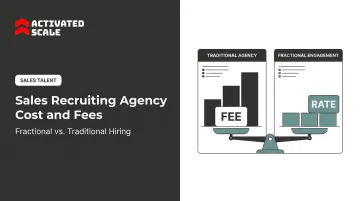
A sales professional is engaged part-time or on contract, letting you evaluate performance before committing to full-time employment. The upfront financial risk is lower than traditional placement fees, and you don't pay a large one-time fee if things don't work out.
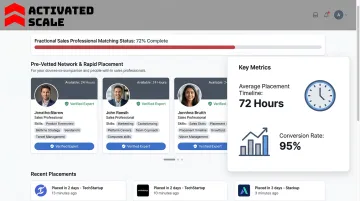
Activated Scale is built on this model, connecting B2B SaaS startups with pre-vetted fractional sales professionals (SDRs, AEs, fractional VPs of Sales) in 7 days or less. The network draws from professionals with backgrounds at Salesforce, Datadog, Oracle, and Zendesk, matched to your specific ICP and deal size.
A few things that distinguish the approach:
- 60% of clients convert their fractional hire to full-time — making it a genuine alternative to traditional placement, not just a stopgap
- Contract-to-hire path available from the start
- Placement in 7 days or less, with same-day options for some roles
Key Factors That Affect Sales Recruiting Agency Fees
Understanding what pushes fees up helps you negotiate more effectively and set realistic expectations before getting quotes.
Role Seniority and Specialization
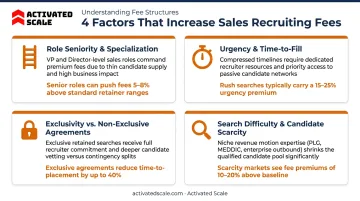
An SDR search and a VP of Sales search are priced completely differently. More senior roles require passive candidate outreach, longer search timelines, and deeper market mapping — all of which agencies price into their fees. Roles that combine narrow specializations (enterprise SaaS + specific vertical + documented quota performance) cost more to fill because the candidate pool is smaller.
Urgency and Time-to-Fill
Tight timelines increase costs. Agencies prioritize urgent searches by dedicating more recruiter hours upfront, sometimes expediting access to their passive candidate networks, and they price that prioritization into their rates or require a retainer. iCIMS cites a cross-role average time-to-fill of 54 days from 2022 SHRM benchmarking — for senior sales roles, that window can extend considerably.
Exclusivity vs. Non-Exclusive Agreements
Exclusive arrangements sometimes carry a slightly lower percentage because the agency is guaranteed payment if they perform — not racing against competing firms. Non-exclusive deals mean the recruiter risks losing the placement to another agency, so they may quote higher or deprioritize your search when the odds look uncertain.
Exclusivity has real value for senior searches. For SDR and BDR roles, it's usually overkill.
Search Difficulty and Candidate Scarcity
SHRM's 2025 talent trends research found that 69% of organizations struggled to recruit full-time employees. The top reasons:
- 51% cited too few applicants
- 50% cited competition from other employers
Roles that require a narrow combination of skills or specific vertical experience are harder to fill, and agencies factor that difficulty into their quoted percentage.
Hidden Costs Most Startups Miss When Hiring Through a Sales Agency
The headline percentage on the contract is rarely the whole story.
Replacement Guarantees That Fall Short
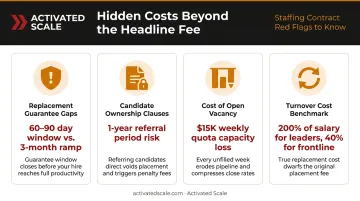
Most agencies offer a 60–90 day guarantee window: either a replacement search or a prorated refund. The problem is that SDR ramp time alone can run close to three months. If a hire fails at month four, you're outside the guarantee window but still absorbing the full cost of a bad hire — wasted ramp, lost pipeline, and a second search fee.
Candidate Ownership Clauses
Some contracts assert ownership over any candidate the agency "presented." That means if a candidate applies through your careers page six months later, you could still owe the full placement fee. ERE notes that a one-year candidate referral period is sometimes treated as customary. Read this language carefully and negotiate explicit terms: how long does ownership last, and what happens with candidates who applied independently?
The Cost of Leaving a Role Open
The Bridge Group's 2024 data puts the median B2B SaaS AE annual quota at $800K, which works out to roughly $15K in weekly quota capacity. That's not guaranteed lost revenue (attainment, pipeline lag, and ramp all intervene), but it gives founders a useful frame for modeling the exposure of an extended vacancy. A search that runs 10 weeks longer than expected has real downstream consequences, separate from the agency fee itself.
Turnover Cost as a Sanity Check
Gallup's turnover cost estimates place replacement costs at roughly 200% of salary for managers and leaders and 40% for frontline staff. Use those figures as a sensitivity check when deciding whether to invest in a stronger guarantee period or a higher-quality (and more expensive) search process.
How to Estimate the Right Sales Recruiting Budget
The goal isn't finding the cheapest agency. It's matching the fee model to the role, the urgency, and the company's financial position.
Before budgeting, answer three questions:
- What's the seniority of the role, and how quickly does this person need to be productive?
- Can the company afford upfront retainer payments, or does it need a contingency or pay-on-hire structure?
- Would a fractional or contract-to-hire arrangement reduce initial financial exposure while still getting vetted talent placed without a lengthy search process?
Questions to ask before signing any agreement:
- What compensation is included in the fee base — base salary only, OTE, bonus, signing bonus?
- When is the fee earned — on acceptance, on start date, or on some other trigger?
- Is the guarantee a replacement search or a cash refund, and for how long?
- How long does candidate ownership last, and how are prior applicants handled?
- Is this search exclusive, and what does exclusivity require from both sides?
For seed-stage and Series A founders who need sales capacity quickly without committing to a large upfront placement fee, a fractional marketplace like Activated Scale offers a lower-risk path forward. Their network includes vetted US-based sales professionals with backgrounds at companies like Salesforce, Oracle, and MongoDB — matched to your specific ICP and deal size, with talent typically placed in 7 days or less.
Frequently Asked Questions
How much does a sales recruiting agency typically charge?
Contingency agencies charge 15–30% of first-year base salary, paid only upon a successful hire. Retained search runs 25–35% of first-year compensation with milestone payments. Temp and fractional models use an ongoing hourly or monthly rate instead of a one-time placement fee.
What is the difference between contingency and retained search fees?
Contingency means you pay nothing until a candidate is hired, but the recruiter works multiple clients at once. Retained search requires milestone payments upfront and gives you exclusive agency commitment — the standard choice for VP Sales and CRO searches.
Are sales recruiting agency fees negotiable?
Almost always, yes. Volume commitments, shorter exclusivity windows, faster payment terms, and clear role definitions are all effective levers. The headline percentage is rarely fixed — most agencies have flexibility, especially for clients who are straightforward to work with and responsive during the search process.
What happens if the candidate the agency placed leaves quickly?
Most agencies offer a 60–90 day guarantee window, usually a replacement search and occasionally a prorated refund. That window rarely covers the true cost of a failed hire. Negotiate the period upward before signing, and confirm whether the remedy is replacement or cash.
Is it cheaper to use a sales recruiting agency or hire in-house?
For companies making fewer than 5 hires per year, an agency is typically more cost-effective than building an internal recruiting function. Above that threshold, in-house recruiting often wins on total cost — but factor in fully loaded recruiter salary, tooling, and realistic time-to-fill, not just the agency fee.
What is a fractional sales model and how does its cost compare to traditional recruiting?
Fractional engagements place part-time or contract sales professionals without a large upfront placement fee, making them lower-risk for early-stage companies. Platforms like Activated Scale offer a contract-to-hire path where strong performers can convert to full-time employees — avoiding the traditional placement fee entirely if you decide to bring them on permanently.