

Introduction
A wrong sales hire doesn't just cost salary — it burns through leads you spent months generating, delays revenue by a quarter or more, and consumes founder time that should go toward product or customers. By the time the problem is obvious, the damage is done.
Most founders hire sales reps the wrong way. They prioritize personality over track record, rush to fill a seat, or skip the foundational question of what "right" looks like for their stage.
A charismatic rep who can't close in your specific motion is worse than no rep at all — they'll drain your best prospects while leaving you uncertain whether the problem is the product or the person.
This guide covers what early-stage B2B SaaS founders need to know: when to hire, what traits to screen for, how to run the process, and the mistakes that cost startups the most.
Key Takeaways
- Hire only after personally closing 10–20 customers and articulating your sales process step by step
- Look for a net-new closer with relevant company stage, product type, and customer profile experience
- Screen for resourcefulness, ambiguity tolerance, and quota attainment numbers you can verify
- Always make the candidate sell your product in the interview — a blank stare is a hard no
- Hiring for likability, skipping references, and promoting to VP too early are the costliest mistakes founders make
When Should You Hire a Sales Rep?
The trigger isn't a revenue milestone. It's when founder-led sales has become the growth bottleneck.
If you're spending more than half your week on sales calls when the company also needs product decisions, investor updates, and hiring calls, that's the signal. But there's a prerequisite that matters more than time pressure.
Two conditions must both be true before you hire:
- You can describe your sales process step by step — who buys, why they buy, what objections arise, and how the conversation moves to close
- Sales is now preventing you from doing other critical work
SaaStr's Jason Lemkin advises founders to close roughly the first 10–30 customers themselves before bringing in reps — and to hire two at once rather than one, so you can tell whether results reflect a repeatable process or one person's individual effort.
If you haven't validated the sales motion personally, no hire will compensate for that gap. A rep needs a proven playbook to run — not a blank page.
What to Look For in the Right Sales Rep
Hunter vs. Farmer — Get This Wrong and Everything Else Fails
The most critical distinction for a first or early sales hire: you need a hunter, not a farmer.
Hunters win net-new business. Farmers manage existing accounts. Startups need pipeline creation, not relationship maintenance — and the two profiles think about their day completely differently.
The common mistake is hiring an "account manager who can also do a bit of sales." That person will wait for inbound, nurture existing contacts, and produce little new pipeline. A startup at the seed or Series A stage can't afford that.
The Relevant Experience Trifecta
Look for someone who has closed new business for:
- A company at a similar stage (startup, not a 500-person org with a full SDR team feeding them)
- A product of similar complexity (not just "SaaS")
- A customer with similar problems (buyer profile, deal size, sales cycle length)
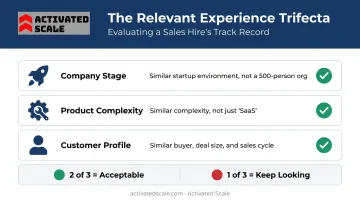
Two out of three is acceptable. One out of three? Keep looking.
Brand recognition from a previous employer rarely transfers. A rep who closed deals at Salesforce benefited from brand trust, inbound volume, and an established playbook. None of that comes with them to a company no one has heard of yet.
Resourcefulness and Ambiguity Tolerance
These two traits are non-negotiable at the startup stage.
Ask candidates directly: How did you build pipeline in a quarter with no inbound? What happened when your CRM broke or your deck wasn't ready? Their answers reveal how they'll operate when there's no infrastructure to lean on.
Watch for these markers in their responses:
- Builds their own pipeline rather than waiting for leads or decks to appear
- Comfortable creating process on the fly, not just following established playbooks
- Self-directed — doesn't need a battle card to have a conversation
A rep who has only worked inside large, structured orgs often struggles when the answer to "where's the battle card?" is "we don't have one yet."
Track Record You Can Actually Verify
Strong sales candidates come prepared with specific, provable numbers for every role on their CV:
- Quota amount
- Attainment percentage
- Average deal size
- Notable wins with context
Vague CVs — no metrics, no context, just title and tenure — are a red flag. So is a pattern of 18-month stints with no explanation. Ask candidates to walk through their process unprompted. If they can't explain how they moved a deal from first call to close, that's your answer.
How to Find and Screen Top Sales Candidates
Where to Source
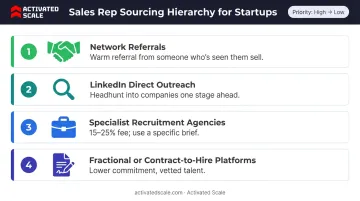
The hierarchy for startup sourcing:
- Network referrals — Ask existing customers, investors, and other founders to name the best rep they've personally encountered. A warm referral from someone who has watched a person sell is worth ten cold applications.
- Direct LinkedIn outreach — Headhunt into companies one or two stages ahead of yours, where strong reps may want more ownership and impact than a larger org can offer.
- Specialist sales recruitment agencies — Use them with a specific brief: "new business closer for an early-stage startup, not an account manager." According to Betts' 2026 NYC tech-sales guide, contingency placement fees typically run 15%–25% of first-year base salary or OTE. Broad briefs produce generic shortlists.
- Fractional or contract-to-hire platforms — These let you access vetted talent with a lower-commitment entry point, which matters when your ideal profile is still taking shape.
Write a Job Description That Attracts Closers
Vague or inflated titles ("Revenue Ninja," "Sales Superstar") attract the wrong candidates and signal an inexperienced hiring process.
A strong sales rep job description includes:
- A specific title (e.g., "Account Executive, New Business")
- Clear performance expectations for the first 90 days
- Honest context about the environment — no playbook, ground-floor opportunity
- What you're not: not a structured sales team with SDRs feeding you leads
Pre-Screen With a Written Test
Send candidates a short written questionnaire before any call. It filters out roughly half the applicants immediately and tests written communication ability — which matters for outbound.
Good questions to include:
- Why do you want this specific role at this stage of company?
- Walk me through how you approach cold outreach from scratch
- Describe a time you built pipeline with no inbound leads
- What does your ideal first 60 days look like?
Make Them Sell Your Product to You
This is the highest-signal interview technique available. Ask the candidate to sell your product to you — not "sell me this pen." There is enough public information about your company for any serious candidate to prepare.
Watch for a structured approach: do they ask discovery questions before pitching, or do they launch straight into features? A polished opener with no follow-through tells you everything. Cut their prep time without warning mid-interview and see whether they stay composed or fall apart.
CV Red Flags to Screen Out
Walk away quickly if you see:
- "Manager" or "Head of" in their current title (you need an individual contributor)
- Stints under two years with no explanation
- No quota or attainment numbers listed anywhere
- Experience exclusively at large companies with established playbooks
- Strong preference for a 70/30 base-heavy compensation split — signals account management mentality
Common Mistakes to Avoid When Hiring Sales Reps
Hiring for Likability Instead of Results
Most startup founders pick the candidate who felt most comfortable in the room — not the one with the strongest track record. It's the most common hiring mistake, and it's costly.
In sales, the cost is concrete. A personable rep who can't close will drain your best leads and leave you questioning whether the problem is the product or the person. By the time you figure it out, a full sales cycle has passed.
Skipping References
When founders finally find a candidate they like, the temptation is strong to skip reference checks or compress the process. Don't.
References reveal what a CV can't:
- How the candidate behaved under pressure
- What actually happened when they missed quota
- What their manager genuinely thought of their performance
Strong performers have references who confirm it plainly. Vague, guarded answers are a signal worth taking seriously — probe further or walk away.
Bringing on a VP of Sales Too Early
Hiring a sales leader before two individual reps are consistently hitting quota is a common and expensive mistake. SaaStr advises waiting until at least two reps have proven the motion repeatable before adding a VP layer.
What you actually need at the early stage is a "player-coach" — someone who can carry a personal quota while also helping build process. A senior VP who wants to manage managers is the wrong profile when you have no team to manage yet.
How Activated Scale Helps You Hire the Right Sales Rep Faster
For B2B SaaS startups at the seed-to-Series A stage, Activated Scale offers a purpose-built alternative to traditional full-time hiring. The model connects founders with fractional sales talent on a contract basis, with a clear path to convert to full-time once performance is proven.
The Try-Before-You-Buy Approach
Rather than committing to a full-time salary before knowing if someone can close in your specific motion, founders work with pre-vetted sales professionals under a contract arrangement first. The matching process takes 7 days or less. Once engaged, founders can assess skills, methodology, and cultural fit before committing permanently.
A concrete example: Windsor, a Y Combinator-backed startup, was matched with an experienced AE in just 8 days. That hire closed deals at 2–2.5x the deal size the founders had been achieving, and built Windsor's outbound motion from scratch. As their co-founder put it: "We love this model of having somebody do a work trial with us — that's exactly what Activated Scale gave us."
What Makes the Model Different
- Pre-vetted talent from Salesforce, Oracle, Datadog, MongoDB, and Zendesk, with documented closing ability, startup experience, and relevant buyer expertise
- Saves 20+ hours of interviewing time by replacing sourcing, initial screening, and early-round interviews
- $0 in termination fees and no long-term financial commitment before performance is established
- 60% of clients convert their fractional rep to a full-time employee after the initial contract period
- 80% of clients continue using Activated Scale talent for 5+ months — a signal that the model works as a sustainable growth lever, not just a stopgap
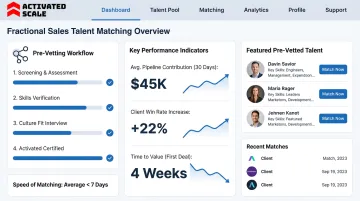
The result: a faster path to a proven sales hire, without burning weeks on interviews or months discovering a bad fit after the fact.
Frequently Asked Questions
When should a startup founder stop doing sales themselves?
The trigger is time, not revenue. When sales consumes more than half your week and you can clearly describe who buys, why they buy, and how to close, it's time to bring in dedicated sales help. If you can't articulate the process yet, hiring won't fix it.
Should I hire an SDR or an Account Executive first?
For most early-stage startups, an Account Executive who can both prospect and close is the right first hire. An SDR generates leads but cannot close. Layering in an SDR only makes sense once you have a repeatable closing motion already in place.
What is the difference between a full-time sales rep and a fractional one?
A full-time rep is a permanent employee with salary and benefits; a fractional rep works part-time or on contract. Fractional is particularly useful for startups that need experienced sales execution before they're financially or operationally ready for a full-time commitment.
How long does it take a new sales rep to ramp up?
In B2B SaaS, expect 3–6 months before a rep is fully productive. A 30/60/90 plan helps structure that ramp: onboarding and learning in month one, pipeline building in month two, and progressing deals in month three. Activity metrics should appear well before closed revenue does.
How do I know if a sales hire isn't working out?
Warning signs within the first 30 days: no curiosity about the product or customer, no pipeline conversations initiated, and continued reliance on the founder for introductions. If these appear, address them immediately — don't wait for the quarter to end.
What should I pay my first sales rep?
According to RepVue's July 2026 data, US SMB Account Executives earn a median base of $70K and $135K OTE. A 50/50 base-to-variable split is typical for new business roles. A candidate pushing hard for a base-heavy split may be signaling account management instincts rather than a new business drive.