

The tension is real: waiting for the right full-time hire sounds disciplined. But leaving the role empty carries concrete costs in stalled pipeline, rep attrition, and growth windows that don't wait around.
This post lays out exactly when an interim VP of Sales is worth the investment — and when it isn't.
Key Takeaways
- An interim VP of Sales is a senior executive who steps in full-time for 3–9 months to own the sales function during a transition
- Worth it when there's a specific, urgent gap — a fired VP, a post-funding sprint, a founder stuck in deals, or a broken process bleeding closes
- A poor fit if the sales motion is undefined, there's no end goal, or it's a workaround for avoiding the permanent hire
- A strong interim VP stabilizes the team, closes 1–2 process gaps, and helps recruit their own permanent replacement
- The clearest signal: the cost of the gap outweighs the cost of the engagement
What Is an Interim VP of Sales?
An interim VP of Sales is a seasoned sales executive who takes full ownership of the sales function for a fixed, high-intensity period. They run pipeline reviews, coach reps, escalate deals, and make hiring decisions — operating as a true owner of the function, not a consultant dropping in with slide decks.
Interim vs. Fractional: A Practical Distinction
These terms get used interchangeably, but they describe different structures:
| Interim VP of Sales | Fractional VP of Sales | |
|---|---|---|
| Time commitment | Full-time or near-full-time | Part-time, ongoing |
| Duration | Defined period (3–9 months) | Open-ended, quarter-to-quarter |
| Best for | Active leadership gap, post-funding sprint | Earlier-stage companies needing senior guidance |
| Primary goal | Bridge to permanent hire | Ongoing strategic leadership |
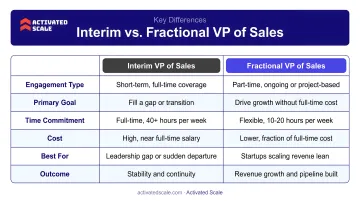
Both models give you VP-level experience without the permanent hire commitment. If you have an active leadership gap and deals in motion, interim is the right call. If you need ongoing strategic guidance at a lower burn, fractional fits better.
Interim VPs are typically former VP- or CRO-level executives who prefer project-based work or have built practices around transition and turnaround engagements. They're not in-between roles by accident — many choose this work deliberately because they're good at it.
Why the Timing of Sales Leadership Matters
Sales leadership gaps compound fast at the startup stage. Without a clear owner of pipeline strategy, rep coaching, and deal escalation, the damage isn't immediately visible — it shows up three months later in missed quota and churned reps.
The data makes this concrete. According to the Bridge Group's 2024 SaaS AE report, the average AE ramp time has hit 5.7 months — up 32% since 2020 — while only 51% of AEs hit their annual quota. Median annual rep turnover sits at 30%. A leadership gap during ramp doesn't just slow things down; it makes an already difficult environment worse.
The downstream math is straightforward:
- Every month without a functioning sales leader = unqualified pipeline building up
- Uncoached reps make avoidable mistakes on deals that never come back
- Enterprise opportunities stall without executive sponsorship to push them forward
- Founders get pulled back into deal work they should have exited months ago
The flip side of that gap is just as costly. Hiring the wrong full-time VP out of desperation is often worse than having no VP at all. A bad permanent hire burns six months of salary, disrupts the team, and resets the clock — except now the reps have watched two leaders fail in a row. An interim VP gives you active leadership while the permanent search happens on your terms, not under pressure.
Scenarios Where Hiring an Interim VP of Sales Is Worth It
There's no universal trigger. The decision depends on your specific situation. These are the scenarios where the math consistently works.
After Losing Your VP of Sales
This is the most common and justifiable use case. When a VP departs — voluntarily or otherwise — the leadership vacuum doesn't just create an org-chart gap. It creates a morale problem.
As Cerius Executives put it in their analysis of sales leadership transitions: "When there's a hole in an organization's leadership, the most likely outcome is those being led will fall into it."
A permanent VP of Sales search typically takes months. During that window, reps lose direction, pipeline reviews stop happening, and deals with no internal champion start dying quietly. An interim hire prevents that slide while the real search runs in parallel.
When the Founder Is Still Running Sales Post-Series A
Founders often carry the sales function through early traction — and they should. SaaStr guidance suggests founders act as the first sales leader until roughly $1M–$1.5M in recurring revenue, and should have at least two productive reps before bringing in a VP.
That model hits a wall once the process starts to repeat. The founder becomes the bottleneck, pulled into:
- Running pipeline reviews and rep coaching
- Handling deal escalations and customer calls
- Riding shotgun on enterprise deals
- Preparing for the next fundraise simultaneously
An interim VP can install process, enable the reps, and free the founder to focus on product and fundraising. This is especially time-sensitive around raise milestones, when founder bandwidth is most constrained.
During a Post-Fundraise Sales Build Sprint
A new funding round creates immediate pressure: hire reps, hit ARR targets, prove the sales model to investors. Bessemer reports that companies at $1M–$10M ARR averaged nearly 200% growth — but that growth requires managed sales capacity, not just capital.
An interim VP can execute this sprint with urgency: building the hiring plan, onboarding early reps, setting up weekly pipeline reviews, and protecting capital efficiency before a permanent VP is seated. Waiting 4–6 months for a permanent hire while headcount sits undeployed is an expensive alternative.
When Sales Processes Are Broken and Costing Deals
Some companies have reps but no repeatable playbook. Deals are inconsistent, conversion rates are poor, qualification is guesswork, and no one owns process design.
CSO Insights found that organizations with formal, charter-based sales enablement achieved 55.1% forecast-deal win rates compared to 39.2% for those with ad hoc approaches — a 16-point gap that compounds across every rep and every quarter.
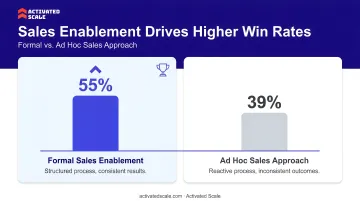
An interim VP with a track record of building sales infrastructure can identify the broken links — qualification gaps, forecasting blind spots, weak rep onboarding — and fix them. Revenue impact often shows up within the engagement window itself.
To Buy Time While Recruiting the Right Permanent Hire
Sometimes a company simply refuses to make a bad permanent hire out of desperation and needs a credible leader in the seat while the right long-term candidate is found.
The best interim VPs don't just hold the chair. They actively help recruit their own replacement: screening candidates, giving a realistic pitch for the role, and enabling a clean handoff. That involvement compresses the search timeline and raises the quality of the eventual hire.
When an Interim VP of Sales Is NOT the Right Move
The interim model has real failure modes. Knowing them matters as much as knowing the use cases.
Three scenarios where the interim model tends to backfire:
Your sales motion is still undefined. If you don't have a repeatable process yet, paying for senior-level leadership to figure it out from scratch is the wrong tool. A fractional VP or a seasoned AE who can do discovery work will deliver faster ROI with less financial exposure. An interim VP scales what works — they don't discover product-market fit.
You're avoiding the real hire. If the interim role is being used to indefinitely defer a permanent search, that signals a deeper alignment problem. Interim works best when there's a concrete end goal — a permanent hire, a fundraise close, a process fix. Without an exit plan, you're paying VP rates for a placeholder.
Your budget and stage don't match the overhead. Pre-revenue or very early seed companies typically don't have the deal volume to justify senior interim costs. A fractional model, a contract-to-hire AE, or a platform like Activated Scale will often deliver faster results at lower financial risk.
What to Look for in an Interim VP of Sales
Hiring an interim VP requires the same rigor as a permanent hire. The "interim" label refers to duration, not seniority.
Define the scope before you interview anyone. Be specific about what this person will own: pipeline strategy, rep hiring, process redesign, deal management. Then confirm the candidate has done those specific things in an operating role — not as an advisor. A true interim VP executes.
When evaluating candidates, look beyond title and years of experience. The right fit depends on three factors:
- Stage fit: A VP who ran a 100-person org may not suit a 4-rep team. Match candidates to your ARR range and sales motion — SMB versus enterprise, product-led versus sales-led.
- Hiring track record: Per SaaStr, a qualified candidate should have hired at least 3–4 strong reps in a prior role, with recruiting representing 20%+ of their focus. Ask directly: how did you build your team at an early-stage company?
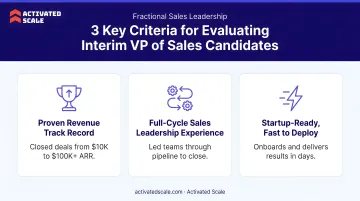
Test for speed to impact. An interim VP doesn't get six months to ramp. Ask candidates what they accomplished in the first 30 days of their last engagement. If they can't name specific pipeline changes, hiring decisions, or process improvements from that window, that's a signal.
Once you know what to look for, the next challenge is finding qualified candidates quickly. Platforms like Activated Scale specialize in connecting B2B SaaS startups with experienced, US-based fractional and interim sales leaders. Monthly retainers are $12,000/month plus bonus, with a try-before-you-buy model and a contract-to-hire conversion path — so you can evaluate fit before committing to a full-time executive search.
Frequently Asked Questions
What is an interim VP of Sales?
An interim VP of Sales is a senior sales executive — typically with VP or CRO-level experience — who steps in full-time for a defined period (usually 3–9 months) to own the sales function during a transition. They cover strategy, team management, and pipeline execution until a permanent hire is in place.
How much does an interim VP of Sales make?
Compensation varies by engagement structure. Vendor-published market guidance suggests retainers typically run $8,000–$15,000 per month — significant as a line item, but far below the $300,000+ total cost of a permanent hire when you factor in benefits, equity, and recruiting fees.
Is an interim VP of Sales a high-level position?
Yes. Interim VPs of Sales are senior executives and should be evaluated with the same rigor as a permanent hire. The "interim" label describes the duration and structure of the engagement, not the seniority level. Expect former VP- or CRO-level executives with real team-building and revenue track records.
How long does an interim VP of Sales engagement typically last?
Most engagements run 3–9 months, with 4–6 months being the most common range. That's enough time to stabilize the sales function, make key hires, and run a permanent search in parallel.
What's the difference between an interim and fractional VP of Sales?
An interim VP works full-time (or near-full-time) for a defined short period, typically to fill an active leadership gap. A fractional VP works part-time on an ongoing basis and is often better suited for earlier-stage companies that need senior guidance but don't yet have the deal volume to justify full-time sales leadership.
When should you avoid hiring an interim VP of Sales?
Skip the interim hire when your sales motion is still undefined, when there's no concrete end goal for the engagement, or when the company is pre-revenue. In those cases, hands-on fractional talent or contract-to-hire reps who can help validate the model at a lower cost are usually a better fit.