

Introduction
Your VP of Sales just resigned. The executive search firm says you're looking at 3–4 months minimum to replace them. Meanwhile, Q3 targets are slipping, pipeline reviews have stopped, and your AEs are closing deals without any coaching or accountability.
This is the exact moment companies bring in an interim sales manager — someone who keeps revenue moving while the permanent search plays out.
CROs and VP Sales roles carry a median tenure of just 1.8–2.0 years with 32% annual turnover, according to SaaStr's analysis of 14,000 executives. Leadership vacuums are common, and most companies aren't ready for them.
This guide covers what an interim sales manager actually does, the five scenarios that call for one, how they drive measurable revenue impact, and how to decide whether interim or fractional is the smarter move for your stage.
Key Takeaways
- An interim sales manager is a full-time, temporary sales leader with execution authority — not a consultant
- They're best suited for companies with 10+ reps and $10M+ revenue facing a sudden leadership vacuum
- Most B2B SaaS startups at seed to Series A are better served by a fractional sales manager — lower cost, faster to deploy, and purpose-built for smaller teams
- Activated Scale connects startups with vetted fractional sales professionals in 7 days or less, with a contract-to-hire option
- The right sales leader installs process, rep accountability, pipeline discipline, and coaching — sales coaching alone links to 32% higher win rates
What Is an Interim Sales Manager?
An interim sales manager is a full-time, temporary sales leader brought in with execution authority. They run the team, own the revenue number, coach reps, and implement process — exactly like a permanent hire, but for a defined period (typically 6–24 months).
That last part matters, because two other roles get confused with it constantly.
What an interim sales manager is NOT:
- A sales consultant — advisory only, no direct reports, no accountability for results
- A fractional sales manager — part-time, advisory cadence, typically 5–20 hours per week
The interim role requires daily, embedded leadership. They're in your CRM. They're running your forecast calls. They're sitting in on rep discovery calls and giving feedback the same afternoon.
Who Actually Uses True Interim Sales Managers
The company profile matters here. True interim engagements fit organizations with 10+ sales reps and $10M+ in revenue that face a sudden leadership vacuum — typically triggered by:
- A VP departure mid-fiscal year
- A turnaround situation requiring immediate structure
- A post-acquisition integration with misaligned teams
Earlier-stage companies — those with 2–10 reps still finding product-market fit — are typically better served by the fractional model. Paying a near-executive full-time salary doesn't make sense when you need 15 hours of strategic guidance per week, not 40. Platforms like Activated Scale connect these companies with experienced fractional sales leaders on a part-time basis, without the commitment of a full-time hire.
When Does a Company Need an Interim Sales Manager?
Some gaps in sales leadership can wait. Most can't. Five scenarios consistently signal that temporary sales leadership is needed — now.
Sudden Leadership Departure
Pipeline doesn't pause during a 90-day executive search. Jason Lemkin at SaaStr notes that hiring a great VP of Sales can take 12–18 months — and that's when you start early. Companies that wait until the seat is empty before searching are compounding the problem.
Every week without a manager means missed coaching, undefined forecasts, and reps who start making their own decisions about territory and pricing.
Revenue Decline or Team Underperformance
69% of sales reps missed quota in 2024, per Ebsta and Pavilion's B2B Sales Benchmarks report. When performance is deteriorating across the team — not just one rep — the problem is almost always structural: undefined process, inconsistent accountability, or misaligned targets.
An external leader without internal political ties can diagnose this faster than a promoted peer. They have no loyalty to the existing CRM setup or comp structure, which means they can challenge both.
Rapid Scaling After a Funding Round
A seed or Series A company doubling its sales headcount in six months has one specific problem: the infrastructure doesn't exist yet. Before the permanent leader arrives, someone needs to build:
A seed or Series A company doubling its sales headcount in six months has one specific problem: the infrastructure doesn't exist yet. Before the permanent leader arrives, someone needs to build:
- The hiring process and rep onboarding playbook
- Territory model and quota structure
- Comp plan aligned to the new headcount
An interim or fractional sales manager stands up that infrastructure during the search — so the new VP inherits a functioning team, not chaos.
M&A Integration or Restructuring
Two sales teams, two CRMs, two comp plans. Someone has to rationalize them. An interim manager can navigate that alignment without political baggage from either side — mapping overlapping territories, consolidating pipelines, and setting unified quota expectations before attrition sets in.
New Market Entry Without Dedicated Sales Leadership
Launching into a new segment or releasing a new product without a dedicated sales leader attached to it is how GTM motions stall. An interim can stand up the motion, identify early customers, and build the repeatable process before handing it to a permanent owner.
How an Interim Sales Manager Boosts Company Revenue
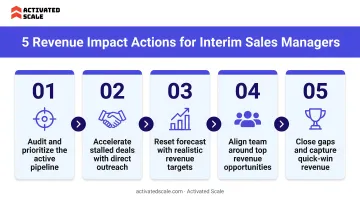
The revenue impact of a strong interim manager comes from five specific actions. The first two happen fast; the others compound over the engagement.
Pipeline and Process Audit
Day one starts with a diagnostic. What's actually in the pipeline — and is any of it real? A competent interim reviews CRM data quality, conversion rates at each stage, and follow-up discipline across the team.
RAIN Group research shows it takes an average of 8 touches to generate a meeting with a prospect, yet most sales teams lack any structured follow-up cadence. Identifying where outreach drops off — and why — is one of the fastest ways to recover revenue that's already in the funnel.
Operating Rhythm and Accountability
An interim earns their fee by installing the cadences that hold a team together:
- Weekly forecast reviews with deal-level scrutiny
- Structured 1:1s focused on pipeline health, not just activity metrics
- Daily standups for outbound-heavy teams
- Clear activity standards (calls, emails, meetings) tied to quota expectations
The Ebsta/Pavilion data makes this concrete: opportunities updated weekly were 17% more likely to close won. Accountability structures aren't soft management — they directly move revenue numbers.
Sales Strategy and ICP Refinement
Many early-stage companies are pursuing the wrong customers. An interim brings objective analysis: which segments are actually buying, what messaging resonates, and where the team is spending time on deals that will never close.
Refocusing on high-value, high-probability opportunities typically surfaces quick wins within the first 30 days — no new headcount required.
Coaching and Performance Uplift
Korn Ferry research links sales coaching to 32% higher win rates and 28% higher quota attainment when grounded in a consistent sales methodology. An interim delivers this hands-on — sitting in on calls, reviewing recordings, and giving reps specific feedback on discovery, objection handling, and closing sequences.
This multiplies across a team: improving five reps' close rates by 15% each is a bigger revenue lever than finding one star performer.
Scalable Sales Infrastructure
The lasting impact of a great interim is what they leave behind. By the end of the engagement, the organization should have:
- A documented sales playbook
- CRM hygiene standards and pipeline stage definitions
- A rep onboarding guide
- A territory model and comp structure with documented rationale
When the permanent VP arrives, they step into a documented, functioning operation — with playbooks, pipeline standards, and a team that already knows the process.
Interim vs. Fractional Sales Manager: Which Is Right for You?
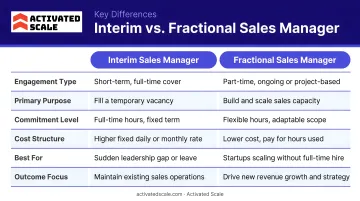
Most founders conflate these two models — but they solve different problems at different company stages. Picking the wrong one wastes money or underserves the team.
Side-by-Side Comparison
| Interim Sales Manager | Fractional Sales Manager | |
|---|---|---|
| Time commitment | 30–40 hrs/week | 15–20 hrs/week |
| Engagement length | 6–24 months | 3 months minimum, then quarter-to-quarter |
| Best fit | 10+ reps, $10M+ revenue | 2–10 reps, under $10M revenue |
| Annual cost | $200K–$350K | $24K–$96K+ depending on role |
| Deployment speed | Weeks (search required) | Days (via marketplace) |
| Execution model | Fully embedded, daily | Strategic cadence, part-time |
Why Most B2B SaaS Startups Need Fractional
A seed or Series A company with four reps doesn't need 40 hours of sales leadership per week. They need someone to set cadence, coach live deals, and build the first process documentation. Paying a near-executive full-time salary ($200K+ annually) doesn't pencil out at that scale.
The fractional model fits this reality.
Activated Scale places fractional sales professionals across every level of the org (SDRs, AEs, and VPs of Sales) at monthly retainers of $4,500/month plus performance pay for SDR/BDR roles, $6,500/month plus performance pay for AE roles, and $12,000/month plus bonus for fractional VP of Sales engagements. Compared to the $200K–$350K annual cost of an interim hire, the cost difference is substantial.
The Try-Before-You-Buy Advantage
The fractional model also de-risks the hiring decision itself. With Activated Scale's contract-to-hire approach, a startup works with a vetted fractional professional for an initial 3-month period while evaluating both execution and cultural fit before committing to a full-time offer.
65% of Activated Scale clients hire their fractional talent as full-time employees after seeing results. That means most engagements aren't just filling a gap — they serve as the front end of a permanent hire, with the risk removed.
The Simple Decision Rule
- 10+ reps, major leadership vacuum, $10M+ revenue → Interim
- Funded startup, small team, building your first sales motion → Fractional is faster, more affordable, and lower risk
What to Expect in the First 90 Days
A strong interim or fractional engagement follows a predictable 90-day arc — here's how it breaks down.
Weeks 1–2: Audit and Assess
This phase is diagnostic, not prescriptive. The incoming leader should be:
- Reviewing CRM data quality and pipeline accuracy
- Assessing every rep's performance against quota and activity metrics
- Analyzing win/loss patterns to identify where deals are stalling
- Mapping the gap between the stated sales process and what actually happens in the field
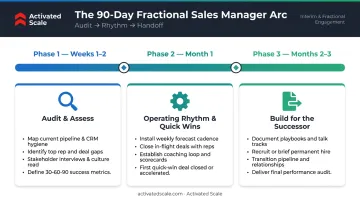
The goal in this phase is earning credibility, not making wholesale changes. Coming in with a predetermined fix before understanding the team destroys trust fast.
Month 1: Operating Rhythm and Quick Wins
By the end of week four, accountability structures should be in place: forecast reviews, structured 1:1s, and defined activity standards. This is the minimum infrastructure required to manage a sales team effectively — without it, there's nothing to build on.
That same visibility surfaces quick wins fast. Identifying stuck deals, pricing misalignments, or territory overlaps creates early proof of value for the team and the executive sponsor.
Activated Scale's engagement model formalizes this via a Statement of Work that establishes clear KPIs before day one — so the fractional professional knows exactly what "success at 30 days" looks like.
Months 2–3: Build for the Successor
Great interim and fractional leaders work themselves out of a job. By the end of month three, the documentation should exist for the permanent hire to walk into a structured operation:
- Sales playbook with call frameworks and objection responses
- Comp structure with documented rationale
- Onboarding guide for new reps
- Territory model and ICP definitions
The permanent VP walks into a functioning system — and starts closing deals, not reconstructing the foundation.
How to Find and Hire the Right Interim or Fractional Sales Manager
Define the Profile First
Credentials matter less than demonstrated execution. Look for:
- Track record in your specific sales motion (outbound B2B SaaS, PLG, enterprise, etc.)
- Experience leading teams of comparable size to yours
- Measurable outcomes from prior engagements — not just tenure, but results
- Cultural fit with a founder-led, fast-moving environment
Someone who ran a 40-person sales org at a Fortune 500 company isn't automatically the right fit for a 5-person team that's still building its playbook. The motion has to match — pedigree alone doesn't transfer.
Set the Engagement Up for Success
Many interim engagements stall not because of the hire, but because of unclear scope or limited access from the start.
Before day one, confirm:
- Scope and success metrics are in writing (pipeline coverage, win rate targets, rep retention)
- Full CRM access is granted immediately
- The handover documentation process is planned from the start
- Key stakeholders know who owns the revenue number during the engagement
Why Activated Scale Fits B2B SaaS Startups
Getting that scope-and-access setup right is easier when you start with the right candidate. For founders who don't want to spend 20+ hours sourcing and evaluating candidates, Activated Scale handles the qualification upfront. A 3-step vetting process — application review, pitch video assessment, and a subject matter expert interview — accepts only the top 7% of applicants.
The talent network includes professionals from Salesforce, Oracle, Zendesk, Datadog, ZoomInfo, Mixpanel, and dozens of other B2B technology companies. All are US-based, matched to your specific ICP, and ready to start in 7 days or less.
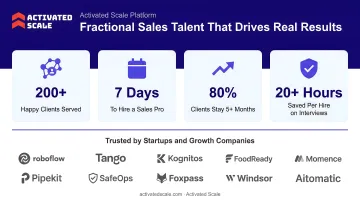
With 200+ clients served and 80% of engagements extending beyond 5 months, the platform suits startups that want proven sales leadership on their terms — with the option to convert to a full-time hire once the fit is confirmed.
Frequently Asked Questions
What is an interim sales manager?
An interim sales manager is a full-time, temporary sales leader who steps into an organization with execution authority — running the team and owning revenue targets for a defined period, typically 6–24 months. Unlike a consultant, they have direct reports and are accountable for results.
What does interim sales mean?
"Interim sales" refers to temporary sales leadership arrangements where an experienced professional fills a gap on a time-limited basis. The company uses the arrangement to maintain revenue momentum while transitioning, scaling, or searching for a permanent hire.
How much does a sales manager get paid?
Full-time interim sales managers in the US typically run $200K–$350K annually. Fractional sales managers cost considerably less: Activated Scale's fractional engagements are $4,500/month plus performance pay for SDR roles, $6,500/month plus performance pay for AE roles, and $12,000/month plus bonus for VP of Sales.
What is the salary for a head of sales?
A Head of Sales or VP of Sales at a US startup typically commands $200K–$400K+ in total compensation including base, bonus, and equity, per Glassdoor benchmarks. Fractional and interim models deliver that same experience level at roughly 20–40% of that annual cost, with no equity dilution or long-term commitment.
When should a startup hire an interim sales manager?
Common triggers: a sudden sales leadership departure, declining revenue or widespread quota misses, a new funding round requiring rapid team scaling, or entering a new market without dedicated sales leadership. For most early-stage startups, fractional coverage gets you moving faster and at lower cost than a full-time hire.
What's the difference between an interim and a fractional sales manager?
An interim is full-time (30–40 hrs/week) and embedded daily, suited for larger teams and significant leadership vacuums. A fractional manager works part-time (15–20 hrs/week at Activated Scale), costs considerably less, and is purpose-built for early-stage startups with smaller sales teams still building their first repeatable process.