
Introduction
Fractional executives used to be what founders hired when they couldn't afford the real thing. That framing is now outdated.
According to a DataIntelo market research report updated in March 2026, the global fractional executive market was valued at $9.4 billion in 2025 and is projected to reach $24.7 billion by 2034 — an 11.3% CAGR. North America alone accounts for roughly $4.1 billion of that.
SMEs represent 61.4% of global market revenue. Not enterprise. SMEs are the primary demand driver, and that shapes everything about how these platforms are built.
The core tension hasn't changed: founders and operators need senior-level expertise in sales, finance, and operations without the cost or commitment of a full-time C-suite hire. What has changed is the number of platforms competing for that business — and with more options comes more room for a bad decision.
This article compares the top fractional executive platforms operating in the US in 2026, with a focus on vetting standards, fee structures, role specialization, and which platforms actually match different company stages and hiring needs.
Key Takeaways
- The fractional executive market hit $9.4B in 2025, with finance (28.6% of market share) and technology (fastest-growing at 14.2% CAGR) leading demand
- Platforms differ most on four dimensions: vetting selectivity, fee model, speed to hire, and role specialization
- Activated Scale is purpose-built for B2B SaaS startups needing fractional sales talent — with a try-before-you-buy model, 7% acceptance rate, and placements in as few as 7 days
- Ongoing markup models (10–20% monthly) add up fast — direct-hire or one-time fee structures cost less for engagements lasting 6+ months
- Define your role, engagement length, and preferred relationship model before choosing a platform
Overview of Fractional Executive Platforms in 2026
A fractional executive platform is a marketplace or matchmaking service that connects businesses with senior professionals who work part-time or on retainer — not as full-time employees.
Unlike consultants who advise from the outside, fractional executives can hold real authority, manage direct reports, and execute strategy. If you need someone to own a function — not just advise on it — that difference determines which type of engagement to pursue.
According to MBO Partners, CFOs represent approximately 18% of fractional executive positions, and CMOs account for 14% — making finance and marketing the two most commonly fractionally hired functions. According to DataIntelo, technology roles are the fastest-growing segment, expanding at a 14.2% CAGR.
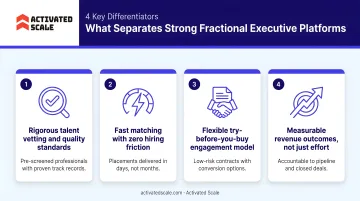
That growth means more platforms to choose from — and more ways to pick the wrong one. The factors that actually separate strong platforms from weak ones:
- Who vets the talent (and how rigorously)
- Whether you own the relationship or the platform does
- How fees compound over a 6–12 month engagement
- Whether the platform's talent pool covers your function
Top Fractional Executive Platforms in 2026
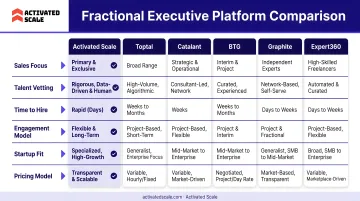
Platforms below were evaluated on vetting rigor, fee transparency, speed to hire, role specialization, and track record with early-stage and growth-stage companies. Specialized sales-focused platforms appear first, followed by broader executive platforms.
Activated Scale
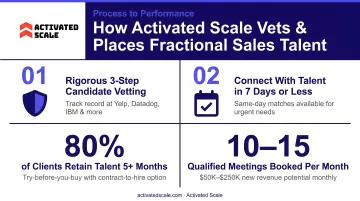
Activated Scale is a US-based fractional sales talent platform built specifically for seed-to-Series A B2B startups. The talent network draws from professionals with backgrounds at companies like Salesforce, Oracle, Zendesk, Datadog, ZoomInfo, IBM, and UiPath — people who have carried quota at companies your buyers recognize.
The platform places SDRs, Account Executives, VPs of Sales, Sales Operations professionals, and Customer Success Managers. Every applicant goes through three stages before joining the network:
- Application review
- A 60–90 second pitch video with supporting email and LinkedIn sequences
- A 30–45 minute interview with a subject matter expert
In 2024, Activated Scale accepted approximately 7% of all applicants.
The try-before-you-buy model works on a month-to-month basis. A typical 3-month contract gives companies enough time to evaluate fit and performance before committing. 65% of clients convert their fractional hire to full-time — at a conversion fee of 18% on base salary, compared to the industry-standard 20% of OTE charged by traditional recruiters.
80% of clients continue engagements for 5 or more months, and the platform saves founders 20+ hours of interviewing time per hire.
| Detail | Info |
|---|---|
| Best For | B2B SaaS startups (Seed to Series A) needing fractional SDRs, AEs, VPs of Sales, or Sales Operations |
| Fee Model | Monthly retainer + performance pay (SDRs at $4,500/mo plus performance pay; AEs at $6,500/mo plus performance pay; VPs at $12,000/mo plus bonus); 18% conversion fee for full-time hire |
| Time to Hire | SDR roles: within 7 days, sometimes 48 hours; AE roles: within 10 days, sometimes 72 hours |
GoFractional
GoFractional covers fractional C-suite, interim, developer, marketing, and sales roles — with a positioning that emphasizes speed and full operational support. The platform handles contracts, invoicing, and payments, making it a managed vendor relationship from day one.
The platform offers flexible monthly retainers based on hours and scope and avoids traditional 25–33% placement fees. GoFractional says it can introduce a shortlist within days and start work in under a week after the discovery call — with placements possible in as few as 3 days.
| Detail | Info |
|---|---|
| Best For | Startups and scaleups that want a fully managed fractional or interim engagement across C-suite and functional roles |
| Fee Model | Monthly retainers based on scope; no traditional search fees (specific markup percentage not publicly confirmed) |
| Time to Hire | Shortlist within days; placements as fast as 3 days |
Fractional Jobs
Fractional Jobs operates as a curated matchmaking service. The platform makes the introduction — then steps back. After the match, companies hire, contract with, and pay the professional directly, with no ongoing platform involvement.
The fee is a one-time referral of $3,000–$5,000, due only if a hire is made. No percentage markup, no spread on the executive's rate, and no conversion fee if the fractional hire moves to full-time. The talent pool spans CFOs, CMOs, CTOs, plus sales, operations, product, HR, legal, and customer success roles.
| Detail | Info |
|---|---|
| Best For | Companies that want direct ownership of the relationship from day one, a large talent pool, and no ongoing platform dependency |
| Fee Model | One-time referral fee of $3,000–$5,000; direct engagement model after match; no ongoing markup |
| Time to Hire | Most companies hire within two weeks of candidate introductions |
Shiny
Shiny is a full-service platform oriented toward startups and SMBs, covering CMO, CFO, COO, CTO, CPO, CRO, and CHRO roles. When a job is posted, the platform automatically surfaces up to 15 matched executives within seconds — no upfront deposit or search fee required.
Over 60% of executives on the platform report 20+ years of experience. The ongoing markup is 10% on what the company pays the executive — half the rate of some competitors — making it more accessible for earlier-stage companies. Full-time conversion carries a separate 15% recruiting fee on first-year guaranteed cash compensation.
| Detail | Info |
|---|---|
| Best For | Early-stage US companies needing C-level guidance with a fully managed experience and no upfront cost |
| Fee Model | 10% ongoing markup; 15% conversion fee for full-time hire |
| Time to Hire | Candidates surfaced within seconds; hiring can happen in days |
Bolster
Bolster covers the full spectrum of executive engagement: full-time sourcing, fractional and interim roles, board memberships, advisory positions, mentors, and coaches. That breadth is its differentiator — a venture-backed company can use the same platform to find a fractional CFO and fill a board seat.
The fee model includes a $2,500 upfront fee plus a 20% ongoing markup for fractional and interim engagements. The platform reports 5 days to first interview, though the broader 75-day-to-hire figure covers full-time placements, not fractional-specific timelines.
| Detail | Info |
|---|---|
| Best For | Venture-backed and growth-stage technology companies needing flexible access across executive, board, advisory, and fractional roles |
| Fee Model | $2,500 upfront + 20% ongoing markup for fractional/interim roles |
| Time to Hire | 5 days to first interview |
Toptal
Toptal is the most selective platform on this list. The network accepts fewer than 3% of the 200,000+ professionals who apply each year — making it the only platform reviewed here with a published, hard acceptance rate. Clients pay a $79 monthly platform subscription. Toptal introduces candidates within 24 hours in nearly all cases, and 90% of clients hire the first candidate introduced — a conversion rate that reflects how tightly the matching process is calibrated.
The platform's strength is in engineering, finance, product management, and design. Toptal lists fractional CMO, CFO, COO, and CIO roles on its FAQ, but it is not a sales leadership platform — go-to-market and quota-carrying roles are not its core.
| Detail | Info |
|---|---|
| Best For | Companies needing highly vetted fractional talent in engineering, finance, product, or design — with global reach and both project and retainer models |
| Fee Model | $79/month platform subscription; no published markup percentage |
| Time to Hire | Candidate introductions within 24 hours in nearly all cases |
How to Choose the Right Platform for Your Business
The most common mistake companies make is choosing based on brand recognition — then discovering the platform doesn't actually serve their function, stage, or preferred engagement structure.
Three criteria tend to separate the right platform from the wrong one: role type, fee structure, and stage fit. Work through each before committing.
Match Platform to Role Type
- Sales talent (SDRs, AEs, VPs of Sales): Activated Scale is built specifically for this. Generalist C-suite platforms don't carry deep sales talent benches.
- C-suite roles (CFO, CMO, COO, CTO): Shiny, GoFractional, and Bolster all cover this territory well.
- Engineering, finance, or product: Toptal's vetting depth makes it the strongest option, with global reach.
- Board and advisory seats alongside fractional roles: Bolster handles this combination.
- Large talent pool, one-time fee, direct relationship: Fractional Jobs.
Evaluate Fee Structure Against Engagement Length
Ongoing markups compound faster than they appear. A 10% monthly markup on a 9-month engagement adds up to nearly a full month of additional cost — at 20%, that's closer to two months.
| Engagement Length | Better Model |
|---|---|
| 1–3 months | Managed platform with percentage markup |
| 6+ months | One-time referral fee or direct engagement |
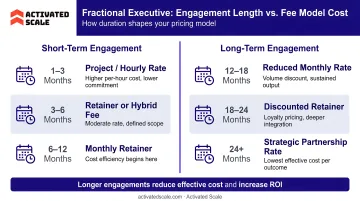
The administrative convenience of a managed platform is worth the premium on short engagements. For anything longer, the economics favor direct models.
Assess Startup-Stage Fit
Not every platform is designed for early-stage companies. Look for:
- Explicit focus on seed-to-Series A businesses
- References from companies at a similar stage and function
- Flexible terms — month-to-month structures with no minimums
- Contract-to-hire pathways if the role grows into a full-time position
- Fast starts — platforms serving early-stage teams typically place candidates within a week
Conclusion
The fractional model has become a deliberate hiring strategy — one that gives companies access to senior expertise without the cost and risk of a full-time commitment. Your platform choice directly shapes match quality, total engagement cost, and how much control you retain over the relationship.
The right platform depends on three things: what role you're hiring, what stage your company is at, and whether you want a managed service or a direct relationship. No single platform is best for every scenario.
For B2B SaaS startups that specifically need fractional sales talent — experienced, US-based professionals who can start generating pipeline quickly — Activated Scale's try-before-you-buy model is built for that exact use case. That means placements in 7 days or less, a 7% acceptance rate, and a clear conversion pathway if the engagement grows into a full-time hire. Book a call to get matched with a vetted sales professional this week.
Frequently Asked Questions
What is the difference between a fractional executive platform and a staffing agency?
Staffing agencies typically place full-time or temporary workers and charge a percentage of first-year salary — often 20–33% of OTE. Fractional executive platforms match companies with senior professionals working part-time or on retainer, with different fee structures, higher talent seniority, and engagement models built around scope and deliverables rather than headcount.
How quickly can I hire a fractional executive through a platform?
Most platforms deliver a shortlist within 24–72 hours for a well-scoped brief. Full placements typically close within one to two weeks. Activated Scale places SDR talent in as few as 48 hours and AE talent within 72 hours in faster cases, while Toptal introduces candidates within 24 hours typically.
Are fractional executive platforms only for startups?
No. Startups and SMEs make up the majority of users (SMEs accounted for 61.4% of global market revenue in 2025), but growth-stage companies, PE-backed businesses, and mid-market operators all use fractional talent too. Common use cases include filling capability gaps, bridging leadership transitions, and running targeted strategic initiatives.
What does it cost to use a fractional executive platform?
Fee models vary significantly across platforms:
- Fractional Jobs: one-time $3,000–$5,000 referral fee, no ongoing markup
- Shiny: 10% ongoing markup
- Bolster: $2,500 upfront plus 20% ongoing markup
- Toptal: $79/month platform subscription
- Activated Scale: monthly retainer plus performance pay at $4,500/month for SDR roles
Which fractional platform works best for B2B SaaS startups?
For sales talent specifically, Activated Scale is the purpose-built option — it only places sales roles and only serves B2B startups. For C-suite roles like CMO or CFO, Shiny and GoFractional are commonly used by early-stage companies. The key is matching the platform's specialization to the function, not just the company stage.
Can a fractional executive hired through a platform later become a full-time employee?
Yes, most platforms support contract-to-hire transitions. Activated Scale is built around this model: 65% of clients convert their fractional AE to full-time, at an 18% conversion fee on base salary. Fractional Jobs charges no conversion fee; Shiny charges 15% of first-year guaranteed compensation.