
Introduction
The global sales and marketing external services market was valued at $28.65 billion in 2022 and is projected to reach $57.46 billion by 2030 — a 9.4% compound annual growth rate. For startups and scaling B2B companies, fractional sales has become a meaningful line-item investment, not a minor experiment.
Yet many companies struggle to see strong returns. Not because the model is flawed, but because avoidable decisions made before and during the engagement quietly erode what could be a strong ROI.
The damage is rarely obvious at first. Activity dashboards look healthy. Meetings are getting booked. The real problems only surface after three or four months when lagging indicators fail to appear: unqualified pipeline, AE time absorbed by bad meetings, retainer spend continuing while conversion stalls.
This guide examines where ROI gets lost in fractional sales engagements and what you can do about it — covering vendor selection, engagement structure, pipeline quality, and the management practices that separate high-performing partnerships from expensive disappointments.
Key Takeaways
- Fractional sales ROI fails due to vague ICP definitions, activity-based KPIs, and poor internal readiness — the model isn't the problem
- Hidden costs compound faster than the monthly retainer and only become visible at the 3–6 month mark
- Fractional and try-before-you-buy models reduce early-stage risk before you commit to a full external engagement
- Track cost-per-SQL and meeting-held rate weekly, not monthly, to catch ROI erosion early
- Scale only after the pilot validates conversion metrics; scaling before that compounds inefficiency
How Fractional Sales ROI Gets Eroded Over Time
ROI erosion in fractional sales builds quietly: meetings that don't show, leads that miss the ICP, AE time absorbed by unqualified calls, and retainer spend continuing while the pipeline stagnates.
The problem is timing. Most of these costs are invisible for the first 60–90 days, when both sides are still onboarding and raw activity volume looks healthy. The damage only becomes measurable when lagging indicators — pipeline conversion, closed-won revenue — never show up by month three or four.
Why the Gap Between Activity and Revenue Is Dangerous
Consider the math: KBCM/Sapphire's 2024 private SaaS survey reports a 6-month median sales cycle for B2B SaaS deals near $56K ACV. A company paying a monthly retainer for fractional SDR work in month one won't see closed revenue from that work until month seven, at the earliest. If the meetings booked in months one and two don't meet qualification standards, the revenue drought doesn't show up until it's expensive to fix.
Salesforce reports that sales reps already spend 60% of their time on non-selling tasks. When unqualified fractional meetings fill AE calendars, they compound an existing capacity problem rather than solving it.
The Three Triggers of ROI Erosion
Erosion is usually caused by one of three specific events:
- A poorly defined qualification standard: the fractional team generates volume because "qualified" was never written down
- A strategy pivot mid-engagement — changing ICP or messaging resets the learning curve and the ramp clock
- An internal AE bottleneck: SDR-sourced meetings stall because AEs lack the capacity or context to move them forward
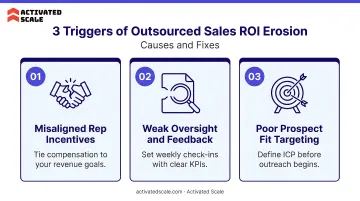
The good news: each trigger has a clear fix, and catching any one of them early can recover months of lost momentum.
Key Cost Drivers for Fractional Sales ROI
Three factors determine whether an fractional sales engagement pays off or burns budget. Getting any one of them wrong drives up cost-per-closed-deal faster than most founders expect.
ICP and Qualification Clarity
This is the single most influential cost driver. When the fractional team works from a vague buyer definition, it defaults to volume. Every unqualified meeting represents both a direct retainer cost and an indirect AE time cost.
According to Forrester, wrong-fit targets hinder sales regardless of seller quality or content quality. The implication is direct: no amount of SDR skill compensates for a poorly defined ICP.
EngageTech's 2023 benchmark data shows an industry-average meeting booked-to-attended conversion of 71%, an SAL-to-opportunity conversion of 38.6%, and an SQL-to-opportunity conversion of 43.33%. These are conversion gates. If meetings aren't held or don't become opportunities, the issue is almost always qualification upstream.
Engagement Model Selection
The wrong model for a company's stage locks in fixed costs before the program is optimized. A startup still validating messaging and ICP fit that commits to a 12-month full-retainer faces a structural cost problem: they're paying for scale before the motion is proven.
Flexible models shift this dynamic. Fractional arrangements (like those offered through Activated Scale) operate month-to-month and allow companies to adjust scope as the program matures. There's also an option to convert fractional talent to full-time if the engagement proves out.
For early-stage companies, this structure reduces financial exposure during the period when ROI uncertainty is highest.
Internal Readiness
Most companies underestimate internal readiness as a cost driver. Fractional pipeline only generates ROI if the internal team can receive, advance, and close the meetings being booked. An AE bottleneck or broken CRM handoff can neutralize an otherwise well-performing fractional program entirely.
Forrester's Q2 2024 Sales and Marketing Alignment Survey found that 65% of sales and marketing professionals report a lack of alignment. In fractional sales contexts, this misalignment most often shows up at the SDR-to-AE handoff — where meeting context gets lost and qualified conversations go cold.
Cost-Reduction Strategies for Fractional Sales ROI
Fractional sales ROI erodes in three places: before the engagement starts, during day-to-day management, and in the structural setup around the fractional team. Most companies only address one. The strategies below cover all three.
Strategies That Reduce Costs by Changing Upfront Decisions
Define the ICP and SQL criteria in writing before the engagement starts. Specify firmographics, job titles, minimum deal size, and explicit disqualifiers. Without this document in the contract, the fractional team defaults to volume and cost-per-qualified-meeting climbs. This isn't optional — it's the single highest-leverage upfront action.
Match the engagement model to your current stage. Early-stage companies still validating messaging should choose flexible, lower-commitment models rather than locking into a long-term retainer before the outbound motion is proven. The contract period should reflect where you are, not where you hope to be in six months.
Build outcome-based KPIs into the contract from day one. Define success as:
- Meetings held (not booked)
- Cost-per-SQL
- Meeting-to-opportunity conversion rate
Activity volume — dials made, emails sent — is not a success metric. It's a diagnostic. Vendors whose incentives are tied to activity rather than outcomes will optimize for activity.
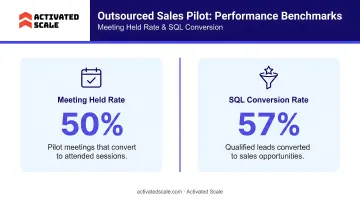
Require a structured pilot with explicit performance thresholds. Using EngageTech's benchmark data as a reference point, a 30–60 day pilot should demonstrate a meeting-held rate at or above the 71% industry average and initial SQL acceptance before any long-term commitment. If those thresholds aren't met, the engagement needs restructuring — not more time.
Strategies That Reduce Costs by Changing How the Engagement Is Managed
Track leading indicators weekly, not monthly. Salesforce recommends pipeline reviews weekly or twice a month, capped at 30 minutes. The same cadence applies to fractional programs. The metrics to inspect weekly during the first 60 days:
- Meeting-held rate vs. the 71% benchmark
- Meeting-to-opportunity conversion vs. the 38.6%–43.33% benchmark
- Reply-to-meeting conversion (channel-level health)
Monthly reviews let early quality decay go undetected until it becomes a revenue problem. Weekly reviews catch drift while it's still correctable.
Build a structured feedback loop back to the fractional team. Share deal outcomes, common objections, which ICP segments are converting versus stalling, and any positioning changes. Vague feedback produces generic adjustments. Specific, data-backed input accelerates ICP refinement and improves lead quality faster than any change to outreach volume.
Establish one named point of contact on each side with a defined weekly sync. When multiple stakeholders informally manage the engagement, feedback fragments, iteration slows, and no one owns the outcome. A single accountable contact on each side closes that gap before it costs pipeline.
Review attribution rules quarterly. First-touch and last-touch attribution both distort fractional channel performance. Misattribution leads to cutting a program that's contributing to revenue — or doubling down on one that isn't. Multi-touch attribution, which assigns partial credit to every customer interaction, gives a more accurate read. Use it as the baseline for evaluating fractional channel contribution.
Strategies That Reduce Costs by Changing the Structural Context
Audit internal AE capacity before scaling outreach volume. KBCM/Sapphire reports 2.5 AEs per BDR overall and 1.9 AEs per BDR for SMB companies. If fractional meeting volume exceeds what AEs can realistically receive and advance, you're generating pipeline that degrades rather than accelerates revenue. Cost-per-closed-deal rises even when cost-per-meeting looks fine.
Align the fractional team's tooling with your CRM before the engagement launches. The specific integration gaps that kill ROI are predictable:
- Contact records not transferred from SDR to AE with full context
- Meeting outcomes not logged to source attribution
- Stage progression invisible in the CRM after handoff
Fixing these before outreach starts is cheaper than reconstructing lead history mid-engagement after pipeline has stalled.
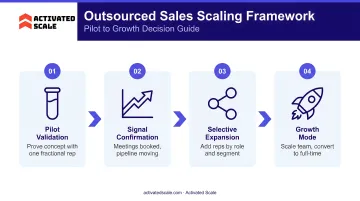
Scale only after the pilot validates conversion metrics. Increasing outreach volume or adding SDR seats before cost-per-SQL and meeting-to-opportunity conversion are proven compounds inefficiency at scale. Wait until the pilot demonstrates repeatable conversion before expanding. Strong activity dashboards at week four don't substitute for proven cost-per-SQL — and scaling before you have that number turns a fixable problem into an expensive one.
Conclusion
Maximizing fractional sales ROI depends on identifying where the return is actually being lost — whether in upfront decisions, day-to-day management, or structural conditions — rather than simply cutting the retainer or switching vendors.
The companies with the strongest fractional sales ROI treat it as an operational discipline. They track pipeline metrics weekly, give rep-specific feedback consistently, and hold off on scaling until conversion rates are proven — not assumed. That discipline is what separates programs that compound from programs that plateau.
The model is sound. What determines results is whether the structure around it gives the model room to run.
Frequently Asked Questions
What is a good ROI for an fractional sales team?
ROI benchmarks vary by engagement model, ACV, and sales cycle length — a single percentage target is rarely meaningful. More useful metrics are cost-per-SQL, cost-per-closed-deal, and CAC payback period. KBCM/Sapphire reports a 23–24 month fully-loaded CAC payback for private SaaS companies as a baseline for comparison.
What profit margin can you expect from an fractional sales team?
Margin depends on retainer cost relative to deal value. Companies with higher ACV deals typically see stronger margin outcomes because the fixed retainer cost is amortized across fewer, larger deals — a $60K ACV deal absorbs a monthly retainer very differently than a $6K ACV deal does.
How long does it take to see ROI from an fractional sales team?
Well-structured engagements should show initial pipeline signals — held meetings, accepted SQLs — within the first 60 days. Closed-won revenue will typically take 3–6 months or longer, depending on sales cycle length. Don't judge a pilot on closed revenue before the sales cycle has had time to complete.
What are the biggest reasons fractional sales ROI underperforms?
Three failure patterns show up consistently:
- Vague ICP definitions that push the fractional team to optimize for volume over quality
- Activity-based KPIs that don't align vendor incentives with conversion outcomes
- Insufficient internal AE capacity to receive and advance the meetings being generated
What metrics should I use to track fractional sales ROI?
Track these four metrics closely:
- Meeting-held rate (benchmark: 71%)
- Meeting-to-opportunity conversion (benchmark: 38.6%–43.33%)
- Cost-per-SQL
- CAC payback period
Review weekly during the first 60 days — monthly cadence is too slow to catch early quality decay.
How do I know when to switch fractional sales partners?
One bad month isn't the signal. Switch when a partner consistently misses agreed pilot KPIs past the 60-day mark and offers no transparency in reporting or resistance to refining qualification criteria. Bad results paired with opacity and no iteration point to a vendor problem — not a management one.