Introduction
Building a great B2B SaaS product and building a high-performing sales function are two different jobs — and most founders are only wired for one of them. The tension is real: you need revenue to survive, but hiring a full sales team before you've validated your go-to-market motion is expensive and risky.
That's exactly the problem on-demand sales solutions are designed to solve.
On-demand sales solutions give companies access to sales expertise — talent, processes, or tools — without committing to full-time headcount. They've become a practical alternative to traditional hiring for startups that need to move fast without burning runway on the wrong people.
This guide covers everything you need to make an informed decision:
- What on-demand sales solutions are and how they differ from traditional hiring
- The three main types and when to use each
- Core benefits for B2B SaaS startups
- How to choose the right solution and get started quickly
TLDR
- On-demand sales solutions deliver sales expertise — people or tools — without permanent hiring commitments
- Comes in three forms: fractional sales talent, outsourced sales teams, and sales automation tools
- Especially valuable for B2B SaaS startups that need speed, capital efficiency, and lower hiring risk
- The right fit depends on your stage, budget, and whether you need human selling capacity or process efficiency
What Are On-Demand Sales Solutions?
On-demand sales solutions are any model that gives a business access to sales capabilities — people, processes, or tools — without a permanent full-time commitment. The contrast with traditional hiring is straightforward: instead of posting a job, interviewing for months, onboarding, and waiting through a ramp period, you engage sales expertise as and when you need it.
The Core Logic
Most startups are built around a product insight, not a sales machine. On-demand models let founders access purpose-built sales expertise the same way they'd bring in outside legal counsel or a fractional CFO — specialized capability, deployed precisely when needed.
The talent pool supports this approach. According to McKinsey, 36% of employed Americans identified as independent workers in 2022, up from 27% in 2016 — meaning experienced sales professionals working outside traditional employment are now a mainstream option, not a fallback.
Quality and Vetting Standards
A common misconception is that on-demand means lower quality — anonymous call center reps running generic scripts with no context about your product or customer.
The best on-demand models work the opposite way. They invest more in recruiting, vetting, and performance management than a typical startup would during a rushed internal hire. The difference comes down to what you're actually buying:
- Commoditized outsourcing — anonymous reps, generic scripts, no pipeline integration
- Structured on-demand engagement — vetted professionals who learn your product, work inside your existing process, and are accountable to performance metrics
How It Differs from Traditional Outsourced Sales
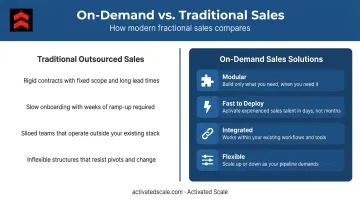
Traditional outsourced sales arrangements often replace a company's sales function wholesale. On-demand solutions are different:
- Modular — you can engage specific functions (prospecting, closing, strategy) without handing off the entire process
- Faster to deploy — operational in days, not months
- Integrated — designed to work within your pipeline and processes, not parallel to them
- Flexible — scale up or down based on pipeline needs or funding stage
Types of On-Demand Sales Solutions
Fractional Sales Talent
Fractional sales professionals are experienced, senior-level salespeople who work with a company on a part-time or contract basis. Unlike a consultant who advises from the outside, fractional reps are embedded in your sales process: running outbound, managing deals, or building the function from scratch.
Roles available in the fractional model include:
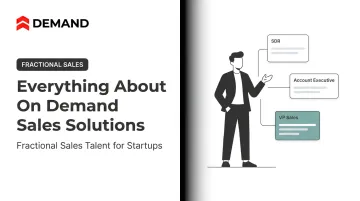
- SDR/BDR: outbound prospecting, cold outreach, and meeting generation
- Account Executive: manages the full sales cycle from discovery through close
- VP of Sales: go-to-market strategy, sales process development, and team scaling
One of the most valuable features of the fractional model is the contract-to-hire structure. Companies engage a fractional rep on a contract basis, evaluate real in-market performance over a defined period, and have the option to convert to full-time. This "try before you hire" approach significantly reduces the risk of a costly mis-hire — you see how someone actually sells before making a permanent commitment.
Activated Scale is built specifically around this model for B2B SaaS startups. The platform maintains a network of 300+ pre-vetted, US-based fractional sales professionals, screened through a three-step process: application review, a pitch video assessment, and a subject matter expert interview.
Matching is fast. Startups are connected with a fractional SDR in 7 days or less (sometimes within 48 hours), and fractional AEs typically within 10 days.
Pricing is structured around role type:
- Fractional SDR/BDR: $2,500–$3,500/month + commission
- Fractional AE: $3,000–$5,000/month + commission
- Fractional VP of Sales: $8,000–$12,000/month + bonus
Outsourced Sales Support Teams
Outsourced sales support involves an external team handling specific sales tasks on behalf of a company (prospecting, lead qualification, appointment setting, pipeline research) so internal reps can focus on closing.
Quality varies significantly across providers. The best outsourced teams operate as a genuine extension of your brand: defined ICP alignment, shared metrics, transparent reporting. The worst are warm-body operations running volume-based outreach with no accountability for pipeline quality.
When evaluating an outsourced support provider, ask:
- How are team members trained on your specific product and ICP?
- What reporting cadences and metrics are included?
- What's the process for redirecting the team when strategy shifts?
Sales Automation Tools
Sales automation tools handle repetitive sales tasks (lead scoring, email sequencing, CRM updates, follow-up triggers) to reduce manual workload and keep deals moving.
The case for automation is grounded in a genuine problem: Salesforce's 2024 State of Sales report found that non-selling tasks, including administrative work and meeting preparation, consume 70% of sales reps' time. That's a significant drag on a function where human attention is the scarce resource.
Automation tools are best positioned as force-multipliers for human sellers, not replacements. The goal is to free up rep time for the activities that actually require judgment: discovery calls, negotiations, and relationship management. Used well, automation doesn't shrink the sales team's role — it shifts their time toward the work that actually closes deals.
Key Benefits for B2B SaaS Startups
Speed to Revenue
Traditional sales hiring takes time — posting the role, screening candidates, interviewing, negotiating an offer, serving out notice periods, onboarding, and then waiting through a ramp period before the rep is fully productive.
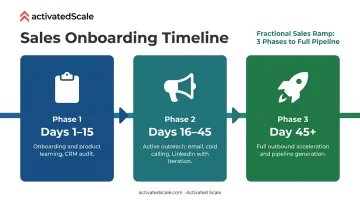
Fractional talent and outsourced support compress that timeline. Activated Scale's structured onboarding follows a clear arc:
- Days 1–15: Onboarding, learning the product, auditing current messaging and CRM
- Days 16–45: Active outreach — email, cold calling, LinkedIn — with iteration based on early signals
- Day 45+: Full outbound acceleration, pipeline generation, and revenue focus
For startups in competitive markets, the difference between weeks and months matters.
Cost Efficiency and Capital Preservation
The full cost of a traditional sales hire goes well beyond the base salary. According to the Bridge Group's 2024 SaaS AE Benchmark Report, the median SaaS AE OTE is $190,000, with a 53:47 base-to-variable split. Add the Bureau of Labor Statistics' reported 29.9% benefits load, recruiting fees, and equity, and the total first-year cost is substantially higher than the headline number.
A fractional AE engagement through Activated Scale, by contrast, runs $3,000–$5,000/month with no benefits, no equity, and no recruiter fee. If the engagement produces results, you have the option to convert — and you go into that conversion with actual performance data.
De-Risked Sales Hiring
The "audition" dynamic is one of the clearest advantages of the fractional model. When you hire on-demand, you see how someone performs in your actual sales environment — with your product, your ICP, your sales process — before committing to full employment.
Activated Scale's 3-month initial contract period is designed specifically for this. The employer evaluates both sales skills and cultural fit; the salesperson earns their base and commission; and at the end, both sides make an informed decision.
Around 85% of Activated Scale clients hire their fractional reps full-time after the initial contract. That conversion rate reflects genuine quality validation, not just a delayed hiring decision.
Scalability Without Structural Overhead
On-demand solutions scale with your pipeline, not against your org chart. A startup that closes a Series A can add fractional SDR capacity within a week. If a pilot program doesn't generate expected pipeline, the engagement ends without a lengthy severance conversation.
As SaaStr notes, founders typically need to transition from founder-led sales around $1M ARR or when lead volume outpaces their capacity to manage it directly. On-demand solutions fill that gap with real sales capacity before a full organizational build makes sense.
Access to Talent That's Otherwise Out of Reach
Enterprise-level sales talent — people who've spent years at Salesforce, Oracle, or IBM running complex deals — typically commands OTEs well above early-stage startup budgets. The fractional model changes that math. A seed-stage startup can access that experience level at a fraction of the full-time cost, with the talent split across multiple engagements.
MBO Partners reported 5.6 million independent workers earning over $100,000 annually in 2025. That's a substantial pool of senior professionals operating outside traditional employment, and fractional platforms are the mechanism for connecting them to startups that need their experience most.
How to Choose the Right On-Demand Sales Solution
Clarify Your Sales Gap First
Before evaluating any provider or tool, identify what's actually missing from your sales function:
| Gap | Solution Type |
|---|---|
| Not enough outbound activity | Fractional SDR or outsourced prospecting team |
| Deals stalling after demo | Fractional AE or closing support |
| No sales process or strategy | Fractional VP of Sales |
| Too much admin, not enough selling | Sales automation tools |
| Need pipeline insights | CRM + automation stack |
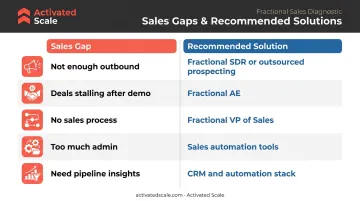
Get this wrong and you'll buy AE capacity when what you actually need is outbound volume — an expensive mistake to unwind.
Evaluate Talent Quality and Vetting Rigor
For fractional talent or outsourced teams, the vetting process is everything. Ask:
- How are candidates sourced and screened?
- Is the assessment practical (pitch reviews, mock calls) or just resume-based?
- Are reps US-based with relevant B2B SaaS experience?
- What does ongoing performance tracking look like?
Activated Scale's three-step vetting process — application review, a 60–90 second pitch video reviewed by existing network members, and a subject matter expert interview — is one example of a structured quality bar. A rigorous process at the front end means fewer surprises once a rep is working your pipeline.
Assess Flexibility and Exit Terms
On-demand solutions should not lock you into a long commitment before you've validated fit. Look for:
- A defined trial or contract period (typically 3 months) before any conversion decision
- Clear performance metrics agreed upfront
- Transparent conversion terms if you choose to hire full-time
- No long-term contracts that outlast your ability to evaluate results
How to Get Started with On-Demand Sales Solutions
Start Small and Specific
Don't try to overhaul the entire sales function at once. Identify the single highest-leverage activity you're currently failing to execute consistently — outbound prospecting, demo follow-up, pipeline nurturing — and begin there.
A focused fractional SDR engagement generating 10–15 qualified meetings per month is a more useful starting point than a broad sales overhaul. Once you've validated that the model works in one area, expanding is straightforward.
The Activated Scale Path
If fractional talent looks like the right fit, Activated Scale's process is designed to get you moving fast — typically matching candidates within a week:
- 30-minute discovery call — discuss your business, ICP, and goals to confirm mutual fit
- Talent matching — Activated Scale reviews their 300+ vetted network and recommends 2–4 matched candidates within 7 days
- Interviews — typically 2 rounds before making a selection
- Engagement kickoff — onboarding begins immediately; active outreach starts within 2 weeks
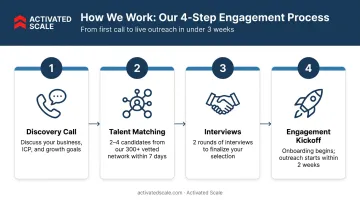
The 3-month initial contract gives you real performance data before any full-time commitment. There's no recruiter fee upfront, no equity dilution, and no benefits overhead. You pay for a focused engagement tied directly to agreed KPIs.
Set KPIs Before Day One
Whatever solution you choose, define success metrics before the engagement begins. Ambiguous expectations lead to frustrating evaluations. Common starting metrics by role:
| Role | Key Metrics |
|---|---|
| Fractional SDR | Meetings booked per month (target: 10–15 by month 3) |
| Fractional AE | New revenue won per month, demo-to-close rate |
| Fractional VP | Pipeline coverage ratio, process documentation, hiring plan |
| Outsourced Support | Qualified leads passed, appointment show rates |
| Automation Tools | Admin time saved, sequence reply rates, CRM data completeness |
Frequently Asked Questions
What are examples of on-demand services in sales?
Common examples include fractional SDRs for outbound prospecting, fractional AEs for full-cycle deal management, outsourced appointment-setting teams, virtual sales assistants for lead intake, and automation platforms for email sequencing and CRM management.
What sales rules or ratios are commonly used in on-demand sales engagements?
Common benchmarks include outreach-to-meeting conversion ratios, meeting-to-opportunity rates, and SDR activity targets (calls, emails, LinkedIn touches per day). These vary by model, ICP, and deal size — what matters most is agreeing on specific targets before the engagement starts and tracking against them consistently.
How is on-demand sales talent different from a traditional outsourced sales agency?
Fractional talent means individual, experienced professionals embedded in your sales process with direct accountability to your team. Outsourced agencies execute defined tasks at arm's length, often with less brand alignment and weaker ownership of outcomes.
How quickly can an on-demand sales solution start producing results?
Fractional reps and outsourced support can be operational within days to two weeks. For Activated Scale clients, early pipeline signals typically emerge within 30–60 days, with consistent meeting volume and pipeline contribution reaching full pace by month three — compared to 3–6 months for a traditional full-time hire to fully ramp.
What types of companies benefit most from on-demand sales solutions?
Early-stage B2B SaaS companies are the primary fit — particularly seed to Series A startups without a dedicated sales team, founders transitioning out of founder-led sales, and companies testing a new market segment or ICP before committing to a full-time hire.
How do you measure the success of an on-demand sales engagement?
Track qualified meetings booked per month, pipeline value created, and deal conversion rates. For fractional talent, also evaluate whether contract-period performance justifies converting to full-time. Define these metrics before day one so evaluation stays objective.