
Introduction
You've found product-market fit. Investors are on board. But now comes the hard part: building a sales team fast enough to match the opportunity.
Most founders—especially technical ones—hit the same wall. Traditional hiring is slow: LinkedIn reports the average time-to-hire is 41 days just to get an offer accepted.
Then add ramp time. According to RAIN Group's 2024 survey of 423 sales leaders, new reps take 3 months to be buyer-ready and 9 months to reach full competence. That's nearly a year before your first hire is genuinely productive.
Sales as a Service offers a different path. Instead of building from scratch, you plug into a ready-made team of experienced professionals who can start generating pipeline in weeks—not months.
This guide breaks down exactly how Sales as a Service works, what it costs to get wrong, and how to implement it in a way that actually moves revenue.
TLDR
- Sales as a Service means outsourcing some or all of your sales functions to an experienced external team.
- It combines vetted talent, proven processes, and sales technology — available part-time, project-based, or on a contract-to-hire basis.
- Key advantages: you generate pipeline faster, spend less upfront, and stay flexible as your needs evolve.
- Best suited for seed-to-Series A B2B startups that need pipeline now but haven't hired a full-time sales team yet.
What Is Sales as a Service?
Sales as a Service is a model where a company outsources part or all of its sales operations (prospecting, lead generation, pipeline management, and closing) to a specialized external provider instead of building an in-house team. The term sometimes shares the "SaaS" acronym with Software as a Service — both follow a pay-for-value, on-demand philosophy where you access external expertise without building the capability yourself.
How It Differs from Traditional Outsourcing
Old-school sales outsourcing meant handing off calls to a generic team with no brand connection. Modern Sales as a Service is different. Today's providers deliver:
- Vetted sales professionals matched to your specific ICP
- Proven outreach processes and CRM integration
- Transparent performance reporting
- A team that represents your brand directly to prospects
The Spectrum of Engagement
The model is modular. Some companies use it for a single function—outbound prospecting only. Others outsource the entire sales cycle. The engagement evolves as the business does.
At Activated Scale, for example, clients can engage at multiple levels:
- Fractional SDRs focused on outbound prospecting and meeting generation ($3,500–$4,500/month)
- Fractional AEs managing full-cycle sales from demo to close ($4,500–$7,500/month)
- Fractional VP of Sales for go-to-market strategy and team development ($8,000–$15,000/month)
Key Components of Sales as a Service
Dedicated Sales Talent
This is the human engine of the model. Sales as a Service providers supply experienced SDRs, AEs, or full-cycle reps matched to your industry, buyer persona, and deal size, then onboarded to your messaging, product, and competitive positioning.
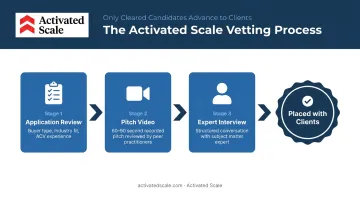
Quality depends entirely on the vetting process. Activated Scale runs a three-stage qualification before any professional joins their network:
- Application review — evaluating buyer type, industry fit, and ACV experience
- Pitch video — a 60–90 second recorded pitch reviewed by peer practitioners
- Expert interview — a structured conversation with a subject matter expert
Only candidates who clear all three stages are placed with clients. The network draws from professionals with backgrounds at companies like Datadog, IBM, Oracle, Salesforce, and Zendesk, covering deal sizes from $10K to $100K+ ARR and buyers from SMB through enterprise.
Sales Technology and CRM Integration
Effective Sales as a Service engagements don't drop pipeline data into a black box. Providers work with or within your existing CRM, set up sequencing tools, and ensure outreach activity, meeting data, and performance metrics stay visible to you in real time.
For Activated Scale's fractional SDRs and AEs, sales tool setup and optimization is included in the engagement scope—meaning the external team handles configuration without pulling internal engineers into the process.
Performance Reporting and Data Analytics
SaaS engagements are measurement-driven by design. KPIs are defined upfront:
- Meetings booked per month
- Pipeline generated
- Demos completed
- Revenue won
Activated Scale's typical SDR engagement delivers 10–15 qualified meetings per month by month three, with some clients reporting 14 meetings set monthly over a six-month period. Fractional AE engagements have generated $50,000–$250,000 in new revenue per month, depending on deal size and sales cycle length.
Benefits of Sales as a Service for B2B Startups
Faster Speed to Revenue
The math on traditional hiring is painful. Forty-one days to hire, then up to nine months to reach competence. That's close to a year before a full-time rep is fully productive.
Sales as a Service collapses that timeline. Activated Scale connects startups with vetted fractional sales professionals in 7 days or less—sometimes within 48 hours. The professionals already know how to prospect, qualify, and close in your target market. There's no discovery phase eating up months of runway.
Cost Efficiency Without Sacrificing Quality
Full-time sales hires carry significant overhead:
| Role | Median Base | OTE (2024) |
|---|---|---|
| SDR | $60,000 | $85,000 |
| SMB AE | $68,000 | $130,000 |
| Mid-Market AE | $85,000 | $160,000 |
Source: RepVue 2024 Sales Salary Guide
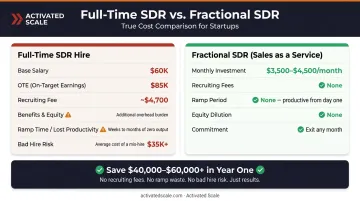
That's before factoring in benefits, equity, recruiting costs (SHRM benchmarks average cost-per-hire at nearly $4,700), and the lost productivity during ramp.
A fractional SDR engagement through Activated Scale starts at $3,500–$4,500/month. One wrong SDR hire can cost over $35,000 in recruiting fees, lost time, and missed pipeline. The fractional model eliminates that downside entirely.
Access to Specialized Expertise and Established Networks
A full-time hire brings what they know from their last company. A fractional professional from a curated network brings experience across multiple similar engagements—meaning they've already navigated the buyer objections, deal dynamics, and messaging challenges you're facing now.
Activated Scale matches talent across three dimensions:
- Buyer persona — CIO, VP Sales, CHRO, and other decision-maker profiles
- Deal size bracket — from $10K to $100K+ ACV engagements
- Company size — SMB through enterprise (100 to 1,000+ employees)
If you're selling a $50K ACV product to VP-level buyers at mid-market SaaS companies, you get a professional who's run that exact motion before.
Scalability and Flexibility
Sales needs change. A growth push requires more SDR capacity. A slower quarter warrants a tighter scope. Activated Scale operates on a month-to-month model with no minimum spend and no long-term contracts, so scaling up or down carries none of the legal or financial complexity of traditional headcount changes.
Risk Mitigation
The try-before-you-buy dynamic is one of the model's strongest features. Activated Scale's initial three-month engagement lets founders evaluate performance—both sales output and cultural fit—before making any full-time commitment. 80% of clients continue for 5+ months. 65% convert their fractional AEs to full-time employees. For many founders, the engagement doesn't just generate pipeline—it identifies the right person to build the sales org around.
Sales as a Service vs. Traditional Sales Hiring
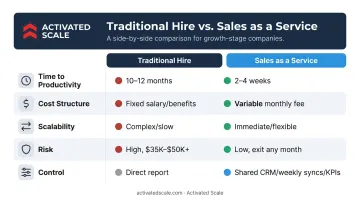
The core tradeoff is real: a full-time hire is culturally embedded and fully dedicated, but comes with high upfront cost, long ramp time, and meaningful risk if the hire doesn't work out. Sales as a Service trades some of that depth for speed, flexibility, and lower risk.
| Factor | Traditional Hire | Sales as a Service |
|---|---|---|
| Time to productivity | 10–12 months (hiring + ramp) | 2–4 weeks |
| Cost structure | Fixed (salary + benefits + equity) | Variable (monthly engagement fee) |
| Scalability | Complex, slow | Immediate, flexible |
| Risk | High (bad hire cost $35K–$50K+) | Low (exit any month) |
| Control | High (direct report) | High with structure (shared CRM, weekly syncs, defined KPIs) |
Addressing the Control Concern
Founders often worry that an external team won't represent the brand properly or that they'll lose visibility into sales activity. A well-structured engagement addresses this directly.
Activated Scale builds in accountability from day one:
- Weekly one-on-ones between founders and fractional talent
- A dedicated point of contact throughout the engagement
- A Statement of Work defined upfront, specifying exactly what's expected
In practice, that structure often provides more visibility than a traditional hire would.
The Hybrid Model
Many startups run a fractional team alongside a founding AE or VP of Sales — the internal leader sets strategy while the outsourced professionals handle execution. It's a practical setup that works especially well at the seed-to-Series A stage, and one Activated Scale clients use frequently.
When Should a B2B Startup Consider Sales as a Service?
The Right Trigger Point
The clearest signal: you've validated product-market fit, you have early customer traction, and the founding team is still handling all sales manually. As HBR's 2024 interview with Mark Roberge notes, founders should scale sales after product-market fit is quantified—not before. When roughly 80% of customers are hitting key retention milestones in the first month, you have a repeatable signal. That's when Sales as a Service adds the most leverage.
Other Scenarios That Fit
- Entering a new market or vertical where you lack established buyer relationships
- Proving sales traction to investors before committing to full-time headcount
- Covering a critical role after high turnover, with no time for a standard hiring cycle
When It Doesn't Fit
Sales as a Service is not a fix for an undefined product. Avoid it when:
- Your go-to-market position is still shifting
- No internal stakeholder can brief and guide the external team
- The sales motion requires years of institutional knowledge to navigate
The model works best when the client is an active collaborator, not a passive observer. Without clear ICP definitions, messaging, and responsive feedback loops, even experienced fractional sellers can't perform.
How to Implement Sales as a Service
Define Your Objectives and Success Metrics
Before engaging any provider, define what success looks like in concrete terms:
- How many qualified meetings per month?
- What pipeline value in 90 days?
- Which markets or buyer segments are you targeting?
- What is your target customer acquisition cost?
Vague mandates produce vague results. Clear KPIs create accountability on both sides and give you the data to make informed decisions at the end of the initial contract period.
Select the Right Provider and Structure the Engagement
Evaluate providers on five criteria:
- Relevant industry and buyer experience — Have they placed talent with similar companies selling to similar buyers?
- Talent vetting rigor — How are professionals screened? What's the rejection rate?
- Reporting transparency — Do you get real-time visibility into activity and pipeline, or monthly summaries?
- Contract flexibility — Is there a trial period? Can you exit or convert without penalties?
- References from similar-stage companies — Ask for examples from seed-to-Series A clients specifically.
Once you know what to look for, the difference between providers becomes clear quickly. Activated Scale, for example, connects B2B startups with vetted fractional sales professionals in 7 days or less, with a try-before-you-buy structure and a rematch guarantee if the initial fit isn't right. The talent network includes professionals with backgrounds from Oracle, Salesforce, Datadog, and IBM — matched to your specific buyer persona and deal size.
Onboard, Integrate, and Monitor Performance
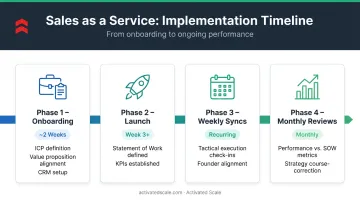
Onboarding with Activated Scale takes approximately two weeks. During this phase:
- Brief the fractional team on your ICP, value proposition, competitive positioning, and current CRM setup
- Establish a weekly one-on-one cadence between the founder (or sales lead) and the fractional professional
- Define the Statement of Work upfront—goals, KPIs, and expectations documented before day one
From there, the team requests biweekly feedback and conducts monthly performance reviews against SOW metrics. Weekly tactical syncs handle execution; monthly reviews course-correct strategy — so founders stay informed without getting pulled into day-to-day sales management.
Frequently Asked Questions
What is Sales as a Service?
Sales as a Service is a model where companies outsource some or all of their sales functions—including prospecting, lead generation, and closing—to an external team of specialized professionals, rather than building an in-house sales department.
What is the SaaS model of sales?
In the context of sales (not software), "SaaS" refers to engaging a third-party provider on a contract or subscription basis to run your sales activities. The provider supplies experienced talent, defined processes, and technology — delivered on demand, much like a software subscription.
What are the benefits of the as-a-service model?
Key benefits include:
- Lower upfront cost compared to full-time hiring
- Faster access to experienced, deployable talent
- Flexibility to scale up or down as needs change
- Specialized expertise and established buyer networks
- Reduced risk when testing go-to-market approaches
What are the 4 P's of service strategy?
The ITIL v3 Service Design framework identifies four dimensions: People, Processes, Products, and Partners. In a Sales as a Service engagement, these map directly to the sales talent, the outreach and pipeline processes, the technology stack, and the provider relationship itself.
How is Sales as a Service different from traditional sales outsourcing?
Modern providers embed into your brand, use shared CRM and reporting tools, and bring senior professionals with relevant domain expertise. Traditional outsourcing relied on generic call-center teams with no brand alignment or buyer-specific knowledge.
Is Sales as a Service a good fit for early-stage startups?
It's a strong fit for seed-to-Series A companies that have validated product-market fit but aren't ready to build a full sales team. Fractional and try-before-you-buy models let founders generate revenue and test their go-to-market without committing to a full-time hire.