Introduction
Many B2B SaaS founders face a painful contradiction: they know structured sales operations are essential for scaling revenue, but building an in-house sales ops team requires hiring VP-level talent at $235,000-$404,000 annually—a cost that's prohibitive at the Seed to Series A stage. Meanwhile, without proper CRM management, forecasting discipline, and process documentation, sales reps spend only 28% of their time actually selling, according to Salesforce's 5th Edition State of Sales report.
This operational gap explains why 61% of B2B companies missed their 2023 revenue targets, and why 70% of early-stage founders report struggling to convert prospects into customers. The challenge isn't pipeline generation alone—it's the operational infrastructure between first contact and closed deal.
This article defines Sales Operations as a Service (SOaaS), covers what it includes and who it's for, and walks through best practices for getting real results from the model.
TLDR:
- SOaaS delivers outsourced sales ops expertise on retainer—typically at 20-45% of a full-time hire's cost
- SOaaS includes CRM management, forecasting, reporting, process design, and tech stack optimization
- Companies with best-in-class forecasting hit quotas 97% of the time vs. 55% without it
- Most startups need sales ops at 5 reps—long before they can afford full-time talent
- Fractional engagement eliminates 5-7 months of recruiting and ramping time
What Is Sales Operations as a Service?
Sales Operations as a Service (SOaaS) is the outsourced or fractional delivery of sales operations functions—including CRM administration, process design, forecasting, reporting, and technology management—on a contract or retainer basis rather than through a full-time hire.
Core Definition and Scope
SOaaS providers take on the processes, tools, data management, and strategic support that normally require a dedicated in-house sales ops team. As Cloud Adoption Solutions defines it, SOaaS "improves a slew of processes within your sales team through training and best practices, as well as better technology purchase combined with the sales ops team's expertise."
SOaaS is not the same as Sales as a Service, which refers to outsourcing the execution layer — quota-carrying reps who run discovery calls and close deals. SOaaS focuses on the operational backbone that makes those reps effective.
Why This Model Has Emerged
The fractional executive market has grown to $5.7 billion with 14% annual growth, and fractional sales leaders in the US and Canada increased 80% between 2020 and 2024 (from 5,000 to 9,000 professionals). The demand is easy to understand.
Most early-stage companies need sales ops infrastructure before they can justify a full-time hire. Three dynamics are driving this gap:
- Rising sales complexity: More tools, longer cycles, and higher buyer expectations require structured ops support
- Faster scaling pressure: Seed and Series A companies need repeatable processes in place before headcount grows
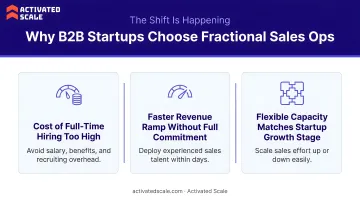
- Cost barriers: A full-time VP of Sales Operations is a $150K–$200K+ commitment — out of reach at the 3–5 rep stage
Flexible Delivery Models
SOaaS can be structured as:
- Fully outsourced: Complete handoff of sales ops to an external provider
- Fractional/part-time: 10-20 hours per week of senior ops expertise
- Augmentation: Supplementing a lean internal team with specialized capabilities
This flexibility lets companies at different growth stages (from 3 reps at Seed to 15 reps at Series A) access VP-caliber expertise without the fully loaded cost of a senior hire.
What Does Sales Operations as a Service Include?
CRM Management and Optimization
One of the core SOaaS deliverables is setting up, maintaining, and optimizing your CRM system—whether HubSpot, Salesforce, or another platform. This includes:
- Data hygiene protocols to eliminate duplicates and ensure accuracy
- Pipeline stage definitions that accurately reflect your sales process
- Automation rules for lead routing, task creation, and follow-up sequences
- Custom fields and objects tailored to your business model
When the CRM accurately reflects reality, forecasts get reliable and reps stop wasting time on manual data entry.
Sales Process Design and Documentation
SOaaS providers map out your entire sales workflow—from lead qualification to contract signature—and create playbooks that ensure consistency. This covers:
- Lead qualification criteria (ICP definition, scoring models)
- Handoff processes between marketing, SDRs, and AEs
- Stage-by-stage playbooks detailing required activities and exit criteria
- Objection handling frameworks and talk tracks
Reporting, Analytics, and Forecasting
Providers build dashboards and regular reports tracking KPIs such as:
- Conversion rates by stage
- Sales cycle length
- Average deal size and velocity
- Quota attainment and rep productivity
- Pipeline coverage ratios
They also develop forecasting models that give leadership visibility into expected revenue. This matters: 71% of companies reported incorrect or hidden forecast details in Clari's 2024 survey, and 67% of sales ops leaders said forecasting was harder in 2023 than in 2020.
Sales Technology Stack Management
SOaaS providers evaluate, implement, and integrate sales tools including:
- Outreach and engagement platforms (Outreach, SalesLoft)
- Lead enrichment and prospecting tools (ZoomInfo, Apollo)
- Conversation intelligence software (Gong, Chorus)
- Proposal and contract automation (PandaDoc, DocuSign)
This ensures your team works with proven tools—without spending weeks researching vendors or managing integrations yourself.
Quota Setting, Territory Planning, and Compensation Design
More comprehensive engagements include:
- Data-driven quota modeling based on historical conversion rates and market size
- Territory allocation to balance opportunity and prevent rep overlap
- Sales compensation structure design that aligns incentives with business goals
Key Benefits of Sales Operations as a Service for B2B Startups
Access to Senior-Level Expertise Without Full-Time Cost
Hiring a full-time VP of Sales Operations costs $235,000-$404,000 annually in total compensation (Glassdoor, April 2025). Even a mid-level Sales Operations Manager runs approximately $107,615/year when factoring in base salary and commissions.
SOaaS provides access to professionals with equivalent experience at a fraction of the cost. Fractional engagements typically range from $5,000-$15,000/month, representing a 70-85% cost reduction compared to a full-time VP hire. For early-stage companies operating on tight budgets, this makes VP-caliber ops expertise accessible at the exact stage when it's most needed.
Faster Time-to-Revenue
With properly structured processes, clean data, and accurate forecasting from day one, reps spend more time selling and less time on administrative work. Salesforce's research shows reps spend only 28% of their week selling, with the remaining 72% consumed by:
- CRM data entry (17%)
- Internal meetings (15%)
- Email and admin tasks (14%)
- Scheduling (12%)
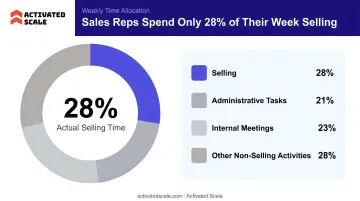
Strong sales operations can meaningfully increase that 28% selling ratio. The 7th Edition of Salesforce's State of Sales (February 2026) shows this is achievable: companies adopting AI and operational improvements have increased selling time from 28% to 40%.
Scalable Infrastructure That Grows With the Company
A well-built sales ops foundation scales as the team grows. Adding new reps, territories, or product lines doesn't require rebuilding systems from scratch. This prevents the operational bottlenecks that commonly slow high-growth startups.
Index Ventures' research shows that AE ramp time stretches from 3 months for teams up to 20 reps to 4-5 months for teams of 40+ as "low-hanging fruit" gets exhausted. Without sales ops to systematize territory planning and process documentation, each incremental hire compounds friction rather than adding proportional revenue capacity.
Improved Forecast Accuracy and Strategic Decision-Making
That scalable infrastructure also produces cleaner data — and cleaner data means more reliable forecasts. Companies with best-in-class forecasting hit quotas 97% of the time versus only 55% without it, according to Aberdeen research.
Poor forecasting is a leading cause of over- or under-investment at critical growth stages. When founders can't reliably predict next quarter's closed revenue, hiring decisions, spending plans, and go-to-market strategy all suffer.
Reduced Risk Compared to In-House Hiring
Building an in-house sales ops team takes time to recruit, onboard, and develop — and carries real replacement cost when a hire doesn't work out. SHRM estimates that cost at 50%-200% of annual salary; for a VP of Sales Operations earning $305,000, that's $152,000 to $610,000 out the door.
| Role | Annual Comp | Replacement Cost Range |
|---|---|---|
| VP of Sales Operations | $305,000 | $152,000 – $610,000 |
| Sales Operations Manager | $107,615 | $54,000 – $215,000 |
An outsourced model transfers much of this risk to the provider. Companies can course-correct in weeks rather than absorbing a six-figure loss on a bad hire.
Signs Your Startup Needs Sales Operations as a Service
Your Sales Reps Are Spending Excessive Time on Administrative Tasks
If your team manually enters data, struggles with disorganized pipelines, or lacks clear handoff processes, you're missing operational structure. When reps spend 17% of their time on CRM entry and only 28% selling, the absence of sales ops is costing you revenue every week.
Your Sales Forecasts Are Consistently Inaccurate or Nonexistent
Founders often rely on gut feeling rather than data when projecting revenue. If you can't reliably predict next quarter's closed revenue, formal sales ops support is overdue. Clari's 2024 survey found 61% of companies missed revenue targets, squandering $2 trillion annually in global economic value due to revenue process breakdowns.
You're Preparing to Scale the Sales Team
Adding headcount to a broken or underdeveloped process amplifies the problem. Jason Lemkin recommends hiring sales ops when you have 1 manager + 4 team members (5 total on the sales team), and at minimum by 8 reps.
Sales ops infrastructure ensures new team members ramp faster and hit quota more predictably. Platforms like Activated Scale connect B2B SaaS startups with vetted fractional sales ops professionals who can build that foundation quickly — without the cost or timeline of a full-time hire.
Sales Operations as a Service vs. Building In-House Sales Ops
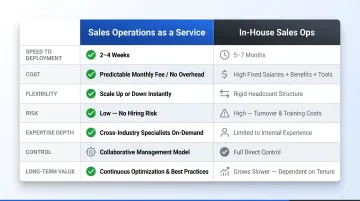
| Factor | Sales Operations as a Service | In-House Sales Ops |
|---|---|---|
| Speed to deployment | 2-4 weeks onboarding | 5-7 months (recruiting + ramp) |
| Cost | $5K-$15K/month ($60K-$180K/year) | $235K-$404K/year total comp |
| Flexibility | Scale up/down as needed | Fixed cost regardless of utilization |
| Risk | Low switching cost, weeks to change | $97K-$610K replacement cost |
| Expertise depth | Access to multiple client learnings | Deep product/company knowledge |
| Control | Requires strong vendor relationship | Direct management oversight |
| Long-term value | Best as bridge to full-time hire | Builds institutional knowledge |
The "Bridge" Use Case
Most startups bring in SOaaS to bridge the gap between zero formal ops and a full-time hire. The fractional engagement builds the systems, processes, and reporting infrastructure that a future internal hire can inherit from day one.
Director/VP roles take 60-90 days to fill, with top candidates off the market within 10 days. By the time you've recruited and fully ramped a full-time ops hire — 5-7 months total — a SOaaS provider has already delivered nearly half a year of operational improvements.
The Hybrid Model
Not every company follows the bridge-then-hire path. Some run both in parallel: a lean internal team handles strategic direction while the SOaaS provider owns execution and tooling management. This keeps costs down while giving internal stakeholders meaningful oversight — without requiring a full headcount expansion.
Best Practices for Implementing Sales Operations as a Service
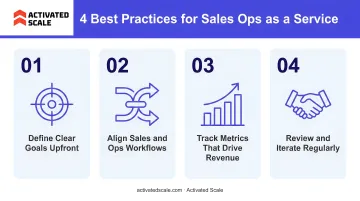
Getting the most from a SOaaS engagement comes down to how you set it up. These four practices separate companies that see measurable results from those that spin their wheels.
Define Success Metrics Before the Engagement Begins
Before onboarding a SOaaS provider, identify specific outcomes you need:
- CRM cleanup and data accuracy improvement
- Forecast accuracy targets (e.g., within 10% variance)
- Sales cycle time reduction
- Rep ramp speed acceleration
- Pipeline visibility and reporting cadence
Both parties should align on what success looks like and how it will be measured. Without clear metrics, it's impossible to assess whether the engagement is delivering value.
Treat the Provider as a Strategic Partner, Not a Vendor
Companies get the most value when they give the SOaaS team full visibility into the business:
- Access to CRM and all sales data
- Participation in leadership and sales team meetings
- Input into go-to-market planning and strategy discussions
- Transparency about challenges, failures, and constraints
The more context they have, the more strategic their recommendations. Limiting them to tactical tasks wastes their expertise.
Establish Clear Ownership and Communication Rhythms
Unclear ownership is one of the fastest ways to stall an engagement. Before work begins, nail down the structural basics:
- Designate an internal point of contact for the SOaaS provider
- Set regular review cadences (weekly syncs, monthly performance reviews)
- Define decision rights — who owns which decisions
- Create escalation paths for urgent issues
This structure also enables faster deployment. Activated Scale places vetted fractional sales operations professionals directly within client teams, so the handoff is clean and momentum builds from day one.
Prioritize Process Documentation and Knowledge Transfer
Documentation is your insurance policy. If the engagement ends or your team transitions in-house, you need to own the infrastructure — not just the outcomes:
- CRM configuration guides and data dictionaries
- Sales process playbooks and stage definitions
- Reporting templates and dashboard documentation
- Technology integrations and tool guides
Well-documented systems protect against provider dependency and cut onboarding time significantly when new hires join the team.
Frequently Asked Questions
What does sales as a service mean?
Sales as a Service is a model where a company outsources its sales functions—talent, processes, and technology—to a third-party provider. The term typically covers outsourced sales execution (SDRs, AEs running outreach and closing deals), while Sales Operations as a Service focuses specifically on the operational infrastructure supporting those reps.
What are examples of sales operations?
Sales operations covers CRM management, forecasting, quota setting, territory planning, pipeline reporting, and compensation design, among other functions. A Sales Operations as a Service provider handles all of this on your behalf—no full-time internal headcount required.
What is the 70/30 rule in sales?
The 70/30 rule refers to Salesforce research findings showing that sales reps spend only about 30% of their time actually selling, with the remaining 70% consumed by administrative tasks, data entry, research, meetings, and scheduling. Strong sales ops exist precisely to reclaim that lost time and keep reps focused on revenue-generating work.
What is the difference between sales operations and sales enablement?
Sales operations is the structural backbone—processes, tools, data, forecasting, and reporting. Sales enablement equips reps with the content and training to have effective buyer conversations. The two are complementary: ops builds the system; enablement teaches people to use it.
When should a startup invest in sales operations support?
Startups typically benefit from sales ops support once they have at least one or two sales reps and a defined sales motion. Key triggers include inconsistent forecasting, reps spending excessive time on administrative work, or preparing to hire and scale the sales team. Jason Lemkin recommends hiring sales ops at 5 reps minimum, no later than 8 reps.
How is Sales Operations as a Service typically priced?
Most providers offer monthly retainers ($5,000–$15,000/month for fractional VP-level support), project-based fees for specific deliverables such as CRM buildout, or hourly fractional arrangements. For context, a full-time VP of Sales Operations runs $235,000–$404,000 annually—making the fractional model a significant cost advantage.