
Introduction
B2B SaaS founders face a common dilemma: outsourced sales sounds appealing until you receive proposals with three wildly different pricing structures — retainer, commission, and per-lead — and no clear guidance on which one actually fits your stage. Many founders struggle to decode whether they should pay $5,000 monthly regardless of results, hand over 20% of every deal, or pay $400 per booked meeting. Each model comes with vendor promises, but the real incentive structures and risk distributions differ significantly.
The wrong pricing model misaligns incentives, drains limited runway without generating pipeline, or locks an early-stage startup into commitments it can't sustain. According to research on outsourced SDR programs, only 7% of companies report their outsourced sales engagement "actually worked" — 93% see underwhelming results or outright failure, often tied directly to poor model selection.
This guide breaks down how each pricing structure works, where each one fits (and where it fails), and which model makes sense for your stage and sales motion.
Key Takeaways
- Retainer: Fixed monthly fee ($2,500–$15,000+) for ongoing sales activity — best when you have product-market fit, a defined ICP, and need consistent pipeline building
- Commission: Pay 10-25% of closed revenue — strong incentive alignment, but struggles with unproven products and long sales cycles
- Per-Lead: Pay $350–$700 per qualified appointment — low upfront risk but quality varies and volume doesn't guarantee revenue
- Hybrid models (base retainer + performance bonuses) often deliver the best balance — risk shared between both parties
Retainer vs. Commission vs. Per-Lead: Quick Comparison
| Factor | Retainer | Commission | Per-Lead |
|---|---|---|---|
| Cost Structure | Fixed monthly fee ($2,500-$15,000+) | Percentage of closed deals (10-25%) | Pay per delivered meeting ($350-$700) |
| Risk Distribution | Buyer bears execution risk | Provider bears market risk | Shared risk, weighted toward quality |
| Best-Fit Stage | Post-PMF with defined ICP | Established brand with proven demand | Early-stage testing or validating ICP |
| Lead Quality Focus | High — provider incentivized to build relationships | Variable — depends on deal velocity needs | Medium — volume incentives can dilute quality |
| Budget Predictability | Very high — fixed monthly spend | Low — fluctuates with closed revenue | Medium — scales with meeting volume |
| Sales Cycle Suitability | Long cycles (60+ days) | Short cycles (under 90 days) | Any length, but best for shorter cycles |
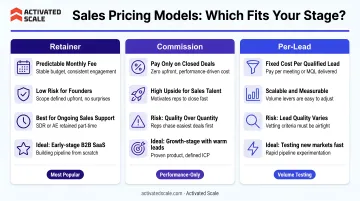
Retainers put execution risk on the buyer — you pay regardless of outcomes. Commission models shift it entirely to the provider — they earn nothing until deals close. Per-lead sits in between: you only pay when a booked meeting actually lands in your pipeline.
Typical monthly retainers range from $2,500 to $15,000+ . Commission rates for outsourced B2B sales typically fall between 15-25% for commission-only structures, or 5-10% when paired with a retainer. Per-appointment costs average $350-$700, with enterprise targeting pushing toward $600-$900 per meeting.
The Retainer Model: Pay for Presence, Not Just Performance
A retainer model means paying a fixed monthly fee to an outsourced sales partner in exchange for a defined scope of sales activities — outreach, discovery calls, pipeline building, follow-ups — regardless of how many deals actually close. The provider commits time and resources; you commit budget.
The core benefit is budget predictability and the ability to build a deeper, strategy-aligned relationship over time. Unlike transactional models, retainers give the sales partner time to learn your product, refine messaging based on objections, and adjust ICP assumptions.
Businesses maintaining retainer partnerships for over six months see a 2.4x ROI improvement compared to short-term campaigns — precisely because the provider has time to develop expertise and optimize performance.
The primary risk for B2B SaaS startups is paying for activity without outcomes. Without strong KPI definitions and performance clauses, a retainer becomes "paying for busy work." To protect against this, structure your contract with:
- Minimum meeting targets — Benchmark data shows outsourced SDRs deliver 8-10 meetings per month on average, with high performers hitting 12-15
- Reporting cadence — Weekly conversion tracking and monthly ROI analysis
- 90-day performance checkpoints — Formal reviews to assess whether benchmarks are being met
- Exit clauses — Ability to terminate if performance falls below agreed thresholds
Without outcome-tied payment, some providers coast on activity metrics instead of driving results. Address this by building milestone-based reviews and performance bonuses into the retainer structure. For example, offer a $150-$400 bonus per qualified meeting that converts to an opportunity, or a percentage kicker when quarterly pipeline targets are exceeded.
When the Retainer Model Fits (and When It Doesn't)
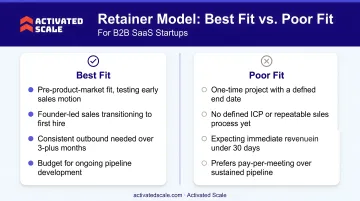
Best fit: Post-PMF startups with a defined ICP, a proven pitch, and sales cycles longer than 60 days. If your product requires relationship-building, multiple touchpoints, and educational nurturing, consistent outreach matters far more than volume spikes. A retainer becomes more cost-effective than pay-per-meeting once volume reaches 18-24+ meetings per month.
Deal size matters too. Outsourcing is difficult to justify for deals below $5,000, since the monthly retainer may exceed potential closed revenue during ramp periods.
Poor fit: Pre-PMF companies still validating their market, or those with very limited runway who can't sustain $3,000-$7,500 monthly for 3-4 months before seeing material results. Outsourced programs can start generating meetings within 30 days, but consistent pipeline and closed revenue typically require 90+ days of optimization.
The Commission Model: Pay Only When Deals Close
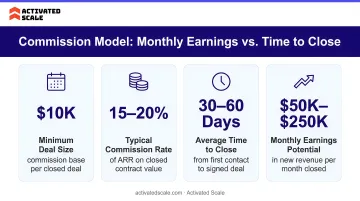
The commission model means the outsourced sales partner earns a percentage of each closed deal's value — with no base payment or activity fees. Variants include straight commission (10-25% of deal value) and hybrid structures (5-10% commission paired with a reduced retainer).
The incentive alignment upside is clear: both parties win only when revenue is generated. This theoretically creates maximum motivation for the provider to focus on quality leads, aggressive follow-up, and closing. Commission rates typically range from 15-25% for software and technology sales, scaling higher for complex enterprise solutions requiring extensive relationship-building.
For early-stage B2B SaaS startups, attracting quality sales talent on pure commission for an unproven product is extremely difficult. Experienced reps won't risk their pipeline and time on an unknown brand with no case studies or market traction.
Commission-only positions experience 40-60% higher turnover than salaried roles — a direct result of the financial instability that comes with unpredictable income.
Long sales cycles compound this problem. For B2B SaaS, cycles now average 134 days — and commission isn't paid until the customer pays, adding weeks of additional delay on top of an already lengthy process.
Most commission-only reps need full income replacement within 2-3 months or they leave the assignment, often without notice.
Commission-only reps rarely dedicate themselves to a single complex offering. They split time across multiple companies to survive financially, resulting in no time for quality relationship-building or proper CRM discipline.
When the Commission Model Fits (and When It Doesn't)
Commission works well when:
- Sales cycles are under 90 days and deal values exceed $25,000
- The company has strong brand recognition and existing case studies
- Commission acts as a performance bonus layered on top of a modest base retainer
Commission breaks down when:
- The startup lacks social proof or market traction
- Sales cycles exceed 120 days
- ACV is too low to produce meaningful per-deal income for the rep
A quick illustration: if your deals average $10,000 and take four months to close, a 20% commission ($2,000) spread over four months of work yields just $500 per month. That's well below what experienced sales professionals require to stay committed.
The Per-Lead Model: Paying for Pipeline Volume
The per-lead (or per-appointment) model means you pay a fixed fee for each qualified lead or booked meeting that meets pre-defined criteria — company size, job title, industry, expressed interest level. Two key terms to know here: a "lead delivered" is a contact who meets criteria and expressed interest, while an "appointment held" is a contact who actually showed up for the meeting. The latter is safer for buyers, since it confirms the lead was engaged enough to commit time.
The core appeal for startups is zero retainer, zero base: you only pay when there's a tangible deliverable in your pipeline. This makes it easy to test a provider, control spend, and scale up or down quickly based on results. Per-appointment costs average $350-$700, with enterprise targeting pushing toward $600-$900 per meeting.
The quality risk is significant: providers paid per lead have an inherent incentive to hit volume targets over quality thresholds. Appointments priced below $100 are often flagged as "quantity over quality" with shallow targeting. To mitigate this:
- Define tight qualification criteria upfront (company size, revenue band, job title, budget authority)
- Include lead rejection clauses allowing you to refuse meetings that don't meet standards
- Build feedback loops into the contract requiring the provider to adjust targeting based on your input
- Track AE-accepted rates — industry average is approximately 50%, meaning roughly half of delivered meetings may not meet quality standards
When the Per-Lead Model Fits (and When It Doesn't)
Best fit:
- Early-stage startups testing a new ICP or market segment
- Companies with short sales cycles where meeting volume directly translates to revenue
- Founders who want a risk-controlled way to validate their sales motion before committing to a larger engagement
- Teams with strong internal closers who need help filling the top of funnel
Poor fit:
- Enterprise B2B with complex, multi-stakeholder sales cycles — a "booked meeting" without relationship groundwork or stakeholder mapping rarely converts
- Deals involving 8+ decision-makers, where superficial lead generation falls well short of what's needed to move an opportunity forward
How to Choose the Right Sales-as-a-Service Pricing Model for Your B2B SaaS Startup
The decision hinges on four key variables:
1. Stage of product-market fit: Pre-PMF companies testing ICPs should use per-lead models to validate demand without fixed costs. Post-PMF companies with proven pitches and defined ICPs should use retainers for systematic pipeline building.
2. Average contract value and sales cycle length: Short cycles (under 90 days) with high deal values ($25,000+) favor commission models. Long cycles (120+ days) require retainer support since commission-only reps can't wait that long for income.
3. Available monthly budget: Startups with limited runway should start with per-lead to control spend. Those with $5,000+ monthly sales budget can justify retainers, especially when meeting volume needs exceed 18-24 per month.
4. Goal — validation or scaling: If you're validating whether a market segment is viable, per-lead minimizes risk. If you're systematically scaling revenue with a known playbook, retainers provide consistency.
Stage-Based Decision Guide
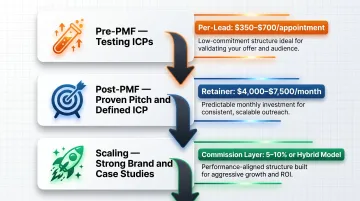
- Pre-PMF testing ICPs → Per-lead ($350-$700 per appointment)
- Post-PMF with proven pitch and defined ICP → Retainer ($4,000-$7,500/month)
- Scaling company with strong brand and case studies → Commission layer (5-10%) or hybrid model
The Hybrid Approach
Combining a modest retainer ($2,000-$4,000/month) with performance bonuses ($150-$400 per qualified meeting or 5-10% commission on closed deals) distributes risk fairly and solves the incentive gap. The provider has income stability to justify dedicating quality time to your account, while you gain downside protection through performance accountability.
If none of these models fit cleanly, a structural alternative may serve early-stage startups better than any agency arrangement.
Fractional Sales Talent as a Structural Alternative
Activated Scale connect startups with vetted sales professionals who have direct experience selling to similar buyers and deal sizes. This reduces ramp time, eliminates the "burnt leads" problem common with generic outsourced providers, and gives founders a realistic path to building an internal team.
Five Contract Must-Haves for Any Pricing Model
- Defined qualification criteria — Document exactly what constitutes a qualified lead or meeting
- Minimum performance benchmarks — Set clear targets (meetings per month, conversion rates, pipeline goals)
- Reporting frequency and format — Weekly activity tracking, monthly conversion analysis
- Clear exit clause — Ability to terminate if performance falls below agreed thresholds
- Revision rights — As your product evolves, your ICP and messaging will change — ensure the contract allows adjustments
Frequently Asked Questions
How to structure a retainer fee?
Structure a retainer around a defined scope: for example, 200 outreach contacts per month with a target of 10-15 meetings. Fees typically range from $2,500-$7,500 depending on target market complexity. Include minimum meeting thresholds to keep providers accountable.
What is a good cost per lead in marketing?
Cost per lead for B2B SaaS averages $237 across all channels, but this measures raw leads before qualification. Sales-qualified leads (SQLs) cost $200-$800 depending on targeting sophistication and vertical. Remember that cheaper leads often have lower conversion rates — a $150 lead with 5% close rate is more expensive than a $500 lead with 20% close rate.
What commission percentage is standard for outsourced B2B sales?
Commission rates for outsourced B2B sales typically range from 15-25% for commission-only structures, scaling higher for complex enterprise deals. In a hybrid model with a base retainer, commission drops to 5-10%. Exact rates depend on deal complexity, sales cycle length, and whether the provider handles full-cycle sales or lead generation only.
Which pricing model is best for an early-stage B2B SaaS startup with limited budget?
Per-lead or per-appointment models ($350-$700 per meeting) work well for early-stage startups since they keep fixed costs low before committing to a full retainer. Fractional sales hires ($3,000-$4,500/month for 20 hours/week) are another strong option, offering dedicated sales capacity without the overhead of a full agency engagement.
Can you combine multiple Sales-as-a-Service pricing models?
Yes. Hybrid models combining a base retainer ($2,000-$4,000/month) with per-meeting bonuses ($150-$400) or commission on closed deals (5-10%) are increasingly common. These structures balance stability with performance incentives, distributing risk fairly between buyer and provider.
What is the difference between per-lead and per-appointment pricing?
Per-lead means payment for a contact who meets defined criteria and expressed interest (such as a form fill or email reply). Per-appointment means payment only when a qualified meeting is actually held. Per-appointment is safer for buyers since it ensures the prospect was engaged enough to commit time.