Introduction
Picture the typical seed-stage founder in 2026: runway shrinking, sales cycle stretching to 84 days, and the pressure mounting to show traction before the Series A window closes. The instinctive response? Hire more salespeople.
Post the job, screen 40 candidates, spend 44 days filling the role, and wait another 5.3 months while your new AE ramps to productivity. By month seven, you've burned through $50,000 in lost revenue per seat — and discovered the uncomfortable truth: only 58% of AEs hit quota. Your new hire might not be one of them.
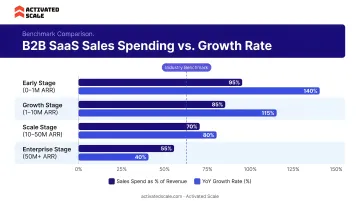
That hiring gamble plays out against a worsening backdrop. Median private B2B SaaS growth fell to 25%, down from 30% the prior year. Sales spending jumped to 13% of ARR (up from 10.5%), yet equity-backed companies spending 89% more on sales than bootstrapped peers achieve only 2 percentage points more growth. Adding headcount no longer produces proportional revenue.
Sales as a Service offers a structurally smarter alternative: faster time-to-revenue, lower risk, and outcomes you can measure before you commit. This article explains why it works — and when to make the switch.
Key Takeaways
- Sales as a Service replaces "hire and wait 6 months" with vetted, experienced sales talent deployed within 7 days
- Fractional sales professionals bring proven expertise from day one — no ramp time, no training overhead
- Traditional full-time hiring exposes startups to $254,000+ mis-hire costs, 7+ month ramp gaps, and 40% failure rates
- With clear targets and review cycles, Sales as a Service functions as a repeatable, scalable revenue system
What Is Sales as a Service
Sales as a Service is an outsourced or fractional sales execution model where companies access experienced sales professionals—typically on a contract or part-time basis—to build and run their sales motion without a full-time internal hire.
The scope is specific, covering:
- Prospecting and targeted outreach to qualified accounts
- Lead qualification and early-stage pipeline development
- Booked meetings and closed deals as measurable outcomes
This is execution, not advisory. You're not buying advice about how to sell; you're buying the selling itself.
Why It Matters More in 2026
B2B buyers have fundamentally changed how they purchase. Gartner research shows buyers spend only 17% of their journey meeting suppliers—and just 5-6% of that time with any single rep. Divided across multiple vendors, each rep gets minutes, not hours, to make an impression.
On top of that, buyers complete 57-70% of their research before contacting sales, arriving later in the funnel and better informed than ever.
This shift demands sales execution that's faster, more targeted, and more accountable than traditional headcount expansion allows. CAC is rising across most SaaS categories: enterprise CAC in fintech now reaches $14,774 per customer, making every interaction more expensive to generate.
Sales as a Service addresses this directly. Professionals deploy from day one—no 3-6 month ramp—and focus entirely on converting limited buyer attention into pipeline.
Key Advantages of Sales as a Service
Advantage 1: Speed to Revenue — Deploy Sales Capacity in Days, Not Quarters
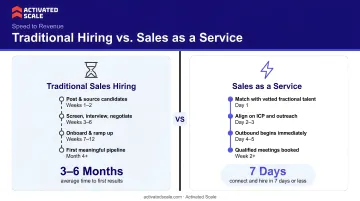
Traditional full-time sales hiring takes 41-44 days to recruit, plus 5.3 months of onboarding and ramp before an AE reliably generates pipeline. Sales as a Service eliminates most of that delay by plugging in professionals who are already trained, already experienced, and already familiar with B2B sales motions.
How this plays out operationally:
Fractional or outsourced sales professionals can begin prospecting, running outreach sequences, and booking qualified meetings within the first week of engagement. Activated Scale, for example, connects companies with fractional sales talent and can have professionals actively prospecting within days of engagement—sometimes same day. Compare this to the 3.2-month average ramp time for SDRs and 5.3 months for AEs, and the speed advantage becomes concrete.
Why this advantage matters:
For seed-to-Series A startups, time is a direct revenue variable. Every quarter spent hiring and ramping is a quarter without a productive pipeline.
Research shows each additional ramp month costs approximately $50,000 per rep in lost revenue (based on a $600,000 annual quota). Across a 5-7 month hiring-to-productivity gap, that's $250,000-$350,000 in opportunity cost per seat before a single deal closes.
The speed advantage creates decision-making leverage: when founders can test a sales motion and get real pipeline data within 30 days, they make smarter decisions about whether to scale, pivot messaging, or adjust ICP before committing to a permanent hire. That's 30 days of real market signal versus months of costly uncertainty.
KPIs impacted:
- Time-to-first-meeting
- Time-to-first-deal
- Pipeline velocity
- Cost per qualified opportunity
When this advantage matters most: Companies in the 6-18 month post-fundraise window, where runway is finite and investors expect demonstrated traction before the next round.
Advantage 2: Cost Efficiency and Risk Reduction — Pay for Performance, Not Overhead
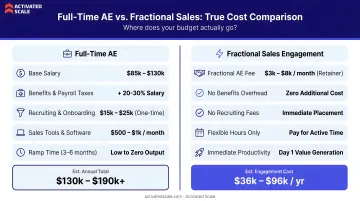
A full-time mid-market AE in a US B2B SaaS company carries significant fully-loaded annual costs:
- Median OTE: $190,000
- Benefits and tax load: +31% of base
- Fully-loaded cost: $249,000-$260,000 annually
This doesn't include sales tools (CRM, engagement platforms, data subscriptions), which add $5,000-$15,000 per seat annually, or recruiting fees, office space, and management overhead.
A fractional engagement operates differently. Companies like Activated Scale offer experienced sales professionals on a part-time or contract basis—often starting at $3,000-$5,000 per month depending on hours and scope—providing immediate cost flexibility without long-term financial commitment.
How the risk profile changes:
With a try-before-you-buy or contract-to-hire model, companies only escalate the relationship once the rep has demonstrated they can generate results in that specific environment. Activated Scale reports that 60% of customers hire their fractional sales talent as employees after an initial contract, demonstrating that the model functions as both a revenue-generation mechanism and a de-risked hiring pipeline.
Why this advantage matters:
Sales mis-hires hit early-stage companies especially hard. The average AE mis-hire rate in SaaS is 40%, and each mis-hire creates a $254,000 ARR gap compared to a good hire within 12 months. Over 24 months (including backfill search and re-ramping), total cost approaches $500,000.
Beyond direct cost, a wrong hire damages prospect relationships, misrepresents the product to prospects, and demoralizes the founding team.
Every dollar not spent on a non-performing full-time rep is a dollar that extends runway, funds product, or goes toward marketing. For a company with $1-3M ARR, this isn't optimization—it's survival math.
KPIs impacted:
- Sales cost as percentage of revenue
- Cash runway
- Cost per closed deal
- Mis-hire rate
- Time-to-quota
When this advantage matters most: Pre-product-market-fit phase and immediately post-raise, when every dollar must be deployed with measurable ROI.
Advantage 3: Immediate Access to Proven Sales Expertise
Sales as a Service gives early-stage companies access to professionals who have already sold in complex B2B environments—often coming from enterprise sales backgrounds at companies like Salesforce, Oracle, IBM, and Zendesk. This is experience that would take a first or second sales hire years to develop and that a startup often cannot attract or afford at the full-time level.
How cross-industry pattern recognition creates advantage:
Experienced fractional reps come with tested outreach frameworks, objection-handling playbooks, and qualification criteria that internal teams would have to build from scratch. New B2B sales hires typically take 3.5 months to develop consistent pipeline-generating habits, with productivity ramping from near-zero in month one to full capacity in month four.
Fractional professionals bypass this curve entirely.
Why this advantage matters:
For founders transitioning out of founder-led sales, the risk isn't just hiring slowly—it's hiring someone who doesn't know what "good" looks like in an early-stage B2B environment. Vetted fractional talent reduces this knowledge gap immediately. Windsor, an AI video personalization startup, saw their fractional hire increase average deal size 4X—from $0.85-$1 per video to $2-$2.50—because the rep understood enterprise sales motions and could articulate value at that level.
Experienced reps qualify harder and disqualify faster, shortening sales cycles and reducing deals that stall in late stages. Only 24.3% of salespeople exceed their yearly quota, and AE quota attainment averages just 58%. Proven, experienced fractional sellers outperform the statistical median of new hires because they've already learned what works.
KPIs impacted:
- Qualified meeting rate
- Pipeline-to-close ratio
- Average sales cycle length
- Win rate
- Deal size consistency
When this advantage matters most: When a company is defining its sales motion for the first time and cannot afford to learn through expensive trial-and-error with a full-time hire.
What Happens When Sales as a Service Is Missing or Ignored
Skip the sales motion — or default to traditional hiring too early — and early-stage B2B SaaS companies tend to hit the same wall, in the same order:
- Inconsistent pipeline: Months of silence, then a burst of meetings that don't convert — because there's no repeatable system behind the outreach. 86% of B2B purchases stall mid-process due to poor sales execution.
- A slow, expensive mis-hire: Companies spend 6-12 months paying full salary before realizing the rep isn't producing revenue. By then, the $254,000+ cost of a mis-hire has already started accumulating — and market relationships may be burned.
- Founder re-entrenchment: Failed sales hires pull founders back into selling, bottlenecking both product development and revenue growth. 29% of startups fail from running out of cash and 14% from poor sales execution — failures that compound each other.
- Scaling inconsistency, not results: Without a validated sales process, hiring more reps just multiplies the problem. 55% of mid-market companies regularly miss revenue targets due to execution gaps between product, marketing, and sales.
How to Get the Most Value from Sales as a Service
Sales as a Service works best when treated as a structured engagement, not a vague outsourcing arrangement. Here's how to maximize value:
Enter with structure:
- Defined ICP (company size, industry, buyer personas)
- Clear target outcome (10-15 qualified meetings per month, for example)
- Communication cadence for reviewing pipeline quality (weekly or bi-weekly pipeline reviews minimum)
Track what matters:
- Which outreach sequences generate responses
- What messaging resonates with which buyer segments
- How qualification criteria need adjustment based on real market feedback
Create a feedback loop: Review pipeline quality regularly and act on insights. Without this, even a strong outreach motion loses calibration over time.
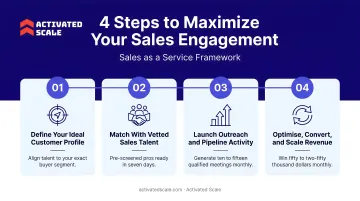
Treat it as a path to permanence: The most effective use of Sales as a Service for B2B SaaS startups is to treat it as a trial period for both the sales motion and the individual sales professional. Activated Scale's contract-to-hire model lets fractional reps who perform well convert to full-time employees, so founders can build a permanent team based on proven results rather than interviews alone.
Conclusion
In 2026, revenue scaling is less about how many salespeople you have and more about how quickly you can deploy a productive, accountable sales motion. Traditional hiring takes 7+ months from job posting to reliable pipeline generation, costs $250,000+ in fully-loaded compensation, and carries a 40% mis-hire rate. Sales as a Service delivers on speed, accountability, and control in ways that traditional hiring simply cannot — especially in the early stages.
Companies that build their first repeatable pipeline through Sales as a Service come away with more than near-term revenue. They leave with:
- Validated ICP and proven outreach messaging
- Process documentation a full internal team can inherit and execute
- The confidence that comes from knowing what works before committing to full-time headcount
That foundation is what makes scaling a sales team sustainable — not a gamble.
Frequently Asked Questions
What is the 3-3-3 rule in sales?
The 3-3-3 rule is a structured prospecting framework—typically referring to finding 3 key pieces of information about a prospect in 3 minutes before outreach. It balances personalization with efficiency, and it's the kind of repeatable process discipline that Sales as a Service models are built to sustain at scale.
What is the 3-3-2-2-2 rule of SaaS?
The 3-3-2-2-2 rule describes a SaaS revenue growth benchmark: triple revenue for two consecutive years, then double it for three more (3x, 3x, 2x, 2x, 2x). Hitting that trajectory requires a scalable sales motion early, which is where Sales as a Service helps teams build repeatable pipeline without the overhead of full-time hiring.
What is Sales as a Service and how does it differ from traditional outsourcing?
Sales as a Service provides dedicated, vetted sales professionals who operate as an extension of your team, executing outreach, qualifying leads, and booking meetings. Unlike a generic call center or lead gen vendor, the model holds professionals accountable to pipeline outcomes, not just activity volume.
How does Sales as a Service compare to hiring a full-time sales rep for a B2B SaaS startup?
Sales as a Service is faster to deploy (days vs. months), lower in upfront cost ($3,000-$5,000/month vs. $250,000+ fully-loaded annually), and carries less hiring risk. This makes it particularly suited to early-stage companies that need pipeline results before they have a validated sales process or the runway to absorb a mis-hire.
Is Sales as a Service a permanent solution or a stepping stone to building an internal team?
For most B2B SaaS startups, it functions as both: an immediate revenue engine and a tryout period for sales talent that can convert to full-time once they've proven results. Many companies use contract-to-hire models to de-risk the transition from fractional to permanent.
How quickly can a Sales as a Service engagement start generating qualified pipeline?
With a prepared ICP, clear messaging, and a vetted sales professional, qualified outreach can begin within the first week and initial meeting results typically appear within the first 30 days. That's far faster than the 3-6 month ramp typical of a new full-time hire.