
That gap between buyer urgency and startup readiness is the core problem with on-demand sales opportunities. They're time-sensitive, unpredictable, and structurally difficult to capture without the right motion in place. For early-stage B2B SaaS founders juggling product, fundraising, and operations simultaneously, that motion rarely exists when it needs to.
This article breaks down what on-demand sales opportunities actually are, how to recognize them before they expire, and how to build a response system that doesn't require a full sales team to work.
TLDR
- On-demand sales opportunities are time-sensitive buying moments triggered by a specific event in a prospect's world.
- The window to respond is short; urgency decays fast once a buyer's trigger fires.
- Most early-stage SaaS startups miss these moments due to capacity gaps, not a lack of market demand.
- Key signals include inbound intent behaviors, technographic shifts, hiring activity, and competitive displacement.
- Fractional sales talent lets startups act on these moments immediately, without the delay of a traditional full-time hire.
What Are On-Demand Sales Opportunities?
An on-demand sales opportunity is a moment when a specific internal or external trigger creates immediate buying intent. The buyer isn't passively interested — they're actively evaluating vendors and ready to engage. That distinction matters enormously for how you sell.
How They Differ From Pipeline Deals
Traditional pipeline opportunities are nurtured over weeks or months. You build awareness, stay top of mind, drip content, and wait for the prospect to warm up. On-demand opportunities don't work that way. They appear suddenly, compress the decision timeline, and close quickly — often within days or a single week.
Responsiveness becomes the primary competitive differentiator, not product quality or brand recognition. The startup that replies first with a credible answer wins, regardless of whether their product is technically superior.
The Trigger That Changes Everything
Buyers rarely act on a problem they've tolerated for years — until something changes. Common triggers include:
- A new VP of Sales arrives and audits the tech stack
- A fundraising round closes and unlocks budget
- A vendor sunsets a product
- A missed quarterly target forces a conversation the team had been avoiding
That shift from passive dissatisfaction to active urgency is what creates an on-demand opportunity. It exists independently in the market — no clever outbound sequence manufactures it. A salesperson's job is to be present and prepared when that trigger fires.
Why These Opportunities Are Disproportionately Valuable
According to the 6sense 2025 B2B Buyer Experience Report, B2B buyers delay contact with sellers until roughly two-thirds of their journey is complete — and initiate outreach themselves more than 80% of the time.
That means when a buyer contacts you, they're not early in their thinking. They're close to a decision. Missing that moment doesn't mean losing a lead — it often means losing a deal that was nearly yours.
The Most Common Types of On-Demand Sales Opportunities for B2B SaaS
Not all on-demand opportunities look the same. They fall into four recognizable categories that a prepared sales team can watch for systematically.
Trigger-Based Opportunities
These are events in a prospect's world that signal urgency:
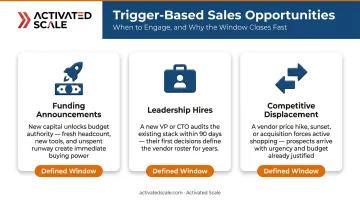
- Funding announcements — new capital typically means new budget authority and a mandate to build
- Leadership hires — a new VP of Sales or CTO almost always audits existing tools within their first 90 days
- Competitive displacement — when a prospect's current vendor raises prices sharply, sunsets a feature, or gets acquired, they're actively shopping
Each of these creates a defined window. The prospect isn't just open to conversation — they're motivated to close one.
Inbound Intent Opportunities
When a prospect visits your pricing page multiple times, starts a free trial, or sends a direct inquiry, they've self-identified as ready. Delayed follow-up is the single biggest cause of losing this type of opportunity. Pitch quality, pricing, and competitors rarely matter if you don't respond fast enough.
G2's 2025 Buyer Behavior Report found that software review sites influenced vendor shortlists for 56% of enterprise buyers in the 1,000–5,000 employee range. A prospect checking your G2 profile alongside a competitor's is a buying signal, not a browsing one.
Referral and Network-Driven Opportunities
A warm introduction from a mutual connection or an existing customer compresses the trust-building phase considerably. The buyer arrives pre-qualified with a shorter timeline than any cold prospect. These opportunities close faster than almost any other type. Treat them accordingly — not as standard nurture candidates, but as deals already in motion.
Expansion and Upsell Windows
Internal on-demand opportunities are often overlooked because the focus is on net-new logos. Existing customers approaching contract renewal, hitting usage limits, or expanding teams create a time-bounded window that's easier to close than any new-logo deal.
ChartMogul's 2023 SaaS Growth Report found that 36% of revenue added by SaaS companies at $15M–$30M ARR came from expansion. For many companies in that range, expansion isn't a supplementary channel. It's where most of the growth actually comes from.
Signals That Tell You a Sales Opportunity Is Ready Right Now
Most startups chase pipeline volume. The ones that close faster are reading behavioral cues that separate a "someday" lead from a "this week" buyer.
Technographic and Firmographic Signals
- A prospect appears on G2 or Capterra evaluating alternatives in your category
- A new role is posted that your product directly supports (a "Head of Revenue Operations" job listing from a company without a CRM integration is a real signal)
- A job description includes specific process gaps your product solves
Job postings, in particular, are meaningful indicators of intent. Research from the Philadelphia Fed analyzing 5.2 million job ads confirms that hiring activity can reveal a firm's intent to pursue more technology-advanced work. They're not a standalone trigger, but in combination with other signals, they're meaningful.
Behavioral Engagement Signals
- A prospect re-engages after going cold — opens three emails in two days, revisits your site
- Asks pricing and integration questions during or after a demo
- Forwards your email to a colleague (visible in some CRM and email tools)
These micro-signals require a system tuned to notice them, not just log them. A rep checking CRM activity manually once a week misses most of them.
The Urgency Decay Problem
On-demand opportunities have a short half-life. The longer a startup waits to respond to a high-intent signal, the more likely the prospect is to move on — self-select out, go with a competitor, or simply de-prioritize the purchase.
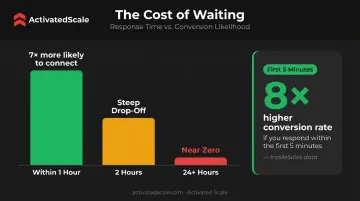
Research from HBR found that companies responding to inbound leads within one hour were nearly 7x more likely to have a meaningful conversation than those waiting two hours — and more than 60x more likely than those waiting 24 hours or longer.
A separate InsideSales study covering 5.7 million inbound leads found conversion rates were 8x greater in the first five minutes after a lead came in.
Same-day response is the floor. Every hour of delay narrows your window to act on a signal that may not repeat.
Building a Simple Signal-Monitoring System
You don't need a full revenue operations stack. A basic system includes:
- CRM alerts for pricing page visits, email opens, and form fills
- LinkedIn notifications for target account hiring announcements and leadership changes
- Intent data tools (even lightweight ones like HubSpot's intent signals) for review site activity
- Weekly rep check-ins to surface anecdotal signals that don't show up in data
The goal isn't perfect coverage. It's making sure no high-intent signal sits unnoticed for more than a few hours.
Why Early-Stage Startups Struggle to Capture On-Demand Opportunities
The Capacity Problem
Most early-stage B2B SaaS companies run on founder-led sales. The person responsible for responding to on-demand signals is also shipping product, meeting investors, and handling customer support. Fast, focused follow-up on a high-intent lead is structurally impossible when the same person is pulled in four directions simultaneously.
This isn't a motivation problem. It's a capacity problem, and working harder doesn't fix it.
The Readiness Gap
Capturing an on-demand opportunity requires a defined sales motion. Most pre-sales-hire startups haven't formalized any of this:
- A discovery framework to qualify the conversation
- A demo flow that maps to the buyer's use case
- A pricing conversation that holds value
- An objection-handling process that keeps deals moving
When a buyer is ready to move and none of this exists, the startup fumbles the response — not from lack of interest, but from lack of preparation.
A prospect who asks "can you show me how this integrates with Salesforce?" and gets a vague, unprepared answer doesn't move forward. They move on.
The False Economy of Waiting
Many founders delay building sales capacity until demand is "proven." The problem: on-demand opportunities are themselves the proof. Missing them creates a distorted picture of market interest. The feedback loop that accelerates product-market fit — what language resonates, what objections come up, what use cases close — only happens when you're actually in the conversations.
Every missed conversation is a data point that never enters the loop. Founders who wait for proof delay the very conversations that would provide it.
How to Build a Sales Response System for On-Demand Opportunities
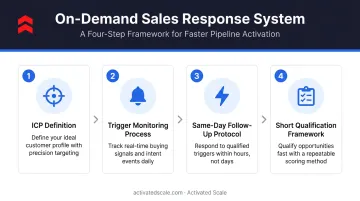
A functional on-demand response system doesn't need to be complex. It needs four components working together:
- A clear ICP definition — who you're watching for and why. Without this, signal monitoring produces noise, not leads.
- A trigger-monitoring process — the CRM alerts, LinkedIn tracking, and intent signals described above.
- A same-day follow-up protocol — high-intent signals get a response the day they appear, not queued into the next week's outreach.
- A short qualification framework — two or three discovery questions that quickly assess fit, so time isn't spent on poor-fit buyers who happened to fill out a form.
What to Put in a One-Page Sales Playbook
Even a single-page sales playbook improves the speed and quality of response when an on-demand opportunity appears. It doesn't need to be elaborate — the essential elements are:
- Common objections and responses specific to your product
- Key discovery questions that surface the prospect's core struggle
- Proof points tied to specific buyer pain (ideally backed by a customer example)
CSO Insights research across 918 organizations found that companies with formal sales process documentation had forecast-deal win rates of 55.1% versus a 46.4% study average — an 8+ point advantage from having a defined approach rather than winging it.
Speed-to-Value as a Closing Tool
On-demand opportunities often convert on the strength of the first interaction — unlike long-cycle enterprise deals where follow-up sequences do the heavy lifting. The rep who can connect a prospect's stated struggle to a specific, credible outcome in that opening conversation wins the deal.
That means leading with a concrete example: "a company like yours used this to cut onboarding time by 40% — here's how." That single exchange outperforms any follow-up sequence you'll send afterward.
The Role of Fractional Sales Talent in Capturing On-Demand Opportunities
Why Traditional Hiring Fails Here
Hiring a full-time AE takes time most early-stage startups underestimate. LinkedIn general hiring data puts average time-to-hire at 41 days — and that's before ramp time. Bridge Group's 2024 SaaS AE benchmark report, covering 170+ B2B SaaS companies, puts median AE OTE at $190,000. On-demand opportunities don't wait 41 days, and not every startup is ready to absorb a $190K salary commitment.
The structural mismatch is real: traditional hiring is built for predictable, stable demand. On-demand selling requires speed and flexibility that traditional hiring can't provide.
A Faster Path to Execution
Fractional sales professionals solve the structural problem directly. They can be deployed quickly, already understand how to operate in startup environments, and bring a tested sales motion from day one — which means they're executing on opportunities within weeks, not months.
Activated Scale connects B2B SaaS startups with vetted, US-based fractional sales talent in seven days or less (sometimes under 48 hours). Key specifics worth knowing:
- Talent sourcing: Professionals with backgrounds at Salesforce, Oracle, Zendesk, IBM, UiPath, and similar companies, matched to your buyer persona and deal size
- Try-before-you-buy: Engagements start with an initial contract period, typically three months
- Conversion rate: About 65% of clients convert their fractional rep to full-time after seeing results
How the Founder-Rep Division Actually Works
Fractional talent handles execution: outreach, discovery, demos, follow-up, and pipeline management. The founder retains strategic oversight: product direction, pricing decisions, and relationship escalations. This division matters particularly for Seed to Series A companies that have identified demand signals but lack the bandwidth to act on them consistently.
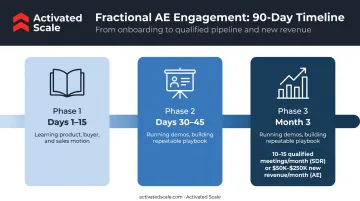
Here's how the timeline typically unfolds:
- Days 1–15: Onboarding — learning the product, the buyer, and the current sales motion
- Days 30–45: Fractional AE is running demos and documenting a repeatable sales playbook
- Month 3: Clients typically see 10–15 qualified meetings per month (SDR model) or $50,000–$250,000 in new revenue monthly (AE model), depending on deal size and sales cycle
The model is designed around that timeline, not despite it.
Frequently Asked Questions
What exactly is an on-demand sales opportunity?
An on-demand sales opportunity is a time-sensitive buying moment created by a specific trigger in a prospect's world — a funding event, leadership change, tool failure, or inbound signal. Unlike pipeline deals nurtured over months, these opportunities appear suddenly and close quickly, making speed of response the primary success factor.
How is on-demand selling different from traditional B2B sales?
Traditional B2B sales relies on patience, nurturing relationships through a structured pipeline over weeks or months. On-demand selling is different: the buyer's trigger fires without warning, the window is short, and whoever shows up prepared wins the deal.
What triggers an on-demand sales opportunity in B2B SaaS?
The most common triggers are funding announcements, leadership hires (especially VP of Sales or CTO), competitive displacement events, inbound intent signals (pricing page visits, trial signups, direct inquiries), and internal expansion needs at existing accounts.
How quickly should a startup respond to an on-demand sales signal?
Same-day response is the benchmark. HBR research found that responding within one hour makes a meaningful conversation nearly 7x more likely than waiting two hours — and over 60x more likely than waiting 24 hours. Speed-to-response is itself a competitive differentiator.
Can a startup without a full-time sales team capture on-demand opportunities?
Yes — with a defined sales playbook, a signal-monitoring system, and access to fractional sales talent, early-stage startups can respond to buying moments without completing a full-time hire first. The infrastructure matters more than the headcount.
What is the biggest mistake startups make with on-demand sales opportunities?
Slow response paired with an underprepared pitch. When a buyer is ready, the startup either misses the signal entirely or can't convert the conversation once it starts. The fix is straightforward: build your monitoring and your sales motion before the next opportunity surfaces, not after.