Introduction
Building a B2B company from scratch means managing product development, fundraising, team building, and revenue generation all at once — with finite resources and no margin for expensive mistakes. Hiring a full sales team before you're ready ranks among the costliest ones.
Many founders dismiss outsourcing sales as "giving up control." The actual risk runs the other direction: trying to build an in-house sales operation before you have the pipeline, the right playbook, the capital, or all three to support it.
According to Ebsta and Pavilion's 2024 B2B Sales Benchmark Report, 73% of sales reps missed quota in H2 2023, and just 17% of reps generated 81% of total revenue. Those are in-house teams at established companies. For an early-stage startup with no sales infrastructure, the odds are even harder.
What follows are the concrete, operational reasons outsourcing sales operations and strategy delivers measurable results — the kind that show up in pipeline and closed revenue, not slide decks.
TL;DR
- Outsourcing sales ops means handing execution and strategy to an external partner — no building from scratch
- Key advantages: lower cost vs. full-time hiring, faster pipeline, and immediate access to experienced talent
- Without structured sales ops: inconsistent pipeline, missed targets, and founders stuck doing execution work
- Treat outsourcing as a strategic move, not a temporary fix, to get the most from it
What Is Sales Operations Outsourcing?
Sales operations outsourcing means delegating the processes, strategy, and day-to-day execution that keep a sales function running — to an external partner rather than building it in-house. That typically includes:
- Prospecting and outreach
- Pipeline management and forecasting
- Performance tracking and reporting
It's most commonly used by seed-to-Series A companies that need revenue but aren't yet ready to build and manage a full sales department.
The real goal is to generate early revenue and build a repeatable playbook — one that gives you the foundation to hire full-time once you know what "good" looks like in your market.
Key Advantages of Outsourcing Sales Operations and Strategy
The advantages below are grounded in operational outcomes — cost, speed, expertise, and founder leverage. Each one is most relevant at the early stage, when resources are limited and growth expectations are high.
Advantage 1: Lower Cost With Direct Revenue Upside
Hiring in-house means absorbing costs well before the revenue arrives. Consider what a single full-time SDR actually costs:
- Base salary: Median SDR OTE is $85,000 according to RepVue
- Benefits load: BLS data shows benefits add roughly 29.9% on top of wages in private industry
- Tooling: Salesforce alone runs $25–$175/user/month
- Recruiting overhead: SHRM estimates total hiring cost at 3–4x the position's salary — meaning a $60,000 role can cost $180,000+ to fill when ramp time, management bandwidth, and missed opportunity are factored in
- Wrong hire risk: One bad SDR hire can cost over $35,000 in recruiting fees, lost demos, and deals that never close
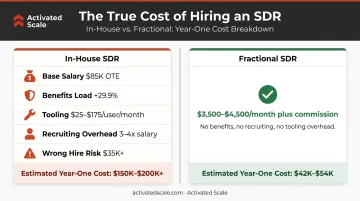
Fractional sales talent changes the math. Activated Scale's fractional SDRs start at $3,500–$4,500/month plus commission — no benefits, no recruiting fees, no long ramp cycle eating into your runway.
That shift from fixed headcount costs to variable, scope-tied costs matters enormously on a fixed fundraise. Every dollar not spent on premature hiring is capital preserved for product, marketing, or the full-time hires you'll eventually be ready to make.
KPIs most affected: Cost per qualified meeting, cost per acquisition, sales headcount as a percentage of revenue, cash runway.
When this matters most: Pre-revenue or early-revenue startups operating on a fixed fundraise with no established pipeline to justify full-time headcount.
Advantage 2: Immediate Access to Proven B2B Sales Expertise
Hiring someone great doesn't mean they're productive right away. The Bridge Group's 2024 SaaS AE Benchmark Report, based on 172 B2B SaaS companies, puts average AE ramp time at 5.7 months — nearly half a year of sub-capacity output.
Median annual AE turnover is also 30%, meaning there's a real chance your hire is gone before you've fully recouped the investment.
Outsourced and fractional sales professionals don't start at zero. They come with:
- Tested outbound sequences and messaging frameworks
- Established ICP targeting approaches
- Familiarity with the tools your stack likely already uses
- Experience running a full sales cycle independently
Activated Scale connects startups with fractional SDRs and AEs from companies like Salesforce, Oracle, Zendesk, Datadog, IBM, and Databricks — professionals who've sold into similar buyer profiles at similar deal sizes. Matching takes 7 days or less, sometimes under 48 hours, with approximately 2 weeks to ramp.
Set that against 5.7 months for a traditional AE hire. For startups under investor pressure to show traction before the next funding round, that timeline difference is a material risk — not a minor inconvenience.
KPIs most affected: Time-to-first-meeting, pipeline velocity, qualified meetings per month, ramp-to-productivity timeline.
When this matters most: When you need to demonstrate early sales traction or hit a milestone tied to your next raise, with no time for a traditional hiring and ramp cycle.
Advantage 3: Founders Can Focus on Strategy Instead of Sales Execution
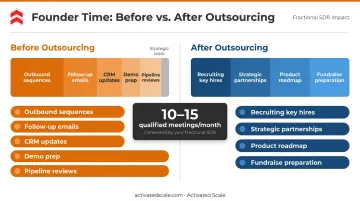
In most early-stage B2B startups, the founder is the sales team. That means hours every week spent on outbound sequences, follow-up emails, CRM updates, demo prep, and pipeline reviews — all valuable activities, but none of them the highest-leverage use of a founder's time.
The decisions that stall while a founder is stuck in execution mode are often the ones that determine whether the company scales:
- Recruiting the next key hire
- Advancing a strategic partnership
- Refining the product roadmap based on customer signals
- Preparing for the next fundraise
Each of those decisions compounds. Outsourcing creates a clean division of labor that frees them up: the external team handles prospecting, outreach, meeting booking, and pipeline management, while the founder maintains visibility through reporting, feedback, and strategic direction.
Activated Scale clients average 10–15 qualified meetings per month from their fractional SDRs, without the founder sourcing each one personally. That volume, sustained over months, is what separates founders who scale from founders who stay stuck in execution.
KPIs most affected: Founder hours reclaimed per week, pipeline coverage ratio, deals advanced without founder involvement.
When this matters most: The 6–18 months after initial product-market fit, when a founder must choose between continuing to sell personally or investing time in scaling the business infrastructure.
What Happens When Startups Skip Sales Operations Outsourcing
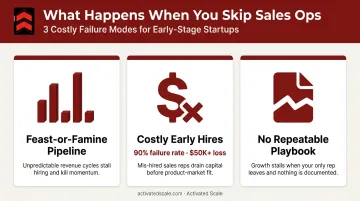
Companies that try to build full in-house sales too early — or rely on founders to sell indefinitely — tend to hit the same walls:
- Feast-or-famine pipeline: Without structured sales operations, lead generation becomes ad hoc — strong months alternate with dry spells and frantic catch-up activity.
- Costly early hires: SaaStr estimates external sales hires made before a founder has a proven playbook fail 90% of the time. A wrong AE hire can exceed $50,000 when recruiting fees, ramp time, and lost pipeline are factored in.
- No playbook to hand off: Delaying a replicable sales process makes it harder to onboard future in-house reps. There's nothing to train from and no baseline for what good performance looks like.
The quota data reinforces the pattern. The Ebsta/Pavilion 2024 report found that only 17% of reps were generating 81% of total revenue — a concentration problem that's even more pronounced at early-stage companies with small, undertrained sales teams.
How to Get the Most Value from Outsourced Sales Operations
Outsourcing works best under specific conditions. Getting those conditions right determines whether you see strong returns or a frustrating engagement.
Before the engagement starts:
- Define your ICP with enough specificity to brief the external team
- Align on messaging and core value proposition
- Clarify what "qualified meeting" means in your context
During the engagement:
- Review pipeline and performance data regularly — weekly is better than monthly
- Treat early outreach results as signal, not just output. What's resonating? What isn't?
- Stay involved in strategy even when execution is delegated
The data a fractional team generates is input that sharpens everything downstream. Which segments convert, how long the sales cycle actually runs, what objections surface repeatedly — this intelligence makes future in-house hiring far more effective than hiring blind.
Activated Scale's try-before-you-buy model is built around this principle. Companies engage fractional talent on an initial contract (typically 3 months), test fit and performance against defined KPIs, and convert top performers to full-time employees if the results justify it.
65% of clients make that conversion. The fee is 18% of base salary — a fraction of what a mis-hire costs when you skip the validation step entirely. By that point, you're not hiring into the unknown. You're hiring someone who has already performed inside your business.
Conclusion
Outsourcing sales operations isn't about giving up control. It's about getting a real revenue engine off the ground without the cost and risk of building one from scratch.
The advantages build on each other:
- Lower costs preserve runway while the outsourced team generates early pipeline
- Faster expertise access closes the gap between fundraise and first traction
- Founder focus frees up the strategic decisions — product, hiring, partnerships — that drive long-term growth
For B2B SaaS startups, outsourcing sales operations and strategy is a deliberate growth decision — not a stopgap. Treat it that way from day one, and it becomes one of the highest-leverage moves you can make before your first full-time sales hire.
Frequently Asked Questions
What is the difference between outsourcing sales operations and hiring a full-time sales team?
Outsourcing provides immediate access to experienced talent with no ramp time and lower fixed costs, while full-time hiring involves salary, benefits, a 3–6 month ramp period, and full recruiting overhead. The right choice depends on your stage and how much validated pipeline and process you already have.
When should a startup consider outsourcing its sales operations?
The clearest trigger points: the founder is spending too much time on sales execution, a funding milestone requires demonstrable traction, or the company needs to test a sales motion before committing to permanent headcount. Any one of these is a strong signal.
How much does it cost to outsource sales operations?
Outsourced SDR engagements typically run $2,000–$12,000/month depending on provider and scope. Activated Scale's fractional SDRs start at $3,500–$4,500/month plus commission. A fully loaded in-house SDR costs $85,000 OTE plus ~30% in benefits plus tooling — often $30,000–$50,000 more in the first year.
What are the risks of outsourcing sales operations?
The most common issues are misaligned partner culture, insufficient brand knowledge, and weak feedback loops. Mitigate these through structured onboarding, weekly performance reviews, and choosing partners who specialize in your specific buyer type and deal size rather than generalist agencies.
How do I know if an outsourced sales partner is performing well?
Track qualified meetings booked per month, pipeline value generated, stage-by-stage conversion rates, and whether the partner is hitting the benchmarks defined in the Statement of Work. These should be agreed before the engagement starts, not evaluated retroactively.
Can outsourced sales operations be transitioned to an in-house team later?
Yes — contract-to-hire and fractional models are specifically designed for this. Activated Scale clients evaluate talent during the outsourced engagement and can convert top performers to full-time employees at a conversion fee of 18% of base salary. 65% of clients take this route.