
Introduction
Building a sales development function from scratch is one of the more punishing problems at the seed-to-Series A stage. Hiring an SDR takes roughly 45 days just to fill the seat, then another three months before that person reaches full productivity.
You're often six months in before your first real pipeline appears — while runway is burning, fundraising timelines are tightening, and your ICP isn't fully validated yet.
The question most founders skip isn't whether to invest in sales development. It's how to stand it up without absorbing that six-month risk window.
Sales Development as a Service (SDaaS) cuts that window dramatically — giving you experienced pipeline-builders without the hiring lag, onboarding cost, or ramp risk. This article breaks down what SDaaS actually is, why its advantages extend well beyond cost savings, and what it takes to get measurable results from the model.
TL;DR
- SDaaS means outsourcing front-end pipeline generation — prospecting, qualification, and meeting-setting — to external fractional professionals rather than hiring full-time SDRs
- Cost efficiency: convert fixed headcount costs into a variable engagement you can start, pause, or scale without HR friction
- Speed matters: experienced SDaaS professionals begin outreach in days, skipping the standard three-month SDR ramp
- Flexibility is built in: scale capacity up or down as your ICP evolves or funding milestones shift
What Is Sales Development as a Service?
SDaaS is the delivery of sales development activities — prospecting, outreach, lead qualification, and meeting-setting — by an external team or fractional professionals who function as an extension of your sales org.
It covers a specific, bounded part of the revenue process: top-of-funnel activity. The external team owns "find and qualify" — not "demo and close."
That distinction matters. SDaaS isn't a full sales outsourcing play; it's the infrastructure that feeds qualified pipeline to whoever is closing: an AE, a co-founder, or a VP of Sales.
What SDaaS Professionals Actually Do
In a typical fractional SDR engagement, the scope includes:
- Cold outreach via email, LinkedIn, and phone
- Prospect list building and ICP targeting
- Lead qualification against defined criteria
- Meeting-setting and calendar handoffs to closers
- Outbound messaging iteration and A/B testing
What falls outside scope: product demos, contract negotiation, and deal closing. Those remain with your internal team.
The actual goal is a measurable, steady flow of sales-qualified meetings — the raw material your closers need to hit revenue targets.
Activated Scale, for example, connects startups with pre-vetted fractional SDR professionals who have sold to specific buyer personas (CIOs, VPs of HR, CMOs) in prior engagements — matching on ICP experience, not just resume credentials.
Key Advantages of Sales Development as a Service
The advantages below are grounded in operational and financial outcomes that founders and sales leaders can track directly: cost, time-to-pipeline, risk exposure, and revenue growth rate.
Advantage 1: Cost Efficiency and Lower Hiring Risk
SDaaS converts the high fixed cost of a full-time SDR hire into a variable, outcome-linked engagement. You pay for pipeline-generating activity rather than a salary-plus-benefits package regardless of output.
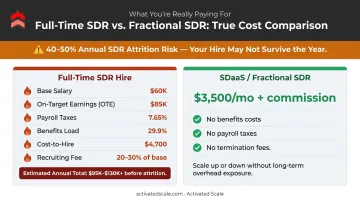
The true cost of a full-time SDR hire adds up quickly:
| Cost Component | Estimate |
|---|---|
| Median base salary | $60,000 (RepVue, 2026) |
| Median OTE | $85,000 (RepVue, 2026) |
| Employer payroll taxes | ~7.65% (Social Security + Medicare) |
| Benefits load | ~29.9% of compensation costs (BLS, Dec. 2025) |
| Average cost per hire | ~$4,700 (SHRM) |
| Recruiting agency fee | 20–30% of first-year base salary (if applicable) |
That's before factoring in manager time, tooling licenses, and the ramp period.
The attrition risk compounds the cost further. According to Bridge Group's 2024 SDR planning model, normal SDR attrition runs 40–50% annually. At 50% attrition, a 10-person team misses annual pipeline production by 11% — and improving ramp-period output for just five churning reps could save an estimated $750,000 in pipeline.
A bad SDR hire at the seed stage doesn't just cost money. It costs 4–6 months of pipeline momentum — directly delaying the revenue milestones that affect your next fundraise.
KPIs this advantage moves:
- Cost per qualified meeting
- Sales headcount cost as a percentage of revenue
- Time-to-first-pipeline from engagement start
Fractional SDR engagements at Activated Scale start at $3,500/month plus commission — no benefits, no payroll taxes, no termination fees. A three-month initial contract with defined KPIs lets you assess performance before committing to a longer engagement or converting to full-time.
Advantage 2: Faster Time to Qualified Pipeline
SDaaS providers bring pre-built prospecting experience, established outreach approaches, and professionals who have already run ICP discovery at other companies. That compresses the learning curve significantly.
An in-house SDR hire needs to:
- Learn your product and value proposition
- Build and qualify target lists
- Test and iterate on messaging
- Survive the ramp period before producing consistent output
An experienced fractional SDR applies proven outreach frameworks from day one. Bridge Group's 2024 benchmark puts average SDR ramp time at three months (plus or minus two weeks) — a figure that has held consistent since 2007. SDaaS engagements bypass that window almost entirely.
What faster pipeline means in practice:
Pipeline velocity — how quickly qualified opportunities enter the funnel — ties directly to revenue predictability.
For early-stage SaaS companies, every month of pipeline delay is also a month of lost learning about which customer segments actually convert.
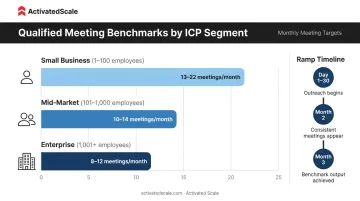
The documented timeline: fractional SDRs begin targeted outreach within the first 30 days, with consistent qualified meetings by month two. By month three, most clients reach 10–15 qualified meetings per month:
- Small businesses (1–100 employees): 13–22 meetings/month
- Mid-market (101–1,000 employees): 10–14 meetings/month
- Enterprise (1,001+ employees): 8–12 meetings/month
KPIs this advantage moves:
- Meetings booked per month
- Pipeline value generated in the first 90 days
- Lead-to-meeting conversion rate
Advantage 3: Scalability and Operational Flexibility
SDaaS lets companies increase or decrease sales development capacity in direct response to market conditions, campaign results, or funding milestones — without the legal, financial, and cultural complexity of hiring or laying off full-time employees.
The practical flexibility looks like this:
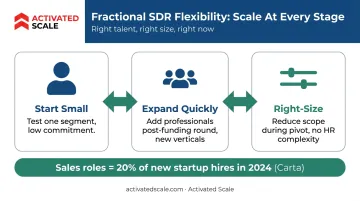
- Start small: one fractional SDR testing outbound in a single segment
- Expand quickly: add professionals focused on new verticals after a funding round
- Right-size without friction: reduce scope during a product pivot without HR complexity
This matters because sales development capacity needs at early-stage companies rarely stay constant. The ICP evolves. New segments open. Funding cycles shift available budget. Carta's 2025 data shows sales roles made up nearly 20% of all new startup hires in 2024, up from 14.8% in 2020 — which reflects how much pressure founders are under to staff up quickly, often before strategy is fully settled.
That's exactly the problem a month-to-month model solves. With Activated Scale, there's no minimum duration and no termination fees — clients can scale up, scale down, or request a professional swap without navigating a severance conversation.
KPIs this advantage moves:
- Outreach volume by segment
- Pipeline coverage ratio (SaaStr recommends 3–4x pipeline-to-revenue target as directional guidance)
- Cost of SDR capacity per active ICP segment
What Happens When Sales Development Is Missing
Without a dedicated sales development function, pipeline generation falls to founders or AEs — creating compounding problems across the entire revenue operation.
The founder problem: Top-of-funnel prospecting consumes significant founder time that should go toward product, fundraising, and customer success. When a founder is the only person doing outbound, outreach is inconsistent at best and stops entirely when other priorities spike.
The AE problem: When account executives self-source and close, they're doing two jobs. Qualification suffers. Cost-per-close rises. Win rates drop. AE burnout follows.
What this does to your pipeline: Without consistent outbound activity, pipeline becomes reactive — dependent on inbound interest that can't be controlled or predicted. The result is the classic feast-and-famine cycle: months of strong activity followed by dry spells that produce revenue gaps two quarters later.
Pavilion's 2022 State of Sales Development survey found that 73% of SDR teams were under 100% quota year-to-date — even in companies with dedicated sales development. The performance gap is wider when the function doesn't exist at all.
How to Get the Most Value from SDaaS
SDaaS works best when the internal groundwork is done before or alongside the engagement. The provider handles execution; you still need to own strategy.
Before starting an engagement, have these ready:
- A defined ICP with firmographic and behavioral criteria
- A clear value proposition your SDR can articulate in outreach
- CRM access and existing messaging for the SDR to audit
- A functional handoff process to whoever is running demos and closing
Operational disciplines that determine SDaaS ROI:
- Review meeting outcomes weekly — quality matters as much as volume. Tracking numbers without analyzing what happened in each call misses most of the signal.
- Iterate on messaging based on reply data. What's working gets scaled; what isn't gets cut.
- Treat the engagement as a system, not a vendor running independently in the background. Close feedback loops between the SDR and your internal team.
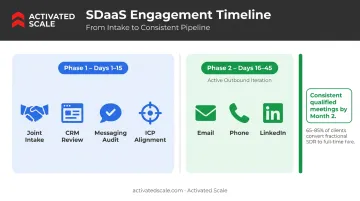
Activated Scale's onboarding is built around this model. The first 15 days cover a joint intake and process audit — CRM review, messaging audit, ICP alignment. Days 16–45 shift to active outbound iteration across email, phone, and LinkedIn, with the fractional SDR and client collaborating directly on what's performing.
Around 65–85% of Activated Scale clients hire their fractional SDR as a full-time employee after the initial contract. The conversion fee is structured to keep that path accessible — so if the fit is strong, going full-time doesn't require starting from scratch.
Conclusion
Sales Development as a Service gives early-stage B2B SaaS companies the pipeline-generating infrastructure they need without the cost, time, and risk of building that capability from scratch. Cost efficiency, faster time to qualified pipeline, and operational flexibility compound when the engagement is structured with a sharp ICP definition, consistent execution, and regular outcome reviews.
The companies that get the most from SDaaS treat it as a core part of their revenue process — not a short-term fix. They act on the meeting data it surfaces and scale the model as pipeline needs grow. Start with one fractional SDR, define your success metrics, and build from there.
Frequently Asked Questions
What is Sales Development as a Service (SDaaS)?
SDaaS is a model where companies outsource front-end pipeline generation — prospecting, qualification, and meeting-setting — to external fractional professionals rather than hiring and managing in-house SDRs. The external team creates qualified pipeline; internal closers handle demos and deals.
How is SDaaS different from hiring a full-time SDR?
SDaaS converts fixed headcount cost into a variable monthly engagement and brings professionals with pre-existing outreach experience — no ramp required. It's also faster to start: days rather than the months a full hiring cycle typically takes.
How quickly can an SDaaS engagement generate qualified meetings?
Timelines vary by provider and ICP complexity. Activated Scale's documented process shows initial outreach beginning within the first 30 days, with consistent meetings appearing by month two — compared to the three-to-six month timeline of a new in-house SDR hire reaching full productivity.
What metrics should I use to measure SDaaS performance?
Track these four KPIs:
- Qualified meetings booked per month
- Pipeline value generated
- Lead-to-meeting conversion rate
- Cost per qualified meeting
Review them with your provider weekly — not just at month end.
Is SDaaS right for early-stage startups?
Yes — SDaaS fits seed-to-Series A companies best. If you need pipeline quickly, haven't fully validated your ICP, or can't absorb the risk of a bad SDR hire, the variable cost model and quick start are built for exactly this stage.
What does SDaaS typically cost compared to a full-time SDR?
A full-time SDR costs roughly $85,000 OTE plus employer taxes (~7.65%), benefits (~29.9% of compensation), a ~$4,700 average cost-to-hire, and potential recruiting fees of 20–30% of base salary. Activated Scale's fractional SDR engagements start at $3,500/month plus commission — with no benefits, no payroll taxes, and no termination fees — making the cost comparison meaningful even before factoring in ramp time.