Introduction
You have a product, a small team, and revenue targets that feel aggressive on paper. But your pipeline is unpredictable — some weeks the calendar fills up, other weeks it's quiet. The meetings you do get aren't always with people who can actually buy.
This is the core challenge of B2B appointment setting at an early stage: random outreach doesn't scale, and more outreach volume alone doesn't fix the underlying problem.
Salesforce research shows sales reps already spend 60% of their time on non-selling tasks. For a founder or first sales hire juggling demos, closing, onboarding, and product feedback simultaneously, that number gets worse. Every unqualified meeting is expensive time that isn't being spent on deals that could actually close.
This article covers:
- What B2B appointment setting is and why it matters
- Why scaling it trips up most startups
- Four practical paths to scale without degrading quality
- How to build a repeatable system
- When to choose in-house SDRs versus fractional talent on limited runway
TL;DR: Key Takeaways
- Appointment setting qualifies leads and books meetings with decision-makers — distinct from general lead generation
- Scaling requires repeatable systems and clean ICP-aligned data, not just more outreach volume
- Four distinct paths to scale: add capacity, expand scope, lift yield, or partner with a specialist
- Fractional sales talent offers a faster, lower-risk alternative to building an in-house SDR team from scratch
- Track held meeting rate, call-to-appointment conversion, and revenue per appointment — not raw activity numbers
What B2B Appointment Setting Actually Is (and Why It Matters for Startups)
HubSpot defines the SDR role as identifying, qualifying, and nurturing potential customers before passing them to closing representatives. That's the clearest functional definition of appointment setting: it's the process of turning a list of names into confirmed, pre-qualified conversations with decision-makers who match your Ideal Customer Profile.
Lead generation fills the top of your funnel with names. Appointment setting applies a qualification filter — so only high-intent, authority-holding prospects make it onto your closer's calendar. That distinction matters more than most early-stage teams realize.
For early-stage B2B SaaS companies, founders and first sales hires are already stretched thin. Every meeting on the calendar should have a real chance of progressing — not burning time on someone with no budget, no authority, or no near-term need.
What Appointment Setting Actually Involves
It's not a single tactic. Effective appointment setting is a multi-channel outreach process that includes:
- Email — personalized sequences with clear value props
- LinkedIn — connection requests, direct messages, profile engagement
- Phone — cold calls and voicemail drops at strategic sequence points
- A documented qualification framework — specific criteria that define what counts as a "good meeting" before anything gets booked
Without that qualification framework, anyone can book a meeting. An unqualified calendar is worse than an empty one: it consumes your sales team's time without moving revenue forward.
Why Scaling Appointment Setting Is Harder Than It Looks
Most startups hit a wall when they try to scale outreach. The instinct is to treat it as a volume problem: more emails, more calls, bigger lists. The result is a flood of low-quality meetings that overwhelm closers, degrade pipeline accuracy, and slow revenue rather than grow it.
The real barriers are structural, not tactical.
Three Structural Barriers at Early-Stage Companies
No ICP or qualification standard. Without clear criteria, reps default to optimism — anyone who responds gets a meeting, and quality degrades silently.
Stale or unverified contact data. Research cited by ZoomInfo found that 94% of companies that increased data-quality investment saw sales and marketing performance improve, while 75% that decreased investment saw performance decline. Volume is meaningless on a bad list.
No repeatable process. When results hinge on individual rep judgment rather than a defined system, performance is unpredictable — and collapses when that rep leaves.
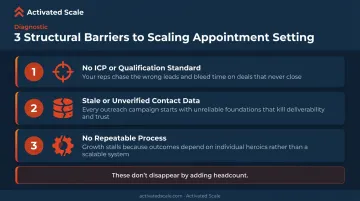
These barriers don't disappear by adding headcount. Addressing them is what makes additional volume worth running.
The Readiness Threshold
Before scaling outreach volume, confirm the current baseline is actually healthy. Look for these signals:
- Held meeting rate — are scheduled meetings actually happening?
- Quality pass rate at booking — do booked prospects meet your ICP criteria?
- Next step rate — what percentage of meetings end with a defined follow-on action?
- Revenue per held meeting — is this number stable or trending upward?
If these signals are weak, scaling volume amplifies the problem. Fix the system first.
The Four Paths to Scale B2B Appointment Setting Without Sacrificing Quality
There are four distinct ways to scale, and the right choice depends on where the actual bottleneck sits: capacity, market coverage, conversion efficiency, or speed-to-scale.
Path 1 — Add Capacity (Same ICP, Same Playbook)
Use this when your current segment is working and calendars are approaching capacity. The goal is to replicate what's proven (same scripts, same sequence structure, same qualification criteria) with 1-2 additional specialists.
A common structure is pods of 2-3 appointment setters paired with one closer. Winning by Design's pod model, designed to help SaaS teams scale toward $10M ARR, typically includes 2 SDRs supporting 1 AE. TOPO benchmark data shows a 1:2 SDR-to-AE ratio at companies under $50M revenue — useful math for staffing decisions.
Don't over-hire. One additional specialist running the same playbook is lower risk than two running different ones.
Path 2 — Expand Scope (One Adjacent Title or Industry)
Use this when you've saturated your best segment and need new pipeline surface area. The discipline is expanding one dimension at a time: either an adjacent title (Director → VP of the same function) or an adjacent industry, never both simultaneously.
Before committing, run a 1-2 week micro-test: small list, real outreach, measure held rate and decision-maker contact rate. If the numbers are comparable to your core segment, expand. If they're not, you've saved weeks of wasted effort.
Path 3 — Lift Yield (More Pipeline from the Same Team)
Use this when you want more pipeline without adding headcount or entering new markets. High-leverage tactics:
- Standardize the highest-performing meeting time slots
- Run one-element-at-a-time sequence experiments (subject line, first sentence, call timing) — not multiple changes simultaneously
- Coach the last 90 seconds of every meeting to secure a defined next step before the call ends
- Tighten list hygiene: remove bounces, re-verify top targets monthly
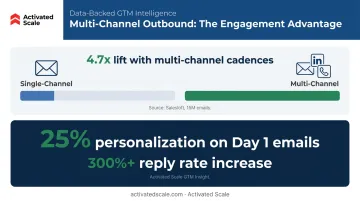
On sequences specifically: Salesloft's analysis of 15 million sales emails found that multi-channel outbound cadences lifted prospect engagement 4.7x compared to single-channel approaches, and that 25% personalization on Day 1 emails raised reply rates by over 300%. If you're only running single-channel sequences, either of those changes alone is worth testing this week.
Path 4 — Partner to Scale (Outsource the Front End)
Use this when you need qualified meetings now but aren't ready to hire and ramp an internal SDR team. In this model, the company retains ownership of ICP definition, qualification criteria, and messaging guardrails. The partner handles list building, outreach execution, and meeting booking.
For Seed-to-Series-A SaaS companies where speed-to-revenue matters most, this path removes the 3-6 month ramp risk entirely. Closers stay focused on closing. Platforms like Activated Scale connect B2B SaaS startups with vetted, US-based fractional SDRs, often within 7 days or less, so pipeline generation starts while the company evaluates whether to build a permanent team.
Building a Repeatable Appointment Setting System
Five components determine whether your appointment setting is a reliable revenue function or an unpredictable activity.
ICP and Qualification Criteria
The foundation is a written definition of the ideal prospect. That definition should specify:
- Company size and industry
- Decision-maker title and seniority
- Specific pain indicators that signal urgency
Pair this with a documented "good meeting" standard: criteria that must be confirmed before a meeting is booked. Without it, reps fill calendars with poor-fit prospects and pipeline data becomes unreliable for forecasting.
Multi-Channel Outreach Sequences
Effective sequences run 10-14 days and coordinate email, LinkedIn, and phone rather than relying on a single channel. Research consistently shows multi-channel outreach outperforms single-channel by a wide margin. Three to four channels works best for most outbound sequences.
Confirmation and Show-Rate Management
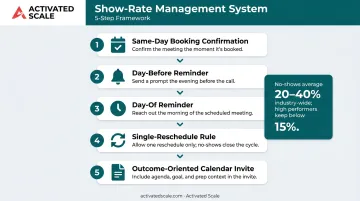
A booked meeting is not a held meeting. B2B SaaS demo no-show rates average 20-40% industry-wide, with high performers keeping them below 15% (RevenueHero, 2025). Calendly found that sales users who implemented automated reminders reduced no-shows by 28%.
A functional show-rate system includes:
- Same-day booking confirmation
- Day-before reminder
- Day-of reminder
- A single-reschedule rule — unresponsive contacts after one reschedule get recycled, not chased indefinitely
- A calendar invite with an outcome-oriented agenda (not just "discovery call")
Handoff and CRM Documentation
Every booked meeting should arrive in the CRM with standardized notes: prospect title and role, what triggered the response, any budget or timing signal surfaced, and the defined next step. This keeps closers informed going in and ensures pipeline data stays accurate for forecasting.
Feedback Loop and Continuous Optimization
Weekly debriefs between appointment setters and closers, reviewing which meetings converted and why, let teams refine messaging, tighten ICP criteria, and catch quality issues before they compound. Without this loop, problems accumulate silently — and the root cause is often weeks old by the time pipeline numbers show it.
In-House SDRs vs. Fractional Sales Talent: Choosing the Right Model
The In-House SDR Case (and Its Costs)
Building an in-house SDR function offers deep product knowledge and institutional memory. But the timeline and cost are significant:
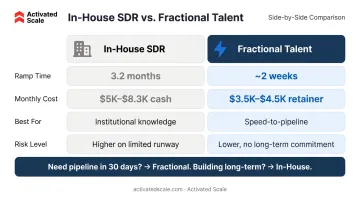
- Ramp time: TOPO benchmarks average SDR ramp at 3.2 months to full quota
- Tenure: TOPO reports average SDR tenure of 15.5 months; SaaStr puts it at 14 months, with 52% not lasting 12 months
- Compensation: RepVue reports a US SDR median base of $60K and median OTE of $85K (as of May 2026), with additional costs for benefits, tools, and management overhead
For a startup with limited runway, hiring a full-time SDR is a meaningful bet on an unproven rep who may be gone before they hit stride.
The Fractional Alternative
Fractional SDRs are experienced, pre-vetted sales professionals working on a part-time retainer. They bring established outbound skills without the ramp time or full-time overhead.
Through Activated Scale, fractional SDRs — with backgrounds at companies like Salesforce, Oracle, UiPath, and Crunchbase — typically reach productive output in roughly 2 weeks, compared to 3+ months for a full-time hire. Pricing runs $3,500–$4,500 per month plus commission, versus the equivalent of $5,000–$8,300/month in cash compensation alone for a full-time SDR (before benefits or recruiting fees).
Current Activated Scale clients average 10-15 qualified meetings per month, with output varying by target segment:
- Small business (1–100 employees): 13–22 meetings/month
- Mid-market (101–1,000 employees): 10–14 meetings/month
- Enterprise (1,000+ employees): 8–12 meetings/month
These numbers align with TOPO's output benchmarks adjusted for ACV.
The Hybrid Path
That meeting volume also gives companies enough signal to decide their next move. Many B2B SaaS companies start with fractional talent to build their outbound playbook and generate early revenue — then convert once the model is validated.
Activated Scale's try-before-you-hire structure includes a conversion path at 18% of base salary, which is below typical agency placement fees. About 65% of Activated Scale clients eventually convert their fractional SDR to a full-time hire.
Decision Framework
| Situation | Right Model |
|---|---|
| Need meetings within 30 days, can't wait for a hiring cycle | Fractional talent |
| Have 6+ months runway, want to build institutional sales knowledge | In-house SDR |
| Testing a new market segment without committing headcount | Fractional or outsourced partner |
| Want to validate the outbound model before full-time hiring | Fractional (try-before-you-hire) |
Metrics That Matter: Tracking Appointment Setting Performance
Activity metrics — emails sent, calls made — are inputs to monitor, not success measures. These six KPIs show whether your appointment setting program is producing results:
- Connect rate — percentage of outreach attempts that reach a decision-maker
- Call-to-appointment rate — percentage of conversations that convert to booked meetings
- Held meeting rate — ratio of attended meetings to scheduled ones (high performers: 85%+)
- Opportunity conversion rate — percentage of held meetings that progress to a sales opportunity
- Revenue per appointment — average deal value attributable to booked meetings
- Cost per appointment — total program spend divided by total held meetings
Dashboard and Review Cadence
A lightweight weekly dashboard — split by ICP segment or outreach channel — surfaces underperforming sequences before they waste significant time. Keep it to a focused set of metrics reviewed on a consistent cadence, not a sprawling report you check once a quarter.
Benchmark Context
For output volume, TOPO's benchmark shows outbound SDR monthly quotas ranging from 15 meetings at $0-$25K ACV down to 7 at $250K+ ACV. SaaStr puts a high-performing mid-market SDR at 15-20 qualified meetings per month. These ranges shift significantly by deal size, so avoid comparing your program against a single universal target.
Frequently Asked Questions
What does a B2B appointment setter do?
A B2B appointment setter identifies qualified prospects, handles objections and gatekeeper navigation, and schedules confirmed sales meetings between decision-makers and the closing sales team. The role exists specifically to protect closer time — keeping it focused on demos and deal progression rather than cold outreach.
What is the best strategy for scalable B2B appointment setting?
The best strategy combines a clearly defined ICP, a repeatable multi-channel outreach sequence, a documented qualification standard, and a consistent feedback loop between setters and closers. The right scaling path — capacity, scope, yield, or partnership — depends on where the current bottleneck actually is.
How many appointments should a B2B appointment setter book per month?
TOPO data shows 7-15 outbound qualified meetings per SDR per month, with lower ACV targets yielding higher volume. SaaStr puts a high-performing mid-market SDR at 15-20. Either way, quality — held rate and opportunity conversion — matters more than raw count.
Should a B2B SaaS startup build an in-house SDR team or outsource appointment setting?
Early-stage startups with limited runway typically benefit from outsourcing or fractional talent first. It validates the outbound model faster and avoids committing to full-time headcount before the approach is proven — especially given the 3-6 month ramp a new SDR requires.
What metrics should you track to measure appointment setting success?
Track held meeting rate, call-to-appointment conversion rate, opportunity conversion rate, and revenue per appointment. Activity volume — calls made, emails sent — reflects effort, not performance.
How quickly can a B2B startup scale appointment setting?
Building an in-house SDR team typically takes 3-6 months to ramp to full productivity. Fractional talent or outsourced partners can be operational in as little as one to two weeks, making them the faster path when pipeline is the priority.