
The catch is that landing one of these roles requires a different approach than applying to a Fortune 500 or an early-stage company still running on hope. Series B hiring managers are looking for builders, not passengers. They move quickly, they ask hard questions, and they can tell within a conversation whether a candidate has actually built pipeline from scratch or just worked a mature territory someone else cultivated.
This guide covers how to find and vet Series B sales opportunities, tailor your application, prepare for interviews, and negotiate a compensation package that reflects both your cash needs and the equity upside you're being asked to bet on.
Key Takeaways
- Series B startups have cleared product-market fit and are deploying capital to capture market share — sales roles carry real ownership and quota pressure
- Financial health vetting matters as much as polishing your resume
- Your interview must prove you can build pipeline and process, not just manage an existing book
- OTE and equity are both negotiable; evaluate them together, not separately
- A fractional or contract-to-hire engagement through Activated Scale lets you validate a company before committing full-time
What Series B Actually Means for Sales Professionals
The Shift That Happens at This Stage
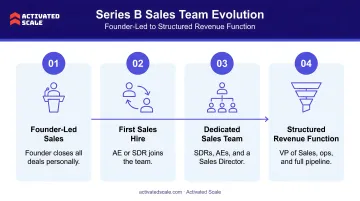
At Series A, sales is usually founder-led and experimental — the team is testing messaging, figuring out who actually buys, and closing deals through sheer force of founder relationships. Series B changes the question. The company has found what works and now needs to scale it.
That means building a repeatable sales motion: defined SDR and AE roles, a structured pipeline process, and quota-carrying headcount that didn't exist six months ago. Sales goes from a scrappy experiment to a core business function almost overnight.
For candidates, this creates a specific kind of opportunity. Roles are newly created. Internal promotion pipelines are short. The people hired in the first wave of Series B often become sales managers or VPs within 18-24 months as the team grows beneath them.
What the Role Actually Demands
Series B sales jobs are not enterprise sales jobs with a startup label. The differences are meaningful:
- Expect to write the playbook, not inherit one
- Own your own pipeline — inbound is thin and outbound is on you
- Handle the full cycle without an SDR handing you qualified meetings (unless you are the SDR)
- Navigate shifting ICP, pricing, and competitive positioning as the company learns
The candidates who thrive have a T-shaped profile: deep expertise in one area — outbound prospecting, enterprise closing, or sales ops — combined with the willingness to do whatever needs doing around it.
Honest Notes on Stability
Series B is more stable than Seed or Series A, but job security is still performance-dependent. According to Crunchbase, just over 1,600 of more than 4,400 U.S. startups that raised Series A in 2020-2021 had gone on to raise Series B by mid-2024 — roughly a one-in-three conversion rate. The companies that made it have cleared a significant filter.
That said, every sales hire is expected to move ARR. The ones who don't tend not to last long.
How to Find and Vet Series B Sales Opportunities
Where to Look
Generic job boards are inefficient for this search. Better channels:
- VC portfolio job boards — a16z's jobs board lists over 767 portfolio companies and 15,000+ open roles; filter by function and stage
- Y Combinator's sales jobs page — high-signal for venture-backed companies actively hiring revenue roles
- Wellfound (formerly AngelList) — filter specifically by funding stage and company size
- Crunchbase and TechCrunch — track funding announcements and go directly to the company careers page within weeks of the round
Timing matters here. Companies hire most aggressively in the weeks immediately after a round closes, when budgets are fresh and there's urgency to show investors the capital is being deployed.
Vetting Financial Health
A Series B label alone doesn't guarantee a healthy opportunity. Before applying, check:
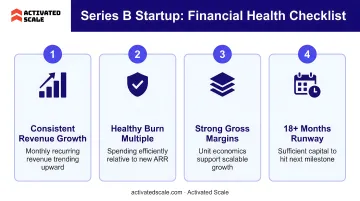
- Tier-1 VC backing (a16z, Sequoia, Bessemer, Lightspeed) signals the business survived rigorous diligence — lower-profile lead investors warrant more scrutiny
- A raise significantly below the $28M Series B median may signal an insider-led bridge round, not a true growth-stage event
- Runway of 24-36 months is the current standard; the old 18-24 month rule of thumb leaves too little margin
- Press coverage, case studies, and job postings contain enough signal to gauge whether ARR growth is real before you ever apply
As YC advises candidates directly: ask about runway, burn rate, and future funding plans before accepting any offer.
Vetting the Sales Infrastructure
Sales professionals need harder answers here than most candidates think to ask for:
- Is there a functioning CRM, or is the team still running deals through spreadsheets?
- Is there a defined ICP, or will the new hire be responsible for figuring out who to sell to?
- What does the current sales cycle look like — average length, win rate, deal size?
- What does quota attainment look like across the current team?
A company unwilling to answer those questions at the offer stage is a red flag, not just a negotiating tactic.
The Fractional Pathway
If you want to pressure-test a company before going full-time, a fractional engagement gives you that option. Activated Scale places experienced B2B sales professionals with funded startups on a 3-month contract-to-hire basis — defined goals, real quota, and a clear path to convert.
Around 65% of clients bring their fractional rep on full-time after the initial contract, and the conversion fee (18% of base salary) is structured to make that transition easy for both sides.
How to Tailor Your Sales Resume for a Series B Startup
Series B hiring managers are not reading CVs looking for polished corporate credentials. They're scanning for evidence that you've built something, owned outcomes, and can operate without a support system.
Lead With Numbers, Not Responsibilities
Every bullet point on your resume should answer the question: what did you actually produce?
- "Managed a territory" → "Built outbound pipeline from zero, closing $X ARR in the first two quarters"
- "Participated in enterprise sales cycles" → "Owned end-to-end deal process on 6-figure contracts, averaging 60-day cycle from first call to close"
- "Supported new market entry" → "Led expansion into mid-market segment, adding 14 new logos in 8 months"
Quota attainment percentage, pipeline generated, average deal size, ramp-to-first-close — these are the numbers that matter.
Translating Enterprise Experience
If you're coming from a large company, you need to do some translation work. Enterprise wins that required two quarters of committee approvals and four internal stakeholders are not the story to lead with.
Instead, surface moments where you:
- Operated without full sales support or a warm lead engine
- Launched a new vertical or product line from a standing start
- Built a repeatable sequence or process the team later adopted
- Closed deals you personally sourced, not ones handed to you
Point Nine Capital's framework for evaluating first AE hires emphasizes operational excellence and startup experience specifically : generating leads, managing full cycles, and helping build playbooks. Your resume should hit each of those points directly.
The Cover Note Still Works
Many Series B companies are small enough that the hiring manager reads every application. A short note referencing their recent funding round, a specific challenge in their GTM motion you noticed, or a question about how their sales team is structured will stand out — because it shows you did actual research.
Acing the Interview for a Series B Sales Role
What to Expect From the Process
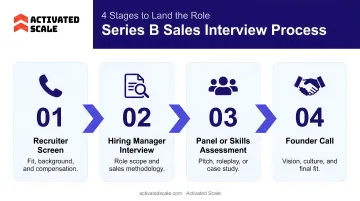
Series B sales interviews typically run 3-4 stages and move fast. A candidate who goes quiet for three days between rounds often loses the slot to someone who stayed engaged.
Typical structure:
- Recruiter or founder screen — fit, compensation alignment, availability
- Sales leader deep dive — pipeline approach, deal walkthroughs, process-building history
- Cross-functional or peer panel — cultural fit, cross-team communication style
- Founder close call — genuine belief in the product, long-term commitment signal
What the Sales Leader Is Actually Evaluating
The deep dive has one underlying question: can this person succeed here, with limited resources, in a market we're still figuring out? Past quota attainment is context — not the point.
They'll probe:
- How you build and qualify pipeline when there's no strong inbound engine
- Whether you've ever built a sales playbook or defined an ICP from scratch
- How you handled a deal that stalled, a prospect who went dark, or a competitive loss
Prepare specific examples that demonstrate building, not just executing.
Case Studies and Deal Reviews
Many Series B companies now include a practical exercise: you'll be given a mock prospect profile and asked to design an outreach sequence, a discovery framework, or a closing strategy.
Research the company's actual ICP before the interview. If their customers are mid-market fintech companies and your case study references a generic "enterprise software buyer," you've already lost ground. Tailor every answer to their real target customer — it signals you're already thinking like someone on the team.
Questions That Differentiate You
Most candidates ask about culture and growth trajectory. The ones who get offers ask questions that signal they're thinking like a revenue partner:
- "What does the sales motion look like today, and where is the biggest conversion drop-off?"
- "What does success look like for this role in the first 90 days — and what does failure look like?"
- "Is there a defined sales playbook, or will part of my role be building it?"
- "What percentage of pipeline currently comes from outbound versus inbound?"
These questions show you've already started thinking about the job, not just the offer.
Understanding and Negotiating Your Compensation Package
What the Package Looks Like
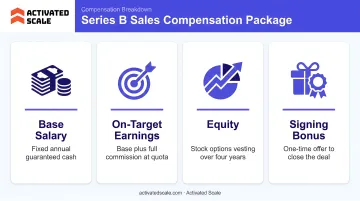
A typical Series B sales compensation package includes:
| Component | What to Expect |
|---|---|
| Base salary | Roughly half of OTE; slightly below enterprise rates |
| OTE | Illustrative range for SaaS AEs: $200K–$250K (OpenView 2023) |
| Base-to-variable split | 50/50 is most common; 60/40 base-heavy is also standard |
| Equity | Stock options, 4-year vest, 1-year cliff |
| Signing bonus | Negotiable, especially if leaving unvested equity elsewhere |
OTE figures vary significantly by market, seniority, and company ARR stage. Treat $200K–$250K as a SaaS benchmark, not a floor, and validate it against the quota you'll be expected to carry. According to KeyBanc and Sapphire's 2024 SaaS survey, median AE quota sits around $750K, with median AE productivity at $333K. Ask how those numbers compare to the role you're considering.
Evaluating Equity Realistically
Equity at Series B can range from meaningful to negligible depending on factors the raw share count won't reveal. Ask for:
- Total shares offered
- Fully diluted shares outstanding (if a company won't disclose this at offer stage, that's a signal)
- The most recent 409A valuation, which sets your strike price
- Any anti-dilution provisions
As Wealthfront's equity guide notes, the real metric is percentage ownership, not raw share count. A smaller grant at a lower strike price and stronger fundamentals may be worth more than a larger grant at an inflated valuation heading into a down round.
Negotiation Tactics That Actually Work
- Bring a competing offer from another funded startup. This is your most effective leverage. Startups routinely decline to match FAANG offers but will respond to competition from peers.
- Negotiate the ramp period. If you're leaving a stable enterprise role, ask for a guaranteed draw or protected first-quarter incentives while you build pipeline.
- Connect your ask to long-term value, not just what you need today. Frame it around what you'll contribute over the full vesting period.
- Push on equity when cash falls short. Many startups have salary-for-equity exchange policies. If base is below your floor, ask whether there's a mechanism to trade cash for additional options.
Frequently Asked Questions
What sales roles are typically available at a Series B startup?
The most common roles are SDR, Account Executive, and Sales Manager, with occasional VP or Head of Sales openings. Teams are small, so roles carry broader responsibility than equivalent titles at larger companies — an AE may handle some SDR work, and a Sales Manager may still carry quota.
How does sales compensation at a Series B startup differ from a large tech company?
Base salaries typically run below enterprise rates, but OTE and equity upside can exceed them if the company grows. Evaluate total compensation over 4 years — base, variable, and equity at a realistic exit — not base salary alone.
What should I look for when evaluating a Series B startup's sales team before joining?
Three signals matter most: whether the sales leader has scaled a team from $5M to $30M+ ARR before, whether a CRM and defined ICP are already in place, and what quota attainment looks like across the team. Low attainment can signal unrealistic targets, GTM problems, or both.
Is a fractional or contract-to-hire sales role a good way to get into a Series B startup?
Yes — it's one of the best ways to validate company health before committing full-time. Activated Scale connects experienced sales professionals with funded startups on a contract basis, with a clear pathway to full-time employment if both sides want to continue.
What interview questions should I expect for a sales role at a Series B startup?
Expect questions on pipeline-building methodology, deal walkthroughs (especially complex or stalled deals), and whether you've built a sales playbook or defined an ICP. Interviewers are specifically testing whether you can operate without enterprise-level support infrastructure — prepare examples that prove you can.
How much equity should I expect as a sales professional at a Series B startup?
Grants vary widely. Index Ventures documents VP-level Series B equity in the 0.2%–0.7% range; AE and SDR grants sit well below that. Focus on strike price relative to current valuation, your percentage of fully diluted ownership, and exit trajectory — not the raw share count.