
Introduction
For most startup founders, the SDR search follows a familiar pattern: post a job, get flooded with unqualified applications, burn through two weeks of interviews, and end up with a rep who churns in six months. The process doesn't fail at the offer stage — it fails at the source.
The sourcing channel matters more than most hiring guides acknowledge. Different platforms attract completely different talent profiles, carry different cost structures, and require different amounts of internal bandwidth to manage.
That sourcing decision compounds fast. According to The Bridge Group's 2023 SDR Metrics Report, median annual SDR turnover sits at 50%, with average tenure of just 1.4 years. A bad hire doesn't just cost you salary — it costs you ramp time, lost pipeline, and the months you'll spend starting over.
Here's how to find SDRs worth hiring — and avoid the channels that waste your time.
Key Takeaways
- The hiring channel you choose shapes talent quality, speed, and cost — match it to your stage, not just your budget
- Fractional and contract-to-hire models carry the lowest risk for early-stage companies still refining their playbook
- Activated Scale connects you with vetted, US-based SDRs in 7 days or less on a try-before-you-buy basis
- Screen for communication skills, resilience, coachability, and business acumen — not just resume credentials
- LinkedIn gives you scale; specialist platforms give you speed and pre-vetted quality
What to Know Before You Start Looking for SDRs
The SDR Role in a B2B SaaS Context
An SDR owns the top of the funnel. They handle outbound prospecting, cold outreach via email, phone, and LinkedIn, and book qualified meetings for Account Executives. They don't close deals — that's the AE's job. Conflating the two during a search will get you the wrong candidates.
Full-Time vs. Fractional vs. Outsourced
Before you post anything, decide which engagement model fits your stage:
| Model | Best For | Trade-Off |
|---|---|---|
| Full-time hire | Teams with validated playbooks, steady pipeline demand | Highest cost, longest ramp, most risk if fit fails |
| Fractional/contract | Seed-to-Series A companies testing sales motion | Lower overhead, faster start, option to convert |
| Outsourced SDR team | Companies that want zero internal management | Least control, variable quality, harder to align to brand |
For most early-stage SaaS founders, a fractional or contract-to-hire model makes more sense before product-market fit is fully confirmed. You avoid locking in overhead while still generating pipeline.
The Turnover Problem You Need to Price In
SDR turnover isn't an edge case — it's the norm. According to The Bridge Group, the numbers are stark:
- 50% median annual turnover across SDR teams
- 16-month mark before the average rep hits full productivity (including a 3.2-month ramp)
- $2.8M median sourced pipeline per SDR — at risk every time a rep churns early
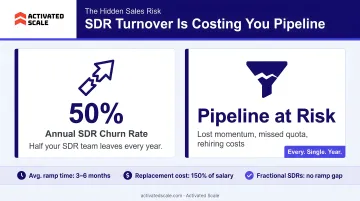
When a rep leaves before they've ramped, that pipeline exposure doesn't disappear. It delays your revenue and restarts your hiring clock from zero.
Every dollar you save on a faster, more accurate hire compounds directly into pipeline protection.
Top Platforms and Sources to Find the Best SDRs for Hiring
The five sources below were evaluated on talent quality, speed to hire, vetting rigor, and fit for B2B SaaS companies at various growth stages.
Activated Scale
Activated Scale is a fractional sales talent marketplace that connects B2B SaaS startups with vetted, US-based SDRs and sales professionals. The talent network draws from enterprise sales backgrounds — Salesforce, Oracle, IBM, Zendesk, Datadog, ZoomInfo, MongoDB, and others — and candidates are matched to clients within 7 days or less, sometimes in under 48 hours.
What makes the vetting process different:
Activated Scale accepts roughly 7% of applicants. Every candidate goes through a three-step process:
- Application review — screened for specific buyer persona experience, industry background, and ACV history
- Pitch video + written sequences — candidates submit a 60–90 second pitch video, an email sequence, and a LinkedIn sequence, reviewed by peers already in the network
- Subject matter expert interview — a 30–45 minute conversation assessing communication, past results, and professionalism
All accepted talent has 3+ years of B2B sales experience and is US-based.
The try-before-you-buy model:
Engagements start on a contract basis — typically a 3-month initial period with defined goals and KPIs. The SDR stays on Activated Scale's payroll, so clients avoid W-2 overhead, benefits, and traditional agency fees. If the fit is strong, clients can convert to a full-time hire at an 18% base salary conversion fee — lower than most traditional agencies.
The retention numbers reflect that quality: 80% of clients use Activated Scale talent for 5+ months, and 65% hire their fractional rep full-time after the initial period. Clients also save 20+ hours of interviewing time per hire by accessing a pre-vetted pool rather than sourcing from scratch.
Pricing for fractional SDRs is $4,500/month plus performance pay, which covers part-time engagement averaging 15–20 hours per week.
For Seed-to-Series-A founders, those numbers — 65% full-time conversion and 5+ month average engagement — indicate a hiring model that's proving itself before it costs you a full salary.
LinkedIn and LinkedIn Recruiter
LinkedIn remains the largest network for sourcing SDR candidates. LinkedIn Recruiter allows filtering by job title, past employers, industry, and location — useful when you're targeting candidates with specific SaaS or enterprise backgrounds.
Where it works:
- Sourcing passive candidates who aren't actively job hunting
- Building a targeted shortlist with specific criteria (for example, "former Outreach or Salesloft user with SMB SaaS experience")
Where it falls short:
- Everything after the search is manual — outreach, screening, scheduling, and evaluation fall entirely on you
- Founders without dedicated hiring support typically spend 30–50+ hours before reaching a qualified shortlist
- LinkedIn Talent Insights draws from 12B+ data points, but the platform itself doesn't vet or rank candidates
SDR-Focused Job Boards and Communities
Niche platforms like Bravado, We Work Remotely (which lists 40,171+ remote jobs), and SDR Nation attract candidates who self-identify as SDR professionals. That's a meaningful filter — someone browsing SDR Nation or the Bravado community is more likely to understand the role than a general applicant responding to an Indeed post.
The honest trade-off: Inbound volume can be strong, but a higher applicant count doesn't mean a better shortlist. Without a structured evaluation rubric, sorting through 80 applications to find 3 qualified candidates can cost more time than sourcing them directly. These platforms work best for companies that already have internal recruiting capacity and a clear vetting process in place.
Sales Recruiting Agencies
Traditional sales recruiting agencies — like Sales Talent Agency — manage sourcing, screening, and shortlisting in exchange for a placement fee, typically 15–25% of first-year base salary (standard across the recruiting industry, not SDR-specific).
When it makes sense: Companies that have already validated their sales motion, need a permanent full-time SDR, and have the budget for a one-time placement fee.
The limitation for early-stage startups: Beyond the fee, timelines can stretch. If the hire doesn't work out, refill clause terms vary by agency, and you may restart the process without cost recovery. These firms are better suited for companies that are ready to commit — not those still testing whether an SDR motion fits their stage.
Offshore and Global SDR Platforms
Platforms like Simera and Remote Growth Partners connect US companies with pre-vetted SDRs from LATAM, Southeast Asia, and Eastern Europe. Both handle compliance, contracts, and payroll management.
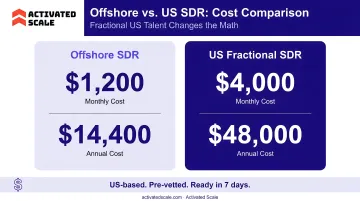
On cost: Simera publishes that its global SDR talent averages $3,325/month versus a US average of $5,000/month — a claimed 40–60% savings. Remote Growth Partners puts the fully loaded offshore SDR cost at approximately $42K annually versus $81K for a US hire. These are vendor-published figures, not independent benchmarks, so treat them as directional.
What to evaluate carefully before choosing this route:
- English fluency and communication quality in live prospect conversations
- Time-zone overlap with your AE team and target buyers
- Whether you have an established outbound playbook the rep can execute independently
Offshore SDR platforms work best for companies that have a repeatable sales process and the management bandwidth to onboard remote international talent. They're a poor fit for first-time SDR hires where the playbook is still being built.
What to Look For When Evaluating SDR Candidates
Resume screening gets you basic qualification. Structured evaluation gets you the right hire. Use these filters at each stage:
Core Traits to Assess
Communication clarity — Can they articulate a value proposition in 30 seconds? Assess this through a live cold call simulation, not a resume review. You're hiring someone to represent your company in the first conversation with a prospect.
Resilience — SDRs face rejection daily. Ask behaviorally specific questions: "Walk me through a month where you missed quota — what changed in your approach?" Look for accountability and adaptation, not just persistence.
Coachability — This is the best proxy for ramp speed. Give a mock call critique, then run a second attempt. How quickly they incorporate feedback tells you more about future performance than any polished first impression.
Business acumen — Strong SDRs research prospects before outreach and connect buyer pain points to product value. Assign a brief prospect research exercise: give them a company name and ask them to prepare a cold outreach angle. Look for specificity — generic pitches signal surface-level prep.
Practical Work Sample Tests
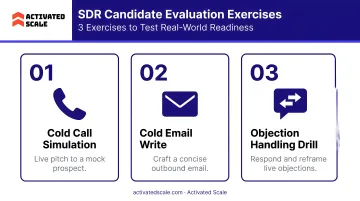
Run every candidate through these three exercises:
- Cold call role-play — caller plays a skeptical prospect; assess opening, discovery, and objection handling
- Written email sequence — a 3-touch outbound sequence targeting a specific persona
- Objection-handling drill — common objections like "We're already using a competitor" or "Send me some info"
Research from HBR confirms that structured, consistent evaluation outperforms conversational interviews for reducing wrong-hire risk — a real cost in a role where annual turnover runs at 50%.
How We Chose the Best SDR Hiring Sources
Every source on this list was evaluated on four criteria:
- Talent quality and vetting rigor — Does the platform pre-screen, or does it just aggregate?
- Speed to hire — How quickly can a qualified candidate start generating pipeline?
- Cost and risk profile — What are the upfront costs, and what happens if the hire doesn't work out?
- Fit for early-stage B2B SaaS — Does the model work for companies that are still building their sales motion?
Those criteria exist because the channel you choose has real revenue consequences. The most common mistake: choosing a channel based on lowest cost alone. A cheap hire who ramps slowly and churns in four months costs far more than a fractional rep who books 10–12 meetings a month from week six. Factor in ramp time, the median $2.8M in sourced pipeline per SDR, and the cost of restarting the search — and channel selection becomes a revenue decision, not just an HR one.
Conclusion
Where you find your SDRs shapes the entire trajectory of your pipeline. Three factors decide the outcome before you've reviewed a single resume:
- The platform determines the quality of talent in the pool
- The engagement model determines how much risk you carry if the fit is wrong
- The vetting process — whether yours or the platform's — determines how fast that rep starts producing
Before you choose a channel, answer three questions:
- Are you making your first SDR hire or scaling an existing team?
- Do you have internal bandwidth to screen and onboard, or do you need that handled?
- Are you ready for a full-time commitment, or do you need a lower-risk starting point?
If you need a vetted, US-based SDR generating meetings within a week and want to avoid the typical sourcing process, Activated Scale's try-before-you-buy model is designed for exactly this situation. Explore the platform to find the right fit without the traditional hiring risk.
Frequently Asked Questions
How much do SDRs cost?
According to RepVue, US SDRs earn a median base of $60K and median OTE of $85K. Fractional SDRs through platforms like Activated Scale typically cost $4,500/month plus performance pay — a fraction of full-time overhead with faster deployment.
What is the difference between a fractional SDR and a full-time SDR?
A fractional SDR works part-time or on a contract basis — typically 15–20 hours per week — without requiring full salary, benefits, or equity. Full-time SDRs offer more dedicated bandwidth but carry higher overhead and more risk if the role, product, or sales motion isn't yet proven.
How long does it take to hire an SDR?
It depends entirely on the channel. Traditional recruiting agencies can take 4–8 weeks. Self-managed job board searches vary based on your internal screening capacity. Fractional talent platforms like Activated Scale place vetted SDRs in 7 days or less — sometimes within 48 hours.
What should I look for when hiring an SDR for a B2B SaaS startup?
Prioritize communication skills, resilience under rejection, coachability, and prospect research ability. Prior SaaS experience helps but isn't mandatory — candidates with strong core traits and relevant buyer persona background can ramp quickly even without exact product-category history.
Should I hire an SDR in-house or use a fractional model?
In-house hiring gives you more control and cultural alignment, but requires significant time and carries full financial risk. Outsourced or fractional models deploy faster, reduce upfront cost, and let you validate your sales motion before committing to full-time headcount — a better fit for most early-stage companies.
What are the most common mistakes companies make when hiring SDRs?
The most consistent ones: choosing a hiring channel based on price alone, skipping structured vetting exercises (like a cold call role-play or written email test), and starting the engagement without defined KPIs. Each increases the likelihood of early turnover and a costly restart.