
Sales team augmentation gets discussed frequently, but rarely explained in concrete terms. What does it actually deliver operationally? How is it different from a fully external sales agency? And why does it matter specifically for companies that haven't yet built a repeatable sales motion?
This article answers those questions directly — and walks through the measurable advantages for early-stage companies trying to grow revenue without overcommitting on headcount.
Key Takeaways
- Sales team augmentation means adding external, experienced sales professionals to your team without permanent hiring commitments
- It differs from a fully external sales agency — you keep strategic control and day-to-day management
- Key benefits: faster ramp-up, lower hiring risk, specialized expertise, and a reduced cost of sale
- Ignoring it leads to inconsistent pipeline, founder burnout, and expensive mis-hires
- Works best when outcomes are defined upfront and results are reviewed on a regular cadence
What Is Sales Team Augmentation?
Sales team augmentation is the practice of integrating external sales professionals — SDRs, Account Executives, or fractional sales leaders — into your existing team to expand capacity, fill skill gaps, or accelerate revenue without a permanent hire.
It's most commonly used by early-stage B2B SaaS companies in situations like:
- Entering a new market or vertical
- Running outbound prospecting campaigns for the first time
- Scaling pipeline generation during a funding push
- Bridging the gap while a full-time hire is being sourced
The goal isn't to "add headcount." It's to generate qualified pipeline, book meetings, and win revenue faster than traditional hiring allows. That distinction matters — augmentation is a means to a revenue outcome, not a staffing category.
That's the model Activated Scale is built around: connecting B2B startups with pre-vetted fractional sales professionals (SDRs, AEs, and VPs of Sales) who can be deployed in under 7 days and measured against clear monthly targets from day one.
Key Benefits of Sales Team Augmentation
The benefits below tie to operational outcomes companies actually track: pipeline velocity, cost per hire, revenue per rep, and time-to-productivity. These aren't abstract flexibility claims.
Flexibility to Scale Sales Capacity Without Long-Term Commitment
Sales demand fluctuates. Product launches, new market entries, seasonal pushes, and funding milestones create pipeline spikes that don't justify permanent headcount. Augmentation addresses this directly.
External sales professionals can be brought in and deployed quickly, calibrated to specific targets, and scaled back without severance, benefits re-administration, or re-hiring costs. That operational flexibility is hard to replicate with full-time hires.
Here's why this matters for early-stage companies specifically:
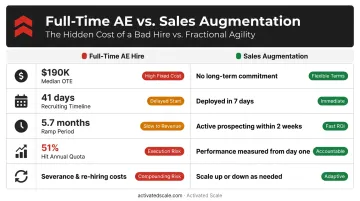
- Committing to a quota-carrying AE — with median OTE of $190,000 and a 5.7-month ramp — before validating a sales motion is a major financial risk
- Only 51% of AEs hit annual quota, according to the same Bridge Group data, meaning nearly half of full-time sales hires underperform
- Augmentation removes the binary choice between "hire full-time now" and "do it yourself indefinitely"
KPIs impacted: Time-to-first-meeting, pipeline velocity, headcount-to-revenue ratio, average ramp time per hire
When it matters most: Pre-Series A scaling, seasonal demand spikes, and new vertical entry — anywhere a permanent headcount decision would be premature before the sales motion is proven.
Access to Specialized Sales Expertise Without the Full-Time Cost
Selling enterprise B2B SaaS requires specific skills: outbound prospecting, multi-stakeholder discovery, contract negotiation. These are expensive to hire full-time and risky to develop from scratch.
Augmentation solves this by drawing from a vetted network of professionals who already have those skills. Activated Scale's talent network includes professionals with experience at Salesforce, Oracle, Zendesk, IBM, Datadog, and Intuit — meaning companies immediately access skills already proven across similar deal sizes and sales cycles.
The cost argument here is concrete. A 2017 DePaul University sales effectiveness study reported average sales rep turnover costs of $97,690 when factoring in hiring, training, and replacement. A mis-fit full-time hire doesn't just waste salary — it delays revenue, burns founder time, and sets back the entire sales motion by quarters.
Augmented professionals arrive with:
- Domain knowledge and existing playbook experience
- Zero ramp curve on core selling skills (they only need product context)
- A track record that can be evaluated before any full-time commitment
That last point is the try-before-you-hire model in practice. Activated Scale reports that approximately 85% of startups eventually hire their fractional sales talent full-time — after proving performance during an initial contract period.
KPIs impacted: Meeting quality, lead-to-opportunity conversion, average deal size, sales cycle length, rep-to-quota attainment
When it matters most: When founders are still carrying the sales function themselves, or when a company needs a specific capability — like an outbound SDR motion — they've never built internally.
Faster Time-to-Revenue and Reduced Operational Overhead
Traditional full-time sales hiring takes an average of 41 days from search to accepted offer, according to SHRM's 2025 hiring data. Add 5.7 months of ramp time before an AE generates meaningful revenue, and you're looking at 7–8 months before a new hire contributes to pipeline. For a company with a board-mandated growth target, that's not a viable path.
Augmentation compresses that timeline:
- Activated Scale connects clients with vetted sales professionals in 7 days or less — sometimes the same day
- Active prospecting cadences begin within the first two weeks of onboarding
- By month 3, fractional SDR engagements consistently generate 10–15 qualified meetings per month
The operational overhead savings matter too. When an augmented professional operates through a platform like Activated Scale, the client avoids recruiting fees, W2 processing, benefits administration, and the onboarding overhead of a full-time hire. The fractional professional stays on the platform's payroll during the contract period; the client pays only for output.
For B2B SaaS companies with constrained runway or an approaching growth milestone, speed of execution matters more than headcount size. Activated Scale clients report closing $50,000–$250,000 in new monthly revenue from fractional AE engagements — proof that output, not org chart size, drives pipeline.
KPIs impacted: Time-to-first-booked-meeting, monthly qualified meetings, cost per qualified meeting, monthly new revenue, customer acquisition cost
What Happens When Sales Team Augmentation Is Ignored
When augmentation isn't in the picture, most early-stage companies default to one of two situations: the founder doing sales personally, or rushing a full-time hire before the sales motion is validated. Both paths create predictable problems.
The common consequences:
- Pipeline fills only when founders have attention to spare — creating stop-start revenue cycles that are impossible to forecast or build on.
- Every quarter without a functioning sales motion is a quarter of lost ground — competitors with active sales teams are capturing market share and revenue during that window.
- Pressure to "hire sales fast" leads to under-qualified full-time offers. SaaStr notes a wrong first AE can delay a startup by 3–6+ months — before accounting for salary, equity, and onboarding already spent.
- Startup Snapshot's research across 400+ founders found 72% reported stress affected their mental health, with 36% experiencing burnout. When founders carry the sales function, product development suffers — and that bandwidth doesn't come back.
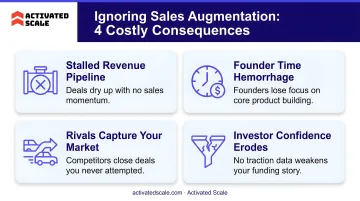
Left unchecked, these consequences feed each other: a thin pipeline forces rushed hires, rushed hires produce missed quarters, and missed quarters put the founder back on the phones.
How to Get the Most Value from Sales Team Augmentation
Sales team augmentation delivers the highest ROI when it's treated as a structured growth motion — not a stopgap. The setup decisions made in the first two weeks determine whether it generates compounding results or just fills time.
It works best when:
- Define outcomes before day one — Qualified meetings per month, target ICP, outreach channels, and deal size should all be locked in before the engagement starts. Fractional professionals perform best with a clear mandate, not a vague brief.
- Integrate them into your stack — Fractional professionals should work inside your CRM, Slack, and weekly pipeline reviews from the start. Keeping them at arm's length produces siloed data and gaps in feedback.
- Results are reviewed on a regular cadence — Weekly pipeline reviews and monthly performance checks let you adjust the engagement based on actual data: scale up, focus differently, or convert to a full-time hire.
Activated Scale structures this through a phased onboarding approach:
| Phase | Timeline | Focus |
|---|---|---|
| Ramp | Days 1–15 | Product context, ICP alignment |
| Iteration | Days 16–45 | Outreach, messaging refinement |
| Acceleration | Day 46+ | Pipeline generation at scale |
Performance is tracked against a Statement of Work with clear monthly targets.
The contract-to-hire option is worth considering. It gives companies a structured 3-month period to evaluate sales skills, cultural fit, and revenue contribution — before making any full-time commitment. The decision to hire full-time becomes data-driven, not instinctive.
Conclusion
Sales team augmentation gives early-stage B2B SaaS companies a practical path to revenue growth that avoids the binary choice between "hire full-time now" and "do it yourself indefinitely." Speed, specialist expertise, and a low-commitment structure — in one motion — is what makes it work for founders who can't afford to wait.
The benefits covered here — flexibility, specialized talent, and faster time-to-revenue — build on each other when engagements run with clear goals and consistent review cycles. Set the right targets early, and each month of augmented selling gets more efficient than the last. For early-stage companies, that momentum is exactly how a temporary sales motion turns into a repeatable growth engine.
Frequently Asked Questions
How do you boost your sales team?
The fastest way is to add focused, experienced external professionals for specific functions — outbound prospecting, pipeline generation — rather than waiting on full-time hiring cycles. Augmentation lets you add capacity immediately, aligned to specific targets, without the 5–7 month ramp that full-time hires require.
What is an example of staff augmentation in sales?
A B2B SaaS startup brings in a fractional SDR through Activated Scale to run outbound prospecting for 90 days — booking qualified meetings with target accounts, operating inside the company's CRM, and attending weekly pipeline reviews. At the end of the engagement, the founders decide whether to convert them to a full-time hire.
What is the difference between sales team augmentation and a fully external sales agency?
Augmentation integrates external professionals directly into your team under your direction. A fully external sales agency delegates a function entirely to a third party. With augmentation, you retain strategic control, day-to-day management, and visibility into every activity — an external agency removes that operational ownership.
How quickly can augmented sales talent be added to a team?
Platforms like Activated Scale can source, vet, and deploy experienced sales professionals in 7 days or less — sometimes the same day. That's significantly faster than the 41-day average for filling a full-time sales role, before ramp time is even considered.
How do you measure the success of sales team augmentation?
Agree on KPIs before the engagement starts and review them weekly. The core metrics to track:
- Qualified meetings booked per month
- Pipeline value generated
- Lead-to-opportunity conversion rate
- Cost per meeting
Is sales team augmentation suitable for early-stage startups without an existing sales team?
It's especially well-suited to that stage. Augmented professionals can validate the sales motion, define the ICP, and generate early revenue before you're ready to commit to full-time headcount — which is exactly the scenario Activated Scale was built for.