
Fractional AEs offer an alternative — experienced quota-carriers available part-time, on retainer, without the full employment overhead. But pricing varies considerably, and founders who budget based on the cheapest available rate often end up with a mismatch that costs more in lost pipeline than it saves in fees.
This article breaks down typical fractional AE hourly rates, what drives pricing up or down, how retainers actually work, and what to budget based on your stage and deal complexity.
Key Takeaways
- Fractional AE rates in the US market run $75–$200+ per hour (marketplace data shows $70–$215/hr for 5+ years SaaS experience)
- Most engagements use a monthly retainer plus performance pay — not pure hourly billing
- Deal complexity and ACV are the primary rate drivers — not just years of experience
- Sales tooling (CRM, LinkedIn Sales Navigator, sequencing tools) is a separate budget line from the AE's fee
- Hiring on price alone — without checking sales motion fit — is the most common founder mistake
What Does a Fractional AE Hourly Rate Actually Cost?
Fractional AE pricing isn't a fixed market rate — it varies by seniority, sales complexity, engagement model, and whether the AE carries a quota or operates in an advisory capacity.
The most direct published data point comes from GoFractional's marketplace, where a Fractional Sales Account Executive role for an AI SaaS startup listed a rate of $70–$215/hr for 10–30 hours per week, requiring 5+ years of SaaS sales experience and including performance-based incentives. The spread reflects how much role scope and seniority move the number.
Typical Hourly Rate Ranges
| Tier | Experience | Approximate Hourly Rate | Best Suited For |
|---|---|---|---|
| Entry-level | 1–3 years B2B | $75–$100/hr | SMB sales, short deal cycles, lower ACV |
| Mid-level | 3–7 years B2B SaaS | $100–$150/hr | Transactional to mid-market SaaS |
| Senior / Enterprise | 7+ years, complex deals | $150–$200+/hr | Multi-stakeholder, high-ACV, enterprise |
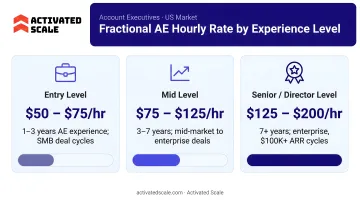
These hourly rates cover active selling hours: pipeline management, prospect meetings, and demo execution.
Tool costs are billed separately. What's typically excluded:
- CRM licenses
- Sales engagement platforms
- LinkedIn Sales Navigator
- Travel expenses
More on that in the cost breakdown section below.
How Hourly Rates Convert to Monthly Retainers
Most fractional AEs prefer a monthly retainer over pure hourly billing. The math is straightforward:
Hourly rate × hours per week × 4.34 weeks = monthly retainer
Example calculations at 10 hours/week:
- $100/hr × 10 hrs × 4.34 = ~$4,340/month
- $125/hr × 10 hrs × 4.34 = ~$5,425/month
- $175/hr × 10 hrs × 4.34 = ~$7,595/month
On Activated Scale, fractional AE engagements typically run 15–20 hours per week with monthly retainers of $6,500 plus performance pay — which aligns with mid-to-senior hourly rates applied to a part-time schedule.
When to add a incentive component:
- Quota-carrying AEs who own pipeline and close responsibility: hybrid retainer + performance pay
- Advisory or ramp-up phases (messaging review, playbook building): flat retainer only, which avoids short-term incentive misalignment
For sales cycles longer than a month, performance-only structures tend to backfire. Without a retainer anchoring the engagement, both sides disengage — and deals stall. A base retainer keeps the AE accountable and gives your company consistent coverage through longer buying cycles.
Key Factors That Affect Fractional AE Rates
The same "fractional AE" title can command $80/hr or $200/hr depending on a handful of specific variables.
Experience and Track Record in B2B SaaS
An AE with verifiable SaaS experience — closing $50K–$200K ARR deals with documented conversion rates — commands a meaningful premium over a generalist with broad B2B exposure.
Bridge Group's 2024 SaaS AE Metrics report (172 B2B SaaS companies, 87% North America) found that the average required AE experience at hire has risen to 3.6 years, up 0.9 years versus 2022. More telling: companies with ACV above $25K require 1.8x more experience than those below that threshold. The implication for fractional hiring is direct — more complex deals justify and require more seasoned AEs, and those AEs price accordingly.
Sales Cycle Complexity and Deal Size
A fractional AE running short-cycle, low-ACV transactional sales carries a lighter cognitive load than one navigating multi-month enterprise deals with multiple decision-makers. The latter requires stakeholder mapping, executive-level communication, and longer sustained involvement — all of which push rates higher.
Bridge Group data shows that the quota gap between AEs selling deals under $25K ACV versus $250K+ ACV is nearly 2.5x. When scoping a fractional engagement, deal size is one of the clearest signals for where a candidate's rate will land.
Engagement Scope: Advisory vs. Quota-Carrying
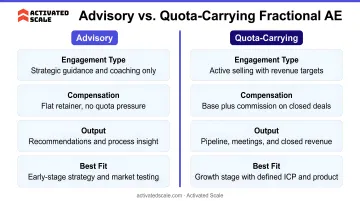
These are functionally different roles:
- Advisory/consulting capacity: reviewing messaging, training junior reps, building playbooks, auditing pipeline — typically a flat retainer, lower hours
- Quota-carrying: owning an active pipeline, running discovery and demos, managing deals to close — typically higher rates plus performance pay
Quota-carrying AEs take on direct revenue accountability — expect their base rate to run 20–30% higher than advisory-only engagements, often with incentive layered on top.
Industry Specialization and ICP Familiarity
An AE who has spent three years closing deals with VP-level Customer Success leaders at SaaS companies doesn't need six months to learn your pitch. They walk in knowing the objections, the buying committee dynamics, and what resonates.
A GoFractional listing for a fractional SaaS AE role explicitly preferred candidates with experience selling to Customer Support and CX leaders. ICP-specific experience is a real hiring filter, not a preference box companies check after the fact.
Bridge Group reports average AE ramp time at 5.7 months for full-time hires. Fractional AEs matched to your specific buyer persona can compress that considerably. Activated Scale's model is built around matching AEs who have already closed deals with your exact ICP, targeting a 2-week ramp rather than several months.
Geography: Why US-Based Rates Are Higher
US-based fractional AEs cost more than offshore alternatives. For most B2B SaaS companies, that premium is worth it:
- Enterprise buyers expect synchronous availability during business hours
- Cultural fluency matters in complex negotiations
- Time zone overlap becomes critical once multi-stakeholder deal cycles involve three or four decision-makers
Activated Scale's network is entirely US-based, with access to 300+ vetted fractional sales professionals — drawing from talent with backgrounds at companies like Salesforce, Oracle, IBM, and Zendesk.
Fractional AE Cost Breakdown
The retainer or hourly fee is not your total cost. Founders who budget only the AE fee regularly underestimate their actual monthly spend.
Full Cost Components
1. Monthly retainer (recurring) The core cost for active selling time. On Activated Scale, fractional AE retainers are $6,500/month plus performance pay.
2. Sales tooling (recurring — separate from AE fee) Fractional AEs typically do not bring their own tool licenses. Budget separately for:
| Tool | Approximate Monthly Cost |
|---|---|
| HubSpot Sales Hub Professional | $90/seat/month (annual billing) |
| Salesforce Enterprise | $175/user/month (annual billing) |
| LinkedIn Sales Navigator Core | $119.99/month/license |
| Sequencing tools (Outreach, Salesloft) | Custom pricing — contact vendors |
Sources: HubSpot pricing, Salesforce pricing, LinkedIn Sales Navigator pricing.
3. Onboarding and ramp time (first month) Experienced fractional AEs still need time to learn your product, ICP, and messaging. Plan for 2–4 weeks of lower-output onboarding — treat the first month's retainer as partly an investment in ramp, not purely active selling.
Activated Scale structures this as a defined process: the first two weeks cover intake and process audit, with active pipeline ownership beginning in week three onward.
4. Performance incentives (periodic) Incentive kickers or milestone bonuses tied to revenue targets work well when structured to reward closed revenue, not just activity. Avoid short-cycle structures that push an AE toward fast-close pressure on deals that need longer cultivation.
When you add these four components together, most early-stage companies are looking at $5,000–$9,000/month in total fractional AE costs — still well below the loaded cost of a full-time hire.
Budget vs. Senior Fractional AE: What's the Difference?
Choosing a lower-cost versus higher-cost fractional AE isn't purely a price decision. Hire too junior and you'll spend management time you don't have. Hire too senior and you're overpaying for deal volume that doesn't justify the rate.
| Factor | Entry-Level ($75–$100/hr) | Mid-Level ($100–$150/hr) | Senior ($150–$200+/hr) |
|---|---|---|---|
| Ramp to productivity | Slower — needs more coaching | Faster with SaaS context | Fastest with matching ICP experience |
| Deal size comfort | Sub-$25K ACV | $25K–$100K ACV | $100K+ ACV, multi-stakeholder |
| Oversight needed | High | Moderate | Low — self-directed |
| Best for | SMB, simple motion | Early-stage SaaS | Enterprise or complex cycles |
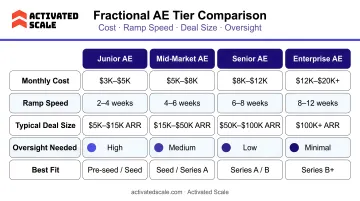
For most seed to Series A B2B SaaS companies — pre-product-market fit or early traction — a mid-level AE with relevant SaaS experience typically delivers the best ROI. An overqualified senior AE may be expensive and under-stimulated by a small deal volume. An underqualified entry-level AE will need management time you don't have.
That calculus gets sharper when you factor in quota attainment rates. Bridge Group data shows only 51% of AEs in a given cohort hit annual quota — down from 66% in 2022. Putting the wrong tier in place doesn't just cost you the hourly rate; it costs you the months of pipeline that never closes.
How to Estimate the Right Budget for a Fractional AE
Budget based on expected revenue impact, not cost minimization. The right framing: what does one closed deal at your average ACV justify in sales investment?
Define these inputs before setting a number:
- Target ACV — deals under $25K have different AE requirements than deals above $100K
- Sales cycle length — a 30-day cycle needs different hour commitments than a 90-day cycle
- Hours per week needed — 10 hrs/week for pipeline support vs. 20 hrs/week for full-cycle ownership
- Quota-carrying or advisory? — determines whether incentive applies
- Runway for pipeline visibility — most fractional AE engagements need 45–90 days before closed revenue is measurable
A practical starting point for seed/Series A:
A mid-level fractional AE at 15–20 hours/week costs $6,500/month on retainer (Activated Scale's rate), plus $300–$400/month in tooling. At an average ACV of $30K–$50K, closing one deal per month returns 4–6x the monthly spend.
Activated Scale's try-before-you-hire model reduces that risk: a 3-month initial engagement lets founders assess fit and pipeline output before converting to a longer engagement or a full-time hire. Roughly 65% of Activated Scale clients end up hiring their fractional AE full-time after seeing results — so the engagement doubles as a structured evaluation period with real revenue on the line.
Frequently Asked Questions
How much do fractional executives charge?
Fractional executive rates vary significantly by function and seniority. C-suite roles like fractional CFO or CMO typically run $200–$400/hr, while fractional AEs as individual contributors fall in the $75–$200/hr range. Total monthly cost depends on hours committed per week.
How are fractional employees paid?
Fractional talent is paid either via a monthly retainer (most common for AEs) or hourly billing. Unlike full-time employees, there are no payroll taxes, employer benefit costs, or equity obligations — the agreed fee is the total invoice.
Is $70 an hour a good rate?
$70/hr sits at the lower end of the US fractional AE market and may reflect limited B2B SaaS experience or a simpler sales motion. It can work for early-stage SMB roles but won't cover complex deal cycles or enterprise selling.
What is the difference between a fractional AE and a fractional VP of Sales?
A fractional AE is an individual contributor — they prospect, run demos, and close deals. A fractional VP of Sales provides strategic sales leadership, team management, and process-building.
When should a startup hire a fractional AE instead of a full-time one?
Fractional AEs make the most sense when you need to validate a sales motion or generate early pipeline without committing to an $80K–$120K annual base salary plus benefits. They're especially well-suited for seed to Series A companies with a defined ICP and a working demo or MVP.