The problem: most buyers approach pricing the wrong way. They compare monthly fees without understanding what's included, choose models that don't match their stage, and get blindsided by tooling costs that weren't in the headline number. Misjudging the budget is one of the most consistent reasons companies get poor results from outsourcing — not the model itself.
This guide covers real pricing ranges across every major engagement type, what drives costs up or down, how to think about budget relative to your stage, and where the common mistakes happen.
Key Takeaways
- Entry-level retainers run $2,500–$7,500/month; dedicated US-based SDR programs reach $7,500–$15,000+/month
- Pay-per-meeting ranges from $200–$600 for SMB/mid-market; $1,000–$1,200 for enterprise or CXO-level appointments
- Price drivers: US-based talent, broader scope, senior reps, complex ICP, omnichannel outreach
- Right metric: cost-per-qualified-meeting, not monthly fee — a pricier provider often delivers lower total cost per pipeline dollar- Right metric: cost-per-qualified-meeting — a pricier provider often delivers a lower total cost per pipeline dollar
- Fractional models offer an alternative for early-stage companies: experienced US-based talent without agency overhead or long-term lock-in- Fractional models give early-stage companies experienced US-based talent without agency overhead or long-term lock-in
How Much Does B2B Sales Outsourcing Cost?
B2B sales outsourcing doesn't have a single price. Cost depends on the engagement type, what's bundled in, who's doing the work, and how results are measured.
Before comparing quotes, understand what goes wrong when cost is misunderstood:
- Underbudgeting leads directly to low-quality vendors — and low-quality vendors waste more money than the savings justify
- Wrong model for your stage produces friction even with a competent provider
- Hidden costs — tooling, setup fees, domain infrastructure — regularly add 20–40% on top of the headline retainer
Here's how the three main pricing tiers actually break down.
Entry-Level Retainer: $2,500–$7,500/Month
This tier typically covers a managed outbound program: email and LinkedIn sequencing, prospect list sourcing, weekly reporting, and account management — usually delivered by one SDR or a shared team.
What's usually included:
- Outbound sequences (email + LinkedIn)
- Prospect data sourcing
- Weekly activity reporting
- Account management check-ins
What's often billed separately: dialer software, CRM integration, enrichment tools, and deliverability infrastructure.
Best for early-stage B2B SaaS companies building pipeline without committing to a full-time hire, and for founders testing whether outbound works before scaling spend.
Mid-Range Retainer or Dedicated SDR: $7,500–$12,000/Month
At this tier, you're paying for a named US-based SDR or a more comprehensive managed program. SalesRoads, for example, publishes dedicated SDR appointment setting starting at $9,950 per four-week cycle — covering a dedicated rep, sales operations support, prospect data, CRM integration, and deliverability infrastructure.
What's typically bundled:
- Onshore reps with omnichannel outreach (email, LinkedIn, cold calling)
- Deliverability infrastructure
- Intent data access
- Structured weekly optimization reviews
- Sales Operations Manager oversight
Best for companies ready to scale outbound consistently, entering new markets, or founders who've validated their ICP and need predictable pipeline without adding headcount.
Premium and Pay-Per-Meeting: $12,000–$15,000+/Month or $200–$1,200 Per Meeting
Dedicated senior SDR programs at this level run $12,000–$15,000+ per rep per month, all-in. Pay-per-meeting pricing varies considerably by target — CIENCE publishes per-appointment pricing of $50–$400 for managed campaigns. Enterprise or CXO-level meetings from specialized providers can reach $1,000–$1,200 per qualified appointment.
Pay-per-meeting shifts performance risk to the vendor, which sounds attractive. The downside: without strict ICP definitions in the contract, vendors optimize for booking volume, not quality. You can end up paying for meetings that waste your AE's time.
This model works best for specialized verticals, enterprise plays, short pilots, or validating a new segment before committing to a retainer.
Key Factors That Drive the Cost of B2B Sales Outsourcing
Pricing is shaped by service scope, talent location, ICP complexity, and your company's stage. Understanding each factor helps you compare quotes accurately — and avoid paying for scope you don't need.
Scope of Services
Top-of-funnel only (prospecting, outreach, booking) costs 30–50% less than full-cycle outsourcing that includes qualification, nurturing, and deal management.
- Top-of-funnel only: SDR handles outreach and hands off booked meetings to your internal closers
- Full-cycle: Outsourced reps manage the entire deal from first contact to close
- Hybrid (most common): Outsourced SDRs feed an internal AE team — this preserves control over deals while keeping costs lower
The hybrid model works well for early-stage SaaS companies precisely because it separates pipeline creation (where outsourcing adds clear leverage) from closing (where founder or AE involvement usually improves win rates).
Geographic Location of Reps
US-based SDRs command higher rates than offshore teams. The practical reason: North American B2B buyers respond better to same-timezone outreach, and cultural alignment in cold calling and follow-up conversations matters in enterprise sales. That performance premium is real, even when offshore rates run 40–60% lower on paper.
If your primary market is North America, offshore programs that look cheap on paper often underperform enough to erase the savings. They can also introduce compliance exposure around employment classification and data privacy — risks worth weighing before optimizing purely for rate.
ICP Complexity and Company Stage
Simple SaaS with a short sales cycle and easy-to-identify buyers costs less to outsource than complex enterprise software requiring multi-stakeholder navigation or technical knowledge.
Cost implications:
| Scenario | Impact on Cost |
|---|---|
| Well-defined ICP, short cycle | Lower cost; faster ramp; less iteration needed |
| Undefined ICP, early-stage | Higher effective cost; first 60–90 days require messaging iteration |
| Enterprise / multi-stakeholder | Premium pricing; senior reps required |
| New market entry | Higher initial cost; intent data and localized messaging needed |
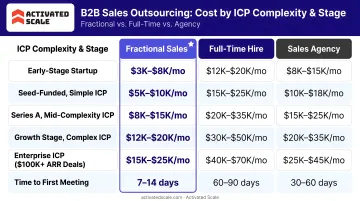
Early-stage companies with unproven positioning effectively pay a "ramp premium" in the first 60–90 days. The per-meeting cost drops once messaging is dialed in — which is why program length matters as much as monthly fee.
Full Cost Breakdown: One-Time vs. Recurring Expenses
Most founders budgeting for outsourced sales focus on the monthly retainer — and underestimate total cost by 20–40%. Setup fees, tooling, and operational overhead all add up, and they vary significantly by provider.
One-Time Costs
- Setup and onboarding: $1,000–$2,000 at entry-level providers (sometimes absorbed at higher tiers)
- ICP and messaging development: Often included in premium programs; sometimes billed separately at lower tiers
- Domain warm-up and deliverability infrastructure: Quality providers absorb this; budget providers often don't
Recurring Tool Costs
Providers either bundle these into the retainer or bill them separately. Key tools to ask about:
- LinkedIn Sales Navigator: $119.99–$159.99/license/month
- Apollo.io (prospecting data): $49–$119/user/month
- Email outreach platforms (Instantly, Smartlead): $39–$97/month at standard tiers
- ZoomInfo, Outreach, Salesloft: Quote-based; no public pricing
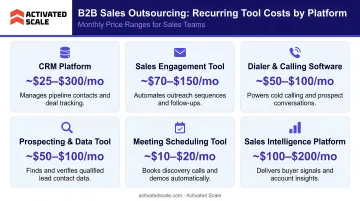
If a $3,000/month retainer doesn't include tooling, add $300–$600/month in tool costs before comparing it to an all-in program at $5,000/month.
Beyond tooling, three cost escalators catch buyers off guard mid-engagement.
Hidden Escalators
- Ask explicitly whether re-onboarding fees apply when an SDR turns over — quality providers absorb this cost, others don't
- Adding channels or new geographies mid-engagement often triggers additional scope fees
- Budget 2–4 hours per week of internal time to manage the relationship; even high-performing programs require client-side oversight to stay on track
Budget vs. Premium Providers: What's Actually Different
Not all providers at the same price point deliver equivalent results. The gap between a $3,000/month and an $8,000/month provider usually comes down to four things:
| Dimension | Budget Provider | Premium Provider |
|---|---|---|
| Rep experience | Junior or offshore SDRs | Senior US-based reps, recognized sales backgrounds |
| Optimization focus | Activity metrics (calls sent, emails sent) | Held meetings and pipeline conversion |
| Reporting | Static weekly decks | Live dashboards, weekly optimization reviews |
| Long-term cost | Unqualified meetings waste AE time | Better conversion protects total pipeline value |
The Cost-Per-Meeting Math
Monthly fee is a misleading comparison metric. Here's a simple illustration:
- Provider A: $5,000/month → 3 qualified, held meetings → $1,667 per meeting
- Provider B: $10,000/month → 12 qualified, held meetings → $833 per meeting
Provider B costs twice as much per month and delivers half the cost per qualified meeting. If your AE's average close rate is 25% and average deal size is $40,000, Provider B also generates four times the pipeline per month.
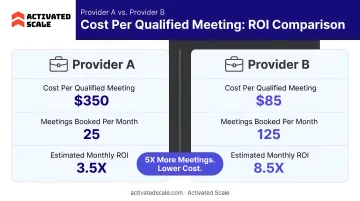
Once you account for outcomes, the lower retainer often costs more. You pay less monthly and get less in return — fewer qualified meetings, more wasted AE time, and weaker pipeline conversion.
How to Estimate the Right Budget for Your Stage
The right outsourcing budget isn't a fixed number. It's defined by your growth objective and your ability to absorb a ramp period before results compound.
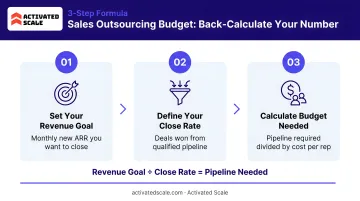
Back-Calculate from Pipeline Requirements
Start with your monthly revenue target, then work backward:
- Target revenue ÷ average deal size = deals needed per month
- Deals needed ÷ close rate = qualified meetings needed per month
- Meetings needed × cost-per-meeting = outsourcing budget
This gives you a budget grounded in output, not just overhead.
In-House SDR Cost Comparison
A fully loaded US-based SDR runs $80,000–$110,000/year in base and OTE, plus benefits. Glassdoor reports US SDR total pay around $102,690/year before employer-side costs — and BLS data shows private-industry benefits add roughly 30% on top of wages.
Add tools, management overhead, and a 60–90 day ramp before productivity, and outsourcing at $5,000–$8,000/month delivers comparable or better output at lower annualized cost for most early-stage teams, with no ramp-period payroll risk.
The Fractional Alternative for Early-Stage SaaS
For Seed-to-Series-A companies, the fractional model offers a lower-risk entry point than a traditional agency retainer.
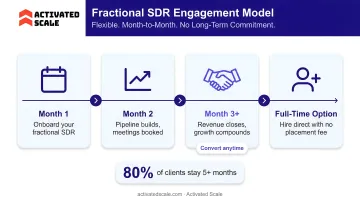
Activated Scale matches early-stage B2B SaaS companies with vetted, US-based fractional sales professionals — SDRs, AEs, and VPs of Sales — on a month-to-month basis, with no placement fees or long-term lock-in. Fractional SDRs are matched in under 7 days (sometimes within 48 hours) and run $3,500–$4,500/month plus commission.
The structure differs from a managed retainer in a few key ways:
- You manage the rep directly and own all prospect data and playbooks
- You can convert them to full-time when revenue supports it
- About 85% of clients end up doing exactly that
Dresma.ai reported a 5X increase in meetings with qualified prospects after engaging a fractional SDR through the platform. Unlike a traditional outsourced agency, this is experienced talent with a built-in try-before-you-hire structure.
What Most Companies Get Wrong About Sales Outsourcing Costs
Optimizing for the Cheapest Monthly Fee
A $3,000/month service producing one held meeting is worse ROI than a $9,000/month service producing 12. Founders who anchor to the lowest retainer often spend more in total — through wasted AE time, poor pipeline quality, and the cost of eventually switching providers.
Ignoring the Ramp Period
Most outsourced programs require 30–60 days before producing steady results. Companies that cancel at the 45-day mark absorb all the setup cost with none of the upside. Budget for a minimum 90-day window before evaluating whether the program is working.
Paying for Full Scope Before Validating the Model
Committing to a premium omnichannel program with dedicated reps before your ICP is defined and your AEs can follow up on meetings is expensive. Before scaling, confirm you have:
- A documented ICP
- At least one proven messaging angle
- An internal process for handling booked meetings within 24 hours
Choosing Offshore Without Evaluating Compliance Risk
Low-cost offshore SDR programs can create real legal exposure. The FTC's CAN-SPAM guidelines are explicit: you cannot contract away legal responsibility by hiring another company to send your email. Both the promoted company and the sender can be held liable, with penalties up to $51,744 per email.
Before signing with any provider, verify the following:
- Valid physical addresses are maintained on all outreach
- Opt-out requests are honored within 10 business days
- Compliant sender identification is used on every send
Conclusion
B2B sales outsourcing costs range from $2,500/month for entry-level managed programs to $15,000+/month for dedicated senior SDR engagements, but neither end of that range is automatically right for your situation. The correct budget is determined by your stage, ICP maturity, and what pipeline volume you actually need.
The metric that matters is cost-per-qualified-meeting. A program that compounds over time — one where reps understand your buyers, messaging sharpens each cycle, and meetings actually convert — justifies the investment.
For early-stage B2B SaaS founders who need experienced sales talent without full-time overhead, Activated Scale's fractional model offers a cost structure built around how startups actually grow: fast placement, month-to-month flexibility, and a clear path to full-time hiring once you've validated the motion.
Frequently Asked Questions
How much does B2B sales outsourcing cost per month?
Most programs run $2,500–$15,000+ per month depending on model and scope. Entry-level retainers start around $2,500–$7,500/month; dedicated US-based SDR programs typically run $7,500–$15,000+. What's included varies significantly: tooling, dedicated reps, and omnichannel outreach may or may not be bundled.
Is outsourcing B2B sales cheaper than hiring an in-house SDR?
A fully loaded US-based SDR costs $80,000–$110,000/year before tools and management overhead. Outsourcing at $5,000–$8,000/month often delivers comparable output at lower annualized cost, with no ramp-period payroll risk while the rep gets up to speed.
What is included in a typical sales outsourcing retainer?
Base retainers typically cover outreach activity, prospect data, and weekly reporting. Higher-tier programs bundle tooling, a dedicated named rep, omnichannel cadences, and a Sales Operations Manager. Always confirm which tools are included vs. billed separately.
How long does it take to see results from outsourced B2B sales?
Most programs produce first MQLs in weeks 2–3, with first qualified meetings by weeks 3–4. Steady-state pipeline volume generally builds by months 2–3. Budget for at least 90 days before drawing conclusions about whether the program is working.
What is the difference between a retainer model and pay-per-meeting pricing?
Retainers offer predictable monthly spend for consistent effort, regardless of short-term output. Pay-per-meeting ties spend directly to delivered meetings but can incentivize booking volume over quality. Without strict ICP definitions in the contract, vendors optimize for booked meetings, not held ones.
When does a fractional sales model make more sense than a traditional outsourcing retainer?
Fractional models suit early-stage companies that need experienced sales talent but aren't ready for a full-time hire or a long agency commitment. They offer faster access, lower risk, and the option to convert to full-time as revenue grows.