B2B sales outsourcing lets companies bypass the friction of traditional hiring by tapping into ready-made expertise. Done well, it compresses the timeline from "we need pipeline" to "we have pipeline" from months to weeks.
This guide covers everything you need to make an informed decision: what outsourcing actually means, which models exist, core benefits, which functions to delegate, when it makes sense, and how to evaluate a partner.
TLDR
- B2B sales outsourcing means delegating specific sales functions — lead gen, prospecting, appointment setting, or full-cycle selling — to an external team or specialist.
- Faster ramp-up and experienced execution without the cost or delay of full-time hiring.
- Four main models: outsourced SDRs, full-cycle sales, hybrid, and fractional professionals.
- Best for companies with thin pipeline, hiring constraints, or entering new markets.
- Success requires clear KPIs, proper onboarding, and tight alignment with internal teams.
What Is B2B Sales Outsourcing?
B2B sales outsourcing means delegating some or all of your company's sales activities to an external provider — an agency, a managed sales firm, or individual fractional sales professionals working on a contract basis.
Unlike B2C outsourcing, B2B involves longer deal cycles, multiple stakeholders per opportunity, and relationship-driven buying decisions. According to Forrester, the average B2B purchase involves 13 people and spans two or more departments. That complexity demands experienced sellers, not generic outreach.
How It Works in Practice
The outsourced partner operates using your ICP, messaging, tools, and positioning. They execute defined sales activities — typically:
- Prospecting and outbound outreach
- Lead qualification and pipeline management
- Appointment setting with decision-makers
In full-cycle models, they handle demos and closing too, passing only the most qualified opportunities to your internal team.
Outsourcing doesn't eliminate your involvement — it structures it. You still provide oversight, feedback, and strategic direction. Even strong partnerships break down when the client goes quiet after onboarding.
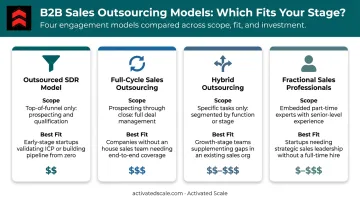
Types of B2B Sales Outsourcing Models
No single model fits every company. The right choice depends on your growth stage, internal capacity, and where your biggest gap sits — top of funnel, closing, or both.
Outsourced SDR Model
This model hands prospecting, outreach, and lead qualification to an external SDR team, while your internal AEs handle demos and closing. It's ideal for companies that have a capable close team but need consistent pipeline feeding it.
The advantage: you skip the cost and timeline of SDR hiring, ramp, and ongoing management without giving up control over deals. Bridge Group's 2024 SDR data shows that SDR attrition planning assumptions run 40–50% annually — which means if you hire in-house, you're essentially replacing half your SDR team every year.
Full-Cycle Sales Outsourcing
Here the partner handles both prospecting and closing. Best for startups launching a new product, entering an unfamiliar market, or companies with no existing sales function at all. It gets you to revenue faster, but the trade-off is less internal knowledge transfer — the learnings tend to stay with the partner.
Hybrid Outsourcing
Companies outsource specific tasks — list building, cold email sequencing, LinkedIn outreach — while keeping strategic selling and relationship management in-house. This is common among growth-stage companies that want cost efficiency without full dependency on an external team.
Fractional Sales Professionals
Rather than engaging an agency, you hire an experienced sales professional on a part-time or project basis — someone who embeds with your team like an employee, not an outsourced vendor.
Activated Scale operates exactly this model: a marketplace of vetted, US-based fractional SDRs, AEs, and VPs of Sales (professionals from companies like Salesforce, Datadog, Oracle, and Zendesk) available on monthly retainers, typically 15–20 hours per week. Their try-before-you-buy structure lets companies evaluate both skills and cultural fit before committing to a full-time hire.
Pricing runs $3,500–$4,500/month plus commission for fractional SDRs and $4,500–$7,500/month plus commission for fractional AEs.
Key Benefits of Outsourcing B2B Sales
The appeal goes beyond cost cutting. Here's what companies actually gain.
Speed to Market
Building an in-house sales team (posting, screening, onboarding, ramping) takes time most early-stage companies don't have. Bridge Group reports that the average SDR ramp period is approximately 3 months, and AEs take an average of 5.3 months to reach full quota capacity.
Fractional and outsourced teams compress that timeline dramatically. Activated Scale, for example, matches clients with vetted fractional professionals in 7 days or less — sometimes under 48 hours. Clients typically see qualified meetings booking by the end of month two, with consistent 10–15 meetings per month by month three.
Cost Efficiency
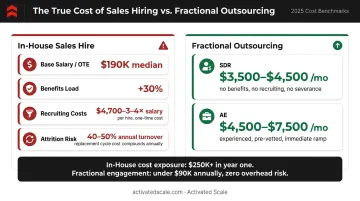
The fully loaded cost of an in-house sales hire goes well beyond base salary. Consider:
- Compensation: Bridge Group's 2024 data puts median SaaS AE OTE at $190,000, with a 53/47 base-to-variable split
- Benefits load: BLS data shows employer benefits add roughly 30% on top of wages for private-industry workers
- Recruiting costs: SHRM estimates average hard cost per hire at $4,700, with total costs reaching 3–4x annual salary when soft costs are included
- Attrition risk: With SDR turnover running 40–50% annually, you may be absorbing those costs repeatedly
Fractional outsourcing converts those fixed costs into variable, flexible commitments. You pay for what you need, scale back when you don't, and avoid the sunk cost of a hire who doesn't work out.
Access to Specialized Talent and Proven Processes
Top outsourcing partners bring systems, not just headcount: established outreach cadences, trained sales professionals, and industry-specific knowledge that would take years to build internally.
Activated Scale's vetting process accepts only the top 7% of applicants, screening each candidate through application review, a 60–90 second pitch video assessed by peers, and a subject matter expert interview. Every professional must have 3+ years of B2B sales experience and a demonstrated track record selling to specific buyer personas — CIOs, CHROs, CMOs — not generic B2B experience.
What this means in practice:
- Professionals arrive with tested outreach sequences, not blank playbooks
- Buyer-persona expertise means faster relationship-building with the right stakeholders
- No internal training investment required before the first meeting gets booked
Scalability Without Long-Term Risk
Outsourced teams can expand during growth sprints and contract during slower periods, with no layoffs, no re-hiring, and no HR complexity. Activated Scale operates month-to-month with no minimum contracts and $0 termination fees, which matters when market conditions shift quickly.
For a startup navigating a product pivot or entering a new vertical, that kind of flexibility isn't a nice-to-have. It's what keeps a bad quarter from becoming a costly one.
Focus on Core Work
Salesforce reports that 70% of sales reps' time is spent on non-selling tasks. For founders personally handling outreach, that number is often higher. Outsourcing reclaims that bandwidth for product development, customer success, and strategic decision-making — the work that actually builds a company.
What B2B Sales Functions Can Be Outsourced?
Outsourcing doesn't require handing over your entire sales org. Most companies delegate one or a few functions based on where gaps exist.
Commonly outsourced functions:
- Lead research and list building
- Outbound prospecting (cold email, cold calling, LinkedIn)
- Appointment setting and pipeline qualification
- SDR function (top-of-funnel outreach and handoff)
- Full-cycle closing (for transactional or mid-market deals)
- Sales operations: CRM management, reporting, tooling
- Fractional sales leadership: strategy, process design, team coaching
Functions harder to outsource effectively:
- Highly technical sales requiring deep product expertise built over time
- Enterprise account management with long-term strategic relationships
- Founder-led sales in early stages where personal trust and narrative are central to the sale
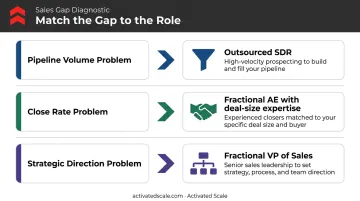
Match the gap to the role:
- Pipeline volume problem → Outsourced SDR work is the clearest fit
- Close rate problem → A fractional AE with experience in your deal size and buyer type
- Strategic direction problem → A fractional VP of Sales is likely the right hire
When Should You Outsource B2B Sales?
Clear Trigger Signals
These situations consistently indicate a company is ready for outsourcing:
- Pipeline is too thin or unpredictable to plan hiring around
- The founding team is splitting time between product and sales
- A full-time AE or SDR hire feels premature or too expensive given current revenue
- You're entering a new market and need rapid outbound coverage
- Internal reps are stuck on admin and prospecting instead of closing
Outsourcing vs. In-House Hiring
| Factor | Outsourcing / Fractional | In-House Hiring |
|---|---|---|
| Time to productivity | Days to weeks | 3–5+ months to full ramp |
| Upfront cost | Low (monthly retainer) | High (salary, benefits, recruiting) |
| Control | Moderate | High |
| Flexibility | Easy to scale up or down | Slower, HR-dependent |
| Long-term talent development | Limited (unless converted) | Strong, if retained |
| Attrition risk | Managed by partner | Yours to absorb |
Outsourcing wins on speed and flexibility; in-house hiring wins on control and institutional knowledge. Many companies use both: fractional talent to validate a model first, then convert top performers to full-time once the approach is proven.
That said, outsourcing isn't always the right call. A few scenarios where it tends to backfire:
When NOT to Outsource
- The product is still pre-product-market-fit and needs exploratory, founder-level conversations to understand what resonates
- Budget is too tight for a quality partner (underfunded outsourcing produces poor results and brand damage)
- There's no internal capacity to onboard or support the outsourced team — even strong fractional talent needs an internal point of contact to stay aligned
How to Choose the Right B2B Sales Outsourcing Partner
The wrong partner costs money and time — months of misdirected outreach can poison your brand with exactly the buyers you most want to win.
Define Your Goals First
Before evaluating any provider, get clear on what success looks like internally. The answer determines which model and which type of partner to evaluate. Common success metrics include:
- Qualified meetings booked per month
- Pipeline value generated
- Revenue influenced within a defined period
- Coverage in a new vertical or market segment
Evaluate Relevant Experience
Generic sales outsourcers struggle with niche B2B markets. Ask whether the partner has worked with companies in your vertical, selling to your type of buyer, at your deal size and sales cycle length. Experience selling $10K deals to SMBs doesn't prepare someone for $100K enterprise cycles — and vice versa.
Assess Team Structure and Talent Quality
Understand who actually does the work. Will you get a dedicated professional or a rotating pool of junior reps? Are they US-based, with conversational credibility in your market?
Activated Scale's network includes professionals from Salesforce, Oracle, Datadog, IBM, Zendesk, ZoomInfo, and 50+ other companies — each vetted through a three-stage process before placement. A 7% acceptance rate tells you more about talent quality than any vendor pitch will.
Review Reporting and Accountability
Good reporting means transparent pipeline visibility, clear KPIs established before day one, and the ability to course-correct quickly when messaging or targeting isn't working. Activated Scale conducts formal monthly performance reviews against Statement of Work metrics, with bi-weekly check-ins between reviews.
Accountability also extends to contract structure. A 12-month commitment with an untested partner is a real risk — short initial engagements with clear extension terms give you a cleaner exit if the fit isn't right.

Understand the Handoff Process
Even strong outsourced pipeline falls apart without a clean handoff. Ask prospective partners how they define "qualified" and how they pass opportunities to your closing team. The mechanics matter more than most buyers expect:
- CRM integration and data hygiene practices
- Call recording standards and accessibility
- Meeting note quality and prospect context passed along
Gaps in any of these mean your closing team inherits half the picture.
Frequently Asked Questions
What is an outsourced B2B sales team?
An outsourced B2B sales team is a group of external sales professionals (employed by a third-party firm or working as fractional contractors) who handle defined sales activities on your behalf. They work with your ICP, messaging, and tools to generate pipeline or close deals — without being full-time employees.
Is outsourcing still a viable strategy for B2B sales?
Yes. Modern outsourcing has moved well beyond low-quality call centers. Specialized providers and fractional professionals integrate closely with internal teams and bring real industry experience. For companies needing pipeline without long-term hiring commitments, it's still one of the most direct paths to building pipeline without a long-term headcount commitment.
How much does it cost to outsource B2B sales?
Cost varies significantly by model. Fractional SDRs typically run $3,500–$4,500/month plus commission; fractional AEs run $4,500–$7,500/month; fractional VP of Sales engagements run $8,000–$15,000/month. Agency-style outsourcing often involves monthly retainers, sometimes with performance fees layered on top.
What are the main types of outsourcing for B2B sales?
Four models cover most scenarios: outsourced SDR teams (top-of-funnel only), full-cycle sales outsourcing (prospecting through close), hybrid models (specific functions only), and fractional sales professionals (embedded, part-time experts on a contract basis).
What sales functions can be outsourced in B2B?
The most commonly delegated functions include lead research, outbound prospecting, cold calling, email outreach, LinkedIn outreach, appointment setting, and pipeline qualification. In some models, full account management and closing are outsourced as well.
How long does it take to see results from B2B sales outsourcing?
Most outsourced and fractional teams deliver qualified meetings within 30–60 days. Consistent pipeline output, typically 10–15 qualified meetings per month for SDR-level engagements, usually materializes by month three.