
SHRM research shows that total hiring expense can reach 3–4x a position's base salary when all costs are factored in — and that's before a single cold call is made. For early-stage B2B founders, that math lands at a very different monthly number than the one on the offer letter.
The blind spots are predictable: benefits and payroll burden, tech stack subscriptions, a 3-month ramp where output is roughly half of what you're paying for, and turnover that hits just when the rep finally gets productive. Each one compounds the other.
This article breaks down realistic monthly cost ranges for SDR teams at different stages, every line item that drives the true number, and how to build a budget that won't surprise you.
Key Takeaways
- A single fully loaded in-house SDR typically costs $9,000–$14,000/month when salary, benefits, tools, management overhead, and recruiting costs are included
- Hidden cost drivers: payroll burden (~25–30% on top of cash comp), tech stack ($150–$700+/rep/month), ramp time, and turnover
- Small teams (1–3 SDRs) pay proportionally more per rep because fixed costs spread across fewer heads
- Fractional SDR models through Activated Scale cost $4,500/month plus performance pay — no recruiting fees, no benefits overhead, and a 2-week ramp instead of 90 days
How Much Does an SDR Team Cost Per Month?
There is no single right number. Monthly SDR costs vary based on team size, experience level, geography, and whether you're running an in-house, agency-based, or fractional model. The gap between what founders budget and what they actually spend, however, stays consistent.
The most common mistake isn't overpaying — it's undercounting. Founders budget for base salary, maybe incentive, and call it done. Then benefits hit. Then the tooling invoices. Then the rep spends month two still learning the product.
Here's where most teams actually land once all costs are counted.
Typical Monthly Cost Ranges
| Setup | Monthly Range | What's Usually Included |
|---|---|---|
| 1 SDR, seed-stage | $6,000–$10,000 | Base + light variable, basic CRM/sequencer |
| 2–4 SDRs, Series A-bound | $20,000–$45,000 | Comp plans, engagement platform, partial manager time |
| 5+ SDRs with management | $55,000–$100,000+ | Full comp stack, enterprise tooling, dedicated SDR manager |
These ranges include compensation and core tooling. They do not account for management overhead, recruiting costs, or turnover provisions — which is exactly where most early budgets fall short.
Entry-Level Setup (1 SDR, Seed-Stage)
This setup runs on base salary plus light incentive, a CRM, and a basic sequencer. Management time is minimal — usually the founder's own. It's the right starting point for validating whether your ICP and messaging can generate meetings before committing to a full team build.
Mid-Range Setup (2–4 SDRs, Series A-Bound)
At this stage, comp plans have defined quotas and incentive tiers. Tooling expands to a dedicated sales engagement platform and a data provider. Management is typically a partial allocation — an SDR manager or a senior AE in a player-coach role.
Best fit: companies with a proven ICP that are ready to build pipeline systematically.
Scaled Setup (5+ SDRs with Management)
This tier includes:
- Full compensation stack with performance incentives
- Enterprise-tier tooling across engagement, data, and CRM
- A dedicated SDR manager or team lead
- Documented onboarding and enablement (not improvised)
It suits post-Series A companies where outbound is a primary growth channel and pipeline predictability matters.
Key Factors That Affect Monthly SDR Team Costs
Monthly SDR spend is shaped by compensation decisions, operational requirements, and organizational factors that compound quickly. Here are the five that move the number most.
Experience Level and Seniority
Entry-level SDR base salaries currently range from $55,000–$70,000 according to Betts Recruiting's 2025 compensation data, with base salaries up 5–10% from 2024. More experienced reps command $65,000–$85,000+. That's a $833–$1,250/month difference in base alone — before variable, benefits, or tooling.
The tradeoff isn't just cost. Under-experienced SDRs in complex B2B environments often produce fewer qualified meetings even at lower pay, which makes the cost-per-meeting metric worse, not better.
Team Size and Span of Control
Costs don't scale linearly. Once you have more than 6–8 SDRs, a dedicated SDR manager becomes necessary — adding $10,000–$20,000/month in fully loaded management cost. Smaller teams absorb that same overhead proportionally more per rep, which is why the per-rep cost at 2 SDRs is often higher than at 8.
Tech Stack Complexity
The difference between a lean stack and a full outbound stack is significant:
- Lean stack (CRM + basic sequencer): ~$50–$200/rep/month. HubSpot Sales Hub Starter runs $7–$20/seat/month; Salesforce Starter at $25/user/month; Apollo Basic at $49/user/month.
- Full outbound stack (CRM + sales engagement platform + data provider + LinkedIn Sales Navigator): $350–$700+/rep/month. LinkedIn Sales Navigator Core alone is $119.99/license/month.
A 2024 Gartner survey of 1,026 B2B sellers found that 50% of sellers feel overwhelmed by required technology — and overwhelmed sellers are 45% less likely to hit quota. When tool count rises faster than adoption, you're paying more for less output.
Geographic Location
Market matters. Per Glassdoor, SDRs in top-tier tech hubs earn a median total upwards of $110,410 — versus the RepVue US median OTE of $85,000. Salary expectations by market:
Top-tier tech hubs: $105,000–$110,000+ OTE
Major secondary metros: ~$80,000 OTE
Emerging/secondary markets: 10–15% below major hubs (per Betts)
Remote hiring doesn't eliminate geography — candidates anchor expectations to their local market, so a remote SF-based SDR typically expects SF-level compensation.
Ramp Time and Turnover
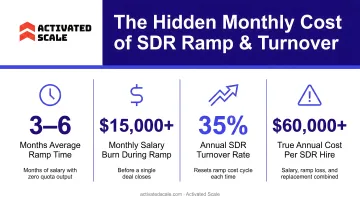
The ramp period — typically 3 months before an SDR reaches full productivity — means you're paying full monthly costs for roughly 50% of expected output during that window. Model this explicitly or you'll miss early pipeline targets.
Turnover amplifies the problem. SHRM data indicates employee replacement costs can range from 50–200% of annual salary. For an SDR earning $75,000, that's $37,500–$150,000 per departure — a cost that hits every time a rep churns, not just once.
Complete Monthly Cost Breakdown of an SDR Team
The real monthly number is not the salary line. It is the sum of six cost categories, and ignoring any one of them produces a budget that will fail.
| Cost Category | Type | Monthly Estimate (Single SDR) |
|---|---|---|
| Base salary | Recurring | ~$5,000/month (RepVue median base: $60K/year) |
| Variable compensation | Recurring | +$1,700–$2,500/month (20–40% of base) |
| Benefits + payroll burden | Recurring | +$1,500–$2,000/month (~25–30% on top of cash comp) |
| Tech stack | Recurring | +$150–$700/month depending on tools |
| Recruiting + onboarding | One-time, amortized | +$300–$600/month (amortized over tenure) |
| Management overhead | Recurring | +$500–$1,500/month (allocated from manager time) |
| Fully loaded total | ~$9,150–$14,300/month |
Three line items in particular deserve more than a table cell. Here's what the numbers actually mean in practice:
Benefits and payroll burden: BLS December 2025 data shows benefits represent roughly 24.7–29.9% of total employer compensation costs for private-industry sales roles. On a $75,000 cash package, that's approximately $1,500–$2,000/month in non-cash overhead.
Recruiting and onboarding: SHRM's 2025 benchmarking data puts the average non-executive cost-per-hire at $5,475. Amortized across a 14–18 month expected tenure, that's roughly $300–$400/month before you account for internal recruiter time or agency fees.
Turnover provision: Rather than treating departure as a surprise, divide estimated replacement cost by expected tenure months and build it into your monthly model as a standing expense. At $5,475 in hard recruiting costs (conservative), that's roughly $350/month if the rep stays 15 months. Soft costs like lost pipeline, manager time, and re-ramp are harder to quantify, but they compound quickly.
How to Build a Smarter Monthly SDR Budget
The right monthly SDR budget isn't the lowest number that keeps reps employed. It's the number that produces predictable, qualified pipeline at a sustainable cost per meeting.
Anchor to Pipeline Output, Not Headcount
Start with your revenue target, work backward to how many qualified meetings per month you need, then determine how many SDRs get you there. Headcount follows math — not intuition.
Model the Ramp Curve
Build a 0–50–100% productivity ramp into months 1–3 of your projections. A rep hired in January won't be fully contributing until April. If your pipeline model assumes full output from day one, your Q1 numbers will disappoint every time.
Standardize the Stack Before Hiring
Settle your tooling decisions before adding headcount. Per-rep tech costs drift significantly when left unmanaged — organizations are projected to overspend by 25% by 2027 from unused entitlements and overlapping tools, according to BetterCloud. Lock in the stack first.
Consider Total Cost vs. Headcount
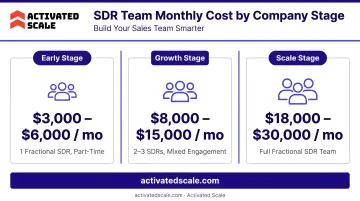
For early-stage B2B SaaS companies that need pipeline now but want to manage cash exposure, fractional and contract-to-hire models change the math entirely. Fractional SDRs through Activated Scale cost $4,500/month plus performance pay, and the structure looks very different from a full-time hire:
- No upfront recruiting fee
- No benefits overhead
- 2-week ramp instead of 90 days
- No restart cost if the fit isn't right after the first engagement
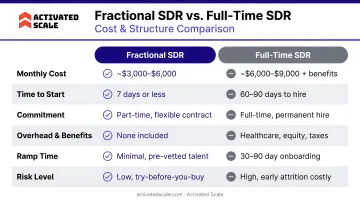
That last point matters more than most founders expect. When a full-time hire doesn't work out after the typical 90-day guarantee period, you're facing a second recruiting fee plus full ramp costs again. With a fractional model, that exposure doesn't exist. About 65% of Activated Scale clients eventually convert their fractional SDR to a full-time hire after seeing results — a genuine try-before-you-hire path, not a compromise.
Common Budget Mistakes to Avoid
- Ignoring benefits, tools, and management overhead — budgeting only base + variable pay routinely understates monthly cost by 40–60%
- Skipping the ramp model — assuming day-one productivity leads to missed pipeline targets and reactive over-hiring that compounds the problem
- Treating turnover as a one-time exception — normalize churn cost into your monthly model from the start, because it will happen
Frequently Asked Questions
How much does an SDR cost per month?
The fully loaded monthly cost of a single in-house SDR typically ranges from $9,000–$14,000/month when salary, benefits, payroll burden, tech stack, management overhead, and amortized recruiting and turnover costs are all included. The base salary alone — roughly $5,000/month at the US median — represents less than 60% of the real number.
What is a realistic OTE for an SDR?
SDR On-Target Earnings in the US typically range from $70,000–$103,000+ annually, depending on experience and market. RepVue puts the median OTE at $85,000; Glassdoor cites a median total pay of $103,000. Base salary covers 60–80% of OTE, with the rest paid through incentives tied to meetings booked or pipeline generated.
How many SDRs does an early-stage B2B startup actually need?
Most seed-to-Series A companies start with 1–2 SDRs to test and validate the outbound motion before scaling. Adding headcount before the ICP, messaging, and qualification process are proven increases monthly spend without proportionally increasing pipeline output.
What is typically included in the monthly tech stack cost for an SDR?
A standard outbound stack includes a CRM, sales engagement platform, and a data or contact provider — with LinkedIn Sales Navigator added for many B2B roles. Public pricing for these tools ranges from $150 to $700+/rep/month depending on which platforms are selected and whether startup or enterprise pricing applies.
How long does it take for a new SDR to become fully productive?
Industry benchmarks put average SDR ramp time at approximately 3–4 months, meaning founders pay full monthly compensation and tooling costs while receiving partial output. Failing to account for ramp time is a consistent budget mistake at the seed and Series A stages.
Is hiring a fractional SDR cheaper than a full-time SDR?
Yes, in most early-stage scenarios. Fractional SDRs eliminate benefits, payroll taxes, and recruiting fees — Activated Scale's fractional SDRs cost $4,500/month plus performance pay, with a 2-week ramp versus 90 days for a full-time hire. About 65% of clients convert their fractional rep to full-time once the outbound motion is proven.