
Introduction
You know your ICP. Your product solves a real problem. You've got a deck, a demo, and a few reference customers. The pipeline is still thin.
For most B2B SaaS founders at seed to Series A, the gap isn't the product. It's consistent, skilled prospecting. Prospecting requires focus, repetition, and a system. A founding team running on fumes can't reliably provide any of them.
This article focuses on the specific strategies fractional SDRs use to build a predictable, qualified pipeline — from ICP targeting and multi-channel cadence design to 30-day setup frameworks and the metrics that tell you whether an engagement is actually working.
Key Takeaways
- Fractional SDRs arrive with tested playbooks — no 90-day ramp required
- A vague ICP generates meetings; a precise ICP generates qualified meetings
- Multi-channel cadences consistently outperform single-channel outreach for meeting conversion
- The first 30 days determine whether the engagement succeeds — structure them deliberately
- Measure activity and reply rates weekly; track SQLs and pipeline value monthly
Why Fractional SDRs Are Built for Pipeline Generation
A fractional SDR has one job: book qualified meetings. No all-hands to prepare for, no internal fire drills, no side projects from the CEO. Full-time SDRs embedded inside growing companies rarely get that kind of focus.
The ramp question comes up constantly. TOPO's Sales Development Benchmark Report of 179 B2B sales development leaders found that SDRs typically take 3.2 months to reach full quota, with a first call happening around the two-week mark — and that's for in-house hires with dedicated onboarding.
Experienced fractional SDRs who arrive with proven outbound playbooks and prior category experience can compress that timeline materially. How much depends on how quickly you get them ramped on your product and ICP.
What Changes With Fractional Talent
The practical difference shows up in three places:
- Prospecting mechanics are already in place — they build sequences, handle objections, and qualify leads without hand-holding
- Hours stay dedicated to outbound — no internal meetings or administrative work pulling them off the phones
- Earlier first meetings — existing playbook frameworks replace the build-from-scratch phase
Those advantages compound quickly when time-to-pipeline matters. For B2B SaaS startups at seed to Series A, Activated Scale connects founders with vetted, US-based fractional SDRs in 7 days or less — meaning outbound activity can start before a traditional hiring process would even finish scheduling a phone screen.
Build a Precise ICP to Drive Targeted Pipeline
A precise ICP doesn't just generate meetings — it generates pipeline that converts.
An experienced fractional SDR given a broad ICP will book meetings. Some will convert. Most won't — because "mid-size B2B software companies" describes half the country. The SDR ends up burning time and contacts on accounts that were never going to buy.
A strong ICP includes:
- Industry and sub-vertical (not just "tech" — specify fintech, DevOps, HR tech, etc.)
- Company size range by headcount and revenue
- Funding stage (seed vs. Series B vs. bootstrapped matters for budget and urgency)
- Tech stack signals — what tools they already use that signal fit or pain
- Org structure — who owns the buying decision, who influences it
- Buyer title and role — not just "VP of Sales" but the specific responsibilities that make them feel the pain your product solves
Sharpening Signals with Technographic and Firmographic Data
Fractional SDRs use data enrichment tools — Apollo, ZoomInfo, LinkedIn Sales Navigator — to layer technographic and firmographic filters onto account lists. A practical example: "they use Salesforce but have no outbound engagement tool in their stack" is a signal that an outbound platform might resonate. That's more actionable than "they're a 200-person SaaS company."
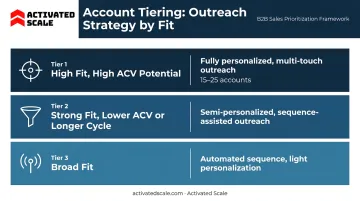
Account tiering keeps the SDR's time protected:
| Tier | Fit | Outreach Style |
|---|---|---|
| Tier 1 | High fit, high ACV potential | Fully personalized, multi-touch |
| Tier 2 | Strong fit, lower ACV or longer cycle | Semi-personalized, sequence-assisted |
| Tier 3 | Broad fit | Automated sequence, light personalization |
TOPO research suggests target-account loads of 15–25 accounts per SDR when working tight, high-value lists — which is roughly what a Tier 1 list should look like.
Aligning ICP to Buyer Persona Messaging
Once the right accounts are identified, outreach has to speak to the right person's specific problem. The pain varies significantly by role:
- A VP of Sales wants to know how this improves rep productivity and pipeline coverage
- A CEO at a 15-person startup wants to know if this closes a critical gap before runway runs out
- A Head of RevOps wants to know if it integrates cleanly with their existing stack
Generic messaging — the "I'd love to learn more about your goals" variety — kills reply rates because it could have been sent to anyone. Specificity is what earns a response.
After 2–3 weeks of outreach, response data tells you something real — who replies, who books, who ignores entirely. Treat the ICP as a starting hypothesis, not a finished document. The SDRs who refine based on live signal are the ones who improve over time.
Multi-Channel Outreach Sequences That Convert Prospects to Meetings
Single-channel outreach underperforms. The data is clear: Gong's analysis of over 300 million calls found email reply rates of 3.44% when calls accompanied email, versus 1.81% for email-only outreach — nearly double the conversion when phone is added to the mix.
RAIN Group research across 489 outbound sellers and 488 buyers found that 8 touches is the average needed to reach an initial meeting, with top performers averaging 5. TOPO puts that number at 21.3 touches over 24 days. The exact number varies by study — but the pattern holds: one channel, one attempt doesn't work.
Building the Core Cadence Structure
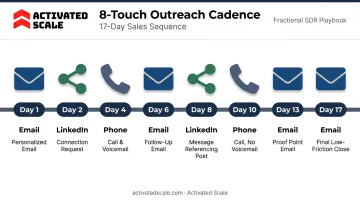
A well-structured 8–12 touch sequence over 2–3 weeks might look like this:
- Day 1 — Personalized email (lead with pain, not features)
- Day 2 — LinkedIn connection request with a brief note
- Day 4 — Phone call + voicemail
- Day 6 — Follow-up email, reference the voicemail
- Day 8 — LinkedIn message (reference a post they wrote or shared)
- Day 10 — Phone call, no voicemail
- Day 13 — Email with a relevant proof point or case reference
- Day 17 — Final email with a clear, low-friction close
The CTA matters. "Would you have 15 minutes this week to see if this is relevant?" converts better than "Can I schedule a 45-minute demo?" The ask should match where the prospect is — which is not yet convinced.
Writing Outreach That Earns Responses
Most SDR emails lead with the product. That's backwards. A better structure:
- Pain — open with something specific to their role or situation that signals you understand their world
- Proof — one sentence connecting a relevant outcome you've helped create
- CTA — one clear, low-pressure ask
Here's what that looks like in practice:
Works: "We help VP of Sales leaders at Series A SaaS companies reduce ramp time by giving reps better call coaching data — we did this for [Company X] in Q1. Worth 15 minutes?"
Doesn't work: "Hi, I'm reaching out because our platform has AI-powered call recording, transcription, sentiment analysis, and coaching features that integrate with Salesforce..."
The first is specific, outcome-focused, and asks for one small thing. The second makes the prospect do all the work of figuring out why they should care.
LinkedIn as a Pipeline Accelerator
LinkedIn does more than InMail. Used well, it functions as a "social warm-up" layer that makes cold email land warmer — because by the time your message hits their inbox, they already recognize your name. The sequence:
- View the prospect's profile
- Comment on a recent post — reference something specific, not a generic "Great post!"
- Send a connection request with a personalized note
- Follow up via message after connecting
Handling Objections to Keep Prospects in the Funnel
Experienced fractional SDRs treat objections as pipeline maintenance. Three common ones and how to handle them:
- "Not the right time" → "Totally understand. When would be a better time to revisit — Q3, or early next year?" (keeps the door open without pressure)
- "Send me more info" → Send one relevant resource, then follow up 3 days later with a specific question about it
- "We already have something in place" → "Good to know — are you happy with how it's performing, or is there a gap you're still working around?" (turns a brush-off into a discovery question)
How to Set Up the First 30 Days for Pipeline Results
Companies that skip structured onboarding see slower ramp and lower meeting quality. Week one is where the engagement succeeds or fails — not week eight.
Week 1 essentials:
- Product and ICP briefing (ideally a 2-hour session with the founder)
- CRM access with appropriate permissions
- Target account list, ready to go
- Messaging review — value prop, key differentiators, persona pain points
- Defined SQL criteria so both sides agree on what a qualified meeting looks like
Defining Goals and Activity Expectations Up Front
The KPI conversation needs to happen before day one. Align on:
- Meetings booked per week and per month
- Outreach volume targets (emails sent, calls made, LinkedIn touches)
- What qualifies as an SQL in this company's specific context
- How activity (leading indicators) will be tracked alongside pipeline (lagging indicators)
This prevents the most common derailment: founders measuring only pipeline in month one, when pipeline is a lagging result of activity that happened weeks earlier. High email volume with low reply rate in week two means the messaging needs adjustment. That's a fixable problem, but only if you're tracking the right signals.
A defined pilot period — typically 60–90 days with clear pipeline targets — gives both sides a structured window to evaluate performance before committing further. Activated Scale's try-before-you-buy model is built around exactly this structure, so the evaluation criteria are set from day one rather than negotiated after the fact.
Building the Messaging Playbook Together
Week one should produce a living document covering:
- Value proposition (2–3 sentences, jargon-free)
- Key differentiators vs. alternatives
- Pain points by persona (VP Sales, CEO, RevOps — each different)
- Objection responses
- Email templates and call scripts as starting points
This isn't about scripting the SDR. It's about reducing the feedback loop when testing new angles and ensuring consistency as the engagement scales.
Integrating the Fractional SDR into the Revenue Team
Fractional SDRs perform better when treated as embedded team members, not vendors:
- Add them to CRM with appropriate access
- Include them in a weekly pipeline sync (30 minutes is enough)
- Define the lead handoff process — what triggers a handoff to an AE, what information must be captured
- Set up a direct Slack or Teams channel for async communication
The handoff process deserves more attention than most teams give it. TOPO data shows 58% of SDR-qualified leads converted to opportunities, with the leading rejection reasons being incomplete handoff meetings (49%) and no next step after the handoff call (43%). The SDR books the meeting; the AE has to show up with context and close the loop within 24 hours.
Measuring Pipeline Success and Avoiding Common Mistakes
The Metrics That Matter
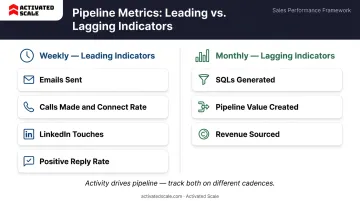
Track two tiers of metrics on different cadences:
Weekly (leading indicators):
- Emails sent
- Calls made, connect rate
- LinkedIn touches
- Reply rate — and specifically positive reply rate
Monthly (lagging indicators):
- SQLs generated
- Pipeline value created
- Revenue sourced from fractional SDR activity
The positive reply rate distinction matters. Outreach's analysis of 6.5 million sequences found that positive reply rate was 33% more correlated with booked meetings than total reply rate. High email volume with mostly unsubscribes looks the same as high email volume with genuine interest if you're only tracking total replies. Track sentiment.
These metrics only improve when you know what's breaking them. That's where most fractional SDR engagements go wrong.
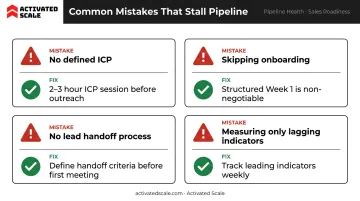
Common Mistakes That Stall Pipeline
1. Launching without a defined ICP The SDR prospects broadly, books meetings, and none of them convert. Fix: spend 2–3 hours on ICP definition before outreach begins.
2. Skipping onboarding The SDR sends generic outreach because they don't have product context. Fix: a structured week one (see above) is non-negotiable.
3. No lead handoff process The AE doesn't follow up within 24 hours. The booked meeting stalls. Fix: define handoff criteria and AE response expectations before the first meeting is booked.
4. Measuring only lagging indicators Pipeline looks slow in month one when activity is actually on track. Fix: track leading indicators weekly and give the lagging metrics time to materialize.
Weekly reviews — what messaging is generating replies, which personas are responding, what objections are coming up most — feed directly back into cadence adjustments. At Activated Scale, the engagements that build pipeline fastest are almost always the ones reviewing signals weekly, not monthly.
Frequently Asked Questions
How many meetings can a fractional SDR realistically book per month?
Meeting volume depends on ICP quality, industry, and outreach approach. TOPO's benchmark data shows qualified-lead quotas ranging from 7 to 15 per month depending on ACV, with higher ACV targets producing lower volume but higher deal value. Fractional SDRs with a defined ICP and a working multi-channel cadence reach the higher end of that range faster than in-house hires still finding their footing.
How long does it take for a fractional SDR to start generating pipeline?
Expect week one to two for setup and alignment, active outreach from week two, and first meetings commonly in weeks three and four. Experienced fractional SDRs compress the ramp because they're not learning how to prospect — they're learning your product, which is a much shorter curve.
What is the difference between a fractional SDR and an external SDR agency?
A fractional SDR is an individual contributor working directly with your team — embedded in your CRM, your Slack, your weekly syncs. An agency provides a team managed through layers of account management, often with less visibility into individual rep activity. Fractional SDRs work better when you need accountability and direct integration; agencies work better when you need raw volume at scale.
How much does a fractional SDR cost compared to a full-time SDR hire?
Fractional arrangements eliminate salary, benefits, equity, and recruiting costs — the loaded cost of a full-time SDR hire runs significantly higher than a fractional engagement at comparable output. Cost varies by experience level and hours, but for early-stage startups, the cost-to-pipeline ratio favors fractional before the outbound motion is proven.
What tools does a fractional SDR need to build pipeline effectively?
The core stack: a CRM (HubSpot or Salesforce), a prospecting data tool (Apollo or LinkedIn Sales Navigator), a sales engagement platform for sequencing (Outreach or Salesloft), and a calendar booking tool. These should be set up and accessible before day one — tool access delays are a common week-one friction point.
When should a startup move from a fractional SDR to a full-time SDR team?
Look for three signals: consistent pipeline proving the outbound motion works, deal volume that justifies full-time headcount, and a documented playbook a new hire can inherit from day one. The fractional stage is the right time to build that foundation. Activated Scale's contract-to-hire model is structured for exactly this transition, with 60% of clients converting fractional talent to full-time after the initial engagement.