

The good news: most bad sales hires are predictable and preventable. Founders who get this right share a common approach — they define the right profile before they start looking, source proactively rather than reactively, and screen for proof of performance, not polish.
This guide covers each of those steps: how to define the sales profile your startup actually needs, where to find genuine talent, how to screen and interview effectively, and how to set whoever you hire up to succeed.
Key Takeaways
- Hire a new business closer (Account Executive), not an account manager or SDR, as your first sales hire
- Top performers rarely apply to job postings — proactive outreach and referrals are essential
- Pre-interview screening assignments filter half the applicant pool before you spend time on interviews
- Watch the CV first: vague metrics and short tenures predict performance better than a polished interview
- Set 30/60/90-day milestones, not annual quotas, to evaluate a new hire early
Define the Right Sales Profile Before You Start Hiring
The Most Expensive Mistake Founders Make
Founders consistently hire the wrong type of salesperson. The three roles sound similar but are completely different jobs:
- New Business Closer (Account Executive) — hunts and closes net-new deals from scratch
- Account Manager — manages and expands existing client relationships
- SDR/BDR — generates and qualifies leads but cannot close independently
For a startup without an established sales team, you need a closer. Hiring an account manager or SDR into a closing role is one of the most common — and most expensive — mistakes in early-stage growth.
What "Startup-Ready" Actually Means
Not every AE can succeed at a startup. Look for someone who has closed new business for:
- A company similar in size and stage to yours (not just a big name)
- A product with similar complexity and a similar sales cycle
- A customer with similar pain points to your ICP
Missing even one of these creates real risk. A candidate who crushed quota at Salesforce or IBM may be excellent on paper.
But if they've only operated with an established playbook, a massive SDR team feeding them leads, and a brand that opens doors, they'll struggle in the ambiguous, figure-it-out reality of an early startup.
Slope Over Intercept
Once you've confirmed startup-readiness, look at trajectory. A candidate promoted 2-3 times in 3 years at a growth-stage company is one of the most reliable hiring signals you'll find. This "slope over intercept" thinking means their upward momentum — how fast they've grown — tells you more than their current title or employer name ever will.
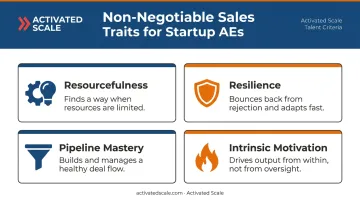
Non-Negotiable Traits Beyond Sales Skills
| Trait | What to Look For |
|---|---|
| Resourcefulness | Figures things out without constant guidance |
| Resilience | Doesn't personalize rejection; rebounds quickly |
| Pipeline mastery | Comfortable generating their own outbound pipeline |
| Intrinsic motivation | Driven by impact, not just incentive |
Where and How to Source Top Sales Talent
Why Job Boards Alone Won't Work
The best salespeople are succeeding in their current roles. They're not browsing job listings at 11pm. A passive posting will attract candidates who are actively looking — which, in sales, often correlates with underperformance or recent quota misses.
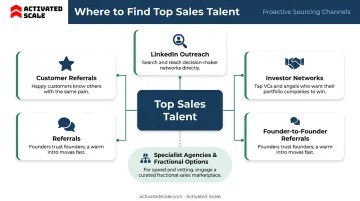
Where to actually find top performers:
- Direct LinkedIn outreach targeting AEs at companies 1-2 stages ahead of yours
- Investor networks: your Series Seed or pre-seed investors have portfolio companies with strong sales talent
- Founder-to-founder referrals — ask other founders "who's the best salesperson you've ever seen?"
- Customer referrals: your best customers know who sold them well elsewhere
The most powerful sourcing question you can ask anyone in your network: "Who is the best salesperson you've ever dealt with?" That name — whoever comes up repeatedly — is your target.
Specialist Channels and Fractional Options
Niche sales recruiting agencies that focus on B2B SaaS environments can accelerate sourcing. For founders who lack the time or network to source independently, Activated Scale connects B2B SaaS startups with pre-vetted, US-based fractional sales professionals (including Account Executives) in as little as 7 days.
Their contract-to-hire model lets founders evaluate real performance before committing to a full-time hire, directly reducing the risk of a $177,000 mistake.
Consider Hiring Two AEs Simultaneously
SaaStr recommends hiring two initial AEs rather than one, specifically because a single rep gives you no internal benchmark. Two reps let you run an A/B comparison — who builds pipeline faster, who closes cleaner, who adapts to your ICP more quickly. If one fails, you still have momentum. Treat this as a practical benchmarking tactic when your runway allows it.
How to Screen and Interview Sales Candidates Effectively
Step 1: Pre-Interview Written Screen
Before any call, send candidates a short written screening assignment — 3-5 biographical and behavioral questions via email. This does two things:
- Filters out half the applicant pool immediately (candidates who don't respond are disqualified)
- Tests written communication — if they can't write a compelling paragraph about why they want the role, they won't write effective cold outreach emails either
Step 2: The Hidden Instruction Test
Embed a small, specific instruction inside the job description — ask applicants to include a specific word in their subject line, or answer a brief question buried in the posting. Candidates who miss it haven't read carefully. In a sales role, where following process and attention to detail directly affect outcomes, this is a meaningful disqualifier.
Step 3: Make Them Sell Your Product
The most revealing interview exercise: ask candidates to pitch your actual product — not a generic "sell me this pen." Give them access to your website and a short brief in advance. During the mock pitch, cut their allotted time in half without warning. Watch how they adapt under pressure. That moment tells you more than 45 minutes of conversation.
Step 4: Behavioral Questions That Reveal Real Capability
Ask for evidence of what they've done, not what they say they'd do. Strong behavioral questions:
- "Walk me through your sales process step by step — from first touch to close."
- "Tell me about a deal you lost that you should have won. What happened?"
- "How do you generate your own pipeline when inbound is slow?"
- "What was your worst month in the last two years, and what caused it?"
The last question is particularly useful. Poor performers blame external factors — bad leads, wrong territory, pricing issues. Strong performers take ownership of their outcomes.
Step 5: Psychometric Assessment as a Supplement
Personality or sales DNA assessments (such as a structured 16-type assessment or a dedicated sales aptitude tool) can reveal work style and values alignment with your company's culture. Use them as supplementary context — research from Sackett et al. shows structured interviews hold an operational validity of .42 while personality measures score .19 — meaning demonstrated skill always outweighs personality fit in predicting performance.
Candidates who engage readily with every step of your process — the written screen, the hidden instruction, the live pitch — signal genuine commitment. That pattern of follow-through is often predictive of how they'll perform on the job.
Red Flags vs. Green Flags: What to Look for in a Sales Hire
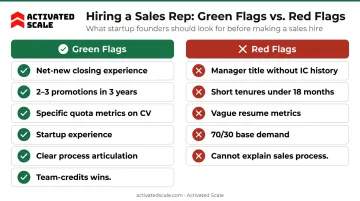
Green Flags
- Closed net-new business (not managed accounts) at a company similar in stage
- Promoted 2-3 times in 3 years
- Specific performance metrics listed for every role (e.g., "114% of $800K quota in FY23")
- Startup or scale-up experience with direct, measurable impact
- Can articulate their sales process clearly and step-by-step
- Credits their team or process for wins — signals self-awareness and ownership, not ego-driven attribution
Red Flags
- "Sales Manager" or "Head of" title without recent individual contributor history
- Job tenures under 18-24 months across multiple sales roles — probe these carefully
- Vague or absent performance data on the resume ("supported revenue growth," "drove initiatives")
- Demands a 70/30 base-to-variable split — signals account manager mindset, not a hunter
- Cannot explain their sales process when asked directly
Once you've run through both lists, one question cuts through everything else.
The Final Litmus Test
Ask yourself honestly: Would I buy my own product from this person?
If the answer is anything but a clear yes, keep looking. Your first sales hire will set the tone for every deal, every prospect relationship, and every rep you hire after them — a polished resume doesn't change that.
How to Set Your New Salesperson Up for Success
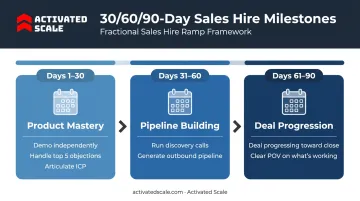
30/60/90-Day Milestones, Not Annual Quotas
Annual quotas are useless for evaluating a new sales hire in the first 90 days. Set leading indicators instead:
| Period | What "Good" Looks Like |
|---|---|
| Days 1–30 | Can demo the product independently, handle top 5 objections, articulate ICP clearly |
| Days 31–60 | Running their own discovery calls, building pipeline without prompting |
| Days 61–90 | At least one deal progressing toward close; clear point of view on what's working and what isn't |
If by day 90 a hire can't articulate your ideal customer profile and generate independent pipeline, they're likely the wrong person — regardless of how well they interviewed.
Onboarding Is the Founder's Responsibility
A sales hire without basic onboarding resources wastes their first month reinventing knowledge that already exists in your business. Before day one, prepare:
- Recorded customer calls (ideally 5-10 examples)
- Customer case studies and objection handling guides
- Competitive landscape documentation
- Clear ICP documentation with firmographic and behavioral criteria
This investment protects the hire and compresses ramp time. A Sales Management Association study found that companies with effective onboarding achieved 10% higher sales growth and 14% better sales objective achievement than those without — even accounting for other variables.
When a New Hire Isn't Working
Set a clear decision framework before day one. Define the leading indicators that signal success or failure — calls made, pipeline generated, meetings booked — and review them formally at day 30 and day 60. Don't wait for day 90 to have the performance conversation.
For founders who want to reduce this risk before committing to a full-time hire, Activated Scale's contract-to-hire model lets you evaluate a sales professional's real performance on your actual pipeline before making a permanent offer. Roughly 60% of clients convert their fractional hire to full-time after the initial contract period — a sign the model produces matches worth keeping.
Frequently Asked Questions
When should a founder stop doing sales and hire a salesperson?
The trigger isn't a revenue number — it's when you've personally closed 10-20 customers and validated that the process is repeatable. If sales is consuming more than half your working week and you have a proven motion to hand off, it's time to hire.
Should I hire a full-time salesperson or start with a fractional one?
A full-time hire offers focus but carries significant financial risk if it fails. A fractional salesperson lets you validate whether a person and a process can work before committing to a full salary. This is especially useful for startups with limited runway who haven't managed a sales hire before.
What's the difference between an SDR and an Account Executive, and which should I hire first?
An SDR generates and qualifies leads but cannot close. An Account Executive takes a prospect from first conversation to signed contract. For your first sales hire at a startup, hire the Account Executive — the closer — first.
How much should I pay my first sales hire?
Plan for roughly a 50/50 base-to-variable split. The Bridge Group's 2024 benchmark report puts the median at 53:47 base-to-variable across B2B SaaS. Get a stage-matched benchmark before finalizing the offer — a failed hire costs far more than a slightly higher base.
How long does it take a new salesperson to start producing results?
The Bridge Group's 2024 data shows a 5.3-month median AE ramp across B2B SaaS. Activity metrics — calls, meetings, pipeline — should be visible within the first 30-60 days even if revenue closes later. Build this timeline into your runway planning before making the hire.
What is the biggest mistake founders make when hiring their first salesperson?
Two mistakes tend to compound each other: hiring an account manager or "sales manager" type instead of a dedicated new business closer, and filling the role exclusively through inbound applicants rather than proactive sourcing via referrals and direct outreach. Do both, and a bad hire becomes nearly certain.