
Introduction
Hiring a sales rep is one of the most expensive decisions an early-stage founder makes — and the price tag extends well beyond the base salary. According to SHRM, the average cost per hire across US companies is nearly $4,700, and total hiring costs can reach 3–4 times a position's annual salary when hard and soft costs are included.
For a B2B SaaS startup on seed or Series A capital, the math gets brutal fast. A 2024 Bridge Group survey of 172 B2B SaaS companies found a median AE base salary of $100K, a median OTE of $190K, and an average ramp time of 5.7 months before a rep is fully productive.
Median annual AE turnover sits at 30%. That means you could spend six figures on a rep, wait half a year for them to ramp, and face a one-in-three chance of starting over within the year.
The real problem isn't that sales talent is expensive by nature. It's that most of the cost comes from avoidable decisions — the wrong model, wrong timing, wrong sourcing channel, and poor management once someone is in the seat. This guide breaks down where those costs actually come from — and which decisions you can make differently to keep them in check.
Key Takeaways
- The real cost of a sales hire goes beyond base salary: recruiting fees, ramp time, turnover risk, and lost pipeline add up fast.
- Fractional and contract-to-hire models give founders a way to generate pipeline and test fit before committing to full-time salary.
- Variable-heavy compensation structures tie spend directly to results, reducing fixed burn.
- Referral sourcing and specialized talent networks cut recruiting costs and reduce time-to-hire.
- Tracking activity-based KPIs in the first 60 days is your lowest-cost signal that a rep is — or isn't — working out.
How the True Cost of Hiring Sales Reps Builds Up
The sticker price — the base salary — is the most visible line item and rarely the largest one. Cost accumulates across stages that most founders don't track until things go wrong.
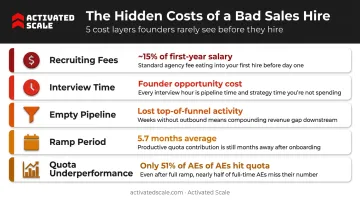
The Hidden Cost Layers
Each stage of the hiring process carries its own price:
- Recruiting: Third-party recruiters typically charge around 15% of first-year salary, per Indeed. On a $100K base, that's $15,000 before anyone's had a first conversation with a prospect.
- Interview time: Founder hours spent screening, interviewing, and deliberating represent real opportunity cost — time not spent closing deals or building product.
- Empty pipeline: The weeks between deciding to hire and a rep's start date are weeks of lost top-of-funnel activity.
- Ramp period: Bridge Group's data puts average AE ramp at 5.7 months. During that window, you're paying full compensation for partial or no output.
- Quota underperformance: The same survey found only 51% of AEs hit annual quota on average — meaning roughly half of your sales hires won't generate the revenue you planned around.
Why Turnover Compounds Everything
Those per-hire costs wouldn't sting as much if sales hires stuck around — but at 30% median annual turnover, a single bad hire rarely stays isolated. You spend 3 months hiring, 6 months discovering the rep isn't working, and another 3 months replacing — all while paying full comp and watching pipeline stall. Then the cycle starts over.
Most founders only see the base salary line. When you factor in recruiting fees, ramp losses, and replacement time, the actual cost of a failed hire routinely exceeds the annual salary itself — often before you realize the hire isn't working.
Key Cost Drivers When Hiring Sales Reps
Cost in sales hiring flows from three distinct categories. Each operates independently and compounds with the others.
Structural Choices
What type of rep you hire, what compensation model you use, and when you hire all determine your cost floor before a single interview happens. A full-time AE on a base-heavy structure creates fixed cost regardless of results. That structural choice shapes everything downstream.
Execution Failures
Poor onboarding, unclear expectations, and slow performance detection are expensive. A rep who's underperforming but unmanaged for 90 days costs exactly as much as a rep hitting quota — until you catch the problem. By the time most founders notice, it's already cost them a quarter.
Sourcing Inefficiency
Generalist job boards like LinkedIn and Indeed surface a broad mix of candidates. Sorting through account managers, SDRs, and enterprise reps when you need a startup-ready closer who can work a short sales cycle wastes weeks. That time has a real cost.
Timing is one of the most underestimated cost drivers. Hiring a rep before you've validated your sales process means there's no repeatable methodology to hand off. The rep burns your best leads trying to figure out what works.
When that happens, the failure gets attributed to the rep — not the missing playbook. Before you hire, you should be able to describe how you close a deal step-by-step, from outreach to signed contract.
Cost-Reduction Strategies for Hiring Sales Reps
No single tactic eliminates hiring cost. The most effective approach targets all three layers: the decisions made before the hire, how the hire is managed once in place, and where and how talent is sourced.
Strategies That Change the Hiring Decision
Choose fractional or contract-to-hire before committing to full-time. A fractional sales professional works part-time or on a defined contract, allowing a startup to generate pipeline and evaluate fit before taking on a full salary commitment. For a pre-Series A company, this is often the right first move — not a compromise, but a more rational sequencing of risk.
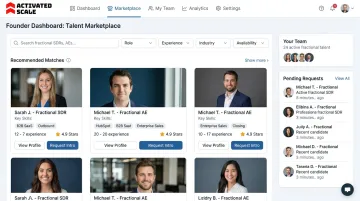
Platforms like Activated Scale connect B2B SaaS founders with pre-vetted fractional SDRs and AEs, with placements in as little as 7 days. Engagements run at $4,500/month plus performance pay for fractional SDRs and $6,500/month plus performance pay for fractional AEs — a fraction of the loaded cost of a full-time hire. Roughly 60% of Activated Scale clients convert their fractional hire to full-time once fit is confirmed.
Design a variable-heavy OTE structure. The Bridge Group's 2024 benchmark found a median pay mix of 53% base to 47% variable for SaaS AEs. Shifting toward a more variable-heavy ratio — for example, 50/50 or 40/60 base-to-variable — ties your spend directly to output and filters for candidates who believe in their own ability to produce. Reps who aren't confident in their ability to close won't take variable-heavy roles. That self-selection has value.
Validate your sales process yourself first. The hire should come after you understand how a deal closes, not before. If you can't describe your sales motion clearly, a rep won't be able to follow one. The founder's firsthand sales experience isn't just useful — it's the prerequisite for a rep being able to succeed.
Consider starting with two reps rather than one. Hiring a single rep creates a diagnostic blind spot: if performance is poor, you can't tell whether the problem is the individual or the process. Starting with two reps gives you a comparison baseline and reduces the risk that one failed hire stalls revenue for 12+ months while you start the search over.
Strategies That Change How the Hire Is Managed
Build a structured 30/60/90-day onboarding plan. Brandon Hall research found that organizations with mature onboarding practices are up to 103% more likely to report improvements in new-hire retention and engagement. For sales specifically, a clear milestone plan — what the rep should know, do, and close by each checkpoint — closes the expensive gray area where underperformance goes undetected.
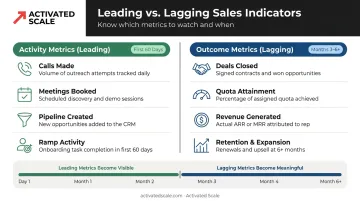
Set activity-based KPIs from day one. There's a critical difference between leading and lagging indicators:
| Metric Type | Examples | When useful |
|---|---|---|
| Activity (leading) | Calls made, meetings booked, pipeline created | First 60 days |
| Outcome (lagging) | Deals closed, quota attainment | Months 3–6+ |
In the first two months, you can't measure quota attainment — the sales cycle hasn't had time to close. But you can absolutely measure whether a rep is doing the activities that lead to deals. Monitoring leading indicators catches underperformers before their inactivity becomes invisible.
Apply the 30% rule as a budget ceiling. A rep's total cost — base, incentive, benefits, and training — should not exceed roughly 30% of the revenue they generate. Use this as a framework to set a financially sustainable pay rate before the hire begins, not after results disappoint.
Conduct structured exit interviews. Gallup found that 42% of voluntary departures are preventable, with compensation issues (30%) and manager interactions (21%) as the leading drivers. Understanding why reps leave lets you fix root causes rather than repeat the same expensive hiring cycle. Most turnover problems are knowable in advance — they just require asking.
Strategies That Change the Sourcing Context
Use referrals as your primary sourcing channel. Ask current customers, investors, advisors, and colleagues one simple question: "Who is the best salesperson you've ever worked with?" This surfaces passive candidates — people not actively job searching — at zero recruiting cost.
According to Jobvite research, referred employees have twice the first-year retention rate of non-referred hires, and 62% of companies with referral programs report faster time-to-fill for referred positions.
Use specialized talent networks, not generalist boards. Generalist platforms require significant filtering time and often surface candidates who look like salespeople on paper but lack startup-specific selling experience. Specialized networks that pre-screen for a startup context — like Activated Scale, which accepts only the top 7% of applicants — cut weeks from the search and sharply improve candidate-to-role fit.
Kognitos founder Binny Gill put it directly: "Activated Scale quickly understood my current stage and recommended an expert that has sold to my buyer." That level of matching specificity simply doesn't come from a LinkedIn post.
Post job descriptions with transparent compensation ranges. SHRM's 2023 survey of 1,386 HR professionals found that 70% reported more applicants after listing pay ranges, 66% reported higher-quality applicants, and 82% of US workers said they were more likely to apply when a salary range was included. Transparent comp expectations filter out candidates whose expectations exceed your budget before either party wastes time on a phone screen.
Use contract-to-hire to avoid sunk-cost commitment. The try-before-you-buy model works because it separates the evaluation from the commitment. A rep works under a defined contract, you assess real-world performance in your specific market context, and you only convert to full-time if results and fit justify it. If the fit isn't right, the contract ends — no severance, no lengthy termination process, no sunk cost beyond the contract period itself.
Conclusion
The real lever in sales hiring costs isn't salary negotiation. Cost originates at three distinct points: the hire decision itself, the management structure around the rep, and the sourcing context. Addressing all three layers is what separates companies that scale efficiently from those that keep repeating expensive mistakes.
Getting this right early compounds quickly. A repeatable, low-waste hiring process builds institutional knowledge about what a successful sales hire looks like in your specific market — knowledge that makes every subsequent hire faster and cheaper than the last. For early-stage companies, models like fractional or contract-to-hire engagements (through platforms like Activated Scale) let you build that institutional knowledge without betting the runway on a full-time hire that doesn't work out.
Frequently Asked Questions
What is the cheapest way to hire a sales rep?
The most cost-effective approaches are fractional hiring, referral sourcing, and variable-heavy compensation structures — each targeting a different cost layer. Weigh "cheapest" against fit quality: a low-cost mishire usually ends up costing more than a well-matched hire at a higher rate.
Is performance-only hiring a good idea for startups?
Performance-only lowers fixed cost but tends to attract lower-quality candidates who need income security to focus. A modest base paired with aggressive incentive typically produces better results — it signals you're serious about the role while still rewarding performance heavily.
What is a fractional sales rep and how does it save money?
A fractional rep works part-time or on a contract basis, giving you access to experienced sales talent without the full-time salary and benefits commitment. You pay for the output you need now, with the option to convert to full-time once performance is validated.
How much should a startup budget for their first sales hire?
A useful rule of thumb: a rep's total cost (base, incentive, benefits, and early ramp-up losses) should not exceed roughly 30% of the revenue they generate. Budget for the fully loaded cost, not just base salary.
When should a founder stop doing sales themselves and hire someone?
Once you've personally validated the sales process and can describe how deals close step by step. If selling is consuming more founder time than the business can sustain, that's the signal to bring someone in.
What's the difference between a fractional sales rep and a full-time hire?
Fractional reps offer part-time commitment, lower cost, and built-in flexibility to evaluate fit before converting. Full-time hires provide dedicated focus but carry higher fixed cost and greater financial risk if the fit turns out to be wrong.