?](https://file-host.link/website/activatedscale-qplyam/assets/blog-images/a8e5a380-c88b-4239-81a2-3fcb13e81946/1783945895282515_ed90ddf79de84735a227cf64bf7d626d/360.webp)
Introduction
You've got a product that works, a few customers who love it, and a founder who's been personally closing every deal. Now you need to scale revenue — fast. For most early-stage B2B SaaS founders, the next question isn't whether to hire a salesperson — it's which kind.
Do you build out an SDR/AE split model, where one person prospects and another closes? Or do you hire someone who owns the entire process — from cold outreach to signed contract?
That second option has a name: the full cycle account executive. This post covers what the role actually means, how it differs from the SDR/AE split model, what responsibilities and skills it requires, and when it's the right hire for your stage.
Key Takeaways:
- Full cycle AEs own pipeline generation and closing — no handoffs between roles
- Best fit for early-stage startups, niche markets, and complex products where continuity matters
- SDR/AE splits scale at higher volume, but carry real handoff and alignment costs
- One experienced full cycle AE can replace two specialized hires
- Fractional full cycle AEs let founders test the model before committing full-time
What Is a Full Cycle Account Executive?
A full cycle account executive is a quota-carrying sales professional who manages every stage of the sales process independently — prospecting, discovery, demo, negotiation, and close — without passing the opportunity to another role between stages. RepVue's account executive role definition captures this precisely: AEs manage the entire cycle from prospecting and discovery through negotiation and close.
How This Differs from the Standard Model
The dominant alternative is the SDR/AE split model, popularized by Aaron Ross and Marylou Tyler's Predictable Revenue (2011). That framework argues for dividing sales into four distinct functions: inbound qualification, outbound prospecting, closing, and post-sale account management. The logic is that specialization improves focus, measurement, and repeatability at scale.
The full cycle AE predates this model and remains the default structure for companies where handoffs introduce more friction than they solve.
What "Full Cycle" Actually Means
In practice, the full cycle AE is accountable for two things simultaneously:
- Sourcing their own leads through outbound outreach, inbound follow-up, and referrals
- Advancing those leads through every stage of the funnel and closing them
Their results don't depend on another team's output or a handoff process working correctly — which makes performance attribution cleaner and accountability direct.
Where the Role Is Most Common
Full cycle AEs are the standard structure in:
- Early-stage startups with small or no dedicated sales teams
- Niche markets where lead volume is limited
- Companies selling complex or consultative solutions requiring deep product knowledge throughout the entire buying journey
- Geographically dispersed teams where handoffs are logistically awkward
AE Levels and Full Cycle Scope
AEs typically progress through a career ladder: Associate AE → Account Executive → Senior AE → Strategic/Enterprise AE. Full cycle responsibilities are most common at the AE and Senior AE levels. Senior AEs tend to manage more complex deal cycles independently, while Associate AEs may handle smaller or inbound-only opportunities with less prospecting expectation.
Full Cycle AE vs. the SDR/AE Split Model
The SDR/AE split divides top-of-funnel work (prospecting, outreach, lead qualification) from bottom-of-funnel work (demos, objection handling, closing). SDRs generate and qualify opportunities, then pass them to AEs. It's a model built for volume and scale — but it requires larger teams, tighter coordination, and carefully designed handoff processes.
Side-by-Side Comparison
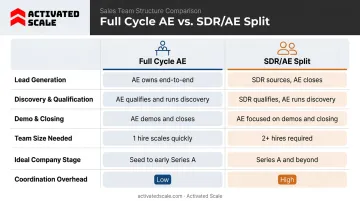
| Factor | Full Cycle AE | SDR/AE Split |
|---|---|---|
| Lead generation | AE sources own pipeline | SDR handles outbound/inbound |
| Discovery & qualification | AE runs discovery | SDR qualifies, then passes to AE |
| Demo & closing | AE does both | AE closes after SDR handoff |
| Team size needed | 1 person | Minimum 2 roles |
| Ideal company stage | Early-stage, niche markets | Series B+, high-volume markets |
| Coordination overhead | Low | Higher |
Where the Split Model Creates Problems
The SDR/AE model has real structural vulnerabilities that make full cycle AEs appealing at certain stages. OpenView's research on sales segmentation documents three common failure modes:
- SDRs rewarded for appointment volume book meetings that aren't genuinely qualified — wasting AE time
- Buyers can wait over a week for the handoff, then repeat information they already gave the SDR
- Incentive misalignment between SDRs (rewarded for meetings booked) and AEs (rewarded for revenue) creates ongoing friction
The right choice comes down to your stage and market. The split model earns its overhead when deal volume is high, the process is repeatable, and the addressable market is large enough to feed two distinct roles. At earlier stages — where continuity and fast feedback loops matter more than throughput — the full cycle model is typically the better fit.
Key Responsibilities of a Full Cycle Account Executive
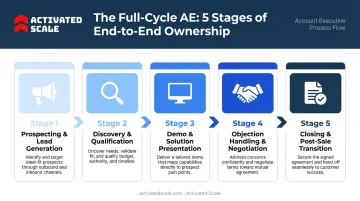
A full cycle AE's responsibilities span the entire funnel. Here's what that looks like in practice:
Prospecting and Lead Generation
Full cycle AEs build their own pipeline. That means outbound cold email, LinkedIn outreach, cold calls, and following up on inbound signals — without waiting for an SDR to deliver qualified meetings. Pipeline generation is a core job requirement, not a bonus activity.
Discovery and Qualification
The AE runs discovery calls to assess fit across budget, authority, need, and timeline. Because they've sourced the lead themselves, they carry context into every next step — no information gets lost in translation between a prospector and a closer.
Demo and Solution Presentation
Because the AE conducted discovery, their demos are more targeted. They already know which pain points matter most to this specific buyer, which objections are likely, and which product capabilities to emphasize. When discovery and demo are split across two reps, that context rarely transfers cleanly.
Objection Handling and Negotiation
Full cycle AEs manage pricing conversations, stakeholder pushback, and deal structure decisions without a handoff. Their familiarity with the prospect from first contact gives them a real advantage at the late stages, when deals are most fragile.
Closing and Post-Sale Transition
Full cycle AEs close the deal and manage the handoff to customer success or onboarding — ensuring the buyer isn't suddenly dealing with someone they've never met.
That continuity matters. A buyer who has built trust with one rep across the full sales cycle is far less likely to experience post-signature regret or early churn than one handed to a stranger right after signing.
Essential Skills of a High-Performing Full Cycle Account Executive
The full cycle AE role demands a broader skill set than either an SDR or a closing-only AE. Here's what separates the effective ones:
Self-Sufficiency and Pipeline Ownership
Full cycle AEs can't rely on another role to keep their pipeline full. That means genuine outbound discipline — consistent prospecting activity, comfort with cold outreach and rejection, and the ability to generate pipeline from scratch.
This is often where candidates who've only worked as closing AEs struggle when they step into a full cycle role.
Consultative Communication and Active Listening
Gartner identifies "mentalizing" — understanding and prioritizing the buyer's perspective — as a critical modern seller competency. For full cycle AEs, there's no workaround: they run discovery themselves, so the quality of their listening directly determines the quality of their demos, proposals, and closes. Asking the right questions matters more here than in a closing-only AE role where someone else has already done the diagnostic work.
Time Management and Prioritization
Full cycle AEs are always managing two competing demands:
- Prospecting builds future pipeline but pays off slowly — easy to skip when active deals feel urgent
- Advancing active deals drives immediate results but can quietly starve the pipeline when it crowds out outbound time
Without strong prioritization, pipeline stalls. Good full cycle AEs use their CRM to track where each opportunity sits in the funnel and protect prospecting time even when active deals feel more urgent. This discipline is what separates reps who hit their numbers quarter after quarter from those who close in bursts with long gaps in between.
Benefits of a Full Cycle AE for B2B SaaS Startups
Faster Feedback Loop Between Market and Product
When one person runs the full cycle, your company gets unfiltered market signal. The AE hears objections firsthand, learns buyer language at the prospecting stage, and can relay competitive insights directly back to the founding team. In a split model, that signal travels through two people — and often arrives distorted or delayed.
As a16z describes in their early-market selling framework, early sales conversations are also discovery: they identify which customers have urgent problems, reveal missing product capabilities, and help establish a repeatable motion. A full cycle AE, owning every stage, amplifies that learning.
Lower Overhead and Team Complexity
Hiring one experienced full cycle AE instead of an SDR plus a closing AE means fewer people to manage, fewer coordination processes to maintain, and one clear owner of results. For founders who are already stretched thin, that simplicity has real operational value.
For context, here's how the math shakes out (based on RepVue's July 2026 benchmarks across 34,000+ verified submissions):
| Role | Median OTE |
|---|---|
| Account Executive (AE) | $200,000 |
| Sales Development Rep (SDR) | $85,000 |
A single full cycle AE costs more upfront than one SDR, but considerably less than two specialized hires. It also eliminates the management overhead that comes with running two distinct functions.
Consistent Customer Experience
Prospects interact with the same person from first outreach to signed contract. That continuity builds trust faster and removes the friction of repeating themselves mid-journey. Sales practitioners consistently note that buyers who must wait for a handoff and re-explain their situation to a new AE are at real risk of disengaging entirely — a pattern many cite as a deal killer.
When to Hire a Full Cycle AE (and When Not To)
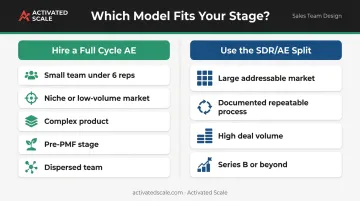
Hire a Full Cycle AE When:
- Your team has fewer than 5-6 sales reps and can't support two distinct roles
- Your market is niche, with limited lead volume that doesn't justify a dedicated SDR
- Your product is complex enough that deep knowledge throughout the entire sale matters
- You're pre-product-market-fit and need one person running experiments across the full funnel
- Your sales team is geographically dispersed, making handoffs logistically impractical
Point Nine's early-stage hiring framework describes this profile as a "Sales Pioneer" — someone entrepreneurial enough to create their own leads and carry opportunities through close without requiring established infrastructure or a known brand to lean on.
Stick with the SDR/AE Split When:
- You have a large, well-defined addressable market with high inbound or outbound volume
- Your sales process is documented, repeatable, and proven
- Deal volume justifies role specialization
- You're at Series B or beyond, where pipeline capacity has outgrown what full cycle AEs can generate alone
Aaron Ross's original heuristic is useful here: consider separating a function once it consumes more than 20% of the broader team's time. That's when specialization starts to pay off.
Testing the Full Cycle AE Model Without a Full-Time Hire
For founders who want to validate this model before committing to a permanent hire, Activated Scale provides access to vetted, experienced fractional full cycle AEs, connectable in 7 days or less. The Windsor case study shows what this looks like in practice: it took just 8 days from an initial call to having an AE actively working, and that AE produced a 4x increase in average deal size.
The fractional engagement starts as a contract role, structured to your timeline and budget, with the option to convert to a full-time hire once you've seen proven performance in a live environment. Roughly 60% of Activated Scale clients make that conversion — because watching someone prospect and close tells you far more than any interview ever will.
Frequently Asked Questions
What is a full cycle account executive?
A full cycle account executive is a sales professional who manages every stage of the sales process — from prospecting and outreach through discovery, demo, negotiation, and close — without relying on handoffs between SDR and AE roles. One person owns pipeline generation and revenue generation end to end.
What are the levels of account executives?
The typical AE career progression runs: Associate AE → Account Executive → Senior AE → Strategic or Enterprise AE. Full cycle responsibilities are most common at the AE and Senior AE levels, where reps are expected to manage complex deal cycles independently.
What is the difference between a full cycle AE and an SDR?
An SDR focuses exclusively on top-of-funnel activities — prospecting, outbound outreach, and qualifying leads — then passes opportunities to an AE for demos and closing. A full cycle AE does both jobs without a handoff, owning the opportunity from first contact to signed contract.
What skills does a full cycle account executive need?
The role requires a broader skill set than either an SDR or closing-only AE position:
- Outbound prospecting discipline to build consistent pipeline
- Consultative listening and discovery to uncover real buyer needs
- Strong negotiation instincts to move deals across the finish line
- Time management to balance prospecting and active deal progression simultaneously
When does a startup need a full cycle AE instead of an SDR/AE team?
Full cycle AEs fit early-stage startups with small teams, niche markets, or complex products. When one experienced person can own the full funnel efficiently, there's no need to build out a two-role structure. The SDR/AE split makes more sense once deal volume, team size, and market scope justify dedicated specialization.