Introduction
You spend three weeks interviewing. The candidate has a polished resume, strong references, and an impressive first impression. You make the offer. Ninety days later, the pipeline is thinner than when they started, your team's energy has dropped, and you're staring at a territory that went backwards — having burned through salary, onboarding time, and momentum you can't recover.
For B2B SaaS startups, a bad sales hire isn't just an inconvenience. It's a strategic setback that hits exactly when growth matters most. Gallup estimates that replacing a single employee costs between 0.5x and 2x their annual salary — and that's before accounting for the deals that never closed, the prospects who moved on, and the quarters your competitor used to gain ground.
Here's what this guide covers:
- Why bad hires slip through even rigorous interview processes
- What the real cost breakdown looks like
- Red flags that signal a problematic candidate
- What to actually look for in a strong sales hire
- How to build a process that dramatically reduces hiring risk
Key Takeaways
- The real cost of a bad sales hire extends well beyond salary: lost pipeline and missed revenue dwarf the direct expenses
- "Drive" is the most critical trait in a salesperson and the hardest to fake across an actual working relationship
- Specific interview behaviors — vague answers, blame-shifting, no self-directed prospecting — predict failure before you make the offer
- Structured interviews and work simulations outperform gut-feel decisions at predicting performance
- A try-before-you-buy model lets you evaluate real-world output before making a permanent commitment
Why Bad Sales Hires Are So Hard to Spot
A 45-minute interview is an environment where a skilled candidate can perform. Charisma, polished answers, and confident delivery are all trainable behaviors — they have nothing to do with whether someone can build a pipeline from scratch or convert a skeptical prospect into a second call.
The Oppositional Reflex
One of the most damaging patterns in a bad sales hire is what practitioners call the Oppositional Reflex — a behavioral tendency to resist coaching, ignore process, and push back against direction. On the surface, it reads as independence or boldness. In practice, it shows up as:
- Arguing in team meetings rather than taking feedback
- Ignoring CRM requirements because "it slows them down"
- Resisting call scripts or playbooks with "that's not my style"
- Blaming the market, the product, or pricing when numbers slip
The reflex isn't incompetence — it's a defense mechanism. And in a 45-minute interview, it looks like confidence.
The "Human Website" Problem
The second pattern is subtler. Some candidates can recite company facts, product features, and market positioning fluently. They sound impressive. But in a real sales conversation, they cannot create value for the prospect — they just deliver information the buyer could have found on your website.
A 2026 Gartner survey of 646 B2B buyers found that 67% prefer a rep-free experience — meaning buyers already have the information. The only reason they'll engage with a salesperson is if that person adds something they can't get elsewhere. A "human website" never converts first calls to second calls.
Why Startups Are Especially Exposed
A rep who might survive in a structured enterprise environment — with warm inbound leads, an established playbook, and a manager providing daily coaching — will fail much faster in a startup context where none of those safety nets exist. Early-stage companies amplify every weakness.
That exposure is compounding. SHRM reports that an estimated 40–80% of applicants now use AI tools to prepare resumes and interview answers — which means the gap between how a candidate presents and how they actually perform has widened considerably. For a startup founder making a first or second sales hire, that gap is where bad decisions happen.
The Real Cost of Getting Sales Hiring Wrong
Direct Costs Are Just the Starting Point
The visible expenses of a bad sales hire include:
- Recruiting fees and sourcing time
- Onboarding and training investment
- Salary and benefits paid during a below-par tenure
- Separation costs when the hire eventually exits
The Bridge Group's 2026 research across 158 B2B companies reports a 6.2-month average AE ramp — the highest figure in the research's history. That's over half a year of salary before you have a clear performance read. With only 48% of AEs achieving annual quota, the odds that a hire underperforms are meaningful even before factoring in a selection mistake.
The Costs That Dwarf Salary
The indirect damage is where bad hires become genuinely expensive:
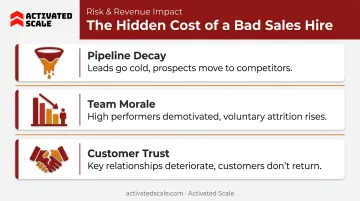
- Pipeline decay: Leads assigned to a struggling rep go cold. Prospects who were warm move on or buy from a competitor. That pipeline doesn't come back.
- Team morale: High performers watch a struggling rep receive the same resources and attention. Over time, that erodes motivation and increases voluntary attrition among your best people.
- Customer trust: When a weak rep handles key accounts or renewal conversations, relationships deteriorate. Some customers don't give you a second chance.
Opportunity Cost: The Most Underestimated Number
Every quarter a bad hire holds a territory is a quarter your competitor is gaining ground. For startups in a land-grab market or launching a new product, a timing gap of one or two quarters can determine whether you become the category leader or the alternative option. Lost ground in a competitive market rarely comes back — your competitor's new customers signed annual contracts and won't be switching anytime soon.
The pattern repeats because the underlying problems go unfixed. Most hiring failures trace to three root causes: the role wasn't scoped clearly before recruiting began, screening was inconsistent across candidates, or onboarding structure collapsed after the offer was signed.
Red Flags That Signal a Problematic Sales Candidate
These signals are observable in a well-structured interview process. Most get missed in unstructured conversations because interviewers aren't asking the right questions.
Vague answers to behavioral questions. High-performers recall specific deals, specific obstacles, specific outcomes. A candidate who pivots to hypotheticals or speaks in broad strokes about what they "usually do" is describing experience they don't have.
Inability to articulate why deals were lost. Great salespeople reflect honestly on failure — it's how they improve. A candidate who consistently blames the market, the product, or pricing without identifying what they could have done differently is signaling low accountability.
No evidence of self-directed prospecting. Early-stage startups don't have a lead generation machine. If their entire track record came from inbound leads or an inherited territory, they won't know how to build pipeline from zero — which is exactly what you're hiring them to do.
Poor curiosity during the interview. Strong salespeople ask sharp questions about the ICP, the sales cycle, what's been tried before, and what success looks like. A candidate who asks only about comp, benefits, or title is showing you where their real motivation sits.
References who praise personality over performance. When every reference mentions "great attitude" without citing quota attainment or deal wins, probe harder. Ask directly: "What was their quota? Did they hit it?" Generalized praise without numbers is a soft no.
The Non-Negotiable Traits of a High-Performing Salesperson
Drive: The Master Trait
Drive is composed of three components that cannot be taught:
- Need for achievement — internal motivation to exceed expectations, not just meet them
- Competitiveness — desire to win against a standard, not just survive in the role
- Optimism — the ability to absorb rejection and continue prospecting without losing momentum
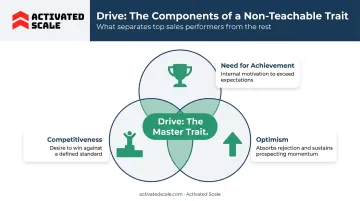
These traits predict sales performance regardless of industry, deal size, or product type. Product knowledge can be transferred. Process adherence can be trained. Drive cannot be installed.
Coachability: Non-Negotiable for Startups
Research published in the Journal of the Academy of Marketing Science found that the combination of high coachability and trait competitiveness — particularly paired with strong leadership — produced the strongest sales performance outcomes. In a startup context, where the playbook is still being written, coachability determines whether a rep gets better every month or plateaus and becomes a management burden.
A rep who won't take direction in month one won't take it in month six either.
Value-Creation Orientation
Buyers today do their own research. When they agree to a conversation with a salesperson, they're hoping to learn something they didn't already know. A great salesperson earns a second meeting by demonstrating they understand the buyer's world better than the buyer expected.
Gartner puts a number on this: 69% of B2B buyers turn to sales reps specifically to validate AI-generated insights. The role isn't information delivery anymore — it's decision support. Ask candidates how they've helped a buyer think through a decision, not just pitch a product. The answer tells you everything.
A Better Hiring Process: From Screening to Onboarding
How to Define the Role Before You Post It
Most startup sales hiring fails before the first resume arrives. The role definition is too vague — "rock star salesperson wanted" tells you nothing about whether the candidate is right for your specific situation.
Build a hiring scorecard before posting. It should specify:
- Who the rep will call on (job titles, company sizes, industries)
- Average deal size and expected sales cycle length
- Expected ramp time
- What "good" looks like at 30, 60, and 90 days with measurable benchmarks
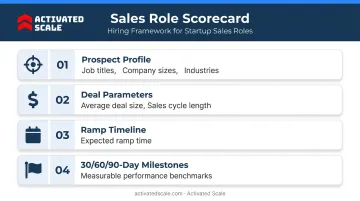
Without these benchmarks, there's no objective basis for evaluating whether someone is on track. The first 90 days turn into guesswork — and guesswork costs you runway.
Once your scorecard exists, your interviews have something to test against.
How to Run Structured Interviews That Reveal Real Capability
Meta-analytic research on selection methods shows structured interviews achieve a validity coefficient of .51 for job performance prediction, compared to .38 for unstructured conversations. Work sample tests reach .54. That's not a rounding error — structured methods consistently outperform gut-feel hiring by a measurable margin.
For sales roles at early-stage startups, structured interviews should include questions like:
- "Tell me about a time you had to build a pipeline from zero — what did you do in the first 30 days?"
- "Describe a deal you lost. What would you do differently?"
- "Walk me through how you'd approach our ICP in the first month."
Work simulations push further. Ask candidates to run a mock discovery call, analyze your ICP, or sketch out a 30-day outreach plan. These exercises are difficult to fake and expose gaps in strategic thinking, customer empathy, and process discipline that a polished resume will never reveal.
De-Risk Your Next Sales Hire with a Try-Before-You-Buy Approach
The traditional sales hiring model — post a job, conduct interviews, commit to a full-time hire — requires you to make a $150,000+ annual decision based on how someone performs in structured conversations. That's an enormous amount of risk concentrated in the wrong moment.
A try-before-you-buy approach inverts that logic. Instead of committing upfront and evaluating later, you evaluate first and commit based on actual performance data.
Activated Scale operates this model specifically for early-stage B2B SaaS startups. Founders get access to pre-vetted, US-based fractional sales professionals with backgrounds at companies like Salesforce, Oracle, and IBM, matched and onboarded in 7 days or less.
The fractional professional begins generating meetings, building pipeline, and closing deals on a contract basis. Founders get real performance data before making any permanent commitment.
What this protects against is substantial:
- Eliminates 20+ hours of interviewing time per candidate
- Removes the financial exposure of a salaried hire who underperforms for 6–12 months before a decision gets made
- Replaces interview impressions with actual output — meetings booked, pipeline created, deals closed — as the basis for a hiring decision
Around 60% of Activated Scale's clients convert their fractional hire to a full-time employee after the initial contract period. The remaining 40% either extend the fractional engagement or adjust course based on what they learned, all without absorbing the cost of a failed permanent hire. And 80% of clients stay with their fractional professional for five months or more — a retention rate that reflects the precision of the matching process.
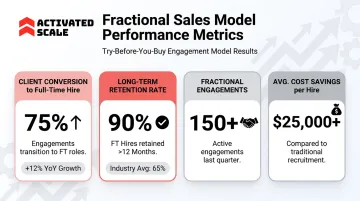
For founders who've already absorbed one bad hire, the model turns the next hiring decision into a data-driven one.
Frequently Asked Questions
What not to say in sales?
Avoid leading with product features before understanding the prospect's problem, making price central to early conversations, and using pressure-based language that signals self-interest. Top performers listen more than they talk — and lead with questions that reframe the buyer's problem, not pitches that push a solution.
How much does a bad sales hire actually cost a startup?
Gallup estimates direct replacement costs at 0.5x–2x annual salary. Add in lost pipeline, missed revenue, and opportunity cost, and the real total climbs significantly higher depending on the role and territory.
What are the most important traits to look for when hiring a salesperson?
The three non-teachable components of drive — need for achievement, competitiveness, and optimism — alongside coachability are the strongest predictors of long-term sales performance. Product knowledge and process skills can be trained; drive and coachability cannot.
How soon can you tell if a new sales hire isn't going to work out?
Warning signs usually surface within 30–60 days: feedback resistance, failure to build pipeline independently, weak first-to-second call conversion, and blame-shifting when results disappoint. Defined 30/60/90-day milestones make these patterns obvious early — before you've lost a full quarter waiting for confirmation.
What's the difference between a fractional salesperson and a full-time hire?
A fractional salesperson works part-time or on contract, giving startups access to experienced talent without full-time salary and benefits. Fractional reps are especially useful for testing your sales motion, validating your ICP, or bridging the gap before a full-time hire is financially justified.
How many interviews should you conduct before making a sales hiring decision?
Structure matters more than volume. A two-to-three stage process — drive screening, structured behavioral interview, and a work simulation — consistently outperforms five unstructured conversations and cuts the risk of a gut-feel hire that fails in the field.