Key Takeaways
- Sales mis-hires cost companies an average of $97,690 per turnover, making specialist recruiting a financial necessity, not a luxury
- Effective agencies headhunt passive talent and screen on behavioral competencies — not just resumes and titles
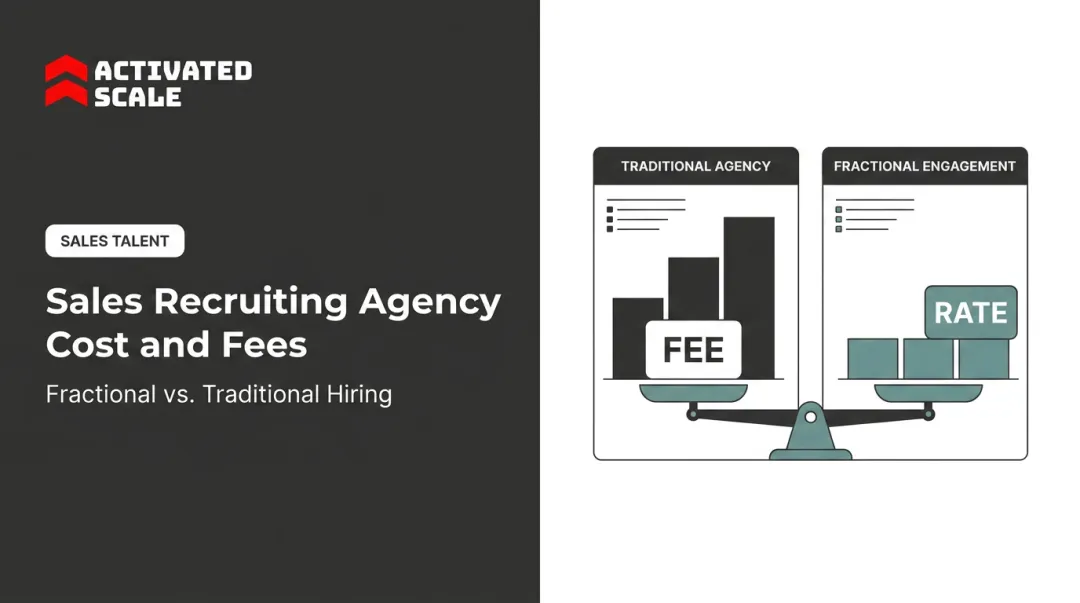
- Contingency fees run ~20% of salary; retained executive search typically costs 30–35%
- Fractional and contract-to-hire models let startups validate fit before committing to full-time headcount
- Ask every agency for their screening methodology, placement retention data, and replacement guarantee terms
Hiring the wrong salesperson is one of the most expensive mistakes a B2B SaaS founder can make. Yet most recruiting processes are designed for established companies with HR teams and structured pipelines — not resource-constrained startups racing against runway.
A vacant sales seat doesn't just delay revenue. It burns founder time, disrupts team momentum, and pushes your next funding milestone further out of reach. A bad hire compounds all of that.
This guide breaks down what separates a specialist sales recruiting agency from a generic staffing firm — the engagement models, the evaluation criteria, and the real timelines and costs involved.
Why Sales Hiring Demands a Specialist Recruiting Partner
Sales roles are uniquely hard to hire for. Performance depends on persuasion, resilience, domain fit, and coachability — traits that don't show up on a resume. A standard internal hiring process, or a generalist staffing firm scanning job boards, will surface candidates who look good on paper but struggle in the field.
The Real Cost of Getting It Wrong
Research from DePaul University's Center for Sales Leadership surveyed 127 US and Canadian organizations and found that the average cost of salesperson turnover is $97,690 — accounting for recruiting, onboarding, lost pipeline, and productivity gaps. The same study found inside-sales roles take 3.69 months to replace on average, and field sales roles take 5.42 months.
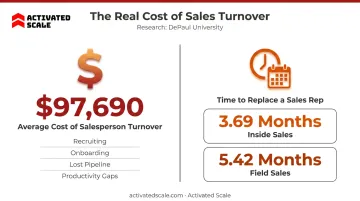
For an early-stage company, that's not just an HR problem. That's a quarter of runway evaporating while your pipeline sits empty.
The turnover cost is only part of the picture. A cross-industry survey by CareerBuilder found that bad hires reduce productivity by 37% and consume 32% of management time during replacement — time founders simply don't have.
Why Generalist Firms Fall Short
General staffing firms routinely miss the distinctions that matter in sales:
- An SDR role requires high outbound activity, rejection tolerance, and scripted curiosity
- An AE role needs closing instincts, deal qualification skills, and pipeline discipline
- A Sales Manager role demands coaching ability, forecasting accuracy, and cross-functional influence
Generalist recruiters treat these roles as variations of the same job description. Sales-focused agencies know the difference — and they screen for the behavioral markers that actually predict quota attainment, not just a polished LinkedIn profile. That includes passive candidates who aren't browsing job boards and wouldn't respond to a cold posting.
What an Effective Sales Recruiting Agency Does Differently
Proactive Sourcing, Not Reactive Posting
Most internal hiring starts with a job posting and waits. Effective agencies work the other direction: they identify currently-employed sales professionals who are performing well, build relationships with them over time, and approach them when a relevant opportunity emerges.
This matters because the best candidates typically aren't applying anywhere. They're closing deals at their current company.
Structured, Sales-Specific Screening
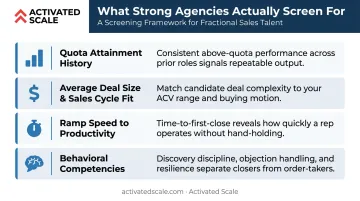
Beyond the resume review, strong agencies assess candidates on:
- Quota attainment history — what percentage of quota did they hit, and for how long?
- Average deal size and sales cycle — does their experience match your environment?
- Ramp speed — how quickly did they reach productivity in previous roles?
- Behavioral competencies — how do they handle objections, manage a pipeline, and prospect into cold accounts?
A 2011 meta-analysis on sales performance drivers identified selling-related knowledge, adaptiveness, cognitive aptitude, and work engagement as the strongest predictors of sales performance — none of which surface through an unstructured interview or a resume scan alone.
Role Profiling Before Sourcing
Before running a search, a strong agency works to understand your business:
- Who is your ideal customer, and how do they buy?
- What's your average contract size and deal cycle length?
- What does "good" look like in the first 90 days — meetings booked, pipeline created, deals progressed?
Without this, even an experienced salesperson can be wrong for your context. A candidate who excelled selling $200K enterprise deals may struggle in a transactional, high-velocity SMB environment — and vice versa.
For example, Activated Scale starts every engagement with an onboarding call to align on the startup's ICP, buyer persona, deal size, and target market before making a match. This intake step is what makes the difference between a placement that sticks and one that churns in 60 days.
Managing Fit Beyond Skills
Role profiling gets you the right skills. But the best agencies go further and assess the factors that determine whether someone stays and performs:
- Compensation expectations — are they realistic for your stage and equity structure?
- Culture and working style — will they thrive in a scrappy, undefined environment?
- Long-term motivation — are they looking to build something, or just collect a paycheck?
For early-stage startups, a mis-hire doesn't just drain budget — it burns runway and delays the market traction you can't afford to lose.
Types of Sales Recruiting Agency Models (and Which Fits Your Stage)
Not all agencies work the same way. The model you choose should reflect your hiring urgency, budget, and risk tolerance.
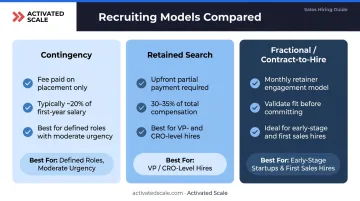
Contingency Recruiting
The agency gets paid only when a candidate is successfully placed. SIA's 2021 survey found a 20% median direct-hire fee, with professional staffing firms ranging 18–22%.
Best for: Companies with defined roles, existing hiring infrastructure, and moderate urgency. The no-upfront-cost structure is appealing, but agencies juggle multiple clients simultaneously, so your search may not always be their top priority.
Retained Search
The client pays a portion of the fee upfront, securing the agency's dedicated attention. Hunt Scanlon's 2024 benchmark places retained executive search at 30–35% of estimated first-year compensation.
Best for: VP of Sales or CRO-level hires where the search complexity is high and the wrong outcome is catastrophic. The upfront commitment signals seriousness from both sides and typically yields a more thorough search.
Fractional and Contract-to-Hire Models
This is where early-stage startups have a genuine structural advantage.
Instead of committing to a permanent hire immediately, companies engage experienced sales professionals on a fractional or contract basis first. The professional works in your environment, with your ICP, using your tools, and you evaluate their actual output before deciding whether to convert them to full-time.
Activated Scale operates this way, connecting B2B SaaS startups with vetted, US-based fractional sales professionals (SDRs, Account Executives, and Fractional VPs of Sales) from backgrounds at companies like Salesforce, Oracle, MongoDB, Datadog, and Zendesk.
Which model fits your situation:
| Situation | Recommended Model |
|---|---|
| Defined role, budget ready, moderate urgency | Contingency |
| VP of Sales or CRO search, high stakes | Retained |
| First sales hire, testing go-to-market | Fractional / Contract-to-Hire |
| Need to validate fit before full-time commitment | Fractional / Contract-to-Hire |
| Limited runway, can't afford a mis-hire | Fractional / Contract-to-Hire |
Key Qualities to Evaluate Before Choosing a Sales Recruiting Agency
Not every agency that calls itself a "sales recruiting specialist" actually is one. Here's how to tell the difference.
Before you engage anyone, run through these five checkpoints:
Sales-role specialization — Ask what percentage of their placements are sales-specific versus general business roles. An agency that places SDRs, AEs, and sales managers routinely will screen for the right things; one that does it occasionally won't.
Candidate network quality — Where do their candidates come from? Strong agencies have real relationships with sales professionals from recognized companies and share pre-vetted profiles quickly. Vague claims about a "large database" are a warning sign, not a differentiator.
Screening methodology — Ask exactly how they evaluate sales performance history. Do they assess quota attainment, ramp speed, average deal size, and behavioral competencies? Agencies that rely on unstructured interviews alone carry significantly higher placement risk.
Transparency and communication — Look for clear timelines, proactive updates, and honest candidate availability assessments. Agencies that overpromise and under-communicate will cost you weeks at the worst possible moment.
Retention track record and guarantees — Ask what percentage of placements are still in-role at 6 and 12 months, and ask for a replacement guarantee. Note: the ASA/NAPS model recruiting agreement treats guarantee duration as a negotiated term — no industry-standard 30-, 60-, or 90-day window exists. Whatever you agree to, get it in writing.
What to Expect: Timelines, Costs, and Red Flags
Realistic Timeline Expectations
Inside sales vacancies take an average of 3.69 months to fill through internal hiring and field sales roles take 5.42 months, according to DePaul's research. A specialist agency with an existing candidate network should cut that timeline — though results vary by role level and market conditions.
Executive searches (VP+) run longer by nature and should not be rushed. Shortlisting a VP of Sales or CRO in two weeks typically means corners were cut.
Framing the Cost Honestly
A contingency fee of 20% on a $100K sales role is $20,000. A retained search on a $180K VP of Sales role runs $54,000–$63,000. Those feel large until you weigh them against the alternative.
Bridge Group's 2024 benchmark study of more than 170 B2B SaaS companies found a $800K median annual AE quota, a 5.7-month average ramp, and only 51% of AEs attaining quota. A three-month vacancy — even at half quota — represents hundreds of thousands in pipeline that never gets built. Treat the fee as insurance against that outcome, not as a line item to minimize.
Red Flags to Avoid
Walk away from agencies that:
- Send unscreened resumes in bulk without a clear vetting rationale
- Can't explain their screening process in specific, measurable terms
- Never ask about your sales motion, ICP, or deal cycle
- Can't provide any retention or post-placement performance data
- Charge upfront fees without clear accountability or guarantee terms
Any one of these is a sign the agency optimizes for placement volume, not fit — and you'll pay for that mismatch long after the invoice clears.
Frequently Asked Questions
What is a sales recruiting agency and how does it work?
A sales recruiting agency sources, screens, and presents sales candidates on your behalf — so your team only evaluates pre-qualified finalists. They typically earn a fee upon successful placement, either as a percentage of first-year salary (contingency) or through a partial upfront retainer (retained search).
How much does a sales recruiting agency typically charge?
Contingency direct-hire placements average around 20% of first-year salary, according to SIA's 2021 survey. Retained executive search runs 30–35% of estimated first-year compensation. Fractional and contract-to-hire models operate on monthly retainers and carry lower upfront financial risk for startups.
How long does it take a recruiting agency to find qualified sales candidates?
Internal hiring takes 3.69 months for inside sales and 5.42 months for field sales, per DePaul's research. Specialist agencies with established networks typically deliver candidates faster, though timelines vary by role level. Each month a sales seat stays open is revenue your pipeline isn't generating.
What should I look for when choosing a recruiting agency for sales hiring?
Look for agencies that check these boxes:
- Sales-role specialization (not generalist recruiting)
- A structured, competency-based screening process
- Honest, proactive communication throughout the search
- Measurable retention track record with past clients
- A written replacement guarantee
Ask specific questions during your evaluation — vague answers reveal a lot.
What's the difference between a sales staffing agency and a sales recruiting agency?
Staffing agencies employ the workers they place, handling payroll and HR during the engagement. Recruiting agencies place candidates as your direct employees. Many firms now offer both models, and fractional arrangements can blur the line — clarify which structure applies before signing.
Can a recruiting agency help a startup hire their first salesperson?
Specialist agencies are particularly valuable for startups without internal recruiting infrastructure. Fractional or contract-to-hire arrangements — like those offered through Activated Scale — reduce the risk of that critical first hire by letting founders validate real-world fit before making a full-time commitment.