Most founders know this. What they don't know is how to evaluate the agencies claiming they can solve it. The market is crowded with firms that look credible on an intro call but lack the specialization or screening depth to surface candidates who'll actually perform in your specific sales motion.
This guide covers what sales recruitment agencies actually do, how to distinguish the models, and what criteria and questions to use when making your selection.
Key Takeaways
- Sales recruitment agencies specialize in sourcing revenue-generating talent — from SDRs to VP of Sales — faster than in-house hiring processes typically allow
- Agency models vary widely — contingency, retained, and contract-to-hire each carry distinct risk and cost profiles
- Specialization, sourcing methodology, and screening depth matter more than agency size or name recognition
- Placement data — not testimonials — is the real measure of an agency's track record
- For early-stage SaaS companies, contract-to-hire reduces hiring risk more than a traditional placement fee
What Is a Sales Recruitment Agency?
A sales recruitment agency is a third-party firm that sources, screens, and presents candidates for revenue-generating roles — SDRs, BDRs, Account Executives, Sales Directors, and VP of Sales — on behalf of client companies.
The key distinction from generalist firms is specialization. Sales-focused agencies bring capabilities that general recruiters don't:
- Active networks of sales professionals across roles and industries
- Fluency in sales KPIs — quota attainment, ramp time, ACV — not just resume keywords
- Ability to assess candidates on actual sales competency, not generic fit markers like "communication style"
Common Agency Models
Three models are most relevant for early-stage companies:
| Model | How It Works | Best For |
|---|---|---|
| Contingency | Paid only upon successful placement | Speed-focused searches; lower-stakes roles |
| Retained | Upfront fees with milestone payments | Senior or executive searches (VP Sales, CRO) |
| Contract-to-Hire / Fractional | Talent engaged on contract first, with option to convert | Startups testing GTM motions or de-risking first sales hires |
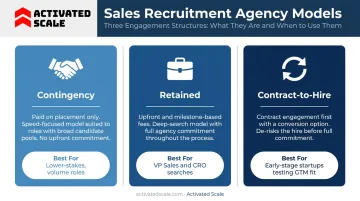
For pre-Series A and Series A companies, contract-to-hire is usually the right call. You see how a rep actually performs in your market before locking in a full-time salary and equity package.
What to Consider When Choosing a Sales Recruitment Agency
The right agency isn't the most recognized name or the lowest-cost option. It's the one whose model, expertise, and process align with where your company is today and what your sales motion requires. Use these factors to translate agency marketing into something measurable.
Industry and Role Specialization
An agency that has consistently placed B2B SaaS sales talent will produce better-matched shortlists than a generalist firm. They understand deal complexity, how long your sales cycle will likely run, and what "good" actually looks like for an SDR at a $2M ARR SaaS company versus an AE at a $20M ARR company.
Ask directly: How many roles similar to mine have you filled in the past 6–12 months? Look for concrete examples with specifics — company stage, role type, outcome — not broad claims about industry coverage.
Candidate Sourcing Methodology
Top-performing sales candidates are rarely refreshing job boards. Employ's 2024 survey of more than 1,500 US workers found that 86% were at least somewhat open to a new opportunity — but only 40% were actively looking. Agencies that rely primarily on inbound applicants will surface the 40%, not the 86%.
What to look for instead:
- Direct outreach and proactive sourcing from named talent pools
- Referral pipelines built through existing placements
- Curated networks assembled over time, not scraped from job boards
- A clear explanation of how they identify candidates who aren't actively looking
Depth of Candidate Screening
A sales résumé doesn't tell you whether someone can sell in your specific context — your price point, your buyer, your sales cycle. Look for agencies that assess beyond credentials:
- Structured interviews designed around sales competencies
- Behavioral assessments or role-specific case studies
- Verification of quota attainment history and ramp timelines
- Screening for the sales motion your company uses (outbound, PLG, enterprise)
Ask explicitly: What does your screening process look like before you present a shortlist? An agency with genuine depth will walk you through each step — not just describe it in general terms.
Track Record and Client References
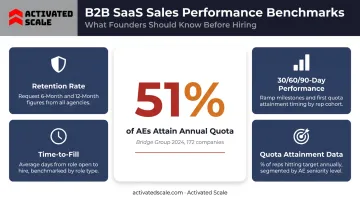
A credible agency should be able to point to verified placements at companies similar to yours in stage, size, or industry. Written testimonials mean less than references with measurable outcomes. Ask for data on:
- Retention rates at 6 and 12 months post-placement
- Time-to-fill averages for roles similar to yours
- Candidate performance at 30, 60, and 90 days
- Quota attainment data for placed AEs
The stakes make this non-negotiable. The Bridge Group's 2024 SaaS benchmark found that only 51% of AEs attain annual quota across 172 B2B SaaS companies. If half your hires miss quota under normal conditions, an agency that can't speak to post-placement performance is a meaningful risk.
Fee Structure and Replacement Guarantees
Two dominant fee models:
- Contingency: A percentage of the placed candidate's first-year salary, paid upon hire. No upfront cost, but agencies may prioritize speed over fit.
- Retained: Upfront fees with milestone payments. Per Korn Ferry's 2025 SEC filings, executive search fees run roughly one-third of estimated first-year compensation — relevant context if you're hiring a VP of Sales.
For early-stage companies, fee structure directly affects cash flow. Ask any prospective agency:
- What is your replacement policy if a placement exits within 60–90 days?
- What conditions apply to that guarantee?
- Are there exclusions that would void the guarantee?
An agency confident in its screening quality will offer a clear, written replacement policy. If the guarantee is buried in fine print or loaded with exceptions, treat that as a signal about how they view placement quality.
Communication and Process Transparency
Sales hiring often moves fast and involves multiple stakeholders. An agency that provides clear process milestones, defined ownership, and regular status updates reduces candidate drop-off and delays.
Ask agencies to walk you through a typical engagement from intake to offer acceptance. Ask:
- Who owns each stage — sourcing, screening, interview coordination, offer support?
- What does your communication cadence look like during an active search?
- What happens if we reach week three with no qualified candidates presented?
The best agencies will give you a named point of contact, a defined cadence, and a clear contingency plan — before you sign anything.
Questions to Ask Before You Commit
Most agencies present well in an initial call. The right questions separate agencies genuinely equipped for your needs from those that are simply good at selling their own services.
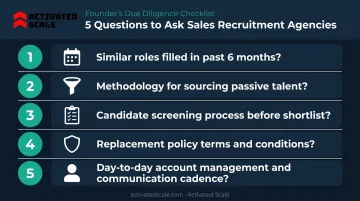
Ask these five in every evaluation conversation:
- How many roles similar to mine have you filled in the past 6 months? Push for specifics: company size, role type, industry.
- What is your specific methodology for sourcing passive sales talent? Listen for concrete sourcing strategies, not generic claims about networks.
- What does your candidate screening process look like before presenting a shortlist? You want to hear about structured assessment, not just a resume review.
- What is your replacement policy if a placement doesn't work out? Get the written terms — triggering events, exclusions, timelines.
- Who will manage our account day-to-day, and what should we expect in terms of communication? Understand whether you'll be working with a senior recruiter or handed off to a coordinator.
Pay attention to how agencies respond to your company, not just how they answer the questions. An agency that asks about your sales motion, ICP, deal structure, and buyer persona before pitching is showing the consultative instinct that makes a partnership work. One that leads with speed claims and success rate statistics — without asking about your context first — is a red flag.
How Activated Scale Helps B2B SaaS Startups Hire Sales Talent
Activated Scale is a fractional sales talent platform — not a traditional recruitment agency — purpose-built for early-stage B2B SaaS companies that need experienced sales professionals without the financial exposure of full-time hiring.
The platform connects founders with vetted, US-based fractional and contract-to-hire sales professionals sourced from companies including Salesforce, Oracle, IBM, Zendesk, and ZoomInfo. In 2024, only the top 7% of applicants cleared the three-step vetting process. Founders receive introductions to pre-qualified professionals, not raw applicants.
What makes the model different for early-stage companies:
- Try-before-you-buy structure: Engage a sales professional on a contract basis, evaluate their real-world performance, then convert to full-time once fit is confirmed
- 7-day placement: Connect with available talent in under a week — no 6-week recruiting cycle when pipeline timing is tight
- Full sales org coverage: From fractional SDRs booking 10–15 qualified meetings per month to fractional VPs of Sales who have scaled teams from early ARR stages
- Pre-vetted candidates: Founders spend 25 fewer hours interviewing — a figure from the CaseActive engagement — because unqualified applicants never reach the intro stage
For founders at Seed or Series A making their first or second dedicated sales hire, the contract-to-hire path lets you test fit against your actual sales motion before committing to the economics of a permanent hire. Most contingency agencies collect their fee at placement and move on. Activated Scale's model keeps them accountable through the contract period — and beyond, if you convert.
Conclusion
Choosing a sales recruitment agency comes down to alignment. The agency's specialization, sourcing methodology, screening depth, and fee model all need to match where your company is today and what your revenue motion requires.
The most prominent agency isn't necessarily the right one. For an early-stage SaaS company, the right one is the agency most capable of delivering the right caliber of sales talent at the right risk level — with a process transparent enough that you can evaluate their work before a hire is ever made.
Agency selection also isn't a one-time decision. Track placement quality, retention, and pipeline impact over time. If a partnership isn't producing measurable results after 90 days, revisit the criteria in this guide.
The standards that hold regardless of company stage:
- Specialization in your sales motion and deal profile
- Sourcing rigor beyond job boards and passive databases
- Screening depth that surfaces fit before you spend time interviewing
- Post-hire performance as the ultimate measure of placement quality
These don't change as your company scales — even if the specific role profiles do.
Frequently Asked Questions
What is the difference between a sales recruitment agency and a fractional sales agency?
Traditional recruitment agencies place permanent hires for a one-time fee, then their involvement ends. Fractional or contract-to-hire platforms like Activated Scale connect companies with experienced sales professionals on a flexible contract basis, allowing companies to test real-world fit before committing to full-time employment.
How much do sales recruitment agencies typically charge?
Retained search firms typically charge around one-third of first-year compensation (per Korn Ferry and Heidrick & Struggles' 2025 filings). Contingency fees vary widely — always request written terms and ask about any additional retainers or expenses before signing.
How long does it take to hire through a sales recruitment agency?
It depends on the model and role. Fractional platforms can connect you with available talent in as few as 7 days; contingency agencies typically run longer. Ask for actual time-to-shortlist data — not just a quoted estimate.
What questions should I ask a sales recruitment agency before hiring them?
Ask about recent placements in similar roles, their passive candidate sourcing strategy, their screening methodology, and their replacement guarantee terms. Pay attention to whether they ask about your sales motion before recommending — that signals a consultative approach.
When should a B2B SaaS startup use a recruitment agency instead of hiring directly?
Agencies add the most value when internal recruiting capacity is limited, the role requires sales expertise the founding team can't easily evaluate, or the cost of a mis-hire is high. These conditions apply to most early-stage startups making their first or second dedicated sales hire.
What is a contract-to-hire sales arrangement?
Contract-to-hire lets you engage a sales professional on a contract basis, evaluate their performance against your actual sales motion, then convert to full-time once fit is confirmed — reducing the financial risk of committing to a permanent hire too early.