
Most founders frame this as a budget question. It's actually a strategic one. The wrong hire doesn't just drain cash; it costs months of compounding pipeline momentum that you can't recover.
This article breaks down the real, total cost of each model—fractional versus full-time—using current US market data. You'll get actual cost ranges, the hidden expenses most founders overlook, a clear ROI comparison, and a stage-based framework for choosing which model fits your company right now.
Key Takeaways
- Fractional VP of Sales retainers average $9,651/month (per Vendux's 2024 survey), with no benefits, equity, or recruiting fees required
- A full-time VP of Sales year-one cost commonly exceeds $300,000–$400,000 once salary, benefits, equity, and recruiting fees are factored in
- Most fractional leaders are operational within 1–2 weeks; full-time hires typically need 4–6 months to reach meaningful productivity
- For Seed to Series A B2B SaaS companies under $5M ARR, fractional is generally the stronger model
- Contract-to-hire is a viable third path—test fractional leadership before committing to a permanent executive
Fractional VP of Sales vs. Full-Time VP of Sales: Quick Comparison
| Factor | Fractional VP of Sales | Full-Time VP of Sales |
|---|---|---|
| Monthly Cost | $6,000–$15,000 retainer | $15,000–$25,000+ base salary alone |
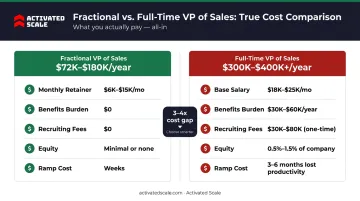
| Annual Total Cost | $72,000–$180,000 | $300,000–$400,000+ (all-in) |
| Time to Start | 1–2 weeks | 2–4 months (search + notice period) |
| Ramp-Up Period | 2–4 weeks to initial impact | 4–6 months to meaningful productivity |
| Equity Required | None | 0.5%–1.5% typical |
| Benefits Overhead | None | ~48% of base salary (BLS data) |
| Recruiting Fees | None | Up to 30% of first-year OTE |
| Commitment Level | Flexible, adjustable | High—severance and legal exposure |
| Time to Revenue Impact | 30–60 days | 90–180 days |
The sticker-price salary comparison is misleading. A full-time VP of Sales at $200,000 base looks twice the cost of a $100,000/year fractional retainer—but that's before you add benefits burden, equity, recruiting fees, and months of full salary paid during a slow ramp. Factor all of that in, and the real cost gap lands closer to 3–4x.
What Does a Fractional VP of Sales Cost?
The Engagement Model
Fractional VPs of Sales are not outside consultants offering strategic advice and slide decks. They're embedded leaders—running pipeline reviews, coaching reps, building playbooks, and owning revenue outcomes—typically for 10–20 hours per week on a monthly retainer basis.
According to Vendux's 2024 State of Fractional Sales Leadership Report, the average monthly compensation across more than 1,000 US and Canada assignments was $9,651, with amounts ranging from a few hundred dollars up to $20,000 or more depending on scope and complexity. Retainers represented roughly two-thirds of engagements; the balance used hourly ($213 average), project-based, or success-fee structures.
The True Cost Savings
What doesn't come with a fractional engagement matters as much as what does:
- No employer payroll taxes or benefits burden — saving you ~48% of the equivalent base salary
- No recruiting agency fees — which Bessemer Venture Partners notes can reach up to 30% per candidate for VP-level searches
- No severance liability — engagements adjust or end with standard notice
- No onboarding overhead — equipment, accounts, and administrative setup costs are minimal
- No equity dilution — fractional leaders work for cash, not cap table allocation
At $30,000 recruiting fees per candidate on a $200,000 OTE search, plus the full-time benefits load, the savings on a 12-month fractional engagement versus a failed full-time hire can easily exceed $150,000–$200,000.
Speed as a Cost Factor
A fractional leader placed through a network like Activated Scale—which connects B2B SaaS startups with vetted, US-based fractional sales professionals in as little as 7 days—can be running pipeline reviews and building your sales process within weeks, not months.
A full-time search runs on a very different clock:
- 2–3 months to identify and close a candidate
- 30–60 days notice period before they can start
- 4–6 months to fully ramp before you see real output
You're covering full salary the entire time—before a single deal closes. For a startup on an 18-month runway, that's a window you can't afford to lose.
Ideal Use Cases for Fractional Sales Leadership
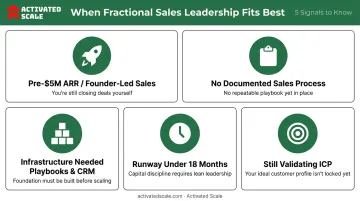
Fractional is the clearest fit when:
- You're pre-$5M ARR and the founder is still running sales personally
- You don't have a documented sales process, ICP definition, or CRM discipline in place
- You need infrastructure built—playbooks, hiring criteria, qualification frameworks—not just team management
- Runway is under 18 months and capital preservation matters
- You're still refining messaging and validating your ideal customer profile
What Does a Full-Time VP of Sales Really Cost?
Base Salary and OTE
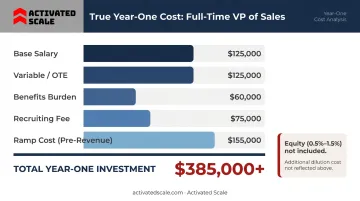
US market data puts VP of Sales compensation well above what many founders expect. RepVue's live salary database, based on 312 verified submissions, shows a $200,000 median base salary and $375,000 median OTE for the VP of Sales role. SaaStr's early-stage SaaS scenario uses $250,000 OTE ($125,000 base + $125,000 variable) as a working model for a first VP of Sales at a small startup.
That $250,000 OTE is just the starting point. The real number is considerably higher once you account for benefits, recruiting, and equity.
The True Employer Cost
Using Bureau of Labor Statistics data for management and financial occupations, benefits (health insurance, 401(k), paid leave, payroll taxes) run approximately 48.5% of base wages. On a $125,000 base salary, that adds roughly $60,000 in annual employer costs.
Here's what full-year employment actually looks like at the mid-range SaaStr scenario:
| Cost Element | Annual Estimate |
|---|---|
| Base salary | $125,000 |
| Target variable (OTE) | $125,000 |
| Benefits burden (~48.5% of base) | $60,000 |
| Recruiting fee (up to 30% of OTE) | $75,000 |
| Equity (0.5%–1.5% of company) | Real long-term cost |
| Total Year-One Cash Cost | ~$385,000 |
Equity deserves a separate note. SaaStr guidance for early-stage SaaS gives 0.5%–1.5% for a Head or VP of Sales, with 1% as a common baseline. It won't appear on your monthly P&L, but at a $50M acquisition, that 1% becomes $500,000 out of your pocket at exit.
The Ramp Cost Nobody Talks About
A new VP of Sales spends their first 30–45 days learning your product, your customers, and your team. SaaStr's practitioner guidance calls for measurable pipeline impact at 90 days and proof of scaling ability by six months.
Six months of base salary plus benefits at the mid-range: approximately $155,000 before a single deal closes. That's the hidden ramp cost — real cash out the door before you have any proof the hire will work.
Misfire Risk
HBR's 2024 research on CRO turnover found that 62% of companies experienced flat or declining revenue growth in the fiscal year following a revenue leader change. Average CRO tenure was just 25 months. VP of Sales roles at early-stage startups face similar or higher failure rates—and when a hire doesn't work out, you're looking at severance, a second search fee, and months of pipeline disruption.
When Full-Time Is the Right Call
Full-time makes sense when:
- ARR has crossed $5M–$10M with consistent, repeatable deal velocity
- You have 5+ reps who need daily oversight and management
- A Series B raise or enterprise growth push requires a permanent executive presence
- The sales motion is documented and proven—the VP's job is to scale it, not build it
Beyond the Price Tag: ROI and Speed to Impact
The Compounding Cost of No Sales Leadership
Every month without structured sales leadership is a month of inconsistent pipeline, uncoached reps, and missed deal velocity. Consider a simple scenario: a fractional VP of Sales improves pipeline quality enough to generate one additional qualified meeting per week—52 additional meetings annually.
At a $40,000 average contract value (typical for early B2B SaaS) and a 20% close rate, that's roughly 10 additional deals and $400,000 in incremental ARR. That's before any process improvements to your existing pipeline motion.
Fractional vs. Full-Time: The Speed Advantage
The real ROI comparison isn't just cost—it's time to pipeline impact:
- Fractional: Operational in 1–2 weeks, measurable process improvements within 30–60 days
- Full-time: Candidate search takes 2–3 months, ramp takes another 4–6, meaningful output starts around month 6–9 of the hiring decision
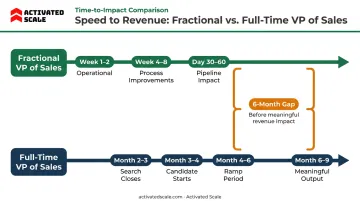
That 6-month gap easily exceeds the full-year cost of a fractional engagement—before accounting for recruiter fees, severance risk, or the deals that slipped while you waited.
Preserving Optionality
Speed matters, but so does the ability to change course. For Seed and Series A companies, keeping commitments flexible has real financial value.
A fractional engagement adjusts easily if your ICP shifts, a full-time candidate emerges, or the scope changes. A full-time hire creates legal, financial, and operational obligations that are costly to unwind.
That flexibility doesn't mean sacrificing continuity. Activated Scale's contract-to-hire model gives companies a path in both directions: 65% of clients eventually convert their fractional professional to a full-time employee, having already built trust in the leader before making the permanent commitment.
Which Model Is Right for Your B2B SaaS Startup?
The right answer depends on ARR, team size, process maturity, and runway—not just monthly budget.
Choose Fractional If:
- You're pre-$5M ARR and still founder-led in sales
- You don't have a documented sales process or repeatable pipeline motion
- You need infrastructure built from scratch: CRM, playbooks, hiring criteria, qualification frameworks
- Runway is under 18 months and capital preservation is a constraint
- You want to de-risk the hire before committing to a permanent executive
According to a Salesforce Ventures survey of 181 VC-backed sales leaders, 54% did not hire their first CRO or VP of Sales until at least $5M ARR—consistent with the pattern that early-stage companies often benefit from fractional leadership until the motion is proven.
Choose Full-Time If:
- ARR exceeds $5M–$10M with consistent deal velocity
- You have 5+ reps requiring daily management and coaching
- A permanent executive presence matters for Series B fundraising or enterprise customer credibility
- The sales process is documented, repeatable, and ready to scale
Consider Contract-to-Hire as a Bridge:
Platforms like Activated Scale offer an embedded fractional model with the option to convert to full-time—letting you evaluate leadership style and real-world performance before making a permanent commitment. You get the evidence you need to hire with confidence, not just a resume and a few interviews.
That said, even the best model fails if the timing is wrong. Before committing to either path, watch for these common missteps:
- Hiring a full-time VP of Sales before product-market fit is clear and pipeline is repeatable
- Hiring a VP of Sales when what you actually need is an AE or SDR
- Treating fractional as a second-tier option rather than a deliberate strategic choice
Frequently Asked Questions
How much does a fractional VP of Sales cost per month?
Fractional VP of Sales retainers in the US typically range from $6,000 to $15,000/month depending on scope, experience, and hours committed (commonly 10–20 hours per week). The Vendux 2024 survey found an average of $9,651/month across more than 1,000 assignments. No benefits, equity, or recruiting fees are required.
What is the total cost of hiring a full-time VP of Sales?
First-year total cost of employment commonly exceeds $300,000–$400,000 when you account for base salary, OTE variable, benefits burden (~48.5% of base wages per BLS data), recruiting fees of up to 30% of OTE, and equity grants of 0.5%–1.5%.
When should a startup switch from fractional to a full-time VP of Sales?
The clearest inflection points are crossing $5M–$10M ARR with a proven, repeatable sales motion; building a team of 5+ reps that needs daily oversight; and approaching a Series B raise where investors and enterprise buyers expect permanent executive presence.
Can a fractional VP of Sales convert to a full-time role?
Yes—contract-to-hire is a common and growing model. Activated Scale reports that 65% of clients hire their fractional sales professionals as full-time employees after the initial contract period—making it a low-risk path to a permanent hire.
How quickly can a fractional VP of Sales start producing results?
Fractional leaders are typically operational within 1–2 weeks of placement and most companies see measurable pipeline improvements within 30–60 days—far ahead of the 4–6 month ramp of a new full-time hire who is still learning the product and team.
Is fractional sales leadership the same as hiring a sales consultant?
No. Consultants advise from the outside and deliver recommendations. Fractional sales leaders are embedded in your team, running pipeline reviews, coaching reps, owning your CRM process, and accountable for revenue outcomes—the same work a full-time VP would do, on a part-time basis.