Introduction
Picking the wrong sales recruitment agency costs money and months you don't have. For an early-stage B2B SaaS company, a vacant SDR or AE seat means pipeline gaps, missed revenue targets, and a go-to-market motion stuck in neutral.
The frustrating reality: every agency promises fast placement, top-tier talent, and a repeatable process. Most can't tell you how they source candidates, what happens if the hire fails, or whether they've ever placed someone in a role like yours.
This guide gives you a structured framework for comparing agencies on the factors that actually matter — specialization, sourcing methodology, engagement model, speed, and risk protection — so you can find a partner that fits where your company is right now, not just one that pitches well.
Key Takeaways
- There's no universal "best" agency — fit depends on your stage, roles, and budget
- Sourced candidates are hired at 8x the rate of inbound applicants — proactive sourcing beats job board posting every time
- Ask every agency about vetting depth, time-to-hire, and replacement policy before committing
- Contract-to-hire and fractional models reduce risk for startups without proven sales motions
- Speed only counts when it comes with fit — a bad hire costs more than a slow one
What Is a Sales Recruitment Agency?
A sales recruitment agency specializes in sourcing, screening, and placing revenue-generating professionals — SDRs, BDRs, Account Executives, Sales Managers, and sales leadership — as opposed to general staffing firms that fill roles across departments.
The Three Main Types
| Model | How It Works | Best For |
|---|---|---|
| Permanent placement (contingency or retained) | Agency finds candidates; you hire them directly as full-time employees | Companies ready to commit to a full-time hire |
| Staffing agency | Agency employs the candidate, handles payroll and compliance | Companies needing flexibility or contractor compliance support |
| Fractional / contract-to-hire | Candidate works part-time or on contract with an option to convert | Early-stage startups validating their go-to-market motion before a full-time commitment |
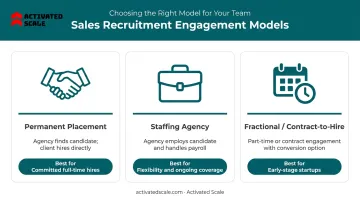
Which model fits depends on where you are in building your sales motion. Permanent placement makes sense once your ICP is clear, your process is proven, and you know what "good" looks like in a rep. Before that point, a fractional or contract-to-hire model lets you build pipeline and evaluate fit at the same time, without committing to a full-time salary before you're ready.
What to Consider When Comparing Sales Recruitment Agencies
Most agencies market the same outcomes. The differences that matter show up in how they work — their sourcing methodology, screening depth, and how they manage risk on your behalf.
These six factors give you a structured lens for comparison.
Industry and Role Specialization
An agency that excels at placing enterprise AEs may be poorly equipped to find a first SDR for a pre-Series A startup. The sales motion, candidate profile, and success criteria are completely different.
Ask for placement examples that match your:
- Role type (SDR, AE, VP of Sales)
- Deal complexity and average contract value
- Target customer profile (SMB, mid-market, enterprise)
- Stage (seed-stage, Series A, growth)
Vague success stories or case studies from unrelated industries are a red flag. A credible agency should be able to name specific, comparable placements.
Candidate Sourcing Methodology
This is the difference agencies talk about least — and the one that matters most.
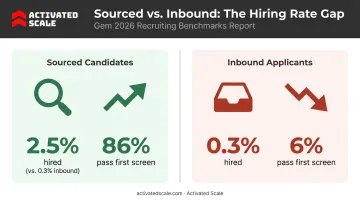
Gem's 2026 Recruiting Benchmarks Report analyzed 165 million applicants across 1.2 million hires. Key findings:
- 2.5% of sourced candidates were hired versus 0.3% of inbound applicants
- 86% of sourced candidates passed the first screen versus only 6% of inbound applicants
Agencies that proactively headhunt passive candidates from curated networks surface professionals who are currently performing well in similar roles — not just whoever responded to a job post. Ask directly: "Do you post our job description on job boards, or do you reach out to candidates who aren't actively looking?"
Engagement Model and Risk Profile
Four main models exist:
- Contingency: Pay only when a hire is made (typically 15–25% of first-year salary)
- Retained search: Upfront commitment; used for senior or executive roles
- Staffing: Agency employs the candidate; you pay a markup
- Fractional / contract-to-hire: Candidate works on contract first, with an option to bring them on full-time
For companies without an established sales team or a proven ICP, the fractional or contract-to-hire model dramatically reduces downside risk. You evaluate performance and fit before committing to a full-time salary and benefits package.
According to Staffing Industry Analysts, 20% of first-year salary is the most common direct-hire fee — a significant upfront cost for a hire that may not work out.
Speed-to-Hire and Pipeline Depth
Gem's benchmarks show a 26-day median time-to-hire for sales roles — that's across all hiring processes, not just agency-assisted ones. For an early-stage company, a month-plus vacancy means missed pipeline every week it drags on.
Ask every agency:
- What's your average time to present first candidates?
- Is that backed by an existing talent pipeline or an estimate?
- How many candidates are pre-screened before I see anyone?
An agency with a pre-built, active talent network can genuinely compress that timeline. One that just blasts job boards cannot.
Screening Depth and Evaluation Process
Resumes don't reveal quota attainment history, why someone left their last role, or how they handle objections. The best agencies evaluate behavioral traits and sales-specific competencies — not just job titles.
Ask specifically:
- What does your screening process look like step by step?
- Do you assess quota attainment and specific performance metrics?
- Can you show me a candidate scorecard?
Agencies that use structured, competency-based screening and give you transparent feedback loops let you calibrate the search in real time rather than waiting through multiple rounds of mismatched profiles.
Placement Guarantees and Post-Hire Support
Find out what happens if a hire leaves or underperforms within the first 90 days. A clear, no-friction replacement policy indicates genuine confidence in placement quality.
Also ask whether the agency stays engaged after placement — onboarding guidance, performance check-ins, compensation benchmarking — or disappears once the fee is collected. The ones that stay involved have skin in the game beyond the invoice.
Questions to Ask Any Agency Before You Commit
Three questions cut through agency marketing faster than anything else:
1. "How many vetted candidates will you present per role, and what does your vetting process look like?"
The answer reveals whether they headhunt proactively or rely on inbound applications. A credible agency describes a specific, multi-step qualification process — not just resume review.
2. "Can you share recent placement examples for roles similar to ours, including time-to-hire and retention outcomes?"
Concrete data from comparable engagements is far more reliable than a vague success rate claim. If they can't provide specifics, that's a clear signal.
3. "What happens if the hire doesn't perform or leaves within the guarantee window?"
A clear, no-friction replacement policy protects your investment and signals confidence in placement quality. Agencies that hedge or add conditions are signaling they're not fully confident the placement will stick — which should give you pause before signing anything.
Any agency worth working with should answer all three without hesitation. Vague responses or deflections are as informative as the answers themselves.
How Activated Scale Can Help
For early-stage B2B SaaS startups — particularly Seed to Series A companies that need experienced sales professionals but aren't ready for the cost and commitment of full-time headcount — Activated Scale offers a different model than a traditional recruiter.
Try Before You Commit
Activated Scale's core model is fractional and contract-to-hire: clients work with pre-vetted, US-based sales professionals on a part-time or contract basis, with the option to convert to full-time once fit and performance are confirmed. Notably, 60% of Activated Scale clients hire their fractional sales talent as full-time employees after the initial contract period — confirming the match quality holds over time.
Network-Driven Sourcing
Rather than posting job descriptions on job boards, Activated Scale draws on a curated professional network. Roboflow's Co-Founder Joseph Nelson described the process as Activated Scale "digging through their personal network" to find their first sales hires — a proactive, relationship-driven approach that surfaces talent unavailable through open-market searches. The network includes professionals with backgrounds at companies like Salesforce, Oracle, IBM, and Zendesk.
Speed and Fit Together
Clients connect with qualified sales talent in as few as 7 days. That speed doesn't come at the expense of fit — Kognitos' CEO noted that Activated Scale "quickly understood my current stage and recommended an expert that has sold to my buyer," while Docvocate's CEO highlighted that their placed professional "could hit the ground running."
Outcomes That Compound
Activated Scale's fractional SDRs are benchmarked to deliver 10–15 qualified meetings per month. Althub's CEO Scott Hall confirmed their fractional SDR "averaged 11 qualified new meetings held each month." Results across clients include:
- $50K–$250K in new revenue per month through fractional AE engagements
- 80% of clients continue with Activated Scale talent for 5+ months
- 20+ hours saved per salesperson on founding team interviewing time
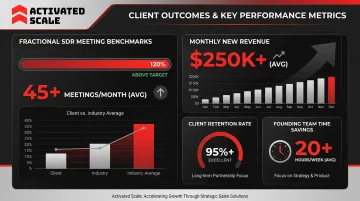
That retention rate reflects match quality — not just placement speed.
Conclusion
The best sales recruitment agency isn't the one with the longest client list or the most polished pitch. It's the one whose specialization, sourcing methodology, engagement model, and risk structure align with where your company actually is right now.
For most early-stage B2B SaaS startups, that means prioritizing agencies that understand your specific sales motion, headhunt from curated networks rather than job boards, and let you validate a hire's performance before committing to a full-time salary. Platforms like Activated Scale are built around exactly this model — connecting founders with pre-vetted fractional sales professionals on a try-before-you-buy basis, so you can validate fit before locking in a full-time hire. As your team scales, your criteria will shift too. Revisit your agency relationship whenever your hiring context changes — what worked at seed stage rarely fits a Series A build-out.
Frequently Asked Questions
What is the best recruitment agency?
There's no single best agency — the right choice depends on your industry, sales roles, company stage, and engagement model preference. Evaluate agencies on their specialization depth, candidate sourcing methodology, and documented results in your specific hiring context rather than on brand reputation alone.
Is it worth using a recruiter to hire for your sales roles?
Yes, particularly for early-stage or fast-growing companies. Specialized sales recruiters access passive candidates that job postings rarely reach, reduce time-to-hire, and front-load the screening work. That makes the fee a fraction of the cost of a prolonged vacancy or a mis-hire.
What is the difference between a sales staffing agency and a sales recruitment agency?
Staffing agencies employ the candidate directly and handle payroll and compliance, while recruitment agencies help you hire sales professionals as your own direct employees. Many firms offer both models, and some also offer fractional or contract-to-hire arrangements that sit between the two.
How much does it cost to work with a sales recruitment agency?
Contingency fees typically run 15–25% of the placed candidate's first-year salary — around 20% is the market norm. Retained search usually includes an upfront component, while fractional and contract-to-hire models are priced as monthly retainers that vary by role type and hours.
When should an early-stage startup use a sales recruitment agency?
Use an agency when internal hiring cycles are too slow to meet growth targets, when the founding team lacks sales recruiting expertise, or when you need to validate a sales hire before committing to a full-time salary. Fractional or contract-to-hire models are particularly well-suited to the Seed-to-Series A stage.