
Introduction
At some point, almost every B2B SaaS founder becomes the de facto head of sales. You're running demos, chasing follow-ups, reviewing pipeline, and somehow also trying to build a product and manage a company. It works — until it doesn't.
The obvious fix sounds simple: hire a VP of Sales. But a full-time VP carries a base salary exceeding $200,000, with OTE closer to $375,000 according to RepVue's benchmark of 312 verified submissions, plus benefits and equity.
That's a significant bet on an unproven hire — before you even know whether they can build what you need.
Fractional sales leadership exists precisely for this gap. A senior sales executive works inside your company part-time, accountable for building the systems that scale revenue — without the full-time price tag or the hiring risk.
This guide breaks down how a fractional sales engagement actually unfolds: the phases, the week-to-week work, and the outcomes you should realistically expect.
Key Takeaways
- Expect an embedded executive with operational accountability — not an outside advisor
- Engagements follow a defined sequence: diagnostic, infrastructure build, ongoing oversight, and handoff
- Core deliverables include ICP refinement, sales playbooks, rep coaching, and forecasting systems
- Vendux reports an average monthly fee of $9,651 — no equity or benefits required
- Best fit: companies with product-market fit that lack a repeatable, team-driven sales process
What Is Fractional Sales Leadership?
A fractional sales leader is a senior executive with VP of Sales, Head of Sales, or CRO-level experience who works with a company part-time on a retainer or contract basis. The key word is embedded. They work inside your company, alongside your team, not from the outside looking in.
How It Differs from Consulting and External Agencies
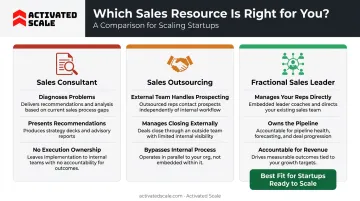
The distinction matters. As Sales Xceleration puts it, a fractional VP works "in your business" as the sales leader, while a consultant works "on your business" without operating it. The practical differences:
- Sales consultant — diagnoses problems, delivers recommendations, moves on. No ownership of execution or outcomes.
- External sales agency — an external team handles prospecting and closing independently. Your company's process isn't being built; it's being bypassed.
- Fractional sales leader — manages your reps, owns the pipeline process, coaches deals, and is accountable for revenue outcomes.
The Gap It Fills
Most early-stage companies hit a point where the founder can't manage the pipeline alone, but can't yet justify a full-time VP. The fractional model was built for exactly this window. Engagement structures vary widely: some companies need 10 hours per week for strategic oversight, others need near full-time involvement for 90 days to build infrastructure from scratch.
That flexibility has fueled real market growth. The number of fractional sales leaders in the US and Canada rose from 5,000 in 2020 to 9,000 in 2024, with software and technology companies driving the majority of that demand.
Platforms like Activated Scale serve this gap directly — matching B2B SaaS startups with vetted, US-based fractional sales professionals across engagements ranging from 10 hours a week to full-time interim roles, with a try-before-you-buy model that lets founders convert top performers to full-time hires without a recruiting gamble.
How Fractional Sales Leadership Works
Fractional engagements follow a defined lifecycle. That structure is what separates this model from ad hoc advisory work — and it's why the best engagements produce lasting infrastructure, not just temporary momentum.
Phase 1: Diagnosis and Scoping
Before touching anything, the fractional leader has to understand what's actually broken.
The engagement typically starts with a scoping conversation: current sales stage, key bottlenecks, what success looks like, agreed KPIs, time commitment, and communication cadence. Then comes a 30-day diagnostic:
- Audit the CRM for hygiene, accuracy, and coverage gaps
- Review pipeline health and win/loss patterns
- Interview sales reps on their current process and blockers
- Assess existing messaging and ICP definition
- Identify the two or three highest-leverage problems before making any changes
Fractional leaders who skip the diagnostic and jump straight to "fixing things" often solve the wrong problems.
Phase 2: Building the Sales Infrastructure
Once the diagnostic is complete, the real build begins. This is typically where companies feel the most visible change.
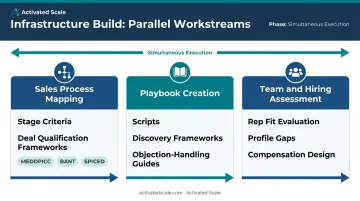
Three workstreams run in parallel during this phase:
Sales process mapping defines stage-by-stage criteria: what moves a deal forward, what disqualifies it, and what questions need answering at each step. Qualification frameworks like MEDDPICC, BANT, or SPICED get applied here to ground forecasting in deal data rather than rep optimism.
Playbook creation surfaces the institutional knowledge that's usually trapped in the founder's head. What resonates with buyers, which objections surface every time, how deals actually close — all of it gets extracted and converted into documented scripts, discovery call frameworks, and objection-handling guides any rep can follow.
Team and hiring assessment answers whether the right people are in the right roles. The fractional leader evaluates rep fit, identifies profile gaps, and manages recruiting and ramp-up for new hires, including designing compensation structures appropriate for the company's stage.
Phase 3: Ongoing Oversight and Coaching
With infrastructure in place, the engagement shifts to a weekly operating rhythm:
- Pipeline reviews — assessing deal health, not just status updates
- One-on-ones with reps — structured, not casual check-ins
- Deal coaching — working live opportunities, not just reviewing closed deals after the fact
- CEO/founder syncs — aligning on strategy and surfacing issues before they become problems
Dashboards and metrics get installed to make performance visible to everyone: pipeline coverage ratios, stage conversion rates, average sales cycle length, forecast accuracy. When the whole team operates from shared data, subjective status reports stop driving decisions.
Phase 4: Transition and Handoff
A well-run fractional engagement ends with a company that either no longer needs the fractional leader, or is ready to bring in a full-time VP to manage what was built.
The deliverables at the end of a completed engagement:
- A documented sales playbook any rep can follow
- A configured, clean CRM with accurate pipeline data
- A team that understands the process and can execute independently
- Forecasting systems that produce reliable numbers
The fractional leader's job, by design, is to make themselves replaceable.
What a Fractional Sales Leader Does in Practice
The role sounds straightforward on paper. In practice, it spans two distinct layers of work that most early-stage companies haven't separated before.
Leadership vs. Day-to-Day Management
There are two distinct layers to the role:
| Layer | What It Involves |
|---|---|
| Leadership | Setting sales strategy, defining the ICP, shaping the go-to-market motion, deciding what to sell and to whom |
| Management | Running pipeline reviews, holding reps accountable, removing blockers on live deals, ensuring process adherence |
A fractional leader does both. That's different from a consultant (who does neither) and different from a full-time VP (who does both, but is also dealing with board meetings, headcount planning, and everything else a full-time executive carries).
A Typical Week
On any given week, a fractional sales leader might:
- Join two or three customer calls to sharpen messaging in real time
- Review CRM entries for accuracy and hygiene
- Run rep coaching sessions using actual call recordings
- Prepare a weekly revenue update for the founder or CEO
- Work a late-stage strategic deal where their seniority can accelerate close
Most founders underestimate the RevOps dimension. Fractional leaders typically own or closely direct CRM configuration, automation workflows, lead routing, and reporting infrastructure. Without clean data and working systems, coaching and strategy remain disconnected from what's actually happening in the pipeline.
Managing the Founder Transition
One of the more delicate parts of the role is helping the CEO step out of day-to-day sales without the pipeline collapsing. This means creating handoff protocols, establishing rep decision-making authority, and serving as the buffer between the team and executive leadership during the transition period.
When this transition is handled well, founders reclaim meaningful time and the team gains clear direction. When it's skipped or rushed, reps lose their footing and pipeline momentum stalls — sometimes faster than anyone expects.

Who Benefits Most from Fractional Sales Leadership
The clearest fit: seed-to-Series A B2B SaaS companies that have proven they can close customers but haven't yet built a repeatable, team-driven sales process — where the founder is still the best (or only) salesperson in the company.
Strong Candidate Signals
- You have product-market fit and paying customers, but every deal still runs through you
- You have two to five junior reps who lack senior oversight and mentorship
- Pipeline is inconsistent quarter to quarter — good months and bad months with no clear explanation
- Investors or your board are pushing for more rigorous forecasting and reporting
- You're losing deals you should be winning but can't identify why
Poor Fits
- No product-market fit yet — without validated demand, there's no repeatable process to build
- Mature teams that need full-time ownership — consistent revenue and an established sales org call for a dedicated VP, not a part-time leader
Activated Scale is built specifically for the strong-candidate scenario. The platform connects B2B SaaS founders with vetted, US-based fractional sales professionals, including VP-level talent with backgrounds at companies like Salesforce, Klaviyo, and Databricks, and can typically complete a match in 7 days or fewer.
60% of Activated Scale clients end up hiring their fractional sales talent as full-time employees after the initial period. The contract-to-hire model lets companies evaluate real performance before making any long-term commitment.
Fractional Sales Leader vs. Full-Time VP of Sales vs. Sales Consultant
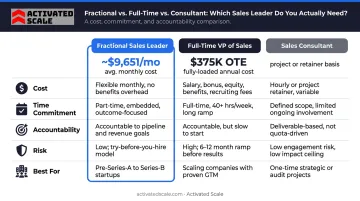
Here's how the three models compare across the dimensions that actually matter:
| Fractional Sales Leader | Full-Time VP of Sales | Sales Consultant | |
|---|---|---|---|
| Cost | ~$9,651/month avg. (no equity or benefits) | $200K+ base, $375K OTE, plus benefits and equity | Project-based; lowest total cost |
| Time commitment | 10–20 hours/week, embedded | Full-time ownership | Limited; project-scoped |
| Accountability | Owns outcomes; manages the team | Full ownership of sales org | Advisory only; no accountability for execution |
| Risk | Low — try-before-you-buy options available | High — bad hire costs months of runway | Low — but limited impact |
| Best for | Building the system; leading team through transition | Managing a built system with a full team | Specific strategic challenges, outside perspective |
How to Choose
- Building from scratch and leading through transition: Fractional is the right fit.
- System built, team large enough for full-time oversight: A VP hire makes sense.
- Outside perspective on a specific challenge, no operational involvement needed: Consultant fits.
The trap many founders fall into: hiring a full-time VP before the system exists, expecting the executive to both build the infrastructure and manage a team at the same time. Most VP hires excel at scaling a system that already works — the process, the playbook, the pipeline. Fractional leaders are hired precisely because that system doesn't exist yet.
Frequently Asked Questions
How is a fractional sales leader different from a sales consultant?
A fractional leader is embedded inside your company, manages your reps directly, and takes accountability for revenue outcomes. A consultant provides external recommendations without running day-to-day operations or owning results. The accountability gap is the key distinction.
How much does fractional sales leadership typically cost?
According to Vendux's 2024 data, the average monthly fee for a US-based fractional sales leader is $9,651, with an average hourly rate of $213. Most engagements (67%) use retainer-based structures. There's no equity, benefits, or bonus obligation.
What does a fractional sales leader do in the first 30 days?
Primarily diagnostic work — auditing the CRM, reviewing pipeline health and win/loss history, interviewing reps, and mapping current messaging against ICP. The goal is to identify the highest-impact gaps before making any structural changes.
How long does a fractional sales engagement typically last?
Vendux reports an average of 9.7 months for 2025. Shorter engagements (around 3 months) focus on a defined infrastructure build; longer ones (12+ months) involve ongoing leadership. Timeline depends on how mature the company's existing systems are at the start.
When should a startup hire a fractional sales leader instead of a full-time VP of Sales?
When you have product-market fit and need to build repeatable processes, but don't yet have the revenue, team size, or certainty to justify a full-time executive salary and equity package. The fractional model gives you senior leadership without the full-time commitment.
Can a fractional sales engagement transition into a full-time hire?
Yes, and it typically goes one of two ways. The fractional leader helps hire and onboard a full-time VP, then transitions out. Or, through a contract-to-hire structure like Activated Scale's, the fractional professional converts to a full-time role once the company is ready to commit — a path 60% of Activated Scale clients take.