Introduction
Hiring a full-time VP of Sales sounds like the obvious move when you're trying to grow — until you see the total bill. Glassdoor data puts the median US VP of Sales total pay at $306,434, and that's before benefits, equity, onboarding, and the three to six months it takes for them to produce measurable results.
For a B2B SaaS startup between $1M and $5M ARR, that fixed cost represents capital that could fund two engineers, a marketing budget, or six months of runway.
Fractional sales leadership solves that math directly. But founders still ask the same question: What will I actually get for this investment, and when?
Here's a clear answer: what ROI looks like, when to expect it, and which metrics tell you whether the engagement is working.
Key Takeaways
- Fractional sales leaders deliver VP-level expertise without the fixed-cost burden of a full-time hire
- Leading indicators — pipeline volume, meeting rates, conversion data — typically improve within 30–60 days
- Closed revenue ROI lags by one to two full sales cycles; don't judge the engagement at day 45
- ROI is highest when you have existing lead flow, proven product-market fit, and at least one rep to coach
- Set 90-day milestones and agreed success metrics before the engagement starts — not after
What ROI Actually Looks Like for B2B SaaS Startups
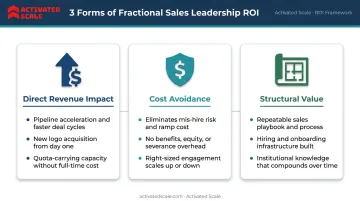
ROI from fractional sales leadership isn't one number. It comes in three forms, and founders who only track closed revenue miss two of the three.
- Direct revenue impact — improved conversion rates, more pipeline, faster sales cycles. Most visible outcome, but takes the longest to materialize.
- Cost avoidance — the gap between fractional engagement fees and a full-time VP's total cost. Factor in base salary, variable pay, benefits (BLS puts employer benefit costs at 29.5% of total compensation), equity dilution, recruiter fees, and three to six months of ramp time. For seed-to-Series A companies, that gap is substantial — capital that can go back into product, headcount, or marketing.
- Structural value — the playbooks, CRM frameworks, ICP definitions, and qualification processes the leader builds. A full-time mis-hire leaves behind problems. A well-scoped fractional engagement leaves behind infrastructure that keeps generating returns after the engagement ends.
Benchmarking Expectations by Stage
Revenue outcomes vary by where you are:
| ARR Stage | Primary Focus | Realistic Timeframe for Impact |
|---|---|---|
| Pre-$1M | Build first repeatable process | 3–6 months |
| $1M–$5M | Scale pipeline and coach the team | 6–9 months |
| $5M–$10M | Enterprise motion and specialization | 9–12 months |
Fractional sales leaders don't close deals themselves — that's not the model. Their ROI driver is building the system: ICP clarity, repeatable qualification, structured pipeline reviews, rep coaching. The existing team closes more consistently because the system works. That team output improvement is its own ROI metric, separate from the revenue line.
The Cost Side of the Equation
Understanding the cost of a fractional engagement requires comparing it to the right alternative.
A platform like Activated Scale connects B2B SaaS founders with vetted, US-based fractional sales professionals in seven days or less. The cost covers strategic, revenue-driving work — not benefits, equity grants, severance exposure, or the productivity loss from a three-month hiring search.
There's another risk worth factoring in: a bad full-time VP hire. No single verified post-2020 figure exists for the total cost of a failed VP Sales hire (anyone citing a specific multiple should be pressed on their source), but the categories are clear:
- Salary paid during an ineffective tenure
- Recruiter or search fees (retained search firms typically charge ~33% of first-year compensation)
- Severance
- Replacement search costs
- Pipeline opportunities that stalled or died
- Rep attrition and team disruption
That's a five- to seven-figure exposure with no upside. Fractional engagements eliminate most of it — no long-term commitment, no severance, no six-month search if it doesn't work.
The efficiency gains compound beyond the engagement itself. A fractional leader who builds documentation, playbooks, and CRM structure in month one keeps generating ROI through those assets long after the work concludes.
Activated Scale's try-before-you-buy model takes this further — companies evaluate fit on demonstrated results, not interview performance alone.
When to Expect Results: A Timeline Breakdown
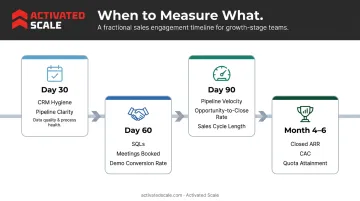
Days 1–30: Discovery and Quick Wins
The first month is diagnostic. A good fractional leader audits where deals stall, identifies gaps in messaging or qualification, and tightens the ICP definition. Quick wins in this window include a structured pipeline review cadence, cleaner CRM data, and early fixes to outreach sequencing.
Closed revenue isn't on the table yet — but you should have meaningfully better pipeline visibility within two to four weeks.
Days 31–60: Process and Playbook Implementation
This is when structured systems go in: qualification frameworks, call structures, follow-up cadences, rep coaching rhythms. Leading indicators to watch at this stage:
- Meetings booked per week
- Demo-to-opportunity conversion rates
- Pipeline velocity and average deal age
Activated Scale clients target 10–15 qualified meetings per month as a benchmark for fractional SDR and sales leader engagements. Flock Homes averaged 14 new meetings set per month over six months through their fractional SDR engagement — a sustained result that lands squarely in that range.
Days 61–90: Performance Visibility
By day 90, a well-scoped engagement produces measurable conversion rate improvement and a more predictable pipeline. SaaStr's operator guidance for new VP-level hires sets roughly one full sales cycle as the horizon for initial measurable impact — the same logic applies to fractional leaders.
This is also the milestone where you decide: extend, convert to a full-time hire, or add reps.
Months 4–6: Compounding Revenue Impact
Whatever you decide at that 90-day mark, revenue attribution follows. Closed deals typically lag process improvements by one to two full sales cycles. For companies with 30–90 day cycles (common at $10K–$50K ACV), expect to see closed ARR tracing back to first-90-day systems beginning around month four. For enterprise deals above $100K, that lag extends further.
One variable that meaningfully compresses this timeline: giving your fractional leader immediate access to CRM data, historical pipeline records, and customer feedback from day one. Early access to that context cuts weeks off the diagnostic phase — which pulls every downstream result forward.
The Metrics That Signal Fractional Sales Leadership Is Working
Leading vs. Lagging Indicators
The most common mistake founders make is judging a fractional engagement on closed revenue too early. Leading indicators move first; lagging indicators follow.
| Timeframe | Watch These Metrics |
|---|---|
| Day 30 | CRM hygiene score, pipeline stage clarity, ICP definition completeness |
| Day 60 | SQLs added per week, meetings booked, demo-to-opportunity conversion rate |
| Day 90 | Pipeline velocity, opportunity-to-close rate, sales cycle length trend |
| Month 4–6 | Closed ARR, CAC, rep quota attainment rate |
Pipeline and Activity Metrics
These are the earliest signals of ROI and the most directly influenced by a fractional leader's work:
- New SQLs added per week: the clearest early sign that ICP targeting is working
- Total pipeline value created: tracks whether enough coverage exists to hit revenue targets
- Pipeline velocity: measures how quickly deals progress through each stage
- Qualified meeting volume: a direct output of outreach quality and ICP definition
Conversion and Efficiency Metrics
Activity metrics tell you what's happening at the top of the funnel. Conversion metrics tell you how well the process is working below it.
HubSpot benchmarks put qualified lead-to-opportunity rates at 15–25%, with proposal-to-close rates ranging 25–40%. A fractional leader focused on qualification and process improvement should move each conversion point incrementally — and those improvements compound across the full funnel.
Track:
- Lead-to-meeting rate
- Demo-to-opportunity rate
- Opportunity-to-close rate
- Average sales cycle length
Team Performance Metrics
These reflect the coaching work that generates long-term ROI:
- Quota attainment rate across existing reps
- Ramp time for any new reps hired during the engagement
- CRM hygiene score — completeness and accuracy of deal data
When Fractional Sales Leadership ROI Falls Short
The engagement model works. But it underdelivers when the foundation isn't there.
Conditions that limit ROI:
- No existing lead flow — a fractional leader optimizes systems, not demand generation vacuum
- ICP still in flux — you can't build a repeatable process if the target changes monthly
- Founder remains the primary deal-closer — if you haven't created space for the leader to own the motion, you've hired a consultant with no authority
- Team of zero reps — building from scratch extends the timeline to revenue ROI significantly
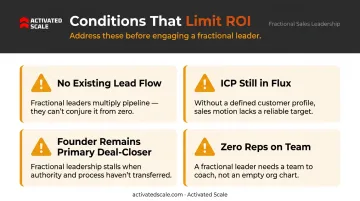
Each of these is fixable. Address them before engaging a fractional leader, not during.
Engagement design failures that kill ROI:
- No defined 30/60/90-day milestones
- Vague success metrics agreed upon too loosely
- A fractional leader overcommitted across too many clients simultaneously
- Expecting the leader to generate leads rather than build the system
Beyond engagement design, there's a structural ceiling to consider. If the role requires daily oversight of five or more reps and involvement in every deal, a fractional leader is structurally undersized — and a full-time hire becomes more cost-effective. The threshold is simple: if you need 40+ hours per week of dedicated sales leadership, fractional isn't the right model.
Frequently Asked Questions
How long does it take to see ROI from fractional sales leadership?
Leading indicators — pipeline improvements and qualified meeting volume — typically appear within 30–60 days. Closed revenue ROI follows at the 90-day to six-month mark, depending on your average sales cycle length. Don't judge the engagement on closed deals in the first 60 days.
What does fractional sales leadership typically cost for a B2B SaaS startup?
Cost varies by scope, seniority, and hours. You pay only for strategic, revenue-driving work — no benefits, equity dilution, or long-term commitment. Total cost runs well below a full-time VP of Sales hire once you account for all-in compensation and the risk of a bad hire.
How do I calculate ROI from a fractional sales leadership engagement?
Compare total engagement cost against three inputs: incremental revenue attributable to process improvements, the cost of a failed full-time hire avoided, and the ongoing value of playbooks and systems left behind. All three are legitimate ROI components, not just top-line revenue.
What metrics should I track to measure fractional sales leadership success?
In the first 60 days, focus on leading indicators: SQLs, qualified meeting volume, and demo conversion rate. After that, shift to lagging indicators: closed ARR, CAC trend, and sales cycle length.
When is fractional sales leadership NOT worth the investment?
When there's no existing lead flow, no product-market fit signal, or no sales team to coach, the engagement has nothing to optimize. Defer until those foundations exist. The model is also undersized for companies that genuinely need 40+ hours per week of full-time sales leadership.
Can a fractional sales leader work with an early-stage team that has no existing sales reps?
Yes, but with a longer timeline to revenue ROI. In a zero-rep scenario, the leader focuses on building the hiring profile, sales playbook, and process infrastructure first. Expect a longer runway before closed revenue appears.