
Hire too early, before you have a repeatable process, and you're asking someone to figure out your market on your dime. Hire too late, and the founder becomes the bottleneck capping revenue. The timing matters as much as the person.
This guide walks through when to hire, what readiness actually looks like, who the right first rep is, and the mistakes that derail most early-stage companies before they even get started.
Key Takeaways
- Close at least 10–20 customers yourself before hiring — enough to know what you're asking someone to replicate.
- Readiness signals include a repeatable process, a defined ICP, and more qualified demand than you can handle alone.
- Startup experience and buyer familiarity are non-negotiables — a polished résumé from a large company doesn't replace them.
- Start with a sales rep who can execute alongside you, not a VP who needs a team to manage.
- Hiring one rep instead of two makes it nearly impossible to separate a people problem from a process problem.
The Founder-Led Sales Phase: When to Start and When to Stop
In the earliest stage, the founder is the best possible salesperson. Not because of sales training — but because nobody else understands the product vision, customer pain, and value proposition as deeply. Every sales call at this stage is really a product discovery session disguised as a pitch.
The learning that compounds during founder-led sales is irreplaceable:
- Which objections come up repeatedly
- What messaging actually resonates versus what you think resonates
- Which customer profiles convert and why
- What the real buying trigger is (often different from what you assumed)
This pattern recognition forms the foundation of any future sales playbook. When you skip it, you're asking a new hire to discover your market while simultaneously selling — a nearly impossible ask.
The Risk of Delegating Too Early
When a salesperson becomes the buffer between the founder and the customer, critical signals get filtered or lost:
- The objection that keeps killing deals goes unreported
- The feature request three prospects mentioned in the same week never reaches product
- Iteration slows at exactly the moment speed matters most
The Practical Benchmark
Jason Lemkin at SaaStr advises founders to close at least 10–20 customers personally before bringing on a rep. You need enough pattern recognition to know what works, explain why it works, and hand someone else a teachable motion.
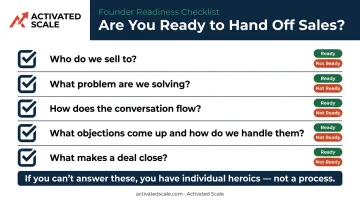
"Ready to hand off" means you can answer all of these without hesitation:
- Who do we sell to?
- What problem are we solving for them?
- How does the conversation flow?
- What objections come up, and how do we handle them?
- What makes a deal actually close?
If you can't answer those questions confidently, you don't have a sales process yet. You have a series of individual heroics.
Signs You're Ready to Make Your First Sales Hire
Readiness isn't about being tired of selling. It's about having enough validated signal to set a new hire up for success rather than frustration.
Operational Signals
Capacity: When qualified inbound leads are sitting uncontacted for days, or you're consistently choosing between selling and building, you have a structural bottleneck — not a motivation problem. That gap costs you deals.
Process: If you can run a sales cycle the same way two or three times and get similar outcomes, it's repeatable enough to document and hand off. Consistency is the key word. One lucky close doesn't count.
Market and Revenue Signals
Product-market fit: Scaling sales before PMF is confirmed wastes both money and momentum. First Round's B2B PMF framework points to metrics like net revenue retention above 100%, more than 10% of new business coming from referrals, and regretted churn under 10% as meaningful indicators. Look for customers who articulate your value proposition back to you without prompting.
ICP clarity: If you can describe your ideal customer profile with genuine specificity — industry, company size, buyer title, trigger event — a new hire has enough direction to work independently from day one.
Vague targeting ("we sell to mid-market companies") isn't enough. Specific targeting ("we sell to VP of Operations at logistics companies with 200–500 employees going through a warehouse expansion") gives a rep something to work with.
Who to Hire: The Profile of Your First Sales Rep
The first sales hire is categorically different from any subsequent hire. This person must thrive without a recognized brand, without established systems, and without a manager telling them what to do. Startup sales experience is a hard requirement, not a preference.
Buyer Familiarity
Hiring someone who has already sold to your target buyer — same title, same industry, similar deal size — compresses onboarding significantly. They arrive with relevant objection responses, intuitive knowledge of how decisions get made, and sometimes existing relationships. The alternative is paying ramp costs while they learn a buyer persona from scratch.
This is exactly what founders working with Activated Scale frequently cite as the most valuable part of the placement process. Kognitos' CEO described it directly: "Activated Scale quickly understood my current stage and recommended an expert that has sold to my buyer." That buyer-fit matching is what separates a six-month ramp from a two-month ramp.
Deal-Size Fit
Deal complexity scales with contract value. Hiring someone who has only closed $20K deals to sell $200K contracts means they're learning enterprise sales mechanics on your leads and your runway — skills they haven't yet built:
- Navigating multi-stakeholder buying committees
- Managing extended sales timelines
- Working through procurement processes
Match the candidate's prior deal size to yours.
The "Would I Buy From This Person?" Test
Early-stage leads are irreplaceable. You should only hand them to someone you'd genuinely trust to sell you your own product. If you wouldn't buy from them, your prospects probably won't either.
Validate Before You Commit
For founders who want to test fit before locking in a full-time hire, a contract-to-hire model removes most of the downside risk. Activated Scale's try-before-you-buy approach lets founders run a real-world trial with a vetted, experienced sales professional. 65% of clients end up converting their fractional AE to a full-time hire after seeing actual results.
Windsor, a Y Combinator-backed AI startup, went from first call to sales hire in 8 days and saw a 4x increase in average deal size after the engagement.
Sales Rep or Sales Leader: Which Role Should Come First?
This decision trips up a lot of founders, and the logic is straightforward once you strip away the status appeal of a VP title.
Start with a sales rep when the process is still being defined and you're actively closing deals. You need someone who executes alongside you — not a leader who needs a team and a process to manage. The rep builds pipeline, closes deals, and helps you refine the playbook.
Bring in a sales leader once two or more reps are hitting quota and you need someone to own process-building, hiring, and forecasting. Before that point, SaaStr's guidance is clear: there's nothing for a VP to scale yet.
The Sequencing Risk
Hiring a VP of Sales before any reps are hitting quota produces a predictable outcome: the leader ends up selling instead of building, the management gap goes unfilled, and you've spent VP-level salary for individual contributor output.
OpenView puts it plainly — hiring before market and revenue validation sets the VP up to fail.
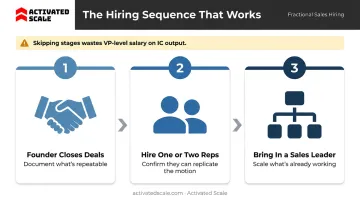
The sequence that works:
- Founder closes deals and documents what's repeatable
- Hire one or two reps and confirm they can replicate the motion
- Bring in a sales leader to scale what's already working
Common Mistakes to Avoid When Hiring Your First Salesperson
Hiring for Pedigree Over Fit
Enterprise sales experience at Salesforce or Oracle doesn't transfer to a startup where there's no brand, no SDR support, no marketing collateral, and no sales operations team. The skills are real — but they were built inside an infrastructure that doesn't exist at your company. Candidates must have proven they can sell without that scaffold. Ask specifically: "Tell me about a time you built pipeline without inbound support or brand recognition."
Hiring Without a Playbook
Bringing in a new rep before documenting the sales process sets them up to reinvent the wheel. They'll develop their own version of your pitch, handle objections differently each time, and give you no consistent signal about what's working. The ICP, discovery questions, objection responses, and closing steps need to be written down — even roughly — before day one.
That foundation doesn't have to be built alone. Activated Scale's fractional professionals help founders create this structure from scratch — Dresma.ai came in with no repeatable outbound strategy and left with one, achieving a 5x increase in qualified meetings.
Hiring One Rep Instead of Two
SaaStr recommends hiring two initial reps simultaneously for a straightforward reason: with one rep, you can't distinguish between a process problem, a product problem, or a people problem. If one of two reps succeeds and the other doesn't, you've learned something. If only one rep fails, you've learned nothing definitive — and you've wasted the time it took to find out.
Beyond the diagnostic value, two reps create healthy competition and remove single-person dependency on your pipeline — both of which matter more than most founders expect.
Frequently Asked Questions
How many customers should a founder close before hiring the first sales rep?
Most experienced operators recommend closing at least 10–20 customers yourself first. That's enough to identify what works, document it, and hand someone a teachable process rather than asking them to build one from scratch.
Should I hire a sales rep or a VP of Sales as my first hire?
Start with a sales rep in almost every case. A VP of Sales needs an existing team and process to be effective — without those, they'll end up selling instead of building, which defeats the purpose of the hire and leaves the management gap unfilled.
What is the 70/30 rule in sales?
Sandler's 70/30 rule says the prospect should speak 70% of the time while the seller speaks 30%, using that time to ask good questions. It's a useful heuristic for evaluating a candidate's discovery approach — does this person talk at prospects or genuinely draw them out?
Should my first sales hire be full-time or fractional?
For most early-stage founders, fractional is the lower-risk starting point. It lets you validate fit, test your sales process with a real professional, and convert to full-time once you have enough pipeline to justify the cost — without betting six months of runway on someone who may not work out.
What traits should I look for in my first sales hire?
The non-negotiables: startup sales experience, direct familiarity with your target buyer, comfort operating without systems or support, and genuine drive to win that shows up before any incentive check clears.
How do I know if my first sales hire isn't working out?
Watch for consistently missed activity benchmarks, inability to move deals through the funnel after a reasonable ramp period, and feedback from prospects suggesting they wouldn't buy from this person. SaaStr recommends evaluating closing performance over one to 1.5 full sales cycles — not an arbitrary 90-day window — to give a fair read on actual performance.