
Introduction
Most B2B tech founders have the same problem: a product that works and a pipeline that doesn't. They generate some early customers through their network, then hit a wall. The outbound motion is inconsistent. Inbound traffic doesn't convert. The team is busy but the calendar stays empty.
According to Forrester's 2024 research, the average B2B buying decision now involves 13 people across multiple departments — which means a single enthusiastic contact rarely turns into a closed deal. You need the right accounts, the right contacts within them, and the right timing.
Pipeline growth comes down to structure, not effort. Companies that scale predictably have a defined Ideal Customer Profile, a mix of outbound and inbound motions, and the execution capacity to run both simultaneously.
This article covers what makes a B2B tech lead worth pursuing, the outbound and inbound strategies that actually fill pipelines, the tools to source leads at scale, and what to do when your process is working but your team can't keep up.
Key Takeaways
- Define your ICP using firmographic, technographic, and behavioral criteria — quality targeting beats volume every time
- Outbound works best as a multi-touch sequence: cold email, LinkedIn outreach, and follow-up over 2–3 weeks
- Inbound pulls in buyers already researching — SEO content, webinars, and review platforms like G2 capture high-intent traffic
- Tools like LinkedIn Sales Navigator, Apollo.io, ZoomInfo, and Bombora give you the data infrastructure for both motions
- When lead gen starts working, execution bottlenecks emerge — fractional SDRs let you scale outreach without a full-time hire commitment
What Defines a High-Quality B2B Tech Sales Lead
More leads is not the answer. Better leads are.
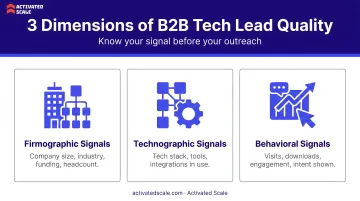
The Three Dimensions of Lead Quality
A high-quality B2B tech lead fits on three dimensions simultaneously:
- Firmographic fit — company size, industry, funding stage, and growth trajectory. A Series A SaaS company with 50 employees has entirely different buying behavior than a 500-person enterprise.
- Technographic fit — what tools and platforms they already use. A company running Salesforce is a different prospect for a CRM integration tool than one running spreadsheets. Tools like BuiltWith, Clearbit, and ZoomInfo Technographics surface this data before you write a single word of outreach.
- Behavioral signals — job postings in relevant roles, recent funding announcements, content engagement, or category research activity. These signals indicate timing, not just fit.
All three matter. Firmographic fit tells you they could buy, technographic fit tells you they should — and behavioral signals tell you exactly when to reach out.
MQLs vs. SQLs: The Qualification Gap
Most founders chase volume. The better target is qualification.
A Marketing Qualified Lead (MQL) has engaged with your content — downloaded a guide, visited your pricing page, or registered for a webinar. They've raised their hand, but they haven't been vetted.
A Sales Qualified Lead (SQL) has been reviewed by sales for budget authority, decision-making power, and buying timeline. HubSpot benchmarks the MQL-to-SQL conversion rate at 13% for B2B SaaS. That means the vast majority of your marketing leads aren't sales-ready yet — and treating them as if they are wastes your team's time.
Building Your ICP Before Prospecting
Your Ideal Customer Profile is the filter that everything else runs through. Without it, you're guessing.
A complete B2B tech ICP defines:
- Company size (headcount or revenue range)
- Industry vertical and sub-segment
- Funding stage or revenue threshold
- Pain points your product directly addresses
- Tech stack signals that indicate fit
- Buyer persona — specific job titles, seniority level, and decision-making authority
Build this before any outbound or inbound work begins. When you have it, every outreach decision gets faster and every conversation gets sharper.
Outbound Strategies to Generate B2B Tech Sales Leads
Targeted List Building Using Firmographic and Technographic Filters
Buying a generic contact list is usually a waste of money. The problem isn't the volume — it's that unfiltered lists include hundreds of companies that will never buy from you, dragging down reply rates and burning your sender reputation.
A filtered, ICP-matched list performs differently. Belkins' analysis of 16.5 million B2B emails found that outreach targeting just 1–2 contacts per company produced a 7.8% reply rate, compared to 3.8% when emailing 10+ people at the same account. Narrower, more precise targeting consistently outperforms volume.
Technographic filtering adds another layer. Knowing that a prospect uses a specific CRM, marketing automation tool, or cloud infrastructure platform lets you frame your outreach around integration, displacement, or compatibility — all of which are stronger hooks than a generic value proposition.
Tools for building filtered lists:
- Apollo.io — firmographic + technographic filters, built-in sequencing
- ZoomInfo — deep technographic data, strong enterprise coverage
- LinkedIn Sales Navigator — real-time signals and precise role-based filtering
- BuiltWith — identifies technology stack by domain
Cold Email and Multi-Touch Outreach
Cold email still works. Average B2B cold email reply rates sit around 5.8% according to Belkins' 2025 data — low, but predictable enough to plan around. The gap between 3% and 10%+ reply rates almost always comes down to personalization.
Sopro's research found that advanced personalization produces an 18% response rate versus 9% for generic emails. Anatomy of a cold email that gets replies:
- Subject line — specific, not clever. Reference the company or role, not a generic hook.
- Opening line — one sentence tied to something real about the prospect (a job posting, a recent announcement, a tool they use)
- Value proposition — one sentence connecting their specific situation to your product's outcome
- CTA — low friction. Ask for 15 minutes, not a demo.
Single-touch campaigns rarely work in B2B tech. Decision-makers are busy and often see your first email on a bad day. A 2–3 week multi-touch sequence — combining email, a LinkedIn connection request, and a follow-up note or call — increases your chances of landing a response without being overbearing.
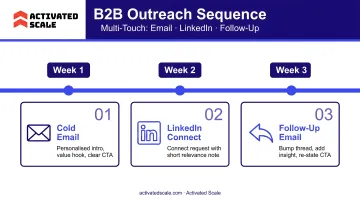
One well-timed follow-up can boost reply rates by up to 49%, though response quality drops and spam complaints rise after the fourth or fifth touch.
LinkedIn Sales Navigator and Social Outreach
That multi-touch approach works best when LinkedIn is part of the mix. It's where B2B tech buyers spend their professional time, and Sales Navigator gives you precise targeting to reach the right ones. 89% of B2B marketers use LinkedIn for lead generation, and LinkedIn reports that InMails generate a 10–25% response rate — roughly 300% higher than the same message sent via email.
A 2023 Forrester Total Economic Impact study modeled a $250M SaaS company and found 312% ROI from Sales Navigator, with one software company attributing 75%+ of sourced meetings to the platform.
The three-Cs outreach framework for LinkedIn:
- Compliment — reference something genuine: a post they wrote, a company milestone, or a specific challenge their role typically faces
- Case study — one short sentence describing a relevant outcome you've produced for a similar company
- Call to action — a specific, low-commitment ask ("Would it be worth a 15-minute call?")
Intent-Based and Trigger-Driven Prospecting
Timing separates a well-received email from one that lands in the trash. Intent data tells you when a prospect is actively researching solutions in your category — tracked through third-party content consumption signals — making outreach far more relevant.
Gartner notes that 99% of B2B purchases are driven by organizational changes, which makes trigger events equally powerful. The best triggers to monitor:
- New executive hires in relevant roles (VP Sales, CTO, Head of Operations)
- Funding announcements (fresh capital typically means active buying)
- Product launches or geographic expansions
- Job postings for roles your product supports
Platforms like Bombora track company-level intent signals. G2 Buyer Intent identifies companies actively researching your category on the review platform. Both let you prioritize which accounts get your attention first — and reach out at the moment they're actually looking.
Inbound Strategies That Pull Tech Buyers to You
SEO-Driven Content Marketing
Gartner research shows that 75% of B2B buyers prefer a rep-free buying experience, and 64% of technology buyers familiar with a product prefer a fully digital purchase. That means your content needs to do sales work before a rep ever shows up.
SEO-driven content targets buyers during their research phase. The most effective formats for B2B tech:
- Comparison pages ("Tool A vs. Tool B") — high intent, captures buyers evaluating options
- Use-case guides — positions your product against specific problems, not generic categories
- Integration-specific content — targets buyers who already use compatible tools
- "Best tools for X" roundups — intercepts buyers building shortlists
Content CTAs should match the buyer's stage. A "what is X" post should offer a downloadable guide or template to capture the email. A "best tools for X" page should drive directly to a demo or consultation request. Without that conversion layer, you're generating awareness for competitors who have it.
Webinars and Software Directories
SEO pulls in passive researchers; webinars pull in active buyers ready to engage. Webinars establish credibility and generate a qualified lead list simultaneously. ON24's 2025 data shows an average registration-to-attendance rate of 57% — everyone who attends has already demonstrated meaningful interest. Effective webinar strategy requires:
- A topic tied directly to your ICP's specific pain points (not product features)
- Promotion across LinkedIn and your email list at least two weeks out
- Attendee data captured for structured follow-up within 48 hours
- A clear CTA at the close — a free consultation, trial offer, or resource download
Software directories like G2, Capterra, and Product Hunt put your product in front of buyers actively building shortlists. G2's 2024 Buyer Behavior Report found that 45% of buyers had 4–7 products on their shortlist before contacting any vendor — which means you need to be discoverable before buyers reach out, not after.
More positive reviews drive higher category rankings, which generate compounding organic traffic from in-market buyers. Responding to reviews and systematically asking satisfied customers to leave them is one of the highest-ROI, lowest-effort tactics available.
Top Tools for Sourcing B2B Tech Leads
Choosing the right tools is half the battle. Here's how the main categories break down:
| Category | Tools | Best Used For |
|---|---|---|
| Contact data & prospecting | LinkedIn Sales Navigator, Apollo.io, ZoomInfo, SalesIntel, Lusha | Building filtered, ICP-matched lists at scale |
| Email finding & verification | Hunter.io, Snov.io | Finding and validating contact emails before sending |
| Intent data & signals | Bombora, G2 Buyer Intent, Clearbit | Identifying in-market accounts and prioritizing outreach timing |
| CRM | HubSpot, Salesforce, Pipedrive | Organizing, scoring, and routing leads once they enter the system |
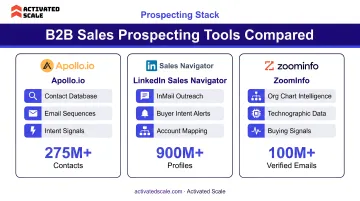
What to evaluate in any lead database:
- Data accuracy and recency (outdated contacts destroy deliverability)
- Firmographic and technographic filtering depth
- CRM integration quality
- Pricing model relative to your outreach volume
A CRM isn't optional once volume picks up. Without a central system, leads from multiple channels pile up fast: contacts get missed, follow-ups stall, and you lose visibility into your pipeline. Tag every lead by source and ICP fit from the moment it enters the system.
How to Scale B2B Tech Lead Generation Without Burning Out Your Team
Getting the strategy right is the first problem. Having enough people to execute it consistently is the second — one that tends to arrive faster than founders expect.
The typical pattern: outbound starts producing responses, inbound starts generating traffic, and suddenly there aren't enough hours in the day to follow up on everything. Promising lead lists go cold, founders get pulled into prospecting instead of closing, and growth plateaus despite a working system.
The Case for Fractional Sales Talent
Hiring a full-time SDR or Account Executive is a $60,000–$100,000 annual commitment before benefits and commissions — and a wrong hire can cost over $35,000 in lost time, missed deals, and rehiring costs. For early-stage startups, that's a significant risk to take before the sales motion is fully proven.
Fractional sales professionals offer a different model. Through Activated Scale, B2B SaaS startups can engage vetted, US-based SDRs and Account Executives from backgrounds at companies like Salesforce, Oracle, Zendesk, and Datadog working 15–20 hours per week on a monthly retainer. Fractional SDRs typically cost $3,500–$4,500 per month plus commission, compared to a full-time hire's $60,000–$100,000 annual salary.
The results are concrete. Client outcomes by the three-month mark typically include:
- 10–15 qualified meetings per month on average across the client base
- Dresma.ai: 5X increase in meetings with qualified prospects after implementing fractional outbound
- Althub: 11 qualified meetings per month from a single fractional SDR
- Flock Homes: 14 new meetings set per month, sustained over six months
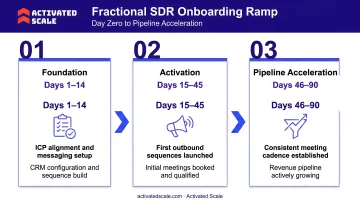
Activated Scale connects startups with fractional talent in 7 days or less (sometimes under 48 hours). The engagement follows a structured ramp:
- Days 0–15: Onboarding — learning the company, ICP, and current acquisition channels
- Days 16–45: Testing and iterating outbound messaging across email, cold calling, and LinkedIn
- Days 45+: Accelerating outreach to book meetings and generate pipeline
80% of clients continue using Activated Scale talent for 5+ months, and approximately 85% hire their fractional SDR full-time after the initial contract — a genuine try-before-you-buy approach to sales hiring.
Systematize Before You Scale
Whether you bring in fractional or full-time talent, documented processes are what make scaling possible. Before adding sales headcount, build out:
- Written ICP criteria with firmographic, technographic, and behavioral filters
- Outreach templates for cold email, LinkedIn connection requests, and follow-up sequences
- CRM workflows for lead tagging, scoring, and routing
- Clear definitions for MQL and SQL so handoffs between marketing and sales don't create confusion
New sales resources ramp faster when the playbook already exists. Hand them a system on day one — don't ask them to build it.
Frequently Asked Questions
How do I find B2B tech sales leads?
Combine outbound tactics — targeted cold email, LinkedIn Sales Navigator outreach, and intent-based prospecting — with inbound strategies like SEO content, webinars, and G2/Capterra directory listings. Start with a well-defined ICP so you're targeting the right companies before investing in either motion.
What makes a B2B tech sales lead "qualified"?
A qualified lead fits your ICP on firmographic criteria (company size, industry, stage), technographic criteria (relevant tools or stack), and has shown behavioral intent through content engagement, intent signals, or trigger events like funding or a new hire. Fit without timing is a cold list — fit plus an active trigger is a real lead.
How much do B2B tech sales leads cost?
Building leads in-house using tools like Apollo.io or LinkedIn Sales Navigator typically runs $50–$500/month in subscriptions. Buying leads from databases or agencies ranges from $30–$150+ per lead depending on qualification depth. A fractional SDR through Activated Scale runs $3,500–$4,500/month and typically delivers 10–15 qualified meetings per month.
Can ChatGPT generate B2B sales leads?
ChatGPT can't source verified contact data or intent signals directly. It's useful for writing personalized cold email sequences, drafting ICP descriptions, building LinkedIn outreach templates, and generating content briefs. Use it to speed up execution, not as a lead source on its own.
What is the best channel for B2B tech lead generation?
LinkedIn consistently ranks as the top channel due to its professional targeting and decision-maker density. The highest-performing programs combine LinkedIn outreach, cold email sequences, and content marketing to reach buyers across multiple touchpoints rather than relying on any single channel.