Introduction
B2B sales teams in 2026 face a paradox: pipeline pressure is higher than ever, yet the tactics that built pipelines in years past are yielding diminishing returns. Cold list blasting delivers sub-6% reply rates. Generic paid campaigns burn budget without booking meetings. 61% of buyers now prefer a rep-free buying experience, and 73% actively avoid irrelevant outreach.
The root cause? Buying committees have nearly doubled from 5.4 stakeholders in 2015 to 8-13 in 2025, attention is scarce, and buyers complete 60-70% of their research before ever speaking to a sales rep.
Front-runners win 80% of the time. If you're not shaping buyer thinking early in that research phase, you've already lost the deal.
This post breaks down the demand generation strategies that fill pipeline in 2026 — covering what to prioritize, how to execute, and where most B2B teams are still leaving opportunities on the table.
Key Takeaways
- B2B demand gen now targets entire buying committees, not individual leads
- Top strategies combine intent data, ABM, precision outbound, and AI-discoverable content
- Sales and marketing alignment drives pipeline velocity; shared ICPs and lead scoring models are non-negotiable
- Measure pipeline velocity and revenue influenced, not form fills or MQL volume
- Smaller teams should master 2-3 core strategies before expanding to new channels
Demand Generation vs. Lead Generation: What's Changed in 2026
Demand generation is the strategic process of creating awareness, interest, and buying intent across a target market before prospects enter your sales pipeline. Lead generation captures that existing demand by converting it into identifiable opportunities. Conflating the two leads to premature gating, low-quality leads, and wasted budget.
Here's what's shifted heading into 2026:
Buyers self-educate across 8-10 channels before talking to a rep. 68% of B2B buyers already have a preferred vendor before the purchase process officially starts—and that front-runner wins 80% of the time. Demand gen that doesn't build preference early means losing deals before they're even announced.
Buying committees have grown dramatically. 8-13 stakeholders now influence the average B2B purchase—roughly double compared to five years ago. That means your demand gen must reach economic buyers, technical evaluators, compliance teams, procurement, and end users at the same time. When a single champion can't carry the deal forward alone, single-threaded lead gen collapses with it.
AI-powered research tools are reshaping how buyers discover vendors. 73% of B2B buyers now use AI tools like ChatGPT and Perplexity during their research. AI-referred traffic converts at 5.1x the rate of Google organic—so if your content isn't structured for AI citation, you're already invisible to some of your highest-intent prospects.
The Best B2B Demand Generation Strategies for 2026
These strategies are selected based on their ability to build pipeline quality, not just lead volume. They're designed to work for B2B sales teams ranging from lean startups to growth-stage companies.
Account-Based Marketing (ABM) With Real-Time Intent Data
Modern ABM in 2026 goes far beyond static account lists. It layers firmographic fit with real-time behavioral signals—pricing page visits, review site activity, multiple stakeholders researching the same topic—to identify accounts that are actively in-market right now.
This approach is called "signal stacking": layering firmographic, technographic, behavioral, and buying group signals into a single intent score. When three stakeholders from the same account hit your pricing page in a single week, that's a buying group in motion—and a clear trigger for coordinated outreach.
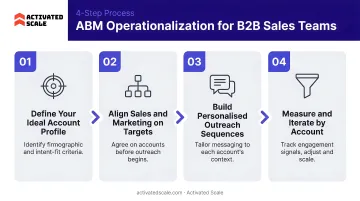
How to operationalize ABM for a B2B sales team:
- Tier accounts by fit and intent — Segment your target list into Tier 1 (best-fit, high-intent), Tier 2 (good-fit, moderate intent), and Tier 3 (watchlist)
- Map 3-5 stakeholder roles per account — Identify economic buyer, technical buyer, end user, procurement, and compliance roles
- Coordinate sales outreach with marketing touches in 90-day sprints — Run synchronized campaigns where marketing warms accounts via content and ads while sales executes timely, context-aware outreach
- Co-select target accounts with sales and marketing — ABM works best when both teams jointly own the account list
The data backs this up: 87% of marketers say ABM delivers higher ROI than other strategies, and companies implementing ABM see a 200% improvement in pipeline efficiency.
Content That Builds Authority and Captures Demand
In 2026, content must serve two audiences simultaneously: human buyers who self-educate across 8-10 channels, and AI-powered research tools that summarize vendor options.
"AI-discoverable" content means structured answers, comparison tables, clear section hierarchies, and consistent terminology that allows AI tools to surface your content accurately. Brand mentions have a 0.664 correlation with AI citations—roughly 3x stronger than backlinks.
Content types by buying stage:
| Stage | Format | Purpose |
|---|---|---|
| Awareness | Educational guides, ungated frameworks, executive POV posts | Build preference before formal buying begins |
| Consideration | Comparison pages, ROI calculators, case studies | Help buyers justify vendor shortlists |
| Decision | Implementation guides, security/compliance docs, customer proof by role | De-risk final selection |
Gating decisions should be selective. Ungate discovery content to maximize reach and peer sharing—51% of buyers say there are too many steps to access content, up from 30% in 2023. Gate only high-value tools where the value exchange is justified (ROI calculators, diagnostic assessments, benchmark reports).
AI-Powered Outreach and Lead Scoring
AI in 2026 extends what lean teams can execute—it doesn't replace the people doing the work. The highest-leverage use cases for B2B demand gen teams include:
- Predictive account scoring trained on closed-won data to surface lookalike accounts
- Next-best-action recommendations based on behavior (for example, if Account X downloads pricing guide + attends webinar, trigger SDR outreach within 24 hours)
- Drafting and personalizing outbound touches by role and industry
- Anomaly detection (flagging when multiple stakeholders from the same account hit pricing pages simultaneously)
83% of sales teams using AI saw revenue growth compared to 66% of teams not using AI. But automation without guardrails creates risk.
Guardrail framework for AI-assisted outbound:
- Maintain a prompt library and style guide to ensure consistency
- Require human review for any outbound copy touching pricing or legal claims
- Run A/B tests before fully automating any decision
- Log AI recommendations alongside human overrides to track performance over time
Event-Driven Demand (Webinars, Roundtables, and In-Person)
Events remain a high-ROI demand gen channel in 2026 despite digital fatigue. They compress the time from first touch to booked meeting, surface buying intent in real time, and build peer-validated trust that a white paper rarely achieves on its own.
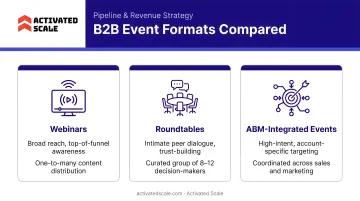
Webinar production grew 225% year-over-year in 2024, with average attendance rates rising to 33%. The most effective formats for B2B include:
- Hands-on workshops — Interactive sessions where attendees solve real problems using your methodology
- Executive roundtables — Invite-only peer discussions that build trust and uncover buying intent
- ABM-integrated events — Curate and invite specific target accounts, then follow up with coordinated outreach
Extend event impact beyond the day itself:
- Convert session recordings into blog posts, short video clips, and annotated decks
- Use post-event behavior (sessions attended, questions asked) as intent signals to trigger timely sales follow-up
- Create AI-generated content from webinar transcripts—AI-generated text assets from webinars grew 11,464% in 2024
Precision Outbound and Email as a Discipline
Effective outbound in 2026 is triggered by account-level behavior signals, not calendar-based sequences. "Useful or invisible" outbound looks like this:
- 100-120 word emails sent only when a behavioral trigger justifies it
- Reference specific context (recent pricing page visit, webinar attendance, competitor mention)
- Include a tangible artifact (checklist, diagnostic, 1-pager) that adds value regardless of reply
- Cap sequences at three touches before pausing
None of that precision matters if your emails don't land in the inbox. Gmail and Yahoo now mandate SPF, DKIM, and DMARC authentication, plus one-click unsubscribe compliance—these are non-negotiable infrastructure requirements. Spam complaint rates must stay below 0.3%—one spike can damage domain reputation permanently.
Current benchmarks for B2B cold email in 2025: 35-45% open rate, 8-10% response rate, 3-4% meeting booked rate. Reply rates declined 15% from 2023 to 2024, making precision targeting and relevance critical.
Partner and Co-Marketing Programs
Partnerships are an underused but high-quality pipeline channel for B2B teams. Co-marketing with non-competing brands that share your ICP gives access to warm, relevant audiences at lower acquisition cost.
Partner-sourced deals are 53% more likely to close and close 46% faster than non-partner deals. They also carry 29% higher contract value.
Co-marketing plays worth prioritizing:
- Joint webinars with shared promotion to both audiences
- Co-authored benchmark reports with dual SDR routing
- Shared ROI calculators where both companies' solutions are represented
- LinkedIn Live series featuring both brands' subject matter experts
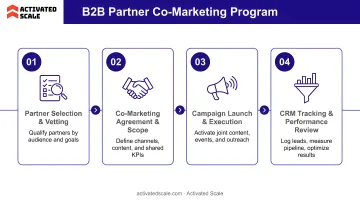
How to structure a partner program:
- Select 1-2 anchor partners with genuine ICP overlap
- Define a joint play (content asset + event + follow-up workflow)
- Enable each other's field sales teams with a 30-minute enablement kit
- Track co-sourced pipeline explicitly in CRM to measure ROI
Sales and Marketing Alignment: The Foundation That Makes Everything Work
The best demand gen strategies fail without alignment infrastructure. When sales and marketing use different definitions, prioritize different metrics, and operate in separate systems, even well-designed campaigns produce low-quality pipeline.
The RevOps model is the 2026 standard: shared dashboards, shared ICP definitions, joint account selection, and closed-loop feedback on lead quality. Companies with RevOps report 36% higher revenue growth than those without.
Practical Alignment Cadences
High-performing B2B teams run these non-negotiable rhythms:
- Weekly pipeline stand-ups — Review top stuck deals and new intent spikes
- Bi-weekly content enablement reviews — Identify which assets are helping reps book meetings
- Monthly SLA compliance reviews — Cover speed-to-lead, follow-up depth, and lead outcome codes
Build a Shared Lead Scoring Model
A strong model pulls from three signal types:
- Firmographic fit — Company size, industry, and revenue range
- Behavioral engagement — Pricing page visits, content downloads, event attendance
- Buying group signals — Multiple stakeholders from the same account engaged
Marketing and sales must co-design the model and review it quarterly against closed-won data. Scoring built in isolation leads to friction and ignored leads.
Speed-to-lead matters. The average B2B company takes 42 hours to respond to a new lead, yet responding within 5 minutes makes reps 100x more likely to connect. Automated lead routing is a high-ROI operational fix.
The Execution Gap for Early-Stage Teams
Founders and small teams often lack dedicated sales talent to execute the outbound and follow-up motions that demand gen programs generate. Fractional sales professionals are a practical fix here. A platform like Activated Scale connects early-stage teams with experienced SDRs and AEs who can run outbound sequences, follow up on inbound intent signals, and book qualified meetings — without the cost or commitment of a full-time hire.
How to Prioritize and Measure These Strategies
Resource-constrained teams should start with 2 creation motions (e.g., ABM + content) and 2 acceleration motions (e.g., precision outbound + events), then execute them consistently before adding new channels.
Simple 90-day phased approach:
- Month 1: ICP refinement, intent instrumentation, confidence asset creation
- Month 2: Launch 2-3 channels with modest budgets and establish reporting rhythms
- Month 3: Scale what's driving pipeline, pause what isn't
Metrics That Matter
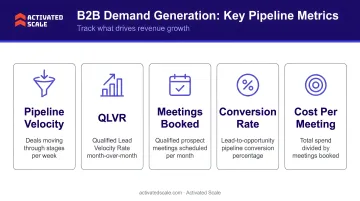
Track metrics that connect activity to revenue, not just activity itself:
- Pipeline Velocity — (Opportunities × Win Rate × Avg Deal Size) ÷ Sales Cycle Length. Use this as your primary marketing-to-revenue link. Median B2B SaaS pipeline velocity is $1,847/day, giving you a benchmark to measure against.
- Qualified Lead Velocity Rate (QLVR) — Month-over-month growth in MQLs. The best leading indicator of future revenue.
- Meetings booked per targeted account — Shows ABM and outbound effectiveness at the account level.
- Engaged buying group size — Unique stakeholders engaged from the same account; critical for enterprise deals.
- Stage progression velocity by channel — Reveals which channels move deals forward, not just which start them.
Treat clicks, opens, and form fills as diagnostic signals, not success metrics.
Multi-Touch Attribution for Long B2B Sales Cycles
With 5-11 stakeholders and 6-18 month timelines, single-touch attribution models mislead budget decisions. W-shaped attribution distributes credit 30-30-30 across First Touch, Lead Creation, and Opportunity Creation, with 10% across nurturing touchpoints.
Run this model for two quarters and you'll quickly see which channels deserve more budget — and which ones only look good on last-click reports.
Conclusion
Demand generation in 2026 is a system, not a campaign. It requires aligning content, outbound, ABM, events, and partnerships around a shared understanding of who you're targeting, what they care about, and where they are in their buying journey.
If your demand gen programs are generating interest but your team lacks the capacity to follow up, book qualified meetings, and convert pipeline, that gap costs you revenue. Activated Scale connects you with vetted fractional B2B sales professionals in 7 days or less, so you can turn that demand into 10–15 qualified meetings per month—without the risk of a full-time hire.
Frequently Asked Questions
What is the difference between demand generation and lead generation in B2B?
Demand generation creates market-wide awareness and buying intent before prospects identify themselves, while lead generation captures contact information from individuals already showing purchase intent. Healthy B2B programs invest in both—demand gen warms buying committees, lead gen harvests the result.
Which demand generation strategies work best for early-stage B2B SaaS startups?
Resource-constrained teams should start with ABM (targeting a focused list of 50-100 high-fit accounts), precision outbound triggered by behavioral signals, and ungated thought leadership content. Starting narrow keeps execution quality high and results measurable.
How long does it take to see results from B2B demand generation?
Engagement and meeting activity can appear within 30-60 days of launching focused programs. Pipeline impact typically shows in 60-90 days. Revenue impact—depending on sales cycle length—often takes 6-12 months. Each quarter of consistent execution builds on the last, shortening future sales cycles as brand familiarity grows.
How do you measure the ROI of B2B demand generation?
Pipeline velocity, pipeline created and influenced, and revenue closed with time-lag analysis are the primary metrics. Cost per acquisition and CAC payback period help connect demand gen investment to business outcomes rather than marketing activity.
What role does AI play in B2B demand generation in 2026?
AI is most valuable for predictive account scoring, personalized outreach drafting, next-best-action recommendations, and anomaly detection. Human oversight remains essential for brand accuracy, compliance, and final decisions. AI accelerates execution — the strategy, judgment calls, and relationship-building still require human expertise.
How can a small B2B sales team execute demand generation without a large marketing budget?
Pick one content channel (LinkedIn thought leadership), one outbound motion (behavior-triggered email sequences to a tight account list), and one event format (monthly roundtable or webinar). If headcount is the constraint, fractional SDRs or AEs from a marketplace like Activated Scale can handle outreach execution without the cost or commitment of a full-time hire.