Introduction
Accounting firms and AaaS providers offer powerful services, but most sales pitches sound identical — opening with features, credentials, and pricing rather than addressing client pain points. In 2026, with the global finance and accounting outsourcing market projected to reach $142.66 billion by 2033 and growing competition among 85,223+ accounting services businesses in the U.S., a stronger pitch isn't optional.
Why do most pitches fail? They lead with "we offer bookkeeping, tax prep, and reporting" instead of the outcomes prospects actually care about: knowing their cash position, reclaiming 25 hours per week spent on manual data entry, or never scrambling at tax time. What prospects want is financial visibility and time back — not a list of deliverables.
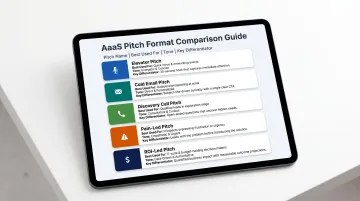
This article breaks down what makes AaaS sales pitches work, followed by five ready-to-use pitch examples across different formats: elevator pitches, cold emails, discovery call openers, pain-led approaches, and ROI-focused conversations.
TL;DR
- Lead with the prospect's pain — not your service features or firm credentials
- Tailor your pitch to the scenario: a cold email reads very differently from a discovery call opener
- Five core elements drive effectiveness: hook, pain statement, value proposition, proof, and clear call to action
- Avoid jargon, making the pitch about your firm, or lacking a specific next step
- Inconsistent delivery kills even well-crafted pitches; if your team lacks confident reps, experienced fractional sales talent can close that gap fast
What Is an Accounting as a Service Sales Pitch (and Why Most Fail)?
Accounting as a Service is a subscription-based or outsourced model where businesses get ongoing accounting, bookkeeping, and financial reporting handled externally. Pitching it is uniquely challenging because you're selling an ongoing relationship, not a one-time project.
Most AaaS pitches fail because they sound like product pitches ("we offer bookkeeping, tax prep, and reporting") rather than outcome pitches ("you'll always know your cash position and never scramble at tax time"). Research shows that businesses spend an average of 25 hours per week on manual data entry or reconciling data, with 91% saying it undermines productivity.
Your pitch needs to address that reality directly: prospects are paying for those 25 hours back, not for accounting services.
The pitch format matters as much as content. What works in a cold email will fall flat in a 30-second elevator pitch. That's why the examples below are organized by format and use case — so you can pick up what fits your next conversation.
Key Elements of a Winning AaaS Sales Pitch
Hook
Every strong pitch opens with a reference to a specific pain — "Most founders I talk to don't actually know their burn rate until it's a problem" — rather than a generic compliment or a company introduction.
That specificity signals you understand their world, not just your services. Problem-focused sellers are 30% more effective than solution-focused sellers, yet only 13% take this approach — which means a sharp, pain-led hook is already a competitive advantage.
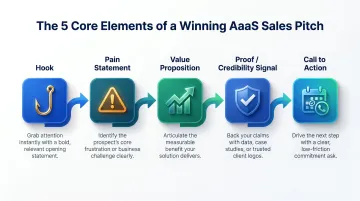
Pain Statement
The pitch must surface a specific problem the prospect is likely experiencing. For AaaS prospects — typically SMBs, startups, or growing businesses — common pains include:
- Month-end close taking too long
- No real-time visibility into cash flow
- Accountants who only show up at tax time
- Books consistently 3+ months behind
Naming the pain builds instant credibility. It shows you've worked with businesses like theirs before. According to the 2024 Small Business Problems & Priorities survey, federal taxes on business income rank #4 among critical concerns (24.9%), while tax complexity ranks #12 (18.8%) — validating that financial pain is real and widespread.
Value Proposition
This is the bridge between pain and your service. Lead with outcomes — "we give you a dedicated accounting team that closes your books in 48 hours every month" lands harder than "we offer outsourced bookkeeping."
A strong value proposition focuses on what the client actually gains:
- Reclaim 10+ hours a month spent chasing numbers
- Save on the cost of a full-time hire while getting senior-level output
- Make growth decisions with current financials, not three-month-old data
- Stay audit-ready without scrambling at year-end
Skip the feature list. 98% of growth-focused businesses say their current digital solutions aren't optimized for growth — your value proposition should make it obvious that AaaS is the fix.
Proof or Credibility Signal
One line of social proof is enough. In a short pitch, a single concrete example — "we've helped 50+ SaaS companies get audit-ready in under 90 days" — is more persuasive than any list of services.
It doesn't need to be a full case study. Client types, measurable results, or relevant credentials that match the prospect's situation all work. Specificity is the only requirement.
Call to Action
Weak CTAs ("let me know if you're interested") leave deals in limbo. Strong CTAs are specific and low-friction:
- "Can we get 20 minutes on the calendar this week?"
- "Would it make sense to send over a short overview of how we work?"
- "Are you free for a quick call Thursday or Friday?"
Low-commitment CTAs outperform high-commitment ones in cold outreach. Cold emails that pitch directly reduce reply rates by up to 57% — question-based CTAs tied to a specific pain keep the conversation moving instead.
Top Accounting as a Service Sales Pitch Examples in 2026
Each pitch below is built for a different context — the format, tone, and CTA shift depending on who you're talking to and where. Pick the one that fits the scenario, then adapt the script to your client profile.
Pitch Example 1: The Elevator Pitch (Networking / In-Person)
Context: This 30–45 second pitch is for founders or sales reps meeting prospects at events, introductions, or brief encounters.
Script:
"Most growing businesses are flying blind on their finances until it's too late — they're spending 20+ hours a month chasing receipts, reconciling accounts, and still don't know their real cash position. We give them a dedicated accounting team that keeps their books current and CFO-level insights accessible weekly. What does your current accounting setup look like?"
Why it works: Opens with a pain hook that surfaces the time burden and visibility gap, states the value clearly (dedicated team + weekly insights), and ends with an open-ended question that hands the conversation to the prospect.
| Component | Notes |
|---|---|
| Format | Spoken, 30–45 seconds |
| Best Used For | Networking events, introductions, referral conversations |
| Tone | Conversational, confident |
| Key Differentiator | Outcome-led (time + clarity), not service-led |

Pitch Example 2: The Cold Email Pitch
Context: Cold email pitches need a subject line that earns an open, a one-sentence hook in the first line, and a CTA that asks for a conversation — not a commitment. Keep it under 150 words.
Subject Line: Your accounting shouldn't slow your growth
Email Body:
Hi [First Name],
Most founders I talk to spend 15-20 hours a month chasing receipts and reconciling accounts — time that could be spent on product, sales, or growth.
We give [industry/company type] a dedicated accounting team that closes your books in 48 hours every month and keeps your financials audit-ready. We've helped 40+ startups reclaim that time and get investor-ready faster.
Worth a quick 15-minute call this week to see if it makes sense for [Company Name]?
Best, [Your Name]
What lands here: The subject line references a universal pain (growth bottleneck). The body names the specific time burden, offers a concrete outcome (48-hour close), includes proof (40+ startups), and closes with a low-friction CTA.
| Component | Notes |
|---|---|
| Format | Written email, under 150 words |
| Best Used For | Cold outbound to SMB owners, startup founders |
| Tone | Direct, empathetic |
| Key Differentiator | Personalized to a named pain point, not a feature list |
Research shows that campaigns using advanced personalization achieve approximately 18% reply rates vs. 9% for generic templates — a 2x improvement. Yet only 5% of senders personalize every email. Even basic personalization — industry, pain point, company name — outperforms generic sends.
Pitch Example 3: The Discovery Call Opener
Context: The first 60 seconds of a discovery call sets the tone. This pitch acknowledges the prospect's time, frames the conversation around their situation (not your service), and hands the conversation back with an open-ended question.
Script:
"Thanks for taking the time today. We work with [type of company — e.g., funded startups, growing service businesses] that typically struggle with books that are months behind, no real-time visibility into margins, and scrambling every time an investor or lender asks for financials. Before I tell you anything about us, I'd love to understand what's going on with your financials right now and what's working or not."
The logic behind it: This consultative opener positions you as a peer, not a vendor. It names a specific pain up front to build rapport, then immediately pivots to discovery. The prospect feels heard, not pitched to.
| Component | Notes |
|---|---|
| Format | Spoken, 45–60 seconds |
| Best Used For | First inbound or outbound discovery call |
| Tone | Curious, consultative |
| Key Differentiator | Prospect-focused, not firm-focused — leads with a question |
When 86% of B2B purchases stall during the buying process and 81% of buyers end up dissatisfied with their provider, pitches that reduce friction and surface the right problem win.
Pitch Example 4: The Pain-Led Pitch (For Prospects in Financial Chaos)
Context: This pitch is designed for prospects clearly experiencing financial pain — recent audit stress, missed investor reporting deadlines, or messy books from rapid growth. Name the pain confidently, validate why it's common, and position AaaS as the structured solution.
Script:
"A lot of companies at your stage are dealing with the same thing — books that are 3 months behind, no visibility into margins, and a scramble every time an investor asks for financials. The good news is it's fixable. We fix that with a dedicated team and a defined monthly close process, so you always know where you stand. Most clients get their first clean close within 30 days. Does that sound like what you're looking for?"
Why buyers respond: Validates the pain ("a lot of companies at your stage") before proposing a solution, creating psychological safety. The outcome is specific (first clean close in 30 days), and the CTA invites confirmation rather than commitment.
| Component | Notes |
|---|---|
| Format | Verbal or email, 3–4 sentences |
| Best Used For | Inbound leads, referrals, or prospects who've expressed frustration |
| Tone | Empathetic, solution-confident |
| Key Differentiator | Validates the pain before proposing the solution |
Approximately 25% of SMBs would consider switching accountants within a year, correlated with infrequent contact and feeling unknown. This pitch speaks directly to that dissatisfaction.
Pitch Example 5: The ROI-Led Pitch (For Finance-Savvy Prospects or CFOs)
Context: When pitching to a CFO, finance director, or analytically-minded founder, lead with ROI and cost-efficiency over convenience.
Script:
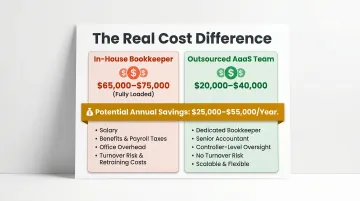
"Most companies your size are paying $65,000-$75,000 fully loaded for one in-house bookkeeper or accountant, but only need about 60% of that capacity. We give you a full accounting team — bookkeeper, senior accountant, and controller-level oversight — at $20,000-$40,000 per year with better systems and no turnover risk. You get your first clean close within 30 days. Want to see a quick cost comparison based on your current setup?"
What drives conversion: Anchors value in a concrete cost differential supported by BLS data showing accountants earn a median of $81,680 and bookkeepers $49,210, plus benefits and overhead. The CTA references a brief analysis, not a sales call, reducing perceived commitment.
| Component | Notes |
|---|---|
| Format | Verbal in meeting or longer email |
| Best Used For | CFOs, financially literate founders, investor-backed companies |
| Tone | Data-driven, confident |
| Key Differentiator | Anchors value in cost comparison and speed to first result |
In-house bookkeepers cost $65,000-$75,000/year fully loaded; outsourced alternatives run $20,800-$41,600, per SystemSix's cost breakdown — a credible ROI anchor for finance-savvy buyers.
What Makes These Pitches Work: Mistakes to Avoid
These pitches work because they lead with the prospect's world, not the provider's credentials. The most common mistake AaaS salespeople make is opening with "we offer bookkeeping, tax, and CFO services" instead of naming a specific problem the prospect faces.
That's product selling, not consultative selling. It kills conversion before the conversation starts.
Two Additional Critical Errors
Pitches that run long: Prospects disengage after 60 seconds in conversation or 150 words in email. Gong's analysis of millions of cold emails found the ideal length is 100 words or fewer across 3-4 sentences. Beyond that, reply rates drop.
Pitches without a specific CTA: "Let me know if you want to chat" loses momentum every time. Strong CTAs name a concrete next step — "Can we schedule 20 minutes this week?" or "Would Thursday or Friday work for a quick call?" — so the prospect knows exactly what you're asking.
Both errors share a root cause: pitches written for a generic prospect instead of a specific one. Personalized outreach doubles reply rates — 18% vs. 9% — yet most AaaS senders still send the same message to every contact.
The Delivery Gap
Even a well-crafted pitch fails if delivered inconsistently or by reps who aren't comfortable with the AaaS model. For early-stage AaaS providers or accounting firms scaling their sales outreach, this is where having experienced fractional sales reps — like those available through Activated Scale — delivers these pitches to qualified prospects without the cost or risk of a full-time hire.
Conclusion
The difference between a forgettable AaaS pitch and one that books a meeting comes down to specificity — knowing your prospect's pain, naming it clearly, and making the value exchange obvious. Prospects can spot a template. Specificity is what makes them reply.
Test one or two of the examples above with your next 10 outbound attempts. Track what resonates — reply rates, questions asked, objections surfaced — and refine from there. The pitches that perform best six months from now will be shaped by the objections and client language you collect starting today.
For AaaS firms and accounting providers ready to scale their pipeline with experienced sales talent, Activated Scale connects you with vetted fractional sales reps who can run these playbooks from day one — with most engagements up and running within a week.
Frequently Asked Questions
What are some good sales pitch examples?
Strong sales pitch examples include elevator pitches for networking (30-45 seconds, pain-led hook), cold emails (under 150 words, question-based CTA), and discovery call openers (consultative, prospect-focused). Each works best when tailored to the scenario and audience — AaaS pitches should reference specific pains like time loss or visibility gaps rather than listing services.
What are 5 key elements of a pitch?
The five core elements are: a hook that makes the prospect feel seen, a pain statement that names their specific problem, a value proposition focused on outcomes (not features), a proof point like a client result or credential, and a clear call to action with a specific next step.
What not to say in a sales pitch?
Avoid leading with company credentials, using jargon, or listing features instead of outcomes ("we offer bookkeeping and tax prep"). These mistakes shift focus to you rather than the prospect — and ending without a clear next step leaves them with nowhere to go.
What are the 3 C's of pitching?
The 3 C's typically refer to Clarity, Conciseness, and Credibility. Clarity means stating your value proposition in plain language. Conciseness means respecting the prospect's time with short, focused messaging (100 words or fewer in email). Credibility means backing claims with proof — client results, industry experience, or relevant credentials that build trust.
How to write a sales pitch for a service?
Follow this four-part formula: open with the prospect's pain ("most businesses spend 25 hours/week on manual accounting"), state the outcome you deliver ("your first clean close in 30 days"), add a proof point ("we've helped 40+ startups get audit-ready"), then close with a specific ask ("can we schedule 20 minutes this week?"). Business value over features — always.
How do I advertise my accounting services?
Use LinkedIn outreach targeting CFOs or founders, cold email campaigns with personalized pain statements, referral partnerships with CPAs or consultants, and content marketing that demonstrates expertise. Keep messaging consistent across channels — lead with outcomes (time saved, visibility gained, compliance ensured) rather than credentials.