The problem isn't the reps — it's the missing infrastructure underneath them. No playbooks, no structured onboarding, no content that maps to how buyers actually make decisions. Sales Enablement as a Service (SEaaS) addresses this directly, giving early-stage companies access to the sales infrastructure function without requiring them to build it from scratch internally.
This post covers what SEaaS actually is, what a real engagement includes, how it compares to hiring in-house, and how to tell whether it fits where your company is right now.
TL;DR
- SEaaS is a third-party delivery model where an outside provider equips your sales team with the content, training, tools, and talent needed to close deals consistently
- Unlike a software subscription, it's an active engagement — providers adjust scope, content, and support as your pipeline and team change
- It typically covers content development, coaching, deal support, sales talent, and process infrastructure
- Early-stage B2B SaaS companies benefit most — especially those without a dedicated internal enablement function
- Fractional sales talent platforms like Activated Scale represent one form of SEaaS — placing experienced sales professionals directly into your team on a part-time basis
What Is Sales Enablement as a Service?
Defining Sales Enablement
Forrester defines sales enablement as "a strategic, ongoing process that equips all client-facing employees with the ability to consistently and systematically have a valuable conversation with the right set of customer stakeholders at each stage of the customer's problem-solving life cycle."
That definition matters because it establishes two things people often miss: enablement is strategic (not tactical) and it's ongoing (not a one-time event). Buying a new CRM or running a two-day sales training doesn't qualify.
The "As a Service" Layer
When delivered as a service, a third-party provider takes ownership of planning and executing the enablement function. The client pays a recurring engagement fee rather than building the function internally with headcount.
What SEaaS is not:
- A software subscription (though tools may be part of the scope)
- A one-time consulting project or audit
- A staffing arrangement with no strategic wrapper
It's a sustained, cross-functional support model covering people, process, and tools.
Two Distinct Forms
SEaaS comes in two broad layers, and early-stage companies often need to think carefully about which one they actually need first:
| Layer | What It Covers | Examples |
|---|---|---|
| Software layer | CRMs, content platforms, sales engagement tools | Outreach, Seismic, Highspot |
| Human layer | Fractional reps, coaches, strategists, ops support | Fractional AEs, Sales Ops, VP of Sales |
Most early-stage B2B SaaS companies are underserved on the human layer — they have tools but no one who knows how to use them to build a repeatable motion.
Why the Model Is Growing
That gap helps explain why the outsourced model has gained traction. According to CSO Insights, organizations with a formal sales enablement function grew from 19.3% in 2013 to 61.3% in 2019 — niche to standard in six years. Companies that can't justify a full-time hire now use SEaaS to access the same function without the headcount cost.
Why Early-Stage B2B Companies Need SEaaS
The Common Failure Pattern
The typical sequence looks like this: a founder closes the first ten customers themselves, decides it's time to hire, brings on one or two reps, and then watches pipeline stall. The reps aren't underperforming because they're bad — they're underperforming because nothing is set up for them to succeed.
No battle cards. No email sequences that actually convert. No defined sales stages with clear exit criteria. Enablement should precede or at minimum accompany the first hire. Most of the time, it doesn't.
The Ramp-Time Problem
Unstructured onboarding costs real time and real money. Research from the Sales Management Association found that highly structured onboarding reduced average ramp time from 9.1 months to 5.7 months — a 3.4-month compression per hire. At early stage, that 3.4-month difference can decide whether you hit a runway milestone or miss it.
That's just the onboarding side. CSO Insights adds another layer: organizations take an average of 3.7 months to fill an open sales role and 9.2 months to reach full productivity. Without enablement infrastructure in place, you're paying for a seat that won't perform at full capacity for the better part of a year.
The Revenue Impact
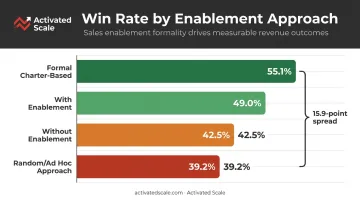
The performance gap between enabled and non-enabled teams is measurable. CSO Insights data shows:
- Organizations with enablement: 49.0% average win rate on forecast deals
- Organizations without enablement: 42.5% win rate
- Companies with a formal, charter-based enablement approach: 55.1% win rate
- Companies with a random approach: 39.2% win rate
That's a 16-point spread between structured enablement and doing it ad hoc. At early stage, where every deal matters, that gap compounds quickly.
The Resource Constraint Reality
Most Seed to Series A companies can't justify hiring a full-time VP of Sales Enablement. Glassdoor data puts the median total compensation for a Sales Enablement Manager at $122,000 per year, with a VP of Sales Enablement reaching $260,000+.
SEaaS gives you access to that function without the full-time headcount cost or the 3–4 month hiring cycle to fill the role.
What Does Sales Enablement as a Service Include?
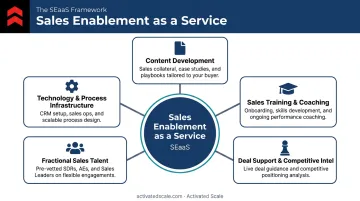
A well-scoped SEaaS engagement covers five core workstreams. Most providers weight them differently depending on where the company is in its sales maturity.
Content Development and Management
SEaaS providers create and maintain the sales collateral reps actually use: pitch decks, case studies, email sequences, competitive battle cards, and pricing tools. Forrester reports that an estimated 65% of B2B content assets go unused — not because the content is poorly written, but because it doesn't map to what buyers need at each stage. Governance — keeping content current as the product evolves — is an ongoing workstream, not a one-time deliverable.
Sales Training and Coaching
This covers onboarding new reps, running regular skill-development sessions, and role-play coaching tied to real pipeline. Sales Management Association research found that firms with a named enablement function had overall sales training effectiveness 29% higher than firms without one — including 31% better support when messaging changed.
Training is a recurring commitment. A single onboarding session gets reps started; it doesn't make them effective over time.
Deal Support and Competitive Intelligence
Active in-flight deal support is what separates SEaaS from a training program. This includes reviewing deal strategy, providing objection-handling guidance, and maintaining competitive positioning so reps have an informed answer when a prospect says "we're also looking at [competitor]."
Experienced Sales Talent as Enablement
This is the component software tools can't replicate. Fractional sales professionals — embedded part-time or on contract — bring pattern recognition and pipeline-building ability that compounds over time.
Activated Scale connects B2B SaaS founders with vetted, US-based fractional sales reps matched on prior buyer experience and ACV — which compresses the gap between placement and productivity. Fractional SDRs placed through the platform average 10–15 qualified meetings per month by month three; fractional AEs average $50,000–$250,000 in new revenue per month for clients.
Technology and Process Infrastructure
SEaaS also covers the operational foundation: CRM setup and hygiene, lead routing workflows, reporting dashboards, and documented sales processes. Fractional SDRs, for example, typically own CRM implementation and outbound tooling setup as part of their onboarding responsibilities, so infrastructure gets built in parallel with active prospecting.
How SEaaS Engagements Are Structured
Most SEaaS engagements follow a three-phase pattern. The specific timelines vary by provider and scope, but the sequence is consistent.
Phase 1 — Foundation (Months 1–3)
This phase creates the infrastructure everything else runs on. Deliverables typically include:
- Sales process audit and buyer persona development
- CRM configuration and KPI baseline setup
- Initial content creation (pitch decks, sequences, talk tracks)
For Activated Scale engagements, this overlaps with the fractional professional's onboarding period — learning the product, buyer, and acquisition channels before ramping outbound.
Phase 2 — Recurring Monthly Work Ongoing coaching sessions, content refreshes, competitive intelligence updates, pipeline reviews, and performance reporting. This is where the retainer delivers consistent value — not in the setup, but in the sustained execution.
Phase 3 — Periodic Campaigns Deeper initiatives — cohort-specific training, quarterly business reviews, targeted content for a new market segment, or cross-sell programs — run on a quarterly cadence. These work best when the scope is defined in advance with clear success criteria, not treated as an open-ended project.
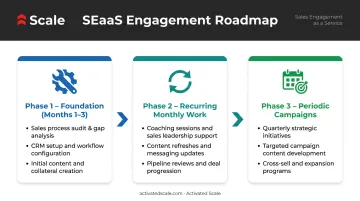
This three-phase structure maps directly to how Activated Scale runs its engagements. Monthly retainers with no minimum duration let companies adjust scope as pipeline and budget shift. In practice, 80% of clients stay on for five or more months, and 65% eventually convert their fractional hire to a full-time employee — which says more about outcomes than any service description could.
SEaaS vs. Building Sales Enablement In-House
Cost and Speed Comparison
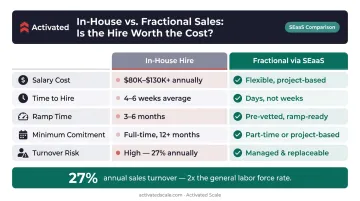
The cost difference at early stage is significant:
| Factor | In-House Hire | Fractional via SEaaS |
|---|---|---|
| Sales Enablement Manager salary | $97K–$155K/yr | N/A — covered in retainer |
| Fractional AE | N/A | $4,500–$7,500/mo + commission |
| Time to hire | 90+ days | 7–10 business days |
| Ramp time | 90 days | ~2 weeks |
| Minimum commitment | Employment contract | Month-to-month |
Full-time hiring also carries turnover risk. HBR has reported annual sales turnover as high as 27% — roughly twice the general labor force rate. A team of two reps will statistically lose one within four years, sending recruiting, onboarding, and ramp costs right back to zero.
What Should Stay In-House
SEaaS complements leadership judgment — it doesn't replace it. Keep these in-house:
- Final hiring decisions for permanent sales leadership
- C-level relationship management for strategic accounts
- Deal strategy for named, high-stakes accounts
- Long-term go-to-market positioning decisions
When to Make the Switch to In-House
A few signals indicate the company has outgrown the fractional model:
- Revenue is predictable and the sales motion is fully documented
- Headcount justifies a dedicated internal enablement function (typically 8–10+ reps)
- You're ready to hire a VP of Sales or CRO who will own the enablement strategy directly
Before those thresholds are hit, the fractional model lets early-stage teams build a real sales function — without a six-figure salary commitment or a 90-day hiring delay.
Frequently Asked Questions
What is the difference between sales enablement and sales training?
Sales training is one component of sales enablement. Enablement is the broader system — covering content, tools, process, coaching, and talent — while training specifically refers to skill-building programs for reps. You can have training without enablement, but enablement without training isn't complete either.
Who typically provides sales enablement as a service?
SEaaS providers range from full-service revenue agencies and specialized consultants to fractional sales talent platforms like Activated Scale. The right fit depends on whether the company needs tools and strategy, execution-level human support, or a combination of both.
How much does sales enablement as a service cost?
Pricing varies based on scope and provider type. Fractional talent through platforms like Activated Scale runs $2,800–$7,500 per month per role depending on the position. Full-service agencies typically charge retainers based on the workstreams engaged. No published benchmark exists for the SEaaS market as a whole.
How long does it take to see results from SEaaS?
The foundation phase typically takes one to three months. Measurable improvements in rep productivity and pipeline quality generally become visible after a consistent three-to-six month engagement. For fractional talent specifically, Activated Scale clients typically reach target meeting or deal volume benchmarks by month three.
Can early-stage startups with no sales team benefit from SEaaS?
Yes — and they're often the best candidates. Dresma.ai engaged Activated Scale before any outbound infrastructure existed and achieved a 5x increase in qualified meetings after implementing tools and messaging through a fractional hire. Founders get expert sales execution without committing to full-time headcount.
What metrics should I track to measure SEaaS effectiveness?
Focus on five indicators:
- Quota attainment rate per rep
- Average ramp time for new hires
- Win rate by sales stage
- Lead-to-close conversion rate
- Content utilization — whether reps are actually using what's been created