Introduction
Most early-stage B2B companies are laser-focused on closing deals. That makes sense — revenue keeps the lights on. But without the infrastructure to support selling, growth hits a ceiling fast. Reps run their own playbooks, forecasting becomes guesswork, and managers spend hours manually pulling reports that should take minutes.
That's the problem sales operations solves.
According to Salesforce's State of Sales research, 82% of sales professionals say sales ops plays a critical role in growing the business — yet most startups don't build this function until the problems have already piled up.
This guide breaks down what sales operations actually is, who owns it, and what good looks like — with a specific lens on B2B SaaS companies at the early to growth stage.
TL;DR
- Sales ops is the infrastructure layer that makes selling predictable — covering CRM, forecasting, territory planning, compensation, and process design
- Roles range from analyst to VP, with team complexity scaling alongside ARR
- The right time to invest is when process chaos is costing more than the fix
- Early-stage companies can start with fractional ops support before committing to a full-time hire
- Key metrics to track: quota attainment, win rate, forecast accuracy, sales cycle length, and CAC
What Is Sales Operations?
Sales operations — or "Sales Ops" — is the function responsible for the strategy, processes, data, and technology that enable a sales team to operate efficiently and hit revenue targets. It handles the behind-the-scenes work so reps can focus on selling.
Sales Ops sits behind the scenes — its job is building the systems and processes that let reps focus on selling. Core responsibilities include:
- Territory and capacity planning
- Quota setting and compensation design
- CRM management and tech stack ownership
- Sales forecasting and pipeline analysis
- Process documentation and optimization
Sales Ops vs. RevOps vs. Sales Enablement
These three functions often get conflated, but they serve distinct purposes:
| Function | Primary Focus |
|---|---|
| Sales Ops | Processes, data, and technology for the sales team specifically |
| RevOps | Cross-functional alignment of sales, marketing, and customer success |
| Sales Enablement | Training, content, and coaching to help reps sell better |
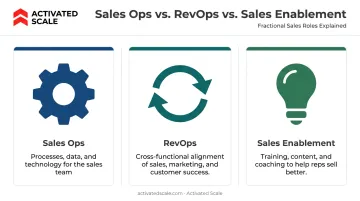
In mature organizations, Sales Ops often operates as a specialized branch within a broader RevOps structure. Sales Enablement frequently sits inside Sales Ops, though in larger companies it functions as its own team.
A useful rule of thumb: if a problem involves how reps sell, that's Enablement. If it involves the systems and data they sell within, that's Ops.
Core Responsibilities of a Sales Ops Team
Strategic Planning
Sales Ops drives high-level planning before a single call is made:
- Go-to-market input — defining territory coverage, ideal customer profiles, and segmentation
- Quota and capacity planning — setting realistic targets based on historical data and headcount
- Compensation design — structuring commission plans that incentivize the right behaviors
- Forecasting — building models that give leadership a reliable view of expected revenue
Process Optimization
Sales Ops maps the sales process end-to-end, then continuously refines it. This means identifying where deals stall, documenting what top performers do differently, and turning those patterns into playbooks that new reps can follow from day one. Each pipeline review and deal postmortem surfaces another gap to close.
Technology and CRM Management
Sales Ops owns the tech stack. That includes evaluating tools, managing integrations, and — critically — maintaining CRM hygiene. Poor data quality isn't just an inconvenience. Research from the 2025 GTM Benchmarks report found that 44% of contacts sellers interact with aren't recorded in CRM, and 17% of existing CRM contacts have outdated job titles or phone numbers.
Bad CRM data corrupts forecasts, misroutes leads, and wastes rep time. Sales Ops prevents that.
Data Analysis and Reporting
Sales Ops collects and interprets sales data to produce dashboards that managers can use — covering pipeline health, win/loss trends, rep performance, and revenue projections. The goal is replacing gut-feel decisions with data-backed ones.
Cross-Functional Collaboration
Sales Ops doesn't operate in isolation. It coordinates with:
- Marketing — on MQL/SQL definitions and lead handoff quality
- Finance — on forecasting accuracy and comp modeling
- Customer Success — on onboarding velocity and early churn signals
Sales Operations Roles and Team Structure
How Teams Are Structured
Sales Ops teams typically report to either a VP of Sales / CRO, or operate as a centralized function under RevOps leadership. At early-stage companies, one generalist handles everything. At scale, it becomes a multi-layer department.
Key Roles and Responsibilities
| Role | Focus Area |
|---|---|
| VP/Director of Sales Operations | Strategy, team leadership, cross-functional alignment, GTM planning |
| Sales Operations Manager | Day-to-day process management, tool administration, reporting |
| Sales Operations Analyst | Data analysis, CRM hygiene, dashboard maintenance |
| Sales Enablement Manager | Training, onboarding programs, playbook development |
How Hiring Evolves with ARR
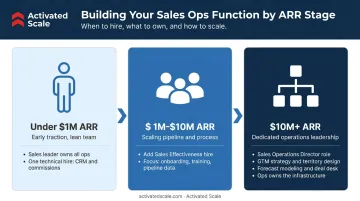
The SaaStr framework for building Sales Ops from $1M to $50M outlines how investment should scale:
- Under $1M ARR — The sales leader owns most operational tasks. A single technical ops hire can manage CRM, reporting, and commissions.
- $1M–$10M ARR — Add a Sales Effectiveness or Operations/Analytics hire focused on onboarding, training, and pipeline data. This person often comes from pre-sales, finance, or customer success.
- $10M+ ARR — A Sales Operations Director takes ownership of GTM strategy, territory design, forecast modeling, and deal desk management.
Traits to Look for When Hiring
Knowing when to hire is only half the equation. The best Sales Ops professionals share these traits regardless of ARR stage:
- Pull apart data and surface the story behind the numbers
- Translate analysis into clear decisions, not just polished reports
- Evaluate and implement tools hands-on, not just scope requirements
- Build credibility across sales, finance, and marketing through consistent follow-through
When Should You Invest in Sales Operations?
The Warning Signs
You need dedicated sales ops when the cost of process chaos exceeds the cost of fixing it. Watch for these signals:
- Forecasting is a gut call, not a data exercise
- Every rep runs a different version of the sales process
- Managers spend hours each week manually building reports
- Leads are being routed inconsistently or falling through the cracks
- CRM data doesn't reflect what's actually happening in the pipeline
The urgency is real. Salesforce's State of Sales 2026 report found that sales reps spend only 40% of their workweek on direct selling — the remaining 60% goes to manual data entry, creating quotes, planning, and other non-selling activities. That's a systems problem, not a rep performance problem.
The Right Timing for B2B SaaS Companies
For most B2B SaaS startups, the need for sales ops surfaces as the team moves past founder-led sales. Once you have a small sales team and a repeatable process worth scaling, operational gaps start compounding quickly.
The transition doesn't require hiring a full-time Sales Ops Director on day one. Early-stage companies can close the gap with a fractional approach — bringing in an experienced ops professional part-time to set up CRM infrastructure, build reporting dashboards, and establish process documentation.
Activated Scale matches B2B SaaS startups with pre-vetted fractional Sales Operations professionals at the Director and VP level, typically placed within 7 days. Dresma.ai used this model to get a fractional salesperson who "implemented the necessary sales tools and customer-focused messaging" — the result was a 5X increase in meetings with qualified prospects.
Sales Operations Best Practices
Define the Mission in Measurable Terms
Sales Ops without clear objectives defaults to reactive fire-fighting. Start by documenting the function's mission and tying every initiative to specific, trackable outcomes — reduce average sales cycle by X%, improve forecast accuracy to within Y% of actual. Without those benchmarks, you have no way to prioritize what to fix first or prove the function's impact.
Consolidate the Tech Stack
Salesforce's 2026 State of Sales report found that 42% of sales reps feel overwhelmed by the volume of tools they use, and 84% of teams without an all-in-one platform plan to consolidate their stack — a clear signal that tool sprawl is a real productivity drain. Sales Ops should build around a core CRM and integrated solutions — not accumulate point solutions that create more work than they eliminate.
Build Feedback Loops
The best Sales Ops teams treat processes as hypotheses, not policies. That means building structured review cycles into the workflow:
- Running regular pipeline reviews with sales managers
- Conducting win/loss postmortems on significant deals
- Gathering rep feedback on where the process creates friction
- Iterating playbooks based on what's actually working
Systems that never get revisited calcify into bottlenecks. Schedule a quarterly process audit — even 90 minutes reviewing where deals stall can surface fixes that shorten the cycle for every rep on the team.
Key Metrics to Measure Sales Operations Success
Sales Performance Metrics
These measure whether the team is hitting its targets:
- Quota attainment rate — the percentage of reps hitting their number; 2025 GTM Benchmark data shows missed quota rates climbed to 78% last year, a significant jump from 69%
- Win/loss rate — new-logo win rates currently average 19%
- Average deal size — tracks whether you're moving up-market or drifting down
- Average sales cycle length — new business deals now average 91 days, with expansion at 52 days
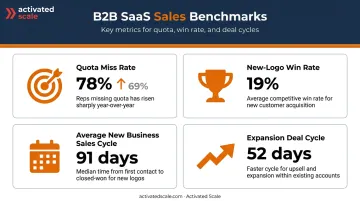
When these numbers shift, Sales Ops needs to flag it fast — and own the diagnosis.
Efficiency and Process Metrics
These reveal where the infrastructure is failing:
- Time spent selling vs. non-selling tasks — the benchmark target is maximizing the 40% selling window
- Lead response time — speed to first contact directly impacts conversion rates
- Forecast accuracy — predicted vs. actual revenue; gaps signal either bad data or bad process
- Pipeline coverage ratio — the ratio of total pipeline to quota, indicating whether there's enough opportunity to hit targets
Revenue Health Metrics
For SaaS companies, these connect Sales Ops performance to business outcomes:
- Customer Acquisition Cost (CAC) — total sales and marketing spend divided by new customers acquired
- LTV:CAC ratio — OpenView's SaaS benchmarks recommend targeting a 3:1 ratio, meaning customers generate three times their acquisition cost
- Sales velocity — calculated as (number of opportunities × average deal value × win rate) / sales cycle length; a single formula showing how fast revenue moves through your pipeline
- MRR and churn rate — the core SaaS health indicators every Sales Ops team should monitor consistently
Frequently Asked Questions
What does a sales operations role do?
A sales operations professional manages the processes, tools, data, and strategy that support the sales team — handling CRM administration, sales forecasting, territory planning, and performance reporting. The goal is removing operational friction so reps can spend more time actually selling.
What is Operations as a Service?
Operations as a Service (OaaS) refers to outsourcing operational functions — including sales ops — to external specialists rather than building in-house. This model gives early-stage companies access to experienced ops talent without the cost and commitment of full-time employees.
What is an S&OP process?
S&OP (Sales and Operations Planning) is a supply chain discipline focused on aligning production, inventory, and demand forecasting — distinct from Sales Operations (Sales Ops), which optimizes the sales team's processes, technology, and performance.
What is the difference between sales operations and sales enablement?
Sales Ops focuses on systems, processes, and data infrastructure — CRM management, forecasting, territory planning. Sales Enablement focuses on equipping reps with training, content, and coaching. Both support the sales team but operate differently, and at many companies Enablement sits within the Ops function.
What are the most important KPIs for sales operations?
Key Sales Ops KPIs include quota attainment rate, win/loss ratio, forecast accuracy, average sales cycle length, time spent selling, CAC, LTV:CAC ratio, and pipeline coverage. The right set depends on your company's stage and growth goals.
When should a startup invest in sales operations?
Most startups benefit from sales ops support once they move beyond founder-led sales, when process inconsistency or CRM chaos is slowing growth. Early-stage companies can start with a fractional ops resource through Activated Scale before committing to a full-time hire.