Introduction
Your first sales hire is one of the most consequential decisions you'll make as a B2B SaaS founder. Get it right and you unlock compounding growth. Get it wrong and you burn runway, stall momentum, and restart from scratch — often six to twelve months later.
Most founders approach this without a framework. They hire on gut, overvalue industry experience, or bring someone in before the sales motion is actually repeatable. The result is a rep set up to fail, and a founder who blames the hire when timing was the actual culprit.
This playbook covers the full picture:
- When to hire (and when not to)
- Who to look for in that first rep
- How to evaluate candidates without wasting weeks
- How many to bring on at once
- What failure modes to avoid before they cost you six months of runway
TL;DR
- You're ready to hire when you've closed 5–10 deals yourself, documented the pitch, and sales is eating more than half your week
- Your first rep should be a full-stack generalist — SDR and AE in one — not a polished enterprise closer
- Use mock calls and writing exercises to evaluate; charisma alone will fool you
- Two reps staggered 30–45 days apart creates faster learning loops — worth it if your runway allows
- Most first sales hires fail because the founder wasn't ready — not because the rep was bad
Signs You're Ready to Make Your First Sales Hire
Founders tend to hire too early or too late. Too early is the more common mistake.
According to GTMnow, the right framework moves through four stages: design partners via personal networks → paid early customers outside your network → founder-assisted sales → a repeatable motion where a rep is actually needed. The first hire belongs at stage four. Not stage two.
The Three Readiness Criteria
Before opening the role, check these three things honestly:
- You've personally closed 5–10 deals — and you know why you won them. Not a vague sense, but a clear pattern: the ICP, the trigger, the objection that kept coming up.
- You have a transferable sales narrative — a pitch, a demo structure, and a pricing model that exists somewhere other than your head. If you can't hand it to someone on day one, you're not ready.
- Your time is the bottleneck — sales is consuming 50%+ of your week, and pipeline is piling up faster than you can work it.
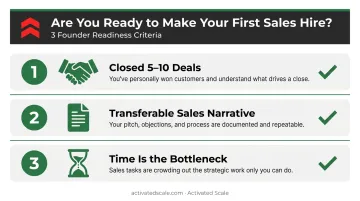
If all three are true, it's time. If only one or two apply, keep selling yourself.
Product-Market Signal vs. Full PMF
Checking those boxes confirms your readiness as a seller — but you also need to know the market is ready for someone else to sell it.
You don't need full product-market fit before hiring. But you do need paying customers who found you — not customers who bought because of a personal relationship. SaaStr recommends reaching 10–20 customers or $10K–$20K MRR as a practical gate.
If your only wins came through warm intros and founder relationships, you haven't validated that a stranger can sell this.
The biggest risk of hiring too soon is outsourcing your learning. A rep without a foundation will improvise — and you'll lose the market feedback you need to improve the product.
What to Look for in Your First Sales Rep
This is not a traditional sales hire. Repeat that to yourself before you start reviewing resumes.
You're not looking for a seasoned enterprise AE with a polished Salesforce track record. You're looking for someone who can prospect, qualify, run discovery, demo, and close — all without an SDR queue, a marketing team generating inbound, or a brand anyone's heard of.
Startup-Tested and Comfortable with Zero Infrastructure
OpenView points out that reps from large companies like IBM or Oracle often struggle at startups precisely because they've never had to build pipeline without brand recognition and steady inbound. They've executed mature playbooks handed to them — they've never had to build one from scratch.
Red flags to watch for in interviews:
- "What's my lead list going to look like?"
- "When will the sales deck be finished?"
- "Do you have an SDR team I'll be working with?"
These questions aren't wrong at a Series B. At the seed stage, they signal the wrong fit.
A Full-Stack Generalist
SaaStr notes that your first rep needs to handle prospecting, demand gen, cold outreach, demos, and closing — and recommends at least 2–3 years of AE experience to carry all of it. The key word is full-cycle. You need someone who has self-sourced leads, run discovery, and closed deals — not someone who stepped in only for the final handoff in a segmented org.
A Missionary, Not a Mercenary
You want someone motivated by building something, not just chasing a number. In interviews, this shows up as genuine curiosity about the problem you're solving — not just the comp structure. Ask them what excites them about early-stage work. A missionary will talk about the product and the customer. A mercenary will ask about ramp time and OTE before anything else.
Key Red Flags Summary
- Came only from companies where inbound handled most of pipeline generation
- Has never done outbound prospecting independently
- Identifies primarily as a "closer" rather than a full-cycle seller
- Can't cite specific deals they sourced and closed in an early-stage or unstructured environment
How to Interview and Evaluate Sales Candidates
Here's the challenge: salespeople are trained to sell. That means they're often very good at selling themselves. A polished interview performance is not evidence of selling ability — it's evidence of interview preparation.
Use structured evaluation methods, not just conversations.
Use Performance-Based Assessments
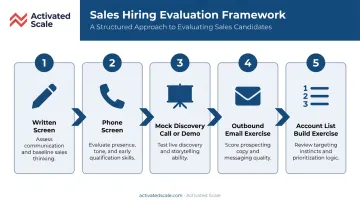
First Round's Peter Kazanjy recommends a multi-stage process:
- Written screen — a set of open-ended questions completed in about an hour, evaluating communication quality and detail orientation
- 30-minute phone screen — assess funnel thinking, critical thinking, and how they think about conversion
- Mock discovery call or demo — have them present as if selling to a real prospect, including a calendar invite, screen share, and follow-up proposal
GTMnow adds two more useful exercises: ask them to write a sample outbound email to an actual prospect in your ICP, and have them walk through how they'd build their first 50–100 account list and what criteria they'd use. These exercises separate people who talk about prospecting from people who can actually do it.
Ask Behavioral Questions, Not Hypotheticals
"How would you handle a pricing objection?" tells you how someone thinks on their feet. "Walk me through the last three deals you closed end-to-end — what was your outbound sequence, how did you run discovery, and how did you close?" is a different question entirely. It tells you what they've actually done.
Hypotheticals surface polish. Behavioral questions surface track records.
Evaluate for ACV Alignment
This matters more than most founders realize. Bridge Group's 2024 B2B SaaS AE report, based on data from 170+ companies, found that quota varies nearly 2.5x between sellers working below $25K ACV and those working $250K+ ACV deals. A rep who's excellent at closing $12K/year contracts will likely struggle with $120K/year deals — and vice versa. Match your candidate's experience to your actual deal size.
Check References — Specifically About Ambiguity
When you call references, don't ask generic performance questions. Ask:
- Did they thrive when structure was missing?
- How did they handle product gaps mid-deal?
- Did they make the people around them better?
A rep who claims strong numbers but can't surface a single reference from a past manager is a red flag. Pass.
One Rep or Two: How Many Should You Hire First?
The Case for Two Reps
SaaStr has advocated for hiring two reps since at least 2013, and the logic holds: one rep is a single data point. If they fail, you can't tell whether the problem is the person, the process, the pricing, or the ICP.
Two reps, staggered 30–45 days apart, give you:
- A natural A/B test for messaging and ICP targeting
- A benchmark for what "good" looks like
- The ability to separate people problems from process problems
- Better morale — being the only seller at an early-stage company is isolating
Conditions that make hiring two the right call:
- Clear pipeline and a documented ICP
- 12–18 months of runway post-OTE for both reps
- You can narrate your last five wins clearly and consistently
The Case for Starting with One
If runway is tighter or your sales signal is still thin, start with one. Use a hiring gate — a pre-committed trigger that automatically opens the second requisition when specific criteria are met. For example: 10 SQL/month plus 25%+ discovery-to-demo conversion for two consecutive months. The gate removes emotion from the decision.
The Fractional Option
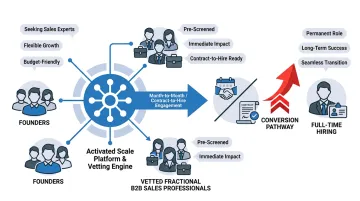
A fractional or contract-to-hire model sidesteps the binary entirely. Activated Scale connects founders with vetted B2B sales professionals on a month-to-month basis — no long-term contracts, no termination fees. You evaluate the rep inside your actual sales environment before committing to a full-time hire.
The numbers bear it out: 65% of Activated Scale clients convert their fractional rep to full-time after an initial period that typically runs about three months. For a first-time sales hire, that trial window can mean the difference between a costly mis-hire and a rep who already knows your motion.
How to Set Your First Sales Hire Up for Success
Most first sales hires fail not because the rep was wrong for the role — but because the founder handed them an empty room and expected them to furnish it.
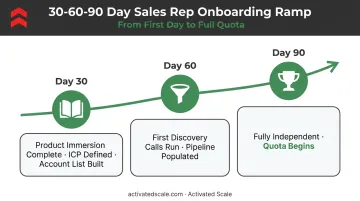
The First 30 Days
Structure their ramp from day one:
- Product immersion — recorded demos, customer call recordings, written notes on why past deals were won or lost
- Defined ICP — in hard criteria (company size, industry, tech stack, buying trigger), not vague aspirations
- Pre-built account list — 50–100 accounts they can start prospecting immediately, so day one isn't spent on research
OpenView recommends measuring progress on sales skills and product competency at 30, 60, and 90 days. Informal onboarding at small startups creates a sink-or-swim dynamic that accelerates turnover. Set those checkpoints before the hire starts — once a rep builds bad habits, correcting them takes longer than the ramp itself.
CRM and Feedback Loops
Implement a CRM before the rep starts — not after. If they're building their pipeline into a spreadsheet on day one, you've already lost a week.
Keep the pipeline simple: OpenView recommends 4–6 stages, not 10–15. Each stage should map to a buyer action, not an internal milestone.
Hold a weekly 1:1 with a standing agenda:
- Pipeline review by stage
- Two-way feedback on what's working
- Blockers — pricing, product gaps, ICP mismatches
Review losses together. If deals are dying at the same stage repeatedly, that's a process or positioning issue — not necessarily a rep issue.
Avoid Scope Creep
Your first AE is not your RevOps lead, growth marketer, or product researcher. Define clearly what they own: pipeline generation and closing. Use advisors or fractional specialists to fill other gaps while you scale.
Common Mistakes Founders Make with Their First Sales Hire
Hiring Too Senior for the Stage
The pattern looks like this: a founder decides they're ready to "get serious about sales," so they hire a VP or enterprise leader who's managed large teams at a mature company. That person is optimized for $50M+ infrastructure — they know how to run a team, not how to build the first deals from scratch.
OpenView notes that VP of Sales turnover at startups averages around 19 months, with first-time startup VPs churning even faster. The fix: hire a high-performing rep first, not a manager. You don't need someone to build a team yet. You need someone to close.
Over-Indexing on Industry Experience
Founders without sales backgrounds often default to "I need someone who knows this space." It feels safe. It's usually the wrong call. Sales skill, startup operating experience, and the ability to function without structure matter far more than domain knowledge.
A great seller from outside your industry will outperform a weak seller from inside it. Consistently. Without exception.
Not Having a Documented Sales Process Before Hiring
Without a transferable sales narrative, your knowledge stays locked in your head. A new rep will improvise. The message will dilute. The deals will stall for reasons you can't diagnose.
Build a basic sales playbook before the hire starts. At minimum, it should cover:
- Your pitch: A clear, repeatable way to explain what you do and why it matters
- ICP criteria: Who you're selling to and how to qualify them fast
- Objection library: The top 5-7 pushbacks and how to handle them
- Demo structure: A consistent flow from discovery to close
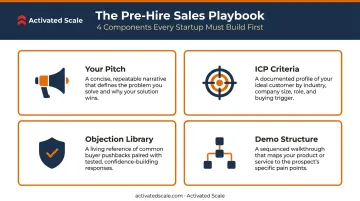
It doesn't need to be 40 pages. It just needs to exist before day one.
Frequently Asked Questions
When should a founder stop doing sales themselves and hire their first salesperson?
The right time is when you've personally closed 5–10 deals, have a repeatable narrative documented outside your head, and founder time has genuinely become the primary bottleneck. Don't delegate sales before you've validated the motion — you'll outsource your learning along with the workload.
What's the difference between hiring a sales rep and a sales manager as your first hire?
Your first hire should almost always be a rep — a doer who can prospect and close independently. A manager needs infrastructure, a team to manage, and processes to optimize. None of those exist yet.
How should you structure compensation for your first sales hire?
Keep it simple: the rep should generate 3–4x their OTE in revenue. Build in a ramp period with reduced quota for the first 60–90 days, then revisit the plan once you have real performance data.
How long does it take to ramp a first sales hire?
Expect 30–90 days before a rep is fully independent, with most early-stage companies hitting break-even around the 3–4 month mark. Early wins are possible in the first few weeks if onboarding is structured and the rep starts with a pre-built account list.
What are the biggest red flags when hiring your first salesperson?
Three stand out: only big-company experience with inbound pipelines, reliance on SDR support to generate their own pipeline, and inability to give specific examples of full-cycle wins in scrappy or ambiguous environments.
Should I build a sales playbook before making my first sales hire?
Yes. A basic playbook — ICP definition, pitch narrative, common objections with responses, demo structure — should exist before onboarding begins. Without it, training depends entirely on your availability, which defeats the purpose of hiring in the first place.