
Introduction
Every week without a producing salesperson is pipeline sitting idle. For B2B SaaS founders, that tension is real — you need revenue coverage now, but a bad hire or a drawn-out process can cost you three to six months of lost momentum.
The typical sales hiring cycle runs 60–90 days from job post to start date. According to LinkedIn's benchmarking data, average time-to-hire across industries sits at 41 days — and that's for roles with established processes. For early-stage startups without a dedicated recruiter, it's often longer.
Rapid sales hiring means compressing that timeline to days or weeks without sacrificing fit quality. The goal is eliminating the process bottlenecks — slow job posts, sequential interviews, vague scorecards — that add weeks without improving the decision.
This article covers:
- Readiness signals to confirm before you post a role
- How to build an Ideal Rep Profile that filters fast
- Parallel sourcing tactics to fill your pipeline quickly
- A compressed screening process that cuts weeks off the timeline
- Why fractional talent is often the fastest path to immediate pipeline coverage
TL;DR
- Confirm a repeatable sales motion and a narrow ICP before hiring — adding headcount without these burns cash without driving revenue
- Build an Ideal Rep Profile before sourcing or you'll flood your pipeline with unqualified candidates
- Run agencies, referrals, and LinkedIn outreach simultaneously — sequential sourcing is too slow
- Use asynchronous written screens and live sales simulations to cut weeks from your interview process
- Tap fractional sales talent to get a rep active and generating pipeline in 7 days or less
Know Before You Hire: Are You Actually Ready?
Speed without readiness is expensive. Before pulling the trigger on rapid hiring, answer one question honestly: do you have more qualified leads than your current team can handle?
If the answer is no, adding headcount won't fix the problem. It will accelerate cash burn without accelerating revenue.
Bessemer's founder playbook puts this clearly: founders should land the first 10–20 customers themselves, maintain an "uncomfortably narrow" ICP during the $0–$100K ARR stage, and transition to team-led sales between $100K and $1M ARR. Hiring a sales team before that transition is validated is one of the most common early-stage mistakes.
Two Signals That Say You're Ready
Before sourcing a single candidate, confirm both of these:
- **You have a repeatable sales motion** — 3–5 consistent wins by the founder or early team following a similar pattern. If every deal closes differently, a new rep has nothing to replicate.
- Your ICP is specific enough to act on — you can describe the buyer's title, company size, and pain point without hedging. Vague ICPs produce vague hiring criteria.
The "Widening Criteria" Trap
Under time pressure, founders often broaden what they'll accept — "We'll consider anyone with SaaS experience." This feels fast but creates a slower outcome. A wider hiring profile forces a broader market approach, lowers win rates, and extends sales cycles. The seat gets filled; the pipeline doesn't.
Get these two signals locked in first. Rapid hiring compounds what's already working — it can't manufacture what isn't there yet.
Build Your Ideal Rep Profile Before You Source
A job description lists responsibilities. An Ideal Rep Profile defines what actually predicts success in your specific sales environment — and skipping it wastes time even when you're moving fast.
Without a clear profile, agencies send whoever's available, referrals send whoever they like, and LinkedIn searches surface whoever matches a title. You'll spend more time disqualifying than progressing candidates.
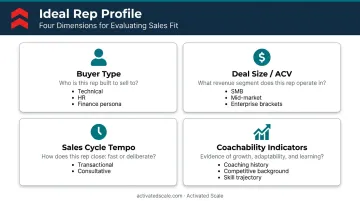
The Four Profile Dimensions That Matter
Buyer type: Who does this rep need to sell to — a technical buyer, an HR leader, a finance decision-maker? Prior experience with the same buyer persona is one of the strongest predictors of early performance.
Deal size (ACV): SaaStr's benchmarks make this concrete — selling at $10K vs. $100K vs. $1M requires entirely different cadences and skills. SMB reps close in 2–3 touches; enterprise reps navigate multi-stakeholder consensus over months. Most sellers can flex one bracket up or down, but rarely more.
Sales cycle tempo: Transactional and consultative selling aren't just styles — they're different skill sets. A rep who thrives closing in a week will struggle in a 90-day evaluation cycle, and vice versa.
Coachability indicators: History of being coached, a competitive background, a pattern of skill improvement over time. At early-stage, these matter more than a big-name employer on a résumé.
When Activated Scale matches fractional sales professionals with clients, the process starts with buyer persona and ACV alignment before anything else — because those two dimensions most reliably predict whether a rep can sell your specific product to your specific buyer.
Rapid Sourcing: Fill Your Hiring Pipeline in Days
Passive sourcing — posting a job and waiting — is too slow for immediate growth. The fastest path is running multiple channels simultaneously from day one.
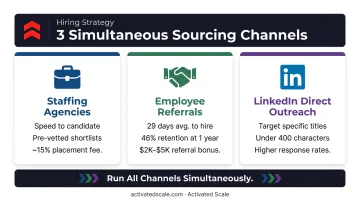
Staffing Agencies for Speed
Sales-specific staffing agencies maintain pre-vetted candidate lists of people actively looking. That's the fastest cold-start option available. The caveat: agencies will fill your pipeline with whoever fits their available inventory unless you enforce your Ideal Rep Profile strictly. Send it to them before they source a single name.
Agency fees typically run around 15% of first-year salary (roughly $15K on a $100K hire), so factor that in when weighing your options.
Employee and Network Referrals
Referrals are the strongest sourcing channel by almost every metric. LinkedIn's referral data shows referred candidates average 29 days to hire versus up to 55 days through traditional methods, and 46% of referred hires stay at least one year compared to 22% from job boards.
The problem: referrals don't happen passively. To activate them:
- Walk through your LinkedIn connections with early team members — out loud, together
- Set a referral bonus ($2K–$5K is enough to motivate without creating gaming)
- Make open roles visible in every team meeting until they're filled
Direct LinkedIn Sourcing for Niche Roles
For specific titles, LinkedIn outreach outperforms most channels. Use combinations of specific role titles (SDR, BDR, AE, MDR) and target company names, not broad category searches. Salespeople actively use LinkedIn, often list personal contact info in their profiles, and respond to direct outreach at higher rates than most other functions.
Keep your outreach short. LinkedIn's own data shows InMails under 400 characters receive 22% higher response rates than average.
Run a Parallel Process
Across all these channels, the most important structural shift is this: evaluate 3–5 candidates simultaneously, not sequentially. When you find the right fit, you need to extend an offer that day.
Why it matters: Sequential sourcing is the single biggest reason rapid hires drag out. A dry pipeline means restarting from scratch — costing you days or weeks you don't have.
Compress Screening Without Sacrificing Quality
Most hiring processes are slow because they're linear, synchronous, and rely on gut feel. A faster process front-loads work onto the candidate — not the founder — and uses structure to make decisions faster.
Asynchronous Written Screen
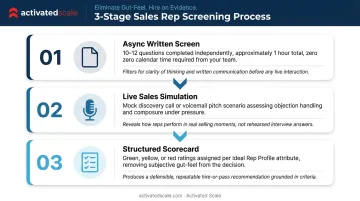
Before any call is scheduled, send a written screen: 10–12 open-ended questions, one hour max for the candidate to complete. What you're looking for:
- Clarity of written communication
- Attention to detail (formatting, follow-through on instructions)
- Self-awareness about strengths and weaknesses
- Personality fit with your team
This step costs you zero calendar time and lets you disqualify quickly. Candidates who submit sloppy responses, miss questions, or write generic non-answers are telling you something important before you've spent a minute on a call.
Live Sales Simulation
Skip the hypothetical interview questions. Instead, include a mock discovery call or a 30-second pitch voicemail as a screening step. A simulation reveals what a resume can't: how candidates handle objections, structure a conversation, and think in real time.
Structured and situational formats are more predictive than unstructured conversations. A 1994 meta-analysis by McDaniel et al. studied 86,311 individuals and found structured interviews had validity of .44 versus .33 for unstructured formats. Situational interviews scored .50 specifically.
Use the simulation to assess:
- How the candidate opens and qualifies a prospect
- Whether they listen or just pitch
- How they respond when challenged or pushed back on
- Composure and adaptability under pressure
Scorecard Over Gut Feel
Build a scorecard tied to your Ideal Rep Profile with green/yellow/red ratings per attribute. Every evaluator uses the same scorecard. Benefits:
- Eliminates the "I just liked them" bias
- Speeds up team consensus — no lengthy debrief meetings
- Makes it easier to compare candidates evaluated on different days
The "If There's Doubt, There's No Doubt" Rule
Speed in hiring doesn't mean lowering the bar. It means making confident decisions faster. If a candidate generates a meaningful red flag at any stage, move on immediately rather than advancing them hoping they'll improve in role. A bad rapid hire is far more costly than a brief delay — Activated Scale's cost modeling shows a wrong hire on a $100K base costs roughly $35,750 in the first three months alone, before factoring in any revenue impact.
De-Risking Fast Hires: The Fractional Sales Model
The structural tension in rapid hiring is that speed and certainty rarely coexist. Fractional sales talent changes that equation.
Instead of a high-stakes permanent hire with a 5+ month ramp, a fractional rep can start generating pipeline within days while you validate fit in your actual sales environment — not a hypothetical one.
How the Contract-to-Hire Pathway Works
Activated Scale structures engagements as a three-month contract with clearly defined goals, during which the rep remains on Activated Scale's payroll (no W2 costs, benefits, or staffing agency fees for the client). During that period, you're evaluating:
- Messaging resonance — does their outreach land with your buyers?
- Pipeline activity — are they building consistent activity or making excuses?
- Deal progression — are early conversations advancing toward qualified opportunities?
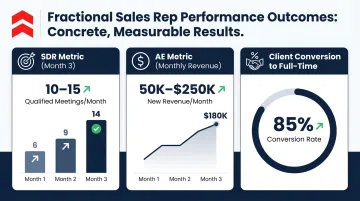
If performance meets the predetermined KPIs, the client can convert to full-time. About 85% of clients make that move — making the fractional period an extended, paid audition with actual output to show for it.
The output is concrete: fractional SDRs typically generate 10–15 qualified meetings per month by month three, while fractional AEs help clients bring in $50K–$250K in new revenue per month depending on deal size and sales cycle.
When Fractional Is the Right Call
The fractional model makes most sense when:
- Pipeline is urgent and a 90-day traditional hiring process isn't viable
- The sales motion needs refinement — a fractional rep with relevant experience can surface what's working before you lock in a full-time hire around a process that may still need iteration
- Budget is constrained and a full-time AE OTE isn't feasible right now (Bridge Group's 2024 data puts median AE OTE at $190K)
Activated Scale connects B2B SaaS founders with pre-vetted, US-based fractional sales professionals in 7 days or less — sometimes within 48 hours — while saving founding teams 20+ hours of interview time per hire.
That speed doesn't come at the cost of quality. Only about 7% of applicants make it into the network, cleared through a three-step process: an application review, a live pitch video against a proprietary case study, and a video interview with a subject matter expert.
Onboard for Immediate Revenue Impact
Rapid onboarding means structuring a clear ramp plan with specific KPIs so the rep has targets from day one. Every week without defined milestones is a week of revenue delayed.
The Ramp Timeline That Works
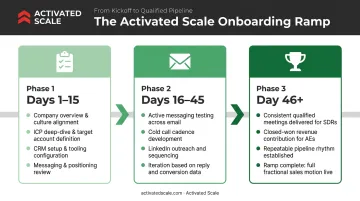
Activated Scale's structured onboarding follows a defined cadence:
- Days 1–15: Intake and process audit — company overview, ICP deep-dive, CRM setup, review of current messaging and customer acquisition channels
- Days 16–45: Active outreach begins — messaging testing across email, cold calling, and LinkedIn; iteration based on what resonates
- Day 46+: Consistent qualified meetings (for SDRs) or closed-won revenue (for AEs) hitting the books
For context on what reasonable ramp expectations look like: SaaStr's benchmarks put SMB ramp at 60 days for deals under $10K ACV and 3–6 months for ACV in the $20K–$80K range. A healthy quota attainment benchmark is 70–80% of reps hitting quota; fewer than 50% is a warning sign.
Three Onboarding Elements That Accelerate Time-to-First-Deal
- Complete the groundwork before day one — assign product deep-dives, ICP research, and competitive landscape review in advance. Week one should start with context already in place, not basic orientation.
- Build structured shadowing into weeks one and two — live calls with the founder or current team, followed by specific debrief questions. Passive listening produces nothing; deliberate debrief does.
- Call coaching cadence — specific, behavioral feedback on actual deals while they're still warm. Feedback on closed lost deals weeks later doesn't change anything.
When these three elements are in place, ramp time compresses — and the first qualified meeting or closed deal arrives weeks earlier than it would through passive orientation alone.
Frequently Asked Questions
What is rapid hire staffing?
Rapid hire staffing compresses the typical recruitment timeline — from months to days or weeks — using pre-vetted talent pipelines, parallel sourcing, and streamlined screening. Fractional and contract-to-hire models accelerate time-to-productivity further by removing the ramp uncertainty of permanent hires.
What are the 30-60-90 and 3-3-3 rules in sales?
The 30-60-90 rule structures a new rep's ramp: onboarding (30 days), pipeline building (60 days), and quota progress (90 days). The 3-3-3 rule means keeping candidates at three pipeline stages at all times, so a dropout doesn't send you back to square one.
What is the 70-30 rule in hiring?
The 70-30 rule is a compensation split: 70% base salary, 30% variable or commission. Most B2B sales roles land between 60/40 and 70/30, with 70/30 common for SDRs and Account Managers where new-business risk is lower than a typical 50/50 AE structure.
How long does it typically take to hire a B2B SaaS salesperson?
Traditional sales hiring cycles run 60–90 days from job post to start date. With pre-vetted networks, parallel sourcing, and asynchronous screening, that can compress to 1–2 weeks. Fractional models can have a rep active within 7 days — sometimes within 48 hours.
What's the difference between a fractional sales rep and a full-time hire?
A fractional sales rep works part-time (typically 15–20 hours per week) on a contract basis, giving startups immediate pipeline coverage and the ability to evaluate real performance before committing to a full-time salary, benefits package, and long-term compensation structure.
How do you avoid a bad rapid sales hire?
Start with a defined Ideal Rep Profile, a structured async screen, and a live sales simulation before any offer goes out. A contract-to-hire or fractional engagement lets real performance speak before you commit to a permanent hire, which removes the most expensive type of hiring mistake from the equation.