Introduction
Building a sales team from scratch is genuinely hard — and most B2B SaaS founders find out the hard way. Product instincts don't transfer cleanly to sales leadership. The result? Costly mis-hires, reps who miss quota, and months of slow revenue growth while the runway shrinks.
The numbers are sobering. According to RepVue's Q4 2024 Cloud Sales Index, only 43.14% of quota-carrying sales professionals hit their targets across 238 companies — down from 53% in early 2022. That's not just a market problem. A lot of it traces back to poor hiring decisions, weak onboarding, and managing by gut instead of data.
This guide addresses those root causes directly. It's written for early-stage B2B SaaS companies scaling from zero, covering five areas:
- Setting the right foundation before your first hire
- Recruiting talent that fits your current stage
- Onboarding for fast ramp-up
- Managing performance with real metrics
- Keeping top reps from walking out the door
TLDR
- Build your ICP, sales process, and playbook before making your first hire — otherwise new reps have nothing to execute against
- Hire for coachability and a builder's mindset, not years of experience or a polished resume
- Structured onboarding cuts ramp time — treat it as a revenue investment, not admin overhead
- Track leading indicators daily (calls, meetings booked) to catch pipeline problems before they become missed quarters
- Retention requires more than pay: coaching, recognition, and visible career paths matter equally
Set the Foundation Before You Hire
Skipping foundation-setting is one of the most expensive mistakes early-stage founders make. When new reps join without a clear ICP, a documented sales process, or defined success benchmarks, they improvise. Some figure it out eventually. Most don't, and by month three, you're already planning a replacement.
What "Foundation" Actually Means
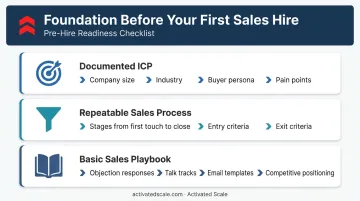
Three things need to exist before you make your first sales hire:
- A documented Ideal Customer Profile (ICP) — company size, industry, buyer persona, pain points, and why they buy
- A repeatable sales process — from first touch to close, with defined stages and entry/exit criteria at each step
- A basic sales playbook — objection responses, talk tracks, email templates, and competitive positioning
Fractional AEs placed through Activated Scale often take on this documentation work themselves, building the sales playbook and CRM structure as part of their engagement. But ideally, founders have the raw material ready before any seller arrives.
Setting Realistic Targets
Work backwards from your revenue goal to determine headcount and quota. Per OpenView's research, quota-to-OTE should sit around 5x, meaning a rep earning $200K OTE should carry roughly a $1M quota. OpenView also notes that SaaS companies should expect 50-60% of ramped reps to hit their target in any given period, not 100%.
Use that expectation when planning cash runway. If you need $2M in new ARR this year and expect your reps to hit around 50% of quota, you need to plan accordingly — either more headcount, higher quotas, or a longer timeline.
Team Structure for Early-Stage Companies
Most early-stage companies don't need a pod model yet. The SDR + AE + CS structure makes sense at scale, but Winning by Design maps the typical SaaS trajectory this way:
- First 20-30 customers: Founder-led sales
- $10K-$50K MRR: First full-cycle AE hire
- ~$100K MRR: SDR specialization begins to make sense
Start with generalist sellers who can run a full cycle (prospecting to close). Splitting roles too early creates handoff problems and leaves gaps in coverage.
Sales and Marketing Alignment
Before scaling headcount, align on lead quality definitions, messaging, and handoff criteria with marketing. Forrester found that 65% of sales and marketing professionals report a lack of alignment — even when leadership believes everything is fine. Misalignment means reps waste time on bad leads and customers receive inconsistent messaging from day one.
Recruit the Right Sales Talent at the Right Time
Traits That Actually Predict Success at Startups
Early-stage sales is not the same job as selling at a 500-person company with an established brand and inbound leads. The traits that matter most at the startup stage:
- Coachability — iterates fast based on feedback without ego getting in the way
- Resilience — bounces back from rejection and keeps dialing without a manager propping them up
- Curiosity — asks better discovery questions because they actually want to understand the buyer's world
- Builder's mindset — comfortable with ambiguity and eager to create process, not just follow it
A rep with five years at Salesforce is not automatically a good fit for a seed-stage company with no brand recognition and no inbound pipeline. What you need is someone willing to do the unglamorous work of building from zero.
When It's Time to Hire
Three signals indicate readiness:
- The founding team has validated product-market fit with paying customers
- There's a documented, repeatable sales process — not just tribal knowledge
- Demand consistently exceeds what founders can handle personally
Hiring before these conditions exist usually produces a mis-hire. The rep has nothing to execute against, flounders, and leaves or gets let go within six months.
The Hidden Cost of Traditional Full-Time Hiring
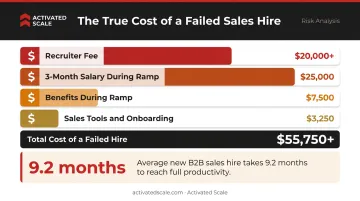
The standard hiring path is slow and expensive. Consider the math for a rep with a $100K base salary:
| Cost Category | Estimate |
|---|---|
| Recruiter fee (20% of OTE) | $20,000+ |
| 3 months salary during ramp | $25,000 |
| Benefits during ramp period | $7,500 |
| Sales tools and onboarding | $3,250 |
| Total if it doesn't work out | $55,750+ |
And that's before counting lost revenue opportunity. CSO Insights found that the average new B2B sales hire takes 9.2 months to reach full productivity. If they wash out at month four, you've burned significant runway with nothing to show for it.
The Fractional Alternative
For early-stage companies, a contract-to-hire model significantly reduces this risk. Rather than committing to a full-time hire upfront, you engage an experienced seller for a defined period — typically three months — with clearly defined goals and the option to convert if they deliver.
Activated Scale uses this model to connect B2B SaaS startups with pre-vetted, US-based fractional sales professionals in seven days or less. Our network includes professionals with backgrounds at companies like Salesforce, Oracle, Zendesk, and Udemy, vetted through a three-step process with only the top 5% of applicants accepted.
Ramp time with this model drops to roughly two weeks, versus the three to six months typical of traditional full-time hires. Clients like Dresma.ai reported a **5x increase in meetings with qualified prospects**, and 65% of Activated Scale clients ultimately convert their fractional hire to a full-time employee.
Onboard and Train for Fast Ramp-Up
Onboarding is consistently the most underinvested growth lever in early-stage companies. Founders assume good reps figure things out quickly. The research tells a different story.
Research from the Sales Management Association found that highly structured onboarding cut average time-to-productivity from 9.1 months to 5.7 months — a 3.4-month improvement. Companies with effective onboarding also saw 10% greater sales growth and 14% better achievement of sales objectives.
The catch: only 40% of firms with formal onboarding programs believed those programs were actually working.
What Effective Onboarding Looks Like
A strong 30-60-90 day structure covers:
Days 1-30:
- Deep-dive into product, ICP, and existing customer interviews
- Review of the sales playbook and CRM setup
- Shadowing calls and reviewing recorded demos
Days 31-60:
- Practicing objection handling in role-play scenarios
- Running discovery calls with support from a manager or senior rep
- Iterating on outbound messaging based on early results
Days 61-90:
- Carrying a full pipeline independently
- Hitting activity targets (calls, emails, meetings booked)
- Presenting a self-assessment against initial milestones
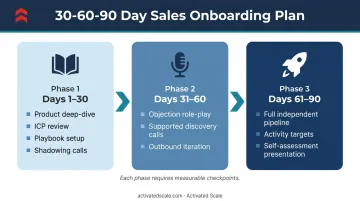
Each phase needs measurable checkpoints, not just a calendar milestone.
Continuous Training After Day 90
Markets shift, buyer expectations evolve, and even strong reps develop blind spots over time. Keep development ongoing after the initial ramp through:
- Weekly call reviews (recorded calls reviewed with specific feedback)
- Monthly skill-specific coaching sessions
- Peer-to-peer knowledge sharing on what's working in the pipeline
Manage Performance With Data, Not Gut Instinct
Leading vs. Lagging Indicators
Most founders track the wrong metrics — or track the right ones too late. Revenue, quota attainment, and deal size are lagging indicators. By the time they look bad, the quarter is already lost.
Leading indicators tell you what's happening now:
| Leading Indicator | What It Tells You |
|---|---|
| Calls made per day | Is the rep putting in the activity? |
| Emails sent | Is outreach volume sufficient? |
| Meetings booked per week | Is outreach converting to pipeline? |
| Opportunities created | Is the pipeline growing fast enough? |
Check leading indicators daily or weekly. Lagging indicators tell you the score. Leading indicators let you change it.
Key KPIs for Managing a Growing Sales Team
- Pipeline coverage ratio: Keep 3x-4x your quota in active pipeline at all times (SaaStr benchmark)
- Win rate: A healthy SaaS win rate is 20-30%; below 15% usually signals a problem upstream, not at close
- Sales cycle length: Varies by ACV — roughly 40 days for sub-$10K deals, 130+ days for $50K-$100K, and 220+ days above $200K
- Quota attainment: Expect 50-60% of fully ramped reps to hit target in any given period
- Lead-to-opportunity conversion: A low rate here exposes a mismatch between lead quality and rep qualification skills
Pipeline Reviews and CRM Discipline
Effective pipeline management requires more than a weekly meeting. It means:
- Regular one-on-one deal reviews focused on specific next steps and blockers
- Clear standards for what qualifies a deal to be in each pipeline stage
- Removing stale deals regularly — bloated pipelines hide real problems and make forecasting meaningless
Without CRM discipline, coaching is guesswork — you're reacting to outcomes instead of steering toward them.
Coaching vs. Managing
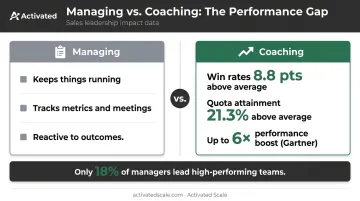
There's a meaningful difference. Managing through metrics and meetings keeps things running. Coaching is where performance actually improves.
Gartner found that effective sales managers can boost seller performance by up to 6x — but only 18% of managers actually lead high-performing teams. Research from CSO Insights shows that dynamic coaching produced win rates 8.8 points above average and quota attainment 21.3% above average.
Protect dedicated coaching time. Review calls. Run skill drills. The administrative load naturally expands to fill available hours — push back on it.
Motivate and Retain Your Best Sales Reps
Why Reps Leave (and Why It's Expensive)
Replacing a sales rep costs far more than most founders account for. Beyond recruiting fees and ramp time, there's the pipeline knowledge lost, the relationships disrupted, and the drag on team morale.
Common reasons top reps leave:
- Poor or inconsistent management
- No clear path to promotion
- Lack of recognition for wins
- Compensation that doesn't reflect their contribution
- Feeling like their feedback doesn't matter
CSO Insights found that fully engaged sales teams had 5.7% voluntary turnover compared to 10.2% for unengaged teams. Engagement, it turns out, is one of the most reliable retention levers available.
Motivation Beyond Commission
Compensation gets reps in the door. It doesn't keep them. Effective motivation strategies include:
- Recognize wins publicly, even small ones — culture is built in the day-to-day, not the quarterly kickoff
- Pair newer reps with senior ones through mentorship programs; it benefits both sides
- Write down promotion criteria clearly — reps should know exactly what "next level" looks like, not have to guess
- Bring high performers into strategic decisions — territory planning, product feedback, or GTM discussions give them genuine ownership
Building a Culture That Sustains Performance
A strong sales culture doesn't mean relentless positivity or avoiding hard conversations. It means:
- Freedom to debrief lost deals without blame
- A shared focus on process adherence over short-term heroics
- Leadership that models the behaviors it expects — if managers don't do call reviews, reps won't either
Culture is set at the top and experienced at the bottom. Founders who build retention intentionally protect their revenue pipeline and make future hiring easier — word travels fast in any sales community.
Frequently Asked Questions
How do you grow your sales team?
Start by establishing a repeatable sales process and a documented ICP before making any hire. Then bring on talent that matches your current stage — typically full-cycle reps early on — and invest in structured onboarding and ongoing coaching to get them productive fast.
What is the 70/30 rule in sales?
The 70/30 rule means managers should spend 70% of their time on core activities (coaching reps, reviewing deals, running skill development) and 30% on admin. Research from the Sales Management Association found that managers who fall below that 70% threshold consistently see below-average team growth.
When should a startup hire its first salesperson?
The right signal is when the founding team has validated product-market fit, can articulate a repeatable sales process, and is generating more demand than it can personally handle. Hiring before those conditions exist typically results in a costly mis-hire within the first six months.
What are the most important KPIs for managing a sales team?
The most important KPIs are pipeline coverage ratio, win rate, sales cycle length, quota attainment percentage, and lead-to-opportunity conversion rate. Track leading indicators — calls made, meetings booked, emails sent — daily so you can catch problems before they become missed quarters.
How do you retain top-performing sales reps?
Top performers stay when they have competitive pay, regular coaching, public recognition of wins, and a clear path to promotion. They leave when they feel invisible or stuck, and replacing them costs far more than addressing those issues early.