Introduction
B2B e-commerce is experiencing rapid growth. Forrester estimates US B2B e-commerce will reach $3 trillion by 2027, accounting for 24% of total US B2B sales. Meanwhile, buyer expectations have shifted just as fast: 67% of B2B buyers prefer a rep-free experience, and 80% initiate first contact only after completing 70% of their buying journey.
Today's B2B buyers are self-directed and research-heavy — they arrive at a conversation already knowing what they want. Companies still running traditional outbound-only playbooks are losing deals before a rep even enters the picture.
This article covers five tactics to close that gap: personalization and ABM, omnichannel sales execution, sales automation and technology, content and social commerce, and B2B marketplace strategies.
TLDR: Key B2B E-Commerce Sales Growth Tactics at a Glance
- Omnichannel is non-negotiable: B2B buyers average 10+ channels; showing up consistently across all of them drives revenue
- Personalization delivers 10-15% revenue lift: buyers expect tailored pricing, catalogs, and content — and reward companies that deliver
- The 95-5 rule shapes strategy: only 5% of your market is ready to buy now; build nurture systems for the other 95%
- Automation frees sales teams: automate low-value tasks so skilled reps focus on closing deals
- Marketplaces expand reach fast: B2B marketplaces offer lower-risk paths to test new markets before scaling infrastructure
Personalization and Account-Based Marketing (ABM): Turning Buyers Into Long-Term Partners
Personalization has become a baseline expectation. B2B buyers are also consumers and bring those expectations into professional purchasing decisions. 72% of B2B customers expect fully personalized content when using products and services. Companies that deliver see results: personalization drives 10-15% revenue lift, and 77% of companies using direct one-to-one personalization saw market share increases.
Account-based personalization means tailoring product catalogs, pricing tiers, and website content to specific companies, divisions, or individual buyer roles. CRM and ERP data integration makes this scalable, removing the manual overhead that once made it impractical.
Segmentation by Role and Buying Stage
Effective segmentation serves different stakeholders with different content. Key examples:
- Engineers receive detailed technical specifications and product datasheets
- CFOs see ROI-focused content highlighting cost savings and efficiency gains
- Procurement leads get vendor comparison materials and compliance documentation
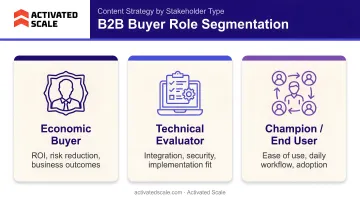
This role-based approach extends through the entire buying journey, adjusting messaging based on whether the buyer is researching options, evaluating vendors, or negotiating terms.
That stage-aware messaging connects directly to how pricing is presented. Dynamic catalogs and account-specific pricing models build trust — showing the wrong price to the wrong buyer erodes credibility fast. Real-time ERP-connected pricing ensures every customer sees accurate, account-specific rates based on their contract terms and order history.
Customer Portals and Repeat Purchasing
Purpose-built customer portals streamline bulk ordering, reordering, and procurement workflows. Instead of forcing buyers to navigate a public catalog every time, portals provide saved orders, approval workflows, and pre-negotiated pricing. Reduced friction means higher average order values and stronger retention — two outcomes that compound over the life of an account.
Ongoing feedback collection — through post-purchase surveys, on-site prompts, and sales team debriefs — keeps ABM calibrated over time. When confusing checkout flows or missing payment options surface, teams can fix them before they affect close rates.
Omnichannel Sales Execution: Inside Sales, Hybrid Models, and Seamless Buyer Journeys
The shift from multi-channel to true omnichannel represents a strategic leap. Multi-channel means being present on multiple platforms; omnichannel ensures buyers can move across channels—social, website, email, phone, in-person—without losing context or repeating information. Companies employing all five modern sales tactics are 2x more likely to see more than 10% market share growth than those focusing on only one.
B2B buyers now use 10 interaction channels on average, doubled from 5 in 2016, with 42% using more than 11 touchpoints. This complexity demands coordinated execution across every channel.
Inside Sales and Hybrid Sales Models
Inside sales is a quota-bearing, remote sales function that leverages data and digital tools to engage prospects across channels. It's not a call center or support role—it's strategic revenue generation. Inside sales reps cover significantly more prospects at a fraction of field sales costs, with lower overhead and no travel expenses.
The hybrid sales model combines remote inside sales with selective in-person interactions for high-value accounts. 57% of companies that grew market share by more than 10% adopted a hybrid model, compared to 40% of companies that lost share. Hybrid sales drives up to 50% more revenue by enabling broader, deeper customer engagement.
This model is especially effective for B2B SaaS companies managing a mix of SMB and mid-market buyers. Early-stage companies without an established sales team face a real tension: they need experienced talent fast, but can't absorb the risk and overhead of full-time hiring.
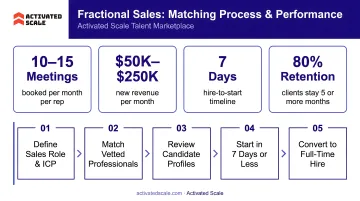
Fractional inside sales professionals (like those available through Activated Scale) let founders get pipeline moving quickly without committing to permanent headcount. Activated Scale's fractional SDRs book 10-15 meetings per month, while fractional Account Executives win $50,000 to $250,000 in new revenue monthly — with professionals matched in under 7-10 days.
Whichever model you choose, the operational infrastructure has to hold it together. Seamless execution requires synchronized pricing across channels, consistent messaging and branding, and a CRM that gives every rep a full view of account history — regardless of which channel the buyer used last. Without this backbone, omnichannel collapses into fragmented multi-channel.
Loyalty Programs and Retention
B2B loyalty programs differ fundamentally from B2C. Rather than generic points systems, they need to reflect the higher lifetime value of B2B relationships through account-specific incentives. Effective B2B programs typically include:
- Volume discounts tied to spend thresholds
- Priority support for top-tier accounts
- Co-marketing opportunities for strategic partners
- Early access to new products or features
- Referral bonuses and reseller program benefits
Sales Automation, Technology, and CRM Integration: Doing More with Less
Automation leaders outperform peers on both revenue growth and cost-to-serve reduction. More than 30% of sales-related activities can be automated, yet only 1 in 4 companies has automated at least one sales process. Most teams are leaving speed, accuracy, and selling time on the table.
Sales reps spend 60% of their time on non-selling tasks such as hunting for sales pitch decks, data entry, and administrative work. Automation reclaims this time, allowing reps to focus on what they do best: building relationships and closing deals.
Key Automation Areas That Drive Impact
Lead management automation surfaces the highest-potential prospects using AI-assisted prioritization. Chatbots contact prospects at optimal times based on behavioral data, and automated follow-up sequences keep leads from going cold. Early adopters report a 15-20% increase in actual selling time.
CPQ (Configure, Price, Quote) automation removes the back-office bottleneck from the quoting process. Sales teams generate accurate, personalized quotes faster — eliminating errors, cutting approval wait times, and surfacing relevant product bundles for cross-sell and upsell opportunities.
CRM and e-commerce platform integration gives every rep 360-degree visibility into account behavior and buying history. Key outcomes include:
- Targeted campaigns triggered by real purchase signals
- Abandoned cart recovery before deals go cold
- Proactive outreach when a high-value account views pricing pages repeatedly but doesn't convert
Split testing (A/B testing) applies to product page layouts, checkout flows, search and filtering, and CTAs. Small, data-driven improvements compound over time into measurable revenue lift — without guesswork.
Content Marketing, Social Commerce, and SEO: Building Demand Beyond Direct Outreach
Content marketing serves two purposes in B2B e-commerce: it drives organic search traffic through high-quality product descriptions, blog posts, and pillar pages, and it educates buyers through a long, research-heavy buying cycle. 9 out of 10 B2B buyers say online content has a moderate to major effect on purchasing decisions, and the average B2B buyer consumes 13 pieces of content before making a purchase.
Content isn't optional—it's the foundation of modern B2B demand generation. 62% of B2B buyers cite web search as one of their first three resources to learn about a solution, and 80% prefer getting company information from articles rather than advertisements.
Social Commerce and LinkedIn
Social commerce—using social platforms to drive sales and pipeline—is uniquely powerful for B2B on LinkedIn, where buyers research vendors and engage with thought leadership. Approximately 75% of B2B buyers use social media to make purchasing decisions, and 84% of CEOs and VPs use social media to help make purchasing decisions.
Content repurposing extends reach efficiently. A single white paper or technical guide can be broken into LinkedIn posts, Twitter/X threads, short-form videos, and email sequences, reinforcing your brand across channels without extra content creation effort.
That efficiency matters because of the 95-5 rule: only 5% of B2B buyers are actively in-market at any given time. Content builds familiarity and trust with the other 95%, so when they do enter a buying cycle, your brand is already top of mind.
Email Marketing and Cart Abandonment Recovery
Email returns between 10:1 and 36:1 ROI for most companies — among the highest of any digital channel. B2B e-commerce teams use email automation to address abandoned carts, re-engage dormant accounts, and run personalized loyalty campaigns.
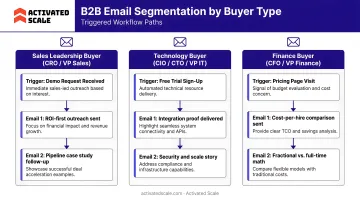
Connecting CRM data to email workflows makes outreach relevant rather than generic. Segment by account type, purchase history, and engagement level, then tailor each trigger accordingly:
- First-time visitors: Send educational content that builds confidence in your product
- Repeat customers: Offer a direct incentive (discount, priority shipping) to complete the order
- Dormant accounts: Re-engage with new product announcements or a personalized check-in
B2B Marketplaces and Market Expansion Strategies: Expanding Your Reach
B2B marketplaces—platforms like Amazon Business, ThomasNet, and industry-specific marketplaces—represent a lower-risk entry point for expanding reach. They provide access to an established buyer base, reduce customer acquisition costs, and allow sellers to test demand for new products before investing in full-scale infrastructure.
B2B marketplaces remain the fastest-growing B2B digital sales channel and are on course to exceed $350 billion. Amazon Business surpassed $35 billion in global annualized sales, serving more than 8 million organizations including 97 of the Fortune 100. 88% of B2B respondents globally sell through third-party marketplaces, rising to 97% in India and 93% in the US.
Key strategies for marketplace success:
- Optimize product listings with detailed descriptions and high-quality visuals that answer buyer questions upfront
- Price competitively using marketplace research and dynamic repricing tools
- Respond to inquiries fast — marketplace algorithms reward quick response times with better placement
- Use marketplace analytics to refine listings and prioritize top-performing inventory
Geographic market expansion requires careful sequencing. Marketplaces provide a testing ground for international sales without requiring full localization upfront — but a clear entry plan still matters:
- Identify high-potential markets using digital infrastructure and demand data
- Partner with local distributors for on-the-ground market knowledge
- Localize the e-commerce experience: language, pricing, and payment methods
- Confirm regulatory compliance before committing to a new region
Frequently Asked Questions
What are the best B2B sales strategies?
The top strategies include personalization/ABM, omnichannel sales execution (inside and hybrid models), sales automation, content and inbound marketing, and B2B marketplace presence. Companies that combine several of these tactics consistently outpace competitors who rely on just one channel.
What is the 95-5 rule for B2B?
Only approximately 5% of B2B buyers are actively in-market and ready to purchase at any given time, while 95% are not yet ready. B2B marketing must build brand familiarity and trust with the 95% through content and nurture strategies, so when they enter a buying cycle, your brand is top of mind.
What are the 4 C's of B2B marketing?
The 4 C's are Customer (understanding buyer needs and motivations), Cost (total cost of solving the buyer's problem, not just price), Convenience (ease of doing business across channels), and Communication (two-way, relevant dialogue rather than one-way broadcasting).
What are the 7 C's of e-commerce?
The 7 C's framework includes Content, Context, Community, Customization, Communication, Connection, and Commerce. Together, these elements shape how B2B buyers discover, evaluate, and complete purchases across digital channels.
How do you increase B2B e-commerce conversion rates?
Improve personalization (account-specific pricing and catalogs), streamline checkout and reordering, implement cart abandonment recovery, use A/B testing to optimize landing pages, and ensure sales follow-up is fast and relevant through CRM integration.
What role does sales talent play in executing B2B e-commerce growth strategies?
Technology and strategy provide the framework, but experienced sales professionals convert digital intent signals into revenue—particularly for high-value deals that require negotiation and relationship-building that automation can't replicate. Pairing the right automation with skilled fractional sales talent is often the fastest path to consistent revenue growth.