

Introduction
Tech sales is one of the few career fields where someone without a technical degree can realistically earn six figures within a few years. The industry runs on revenue, and companies pay well for people who can generate it.
The US tech sector currently generates roughly 317,700 job openings per year, according to the Bureau of Labor Statistics, with a median annual wage of $105,990. Sales roles sit at the center of that growth — and as SaaS funding has surged, so has demand for people who can close.
The harder problem is knowing which roles to target. Titles like SDR, AE, Sales Engineer, CSM, and VP of Sales each sit at a different experience level, pay band, and career stage. Applying to the wrong tier wastes months.
This guide breaks down the six highest-demand technology sales roles in 2025, what each pays, what skills they require, and how to position yourself to land them fast.
TL;DR
- Tech sales offers accessible, high-earning career paths across all seniority levels — entry through executive
- The top roles right now: SDR/BDR, Account Executive, Sales Engineer, CSM, VP of Sales, and Sales Operations Manager
- Compensation varies widely — SDR OTE starts around $85K; Enterprise AE median OTE hits $270K
- Most entry and mid-level roles prioritize communication skills over technical background
- Activated Scale places sales professionals in fractional and contract-to-hire roles at B2B SaaS startups, often within 7 days
What Is a Technology Sales Job?
Tech sales covers selling software (SaaS), hardware, IT services, or cloud solutions — primarily in B2B contexts. It's an umbrella term spanning multiple role types, seniority levels, and specializations, from entry-level prospecting to C-suite revenue leadership.
One key distinction: tech sales focuses on winning new customers and closing deals, while IT sales often extends into post-sale implementation. Both are actively hiring, but the day-to-day realities differ.
That context matters when you're evaluating where to apply. Salesforce's 2024 State of Sales research found that sales teams using AI added headcount at 68% compared to 47% for teams without AI. AI isn't replacing sales roles — it's making sales organizations more productive, and productive organizations hire more.
Top Technology Sales Jobs to Apply for Today
These roles were selected based on hiring volume, compensation potential, career trajectory, and accessibility for both new entrants and experienced professionals.
Sales Development Representative (SDR) / Business Development Representative (BDR)
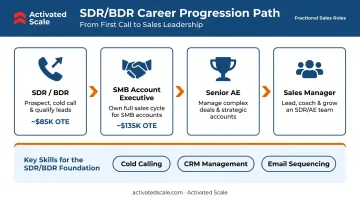
SDRs and BDRs handle outbound prospecting, qualify inbound leads, run cold outreach, and book meetings for Account Executives. It's the top of the sales funnel — and the most common entry point into tech sales.
High hiring volume across SaaS companies of all sizes makes this role consistently available. Most SDR positions come with structured training, a clear promotion path to AE, and commission earning potential from day one. AI tools are also reshaping the role — Gartner projects that by 2027, 95% of seller research workflows will start with AI — which means SDRs who learn these tools early have a real edge.
| Details | |
|---|---|
| Base Salary | ~$60,000 median (US) |
| OTE | ~$85,000 median |
| Key Skills | Cold calling, email sequencing, CRM (Salesforce, HubSpot), objection handling, coachability |
| Career Path | SDR → AE (SMB or Mid-Market) → Senior AE → Sales Manager |
Compensation data: RepVue, 2026
Activated Scale places fractional SDRs with at least two years of experience into B2B SaaS startups. Fractional SDR engagements typically run 15–20 hours per week, with compensation structured at $2,200–$2,800/month plus commissions — a practical way for experienced SDRs to build a portfolio across multiple companies or enter a new vertical.
Account Executive (AE) — SMB, Mid-Market, and Enterprise
AEs run full-cycle sales: discovery calls, demos, proposals, negotiation, and close. They are the direct revenue drivers of any tech sales organization.
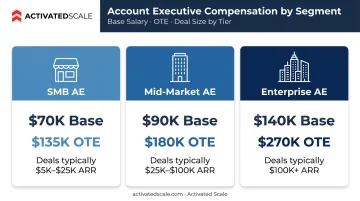
The role exists across three sub-tiers with meaningfully different deal sizes, cycle lengths, and pay structures:
| Segment | Median Base | Median OTE |
|---|---|---|
| SMB AE | $70,000 | $135,000 |
| Mid-Market AE | $90,000 | $180,000 |
| Enterprise AE | $140,000 | $270,000 |
Source: RepVue, 2026
Enterprise AEs at mature SaaS companies routinely exceed $200K OTE — and top performers at that level can reach significantly higher. AI-assisted CRM tools are also reducing administrative burden, freeing AEs to spend more time on high-value selling conversations.
Key Skills Required:
- Discovery and qualification
- Demo delivery and objection handling
- Pipeline management and forecasting
- Negotiation and contract management
- CRM fluency (Salesforce, HubSpot)
Career Path: SMB AE → Mid-Market AE → Enterprise AE → Sales Manager → Director → VP of Sales
Activated Scale's AE network covers deal sizes from $10K to $100K+ ARR across SMB through enterprise segments. Clients working with fractional AEs through the platform typically win $50,000 to $250,000 in new revenue per month, with 65% converting their fractional AE to a full-time hire after the initial engagement.
Sales Engineer (Solutions Engineer)
Sales Engineers sit between technical product teams and the sales floor. They join AE calls to answer deep technical questions, run complex demos, and help prospects work through integration, security, and implementation specifics.
The role suits candidates with a technical background who want client-facing, high-compensation work. As tech products grow more complex — AI platforms, data infrastructure, cybersecurity tools — demand for Sales Engineers keeps climbing. According to the BLS, the median annual wage for Sales Engineers is $121,520, with 5% projected job growth and roughly 5,000 openings per year.
| Details | |
|---|---|
| Base Salary | ~$145,000 median |
| OTE | ~$205,000 median |
| Key Skills | Software/API knowledge, solution architecture basics, demo customization, technical writing, translating features into business value |
| Career Path | Sales Engineer → Senior SE → Principal SE / SE Manager → VP of Pre-Sales or Product Management |
Source: RepVue, 2026
Customer Success Manager (CSM)
CSMs own the post-sale relationship — ensuring customers achieve real outcomes with the product, driving adoption, reducing churn, and identifying upsell and renewal opportunities. In SaaS companies, CSMs are directly tied to net revenue retention (NRR), a metric with an outsized impact on growth rate and company valuation.
Moving NRR from the 90–100% range to 100–110% improves growth rate by roughly 10 percentage points, according to SaaS Capital's 2024 benchmark data. That's why many companies now expect CSMs to carry expansion quotas, which has raised earning potential meaningfully.
| Details | |
|---|---|
| Base Salary | ~$100,000 median |
| OTE | ~$140,000 median |
| Key Skills | Onboarding and training, stakeholder communication, renewal negotiation, data analysis, proactive problem-solving |
| Career Path | CSM → Senior CSM → CS Team Lead → Director of CS → VP of Customer Success |
Source: RepVue, 2026
CSM is a strong entry point for candidates from service, consulting, or account management backgrounds. Activated Scale places fractional Customer Success talent into startups and scaleups, particularly for companies that have customers but haven't yet built a dedicated CS function.
VP of Sales / Sales Director
VP of Sales and Sales Director roles own the full revenue organization: building teams, setting quotas, defining go-to-market strategy, and reporting to the CRO or CEO. These are leadership positions at growth-stage and enterprise companies actively scaling their sales motion.
| Role | Median Base | Median OTE |
|---|---|---|
| Director of Sales | $170,000 | $300,000 |
| VP of Sales | $200,000 | $380,000 |
Source: RepVue, 2026. Top VP of Sales performer potential: $765,729.
Early-stage B2B SaaS companies frequently engage fractional sales leaders to establish repeatable processes without committing to a full-time executive salary. Activated Scale places fractional VPs of Sales at $8,000–$12,000/month on retainer, typically at 15–20 hours per week, covering sales plan development, process refinement, hiring assessment, and team coaching.
Key Skills Required:
- Team building and quota-setting
- Sales process design
- Revenue forecasting
- CRM administration
- Executive communication
Career Path: Sales Director → VP of Sales → SVP of Sales → Chief Revenue Officer (CRO)
Sales Operations Manager
Sales Ops Managers are the operational backbone of a revenue organization. They own the CRM, define sales processes, manage territory planning, analyze pipeline data, run compensation modeling, and give the sales team the tools they need to hit quota.
For candidates with finance, analytics, or operations backgrounds, it's one of the clearest paths into tech sales. As sales technology stacks grow more complex, companies need skilled operators who can turn data into decisions.
Gartner projects that by 2026, 75% of high-growth companies will adopt a RevOps model — up from under 30% today. Companies with advanced RevOps functions are twice as likely to exceed revenue goals.
| Details | |
|---|---|
| Salary (IT Sector) | ~$140,212 median total pay |
| General US Median | ~$114,000 total pay |
| Key Skills | CRM administration (Salesforce, HubSpot), SQL or BI tools, process documentation, compensation plan design, cross-functional collaboration |
| Career Path | Sales Ops Analyst → Sales Ops Manager → Director of Revenue Operations → VP of Revenue Operations |
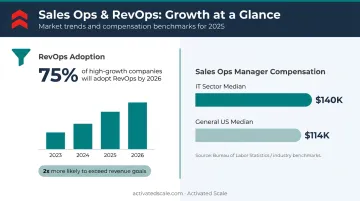
Source: Glassdoor, 2025
What Makes a Tech Sales Job Worth Applying For
Not all open roles are created equal. A job offer with a high OTE headline can still be a poor choice if the underlying structure doesn't hold up.
Green flags to prioritize:
- Structured ramp plan with realistic quota relief in the first 90 days
- Clearly defined ICP (Ideal Customer Profile) with assigned territory — vague targeting leads to wasted pipeline
- Sales leadership with a demonstrated track record of scaling teams
- Product with paying customers and measurable traction — not just a pitch deck
- Promotion history — ask how many SDRs have moved to AE in the last 18 months
Red flags to watch for:
- OTE that's 3x or 4x base with no attainment data — that ratio usually means most reps miss quota
- High rep turnover on LinkedIn (check average tenure at the company)
- Ask whether a sales playbook exists; if there isn't one, you're building from scratch without a safety net
- Vague or overlapping sales territories
A role that looks great on paper can still stall your career if the company runs out of runway or the sales culture is dysfunctional. Vet the company's ARR trajectory, leadership stability, and quota attainment history the same way you'd vet any major career move.
How to Break Into Tech Sales (or Level Up)
Entry Path for Career Changers
Most SDR and CSM roles don't require a technical degree. Hiring managers prioritize communication skill, coachability, and any customer-facing experience.
Concrete steps to get started:
- Earn a recognized certification — The Salesforce Sales Development Representative Professional Certificate on Coursera explicitly requires no prior experience. HubSpot Academy's sales certifications are free and widely recognized.
- Build your LinkedIn presence — Post about sales topics, connect with SDRs and AEs at companies you want to work for, and do informational interviews.
- Target companies with training programs — Look for job descriptions that mention formal ramp plans, SDR bootcamps, or structured coaching.
Advancement Strategy for Existing Sales Professionals
Moving from SMB to mid-market or enterprise requires demonstrating larger deal experience, multi-stakeholder selling, and strategic account management. To reposition your resume for that jump:
- Quantify deal size and sales cycle length explicitly
- Highlight cross-functional selling (legal, procurement, IT, C-suite)
- Show quota attainment as a percentage, not just raw numbers
The Fractional Path
For sales professionals who want to enter B2B SaaS without starting over, fractional and contract-to-hire roles can get you to relevant work faster. Platforms like Activated Scale connect experienced sales professionals with vetted startups — often within 7 days, sometimes the same day.
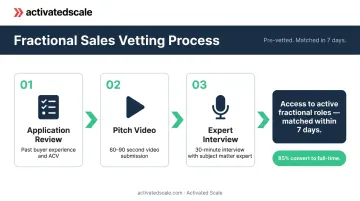
The vetting process runs three stages: application review (past buyer experience and ACV), a 60–90 second pitch video, and a 30-minute interview with a subject matter expert. Professionals who pass get access to active fractional engagements across SDR, AE, CSM, Sales Ops, and VP of Sales roles. Roughly 85% of clients convert their fractional hire to full-time, making it a real path to a permanent role.
Conclusion
The ceiling in tech sales is real — but so is the gap between people who land the right role and those who settle for whatever's available. Your outcome depends on which role you target, at which company stage, and how prepared you are before day one.
Pick the right role for where you are right now. Evaluate companies on product-market fit and sales culture, not just compensation. And once you're in, map out your first 90 days. The reps who move up fastest aren't the most talented — they're the most intentional about proving impact early.
That same principle applies on both sides of the table. If you're a sales professional ready for your next move in B2B SaaS — or a startup founder who needs experienced sales talent without a six-month hiring process — Activated Scale can help. The platform connects vetted, US-based fractional sales professionals with growth-stage companies, and most matches happen within 7 days.
Frequently Asked Questions
Can you make $300K in tech sales?
Yes, though role and company matter. Enterprise AE median OTE sits at $270K per RepVue, Director of Sales hits $300K, and VP of Sales reaches $380K. Reaching those numbers requires a strong track record and positioning at companies with large deal sizes and real commission upside.
What is the highest-paying tech sales job?
VP of Sales and CRO roles sit at the top, with VP of Sales median OTE around $380K. Enterprise AEs follow at $200K–$270K OTE. At growth-stage companies, equity can push total compensation well above those figures.
Do you need a tech background to get into tech sales?
Most entry and mid-level roles — SDR, AE, CSM — don't require a technical or engineering background. Hiring managers care far more about communication skills, curiosity, and coachability. Sales Engineer roles are the exception, where prior technical experience is a real advantage.
What is the difference between an SDR and an AE in tech sales?
SDRs focus on top-of-funnel prospecting and qualifying leads, booking meetings for Account Executives. AEs run the full sales cycle from discovery to close. SDR is the typical entry-level step on the path to an AE role.
Is tech sales a good career in 2025?
Demand for sales talent at SaaS companies continues to grow, AI is augmenting rather than replacing sales roles, and earning potential remains among the highest of any non-technical profession. Teams using AI tools are also growing headcount faster than those that aren't.
How do I get my first tech sales job with no experience?
Start with free certifications (HubSpot, Salesforce/Coursera SDR), apply to SDR roles with training programs, and lean on any prior customer-facing experience. Contract-to-hire roles through platforms like Activated Scale also offer a lower barrier to entry with a built-in path to full-time employment.