_edi.png)
Most CRM implementation projects start with the same goal. Sales leaders want a single view of the pipeline and revenue activity. The system launches successfully, but problems appear weeks later.
57% of sales professionals report longer sales cycles today. Lengthy sales cycle exposes weak CRM usage quickly. Complex buying groups and delayed decisions stretch deals across quarters.
Revenue teams feel the damage quickly, and sales development representative (SDR) activity disappears from reports. Leadership quickly loses visibility into true revenue signals.
In this blog, we break down how sales leaders can approach CRM implementation step by step, using real operational practices that prevent those failures.
Core Insights
- Around 57% of sales professionals say deal cycles are now longer, which makes accurate pipeline tracking more critical for sales leaders.
- Companies that maintain strong pipeline quality are twice as likely to surpass their customer acquisition goals.
- Monthly CRM licensing for B2B sales teams commonly sits around $50–$150 per user, with pricing increasing as automation and analytics features expand.
- Many sales representatives use eight tools to manage and close deals.
- Many organizations require three to six months after CRM rollout before adoption, data quality, and reporting consistency improve across the sales team.
What CRM Implementation Means for You
Real impact appears when the CRM system reflects actual revenue workflows. A structured approach to CRM implementation connects pipeline activity, customer data, and revenue reporting inside one system. The framework process usually includes:
- Pipeline stage design
- Required data fields for deals and accounts
- Activity tracking rules for calls, meetings, and emails
- Integrations with marketing, support, and finance tools
- Reporting dashboards for the pipeline and forecasting
Many organizations confuse deployment with implementation. Here's how to avoid that confusion:
So, the implementation shapes how revenue teams operate inside it. But is it the only advantage? Actually not.
Also Read: CRM for Outbound Sales
Why CRM Implementation Matters for Sales Leaders
Your CRM is either your command center or a very expensive digital landfill. Sales leaders rely on it to forecast revenue, but a weak structural foundation turns that potential into operational chaos.
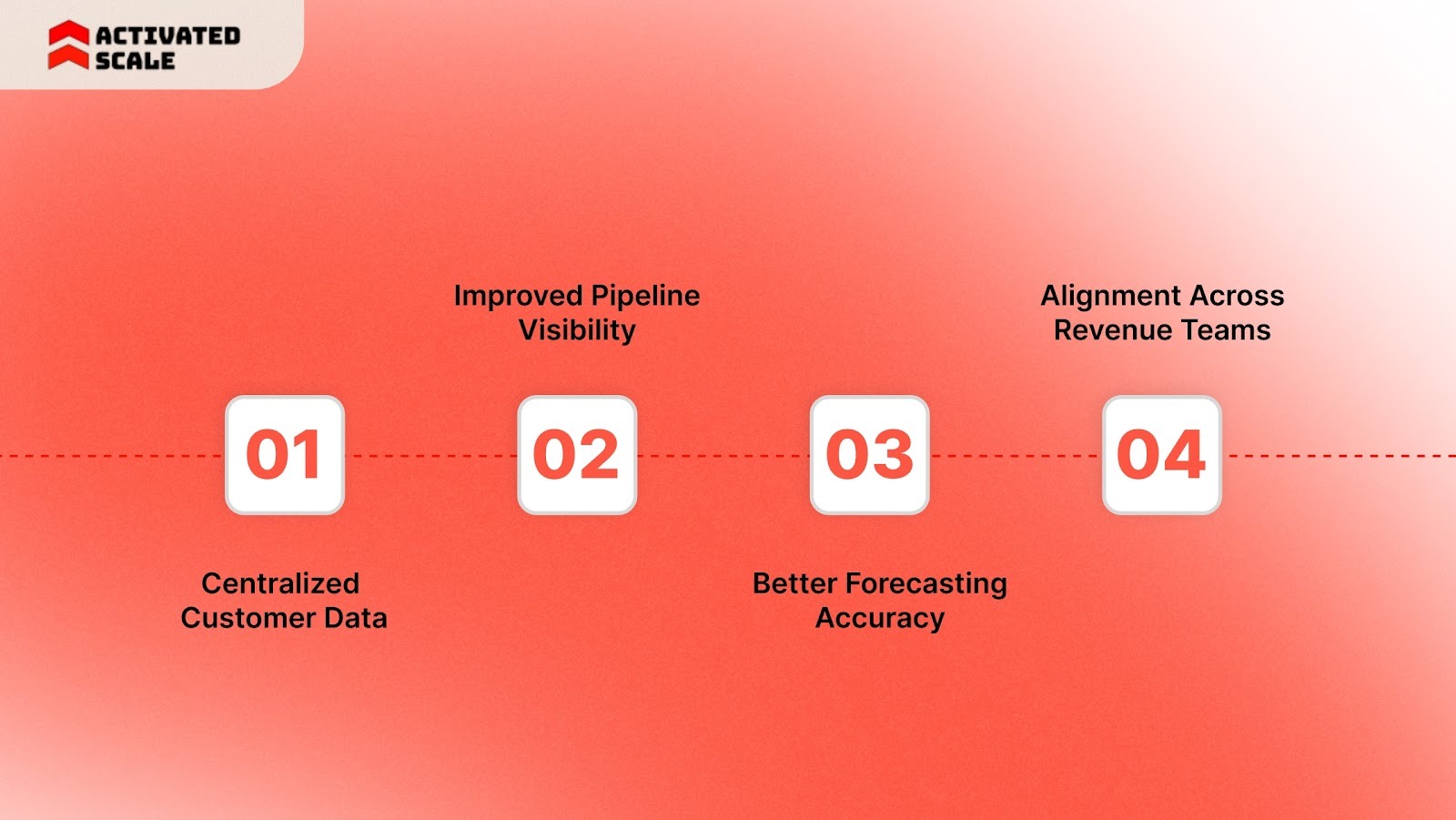
Here is why getting the setup right is non-negotiable:
1. Centralized Customer Data
- Sales, marketing, and success teams access the same account records.
- Customer history stays visible across the full lifecycle.
2. Improved Pipeline Visibility
- Leaders see real deal movement across stages.
- Pipeline reviews rely on current activity instead of manual updates.
3. Better Forecasting Accuracy
- Organizations that prioritize pipeline quality are 2x as likely to exceed their customer acquisition targets. This focus sharpens conversion rates, leading to more achievable revenue projections.
- Deal progress becomes easier to validate during forecast meetings.
4. Alignment Across Revenue Teams
- Marketing tracks lead progression inside the same lifecycle stages used by sales.
- Customer success teams monitor renewal risk using shared account data.
CRM implementation often fails when sales teams lack experienced leadership during rollout. Activated Scale helps companies solve that gap.
Activated Scale provides Fractional Sales Leadership service, giving companies access to experienced VPs of Sales who help design sales processes and choose CRM tools.
The average sales rep uses 8 different tools to close a single deal. So, you cannot treat CRM rollout as a technical project. The system must reflect the sales process and pipeline management rhythm.
CRM Implementation: 10 Steps Sales Leaders Must Follow
You've invested in the software. Now it's time to invest in the strategy. A successful CRM implementation is about building a system your sales team actually wants to use.
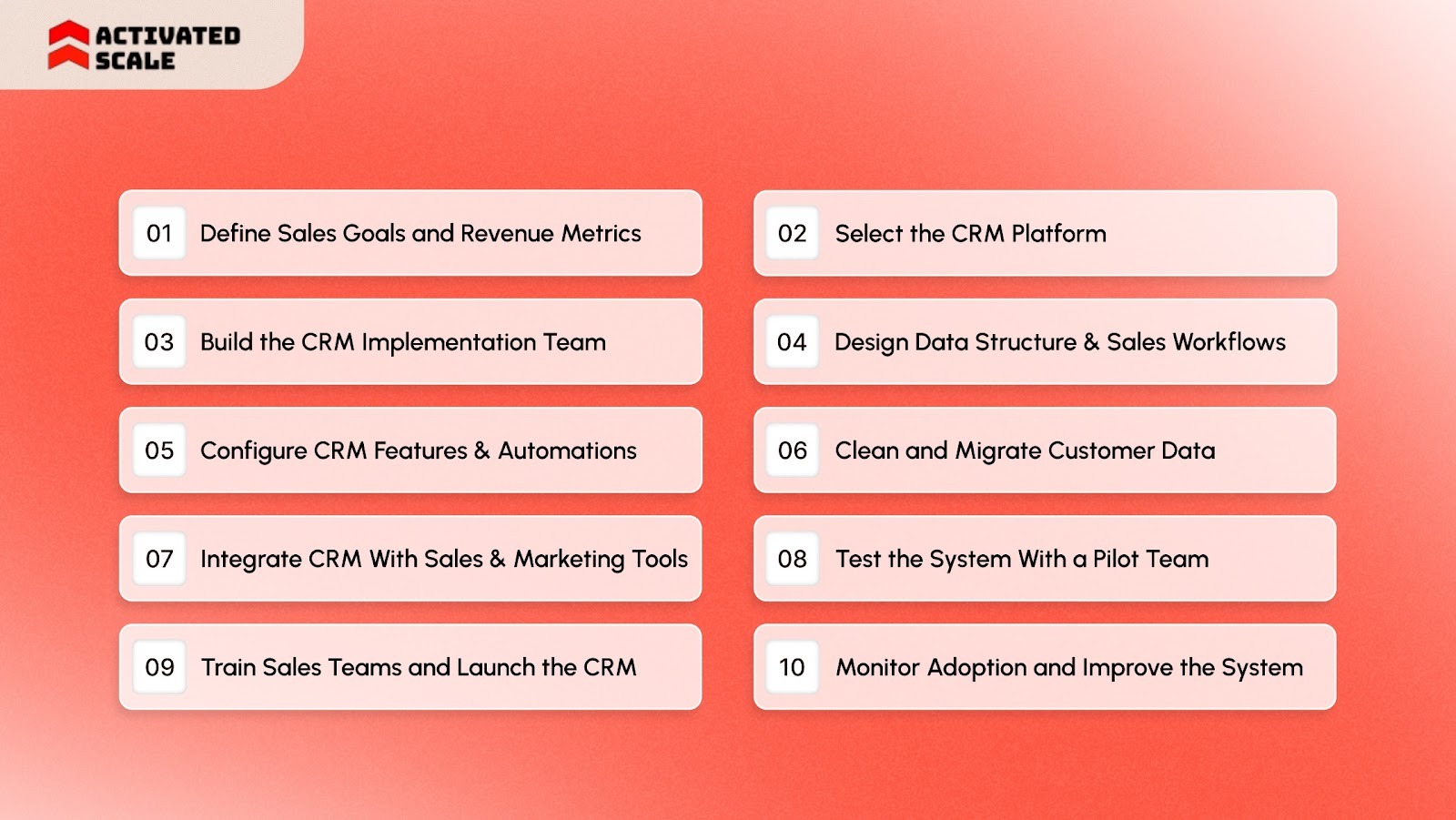
Follow these 10 essential steps to deliver a strong return on investment:
Step 1: Define Sales Goals and Revenue Metrics
A CRM rollout must begin with sales leadership priorities. You should document:
- Pipeline stages aligned with the buying journey
- Deal qualification criteria such as MEDDICC or BANT
- Expected activity levels for SDRs and account executives
- Forecast categories used during revenue reviews
Example:
A SaaS company selling enterprise contracts might track stages such as:
- Discovery
- Technical Validation
- Security Review
- Procurement
- Closed Won
This planning phase often takes two to three weeks.
Step 2: Select the CRM Platform
Software selection determines reporting flexibility and integration options. Sales leaders typically evaluate:
- Salesforce for enterprise reporting and complex workflows
- HubSpot CRM for fast deployment and marketing alignment
- Pipedrive for simple pipeline management
- Zoho CRM for cost-efficient mid-market teams
Costs vary widely. Many B2B teams spend between $50 and $150 per user each month, depending on automation and reporting features.
Step 3: Build the CRM Implementation Team
CRM projects require cross-functional input. Typical roles include:
- Executive sponsor: Usually the VP of Sales or Chief Revenue Officer (CRO)
- RevOps or Sales Operations lead: Manages configuration
- Sales managers: Validate pipeline stages and workflows
- Marketing operations: Align lead lifecycle stages
- IT or data specialists: Support integrations
- External CRM consultants: Assist with complex deployments
Sales leaders remain responsible for final workflow decisions. A clear ownership model prevents endless configuration debates during rollout.
Step 4: Design Data Structure and Sales Workflows
This step defines how deals move across the system. Enterprise deals often involve five to ten stakeholders. CRM systems must capture roles such as economic buyer, technical evaluator, and procurement contact.
Systems like Salesforce Opportunity Roles or HubSpot Contact Associations support this structure.
Step 5: Configure CRM Features and Automations
Configuration converts the design into system logic. Teams usually configure:
- Lead routing rules
- Activity reminders for follow-ups
- Deal stage automation
- Forecast dashboards
Example:
A CRM may automatically create a task when a deal enters “Proposal Sent.” The system reminds the account executive to follow up within five days.
Configuration often requires two to six weeks, depending on complexity.
Need guidance during a CRM implementation? Activated Scale connects you with top-rated sales talent via the Fractional Selling service, who can help you build scalable sales processes.
Step 6: Clean and Migrate Customer Data
Most organizations already store customer information in several locations. Common sources include:
- Spreadsheets used by SDR teams
- Support tools such as Zendesk
- Legacy CRM systems
Before migration, teams should:
- Remove duplicate accounts
- Standardize industry and company size fields
- Confirm deal ownership
Step 7: Integrate CRM With Sales and Marketing Tools
Modern B2B sales teams rely on multiple tools. Common integrations include:
- Gmail or Outlook for activity logging
- Slack for deal collaboration
- Stripe or billing systems for revenue reporting
These integrations allow sales leaders to track account activity in one system. A typical sales stack includes 8–12 tools connected to the CRM.
Step 8: Test the System With a Pilot Team
Testing prevents large-scale rollout problems. Pilot programs usually include a small group of account executives and SDRs.
It often runs two weeks before full launch. Sales leaders should collect feedback and adjust the configuration.
Step 9: Train Sales Teams and Launch the CRM
Training determines adoption. Managers should demonstrate how CRM data appears during forecast meetings. Reps quickly understand why accurate updates matter.
Many teams run two training sessions and one follow-up workshop during launch week.
Step 10: Monitor Adoption and Improve the System
CRM rollout continues after launch. Tools such as Salesforce dashboards, HubSpot reports, and RevOps analytics platforms like Clari help track these indicators.
Most organizations stabilize their CRM implementation within three to six months. Leadership teams who monitor adoption early prevent reporting problems during future forecast cycles.
Many CRM projects look successful during launch week. So how do you make sure your team is on the track?
Also Read: Effective Sales Strategies, Plans, and Examples for Success
Key Metrics to Measure CRM Implementation Success
The training is done. Now comes the real question: Was it worth it? For sales leaders, measuring implementation success goes beyond login rates and data entry.
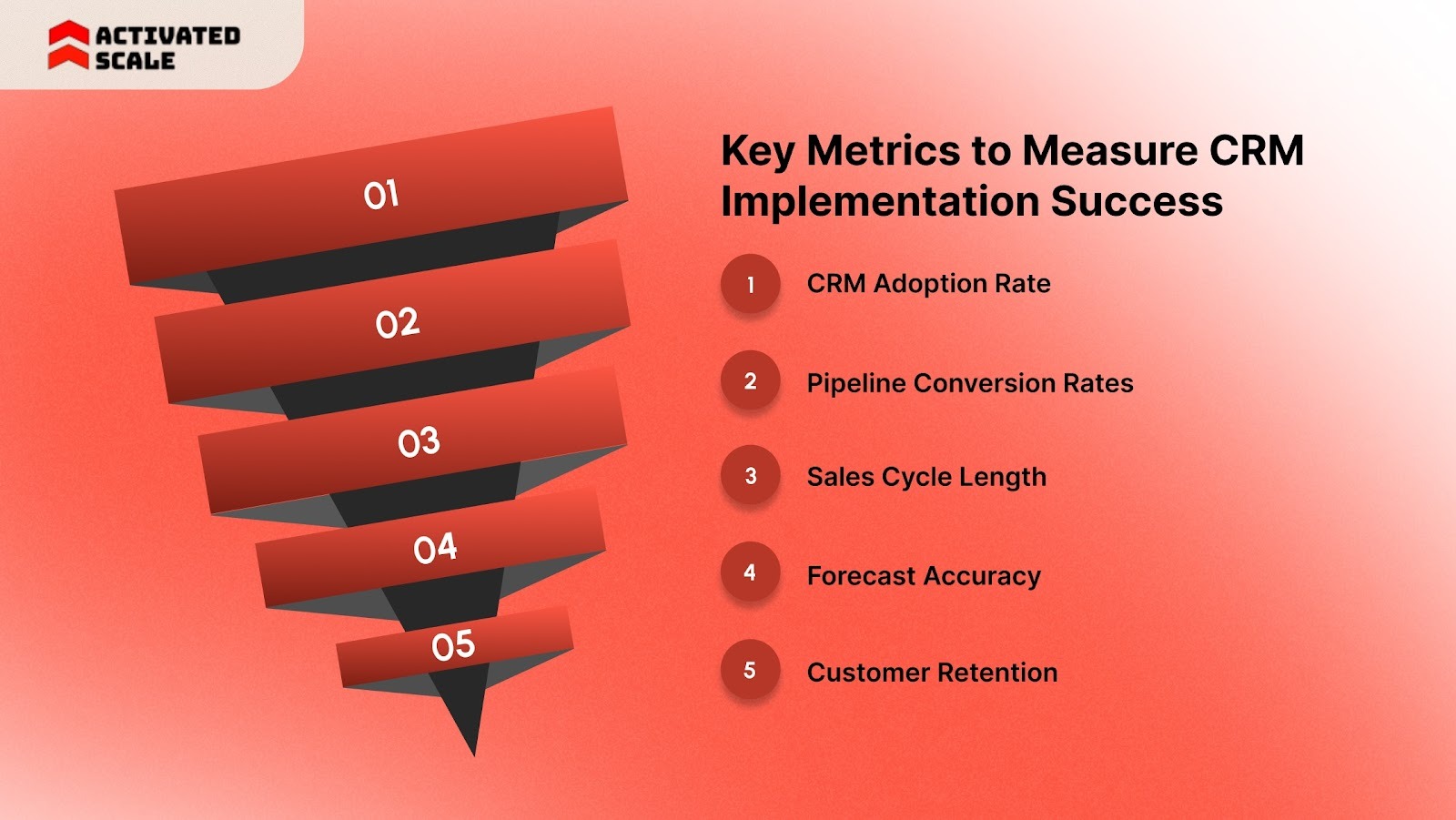
It's about connecting the tool to tangible business outcomes. Here are the key metrics that prove your CRM is actually driving revenue:
1. CRM Adoption Rate
Low adoption signals the system does not match daily workflows. Sales reps often revert to spreadsheets or external tools. Revenue leaders should monitor:
- Percentage of reps logging activities daily
- Number of deals updated each week
- Completeness of required deal fields
2. Pipeline Conversion Rates
Pipeline conversion rates measure how deals move across stages. Revenue leaders should monitor:
- Stage-to-stage conversion rates
- Win rates by pipeline stage
- Deal drop-off points
3. Sales Cycle Length
Sales cycle length shows how long deals take to close. Revenue leaders should track:
- Average days from the first meeting to the closed-won
- Stage duration across the pipeline
- Delays during procurement or technical validation
4. Forecast Accuracy
Sales forecast accuracy measures whether pipeline projections match actual revenue outcomes. Sales leaders often review forecasts weekly or monthly.
Important indicators include:
- Forecast vs actual revenue variance
- Deal movement across forecast categories
- Pipeline coverage ratios
5. Customer Retention and Expansion Revenue
CRM systems should track revenue beyond the initial sale. Sales leaders should monitor:
- Renewal rates
- Expansion revenue from existing accounts
- Upsell and cross-sell performance
Strong retention metrics indicate that customer data and account activity remain visible across.
CRM systems only work when your sales team follows the process. Activated Scale helps companies deploy experienced SDRs via Contract-to-Hire Sales Recruiting who can help execute structured sales workflows inside the CRM.
Over To You
Sales leaders rarely question the value of CRM systems. The real challenge appears after launch. Poor adoption and weak process design reduce the return on a CRM implementation.
CRM platforms also represent a significant investment. Software licenses, consulting support, and internal resources can cost thousands of dollars each year. The real return comes from better pipeline visibility, stronger forecast accuracy, and faster deal progression.
If your CRM rollout still feels disconnected from real sales activity, it may be time to rethink the approach. Set up a call with Activated Scale to understand whether you need a sales leader to start building a better plan for your organization.
Frequently Asked Questions
1. What is the biggest reason CRM implementations fail?
Most CRM failures occur when the system design does not match the real sales process. Sales reps then avoid updating deals or logging activity. Pipeline data quickly becomes unreliable for leadership reviews.
2. How long does a typical CRM implementation take?
Implementation timelines vary by company size and complexity. Small teams may launch within four to six weeks. Mid-sized organizations often require two to four months for configuration, integrations, and training.
3. Should sales leaders be involved in CRM implementation decisions?
Yes. Sales leaders define pipeline stages, forecast categories, and deal qualification rules. RevOps and IT teams support system configuration, but the sales process should guide the design.
4. How can companies improve CRM adoption after launch?
Sales leaders should link CRM activity directly to pipeline reviews and forecasting meetings. When reps understand that leadership decisions rely on CRM data, adoption improves significantly.
The Ultimate Guide to Hiring a Salesperson!
Get the step-by-step guide to hiring, onboarding, and ensuring success!