_edi.png)
Your reps complete training, but then they ignore it on live calls. This gap costs pipeline and productivity. 75% of sales reps say having a coach or mentor is the key to reaching their targets.
However, that is not a solution that can be applied to real deals. Most sales training fails to translate into sustained behavior change, and coaching does not scale as teams grow.
Forecasts slip from inconsistent execution across reps. One team follows the process, another improvises. Customer Relationship Management (CRM) data looks complete, but buyer conversations reveal gaps.
In this blog, we break down how sales enablement gamification closes this execution gap. We focus on turning training into repeatable behavior, not one-time completion.
Key Takeaways
- Most training fails because behavior does not change. Gamification reinforces actions through repetition and feedback.
- 75% of sales reps perform better with coaching support, highlighting the importance of reinforcement in sales execution.
- 40% of reps say managers struggle with coaching and development, creating gaps in skill application across teams.
- Most sales training does not lead to sustained behavior change, which explains why execution remains inconsistent.
- Engagement alone does not drive results. Systems must align with revenue-focused behaviors like discovery, follow-ups, and deal progression.
What Does Sales Enablement Gamification Mean?
Most teams mistake gamification for contests and rewards. It is true that the approach creates short spikes, but then they drop fast. Sales leaders push new playbooks, but reps fall back on old habits under pressure.
Sales enablement gamification addresses this gap by turning learning into daily actions. It links training to real sales behaviors like discovery, follow-ups, and sales pipeline updates. Instead of one-time sessions, reps engage through ongoing challenges, feedback loops, and performance signals.
This approach does not focus on rewards alone. It focuses on reinforcing the right actions at the right time. Points, leaderboards, and simulations act as triggers for consistent execution.
Examples of sales enablement gamifications:
- Pipeline progression contests: Reps earn points for moving deals from one stage to another. This shifts focus from activity volume to deal advancement.
- CRM hygiene scoring: Teams track how accurately reps update deal data, notes, and next steps. This improves forecasting and pipeline visibility.
- Team-based revenue challenges: Sales teams compete against each other on shared targets like pipeline growth or closed deals. This builds collaboration and shared accountability.
- Learning missions and quizzes: Reps complete short quizzes or daily challenges tied to product knowledge and messaging. This improves retention and recall during conversations.
- Recognition-based reward systems: Reps earn badges or rewards for consistent behaviors like follow-ups or meeting targets. Recognition reinforces habits without relying only on monetary incentives.
If training does not convert into daily execution, the issue is not content quality. The issue is reinforcement at scale. Sales enablement gamification has an impact on measurable outcomes.
Also Read: Building a Successful Pipeline Generation Strategy in 2024
5 Core Benefits of Sales Gamification Enablement
Capturing a salesperson's attention during training, especially after a long day of calls, is a challenge. In fact, 40% of reps say coaching and development are among the top areas where managers struggle.

By breaking learning into bite-sized, competitive modules (like daily "missions" or quizzes), teams see benefits such as:
1. Higher Engagement Across Sales Activities
Reps disengage when training feels disconnected from deals. Gamified systems introduce visibility, competition, and progress tracking. Higher engagement means reps actively practice skills instead of passively completing modules.
2. Better Knowledge Retention and Application
Training often fades within days. Gamified learning reinforces concepts through repetition and real-time feedback. This shift helps reps apply messaging correctly during actual deal cycles.
3. Performance Uplift in Revenue-Critical Activities
Gamification links daily actions to measurable outcomes. Teams using structured enablement systems report great improvements in performance metrics. The impact comes from consistent behavior, not only from one isolated high performer.
4. Faster Onboarding for New Sales Reps
New hires often struggle to apply training in real scenarios. Sales enablement gamification breaks onboarding into milestones, challenges, and guided practice. Reps learn faster because they apply knowledge immediately, not weeks later.
5. Increased Collaboration Across Sales Teams
Sales environments often create isolated performance. Top reps succeed, but knowledge stays siloed. Gamified systems introduce team-based challenges and shared goals. This encourages collaboration, peer learning, and knowledge exchange.
Struggling to turn training into a consistent sales performance? Bring in experienced sales talent who already execute proven playbooks from day one from the Activated Scale's Fractional Selling service to fill pipeline gaps without slowing your hiring cycle.
These benefits are not theoretical. Global enterprises have deployed sales enablement gamification and documented the results.
What Sales Enablement Gamification Looks Like in Practice
What happens when a real organization commits to gamified enablement across hundreds of reps? Two enterprise examples show what measurable outcomes look like when the approach is executed well.
1. Deutsche Telekom
Deutsche Telekom needed a consistent way to train and motivate salespeople spread across hundreds of external retail partner locations. Reps had no shared system for product knowledge, performance visibility, or recognition.
They deployed a gamified enablement setup that combined personalized learning, real-time leaderboards, and rep-level performance tracking. The result was a measurable increase in sales across mobile, fixed lines, and TV subscriptions, driven by improving how existing reps learned and executed.
The program worked because it connected training directly to daily selling behavior.
2. BT Group: Making Sales Training Something Reps Actually Return To
BT Group wanted to move away from traditional training formats and build a learning experience that reps would engage with consistently.
They introduced a gamified microlearning model where employees could work through short skill-focused activities, track their own progress, and compete with peers. The standout outcome was the behavior it created. Reps began returning to training voluntarily, repeating activities to improve their scores without being prompted.
That shift from mandatory compliance to habitual learning is what most sales training programs fail to achieve.
These examples share a common pattern. The companies that see measurable outcomes from sales enablement gamification integrate it into the daily flow of learning, coaching, and CRM activity. That integration is what separates a spike in engagement from a durable shift in rep performance.
These results only improve when teams apply the right structure. So you need clear methods that connect training with daily execution.
5 Key Approaches Used in Successful Inside Sales Training Programs
Teams add gamification, but fail to connect it to real selling moments, like discovery or follow-ups. So the focus must stay on how sales enablement gamification shapes behavior during actual deals.
Here are the core strategies that should be used to make the gamification process successful:
1. Structured Competition Around Daily Sales Activities
The key is alignment. Metrics must reflect behaviors that influence pipeline progression. Activity without context leads to inflated numbers and poor outcomes.
2. Skill-Based Practice Through Simulations
Reps struggle most during live conversations. Discovery, objection handling, and positioning break under pressure. Simulations and role-based challenges allow reps to practice in controlled scenarios. Repetition builds confidence and consistency.
3. Progression Systems That Track Learning Milestones
Sales training often lacks visibility after completion. Managers cannot track who has mastered which skills. Progression systems break training into levels and milestones.
If reps see where they stand and what to improve next, then the structure keeps learning active beyond onboarding.
4. Team-Based Challenges That Drive Collective Performance
Team-based challenges encourage collaboration and shared learning. Reps exchange tactics, review calls, and improve together. This strengthens overall team execution.
5. Behavior Reinforcement Through Continuous Feedback
Gamified systems provide instant feedback through scores, rankings, and coaching inputs. This keeps reps aligned with expected behaviors across the sales cycle.
These approaches define how gamification works today. But the systems sales leaders evaluate in 2026 look meaningfully different from the leaderboards of five years ago. AI is changing what gamification can do and what it should do.
Read Also: How to Improve Lead Generation Quality: Actionable Tips and Strategies
How AI Is Changing Sales Enablement Gamification in 2026
The leaderboard was the original gamification mechanic in sales. It worked because it made performance visible. But it had a fundamental flaw: it showed you who was winning, not why. And it rewarded the same top performers repeatedly, while the rest of the team disengaged. AI is solving that problem directly.
Modern sales enablement gamification platforms now use behavioral data to personalize challenges at the individual rep level. After identifying that a rep needs to improve their discovery questioning, an AI-powered system can create a challenge focused specifically on that skill, with points awarded for execution in real calls.
This changes gamification from a team competition mechanic into an individual development engine. Three shifts are underway that sales leaders should understand before evaluating any platform:
AI-personalized challenges replace static contests.
Traditional gamification gives every rep the same leaderboard. AI-driven systems analyze each rep's performance patterns and surface the next most important behavior to reinforce. A rep who is strong on outreach but weak on discovery gets a different challenge than one who books meetings but loses late-stage deals.
AI roleplay becomes the practice layer.
Platforms build gamified learning and leaderboards directly into their roleplay features, encouraging reps to practice more frequently and master new skills faster. Instead of completing a module and hoping the knowledge transfers to a live call, reps simulate the conversation, receive scored feedback, and earn points for improvement, all before the actual deal is on the line.
CRM-triggered challenges create just-in-time coaching.
The future of gamification involves tighter links between gamification platforms and CRMs, making progress tracking and recognition part of the natural sales process. When a rep has three deals stalled in the same pipeline stage, the system can automatically serve a challenge tied to objection handling at that stage. The training is triggered by live deal data, not a calendar.
The engagement layer has always been the easy part of gamification. AI is finally making the development layer just as responsive.
How to Build a Gamification Strategy That Fixes Training Gaps
Most of the companies attain 50% of the quota, and this is absolutely amazing. However, few companies still want to achieve more, and for that, you don't need more effort.
Building a strategy only defines the work; to make it work in real-life calls, you also need to design the whole process. Here's how to do it the right way:
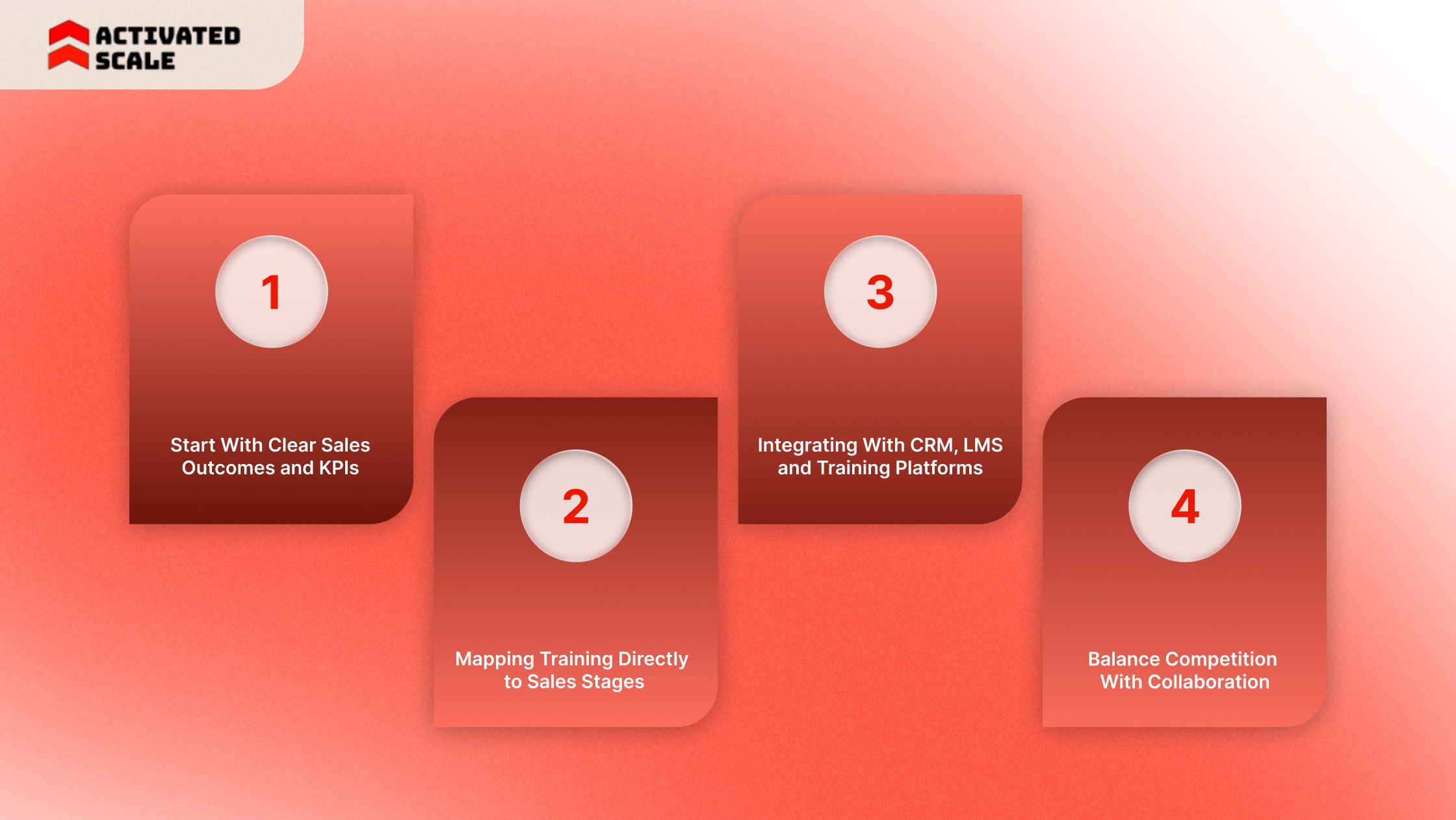
1. Start With Clear Sales Outcomes and Key Performance Indicators (KPIs)
Every gamification layer must tie to a business goal. This means scoring systems should reflect outcomes that influence revenue, not just the volume of tasks. Common targets include :
- Pipeline conversion: The percentage of deals that move successfully from one stage of the pipeline to the next.
- Deal velocity: The speed at which deals progress from first contact to closed-won.
- Win rate: The percentage of opportunities that convert into closed deals.
2. Mapping Training Directly to Sales Stages
Generic modules create gaps during live deals. Gamification must reinforce behaviors like strong discovery, timely follow-ups, and accurate pipeline updates. These actions move deals forward.
3. Integrating With CRM, LMS (Learning Management System), and Training Platforms
Reps avoid tools that sit outside their workflow. Gamification should connect with CRM, call tools, and enablement platforms. This keeps engagement tied to real sales activity.
Sales leaders should evaluate sales gamification software based on the features below:
- Reps live in the field, not at a desk. The platform should fit in their pocket, logging activity, checking standings, and getting alerts without opening a laptop.
- Leaderboards that make sense. A rep in enterprise sales shouldn't compete against someone in Small and Medium-sized Business. The software should let you slice leaderboards by role, region, or team so comparisons stay fair and motivating.
- Rewards that feel immediate. If recognition comes days later, the moment is gone. Points and rankings should update the moment a rep hits a milestone, not after someone runs a report.
- Built to grow. Your team today won't be your team next year. The system should scale across regions and headcount without grinding to a halt.
- Helps you coach smarter. Beyond rankings, strong platforms surface patterns, who's stalling, who's ready for a harder challenge, so you're not guessing what to do next.
A few popular CRMs are:
- Salesforce Sales Cloud integrates training, coaching, and performance tracking inside the sales workflow
- HubSpot Sales Hub embeds playbooks, guidance, and activity tracking within pipeline management
Examples of Gamification Platforms Used by Sales Teams:
Dedicated gamification tools focus on behavior tracking and visibility:
- Hoopla: Focuses on real-time leaderboards, contests, and sales TV dashboards
- Ambition: Combines gamification with performance tracking and coaching
- Spinify: Focuses on motivation through rewards, leaderboards, and recognition
- LevelEleven: Tracks daily activities like calls and meetings inside CRM
A few popular LMSs are:
- Mindtickle combines training, AI role-play, and gamified learning paths
- Kahoot! is used for real-time quizzes and knowledge reinforcement
- Master-O helps microlearning with gamified assessments and skill tracking
These tools support structured learning, practice, and retention within sales enablement gamification.
4. Balance Competition With Collaboration
Top performers dominate leaderboards, while others disengage. Introducing team-based challenges creates shared accountability. Reps learn from each other and improve faster. Balanced systems drive both individual performance and team consistency.
If you're scaling your business, then hiring from the Activated Scale's Fractional Sales Leadership service to strengthen pipeline execution without long hiring cycles.
Two things kill sales initiatives: No strategy, or a strategy without execution. Strategy tells you what to do. Implementation tells you how to run it within your real sales process.
But what breaks in real scenarios?
Also Read: How to Hire Effective Sales Leaders for Startups
Challenges You May Face With Sales Gamification
Sales enablement gamification looks effective in theory. Execution often reveals gaps that impact adoption and results. Sales leaders need to anticipate these challenges early to avoid wasted effort and poor outcomes.

1. Superficial Engagement Without Real Impact
Reps may focus on points, rewards, or rankings instead of improving actual selling skills. Activity increases, but deal quality stays unchanged. This happens when systems reward volume instead of meaningful behaviors tied to pipeline progression.
2. Misalignment With Revenue Goals
Gamification programs often track easy metrics like calls or emails. These do not always reflect deal movement or conversion quality. If scoring does not align with revenue-driving actions, the system creates noise instead of impact.
3. Low Adoption Across Teams
Reps ignore tools that feel separate from their workflow. If gamification systems are not integrated into CRM or daily processes, participation drops quickly. Adoption depends on relevance to real work.
4. Over-Competition and Team Friction
Leaderboards can create pressure and unhealthy rivalry. Top performers dominate, while others disengage. Without balance, competition reduces collaboration and knowledge sharing.
5. Manager Bandwidth and Coaching Gaps
Gamification requires ongoing reinforcement. Managers often lack time to review performance and provide feedback. Without coaching support, reps repeat mistakes despite high activity levels.
6. Complex Systems That Reduce Engagement
Too many rules, metrics, or rewards make systems difficult to follow. Reps disengage when gamification feels complicated or disconnected from their goals.
Recognizing these challenges early helps prevent gamification from becoming another activity layer that looks productive but does not move pipeline outcomes. The next step is measuring whether your program is influencing real sales execution. That requires tracking indicators tied directly to ramp speed, CRM discipline, and opportunity progression rather than participation alone.
How to Measure the Return on Investment (ROI) of Sales Enablement Gamification?
Sales leaders are held accountable for revenue outcomes. If your gamification program cannot be tied to deal progression and quota attainment, it will not survive the next budget conversation. The metrics below give you a framework for measuring both leading indicators (early signals that behavior is changing) and lagging indicators (proof that revenue is moving).
1. Training Completion Rate
This is your first signal. If reps are not completing the training, nothing downstream improves. A completion rate below 60% means the experience is not engaging enough, and the content, format, or incentive structure needs to change. A rate above 80% is competitive. Track this weekly, not monthly.
2. Ramp Time Reduction
Measure new hire pipeline activity at week 4 and again at week 12. Compare cohorts: reps who went through gamified onboarding versus those who did not.
If the gamification program is working, the week-4 cohort should show materially higher CRM activity, more discovery calls booked, and faster first deal progression. A 15–20% reduction in time-to-first-deal is a reasonable benchmark for a well-designed gamified onboarding program.
3. CRM Data Quality Score
This metric is frequently overlooked and uniquely useful because it is objective. Pull a data completeness report from your CRM before and after implementing gamification, specifically for fields that matter to forecasting: Next steps, close dates, contact roles, and deal stage accuracy.
If gamification is reinforcing the right behaviors, CRM hygiene scores should improve within 30 days. Improvement here directly affects forecast accuracy, which is a metric every revenue leader tracks.
4. Deal Stage Progression Rate
Track the percentage of open opportunities that advance from one stage to the next each week. This is the most direct measure of whether reps are executing the sales process, and it is the metric gamification should be designed to move.
If your pipeline progression contests are working, you should see this rate improve within the first quarter. If it does not move after 60 days, the contest mechanics are rewarding the wrong activities.
If you want to see the above results, you need strong leadership in your team. Explore the Fractional Sales Leadership service from Activated Scale to bring proven sales talent who can manage your team as an experienced professional.
Conclusion
Sales enablement gamification connects training with real selling moments and creates continuous feedback loops that improve execution over time. Teams move from isolated performance to repeatable, system-driven outcomes.
The return is reflected in faster ramp times, stronger deal progression, and higher conversion rates. slowly but steadily.
Experienced sales professionals like the VP of Sales, Sales Development Representatives( SDRs), and Account Executives (AEs) are the ones you need in 2026. However, hiring takes time, and hired candidates often fail to execute their expertise.
That's where Activated Scale works right. We offer services where you can hire reps directly without long hiring cycles. Schedule a call with the experts of Activated Scale to strengthen execution without long hiring cycles.
FAQs
1. How long does it take to see results from sales enablement gamification?
Most teams see early engagement signals within a few weeks. However, revenue impact takes longer. Changes in win rates and deal velocity typically appear over one to two quarters. Consistency improves before outcomes.
2. Can gamification work for complex B2B sales cycles?
Yes, but the design must match the deal complexity. Enterprise sales require scenario-based training, coaching feedback, and stage-specific reinforcement. Simple leaderboards alone do not work in long sales cycles.
3. What behaviors should be gamified first in a sales team?
Focus on behaviors that directly impact pipeline progression. Discovery quality, follow-up timing, and CRM accuracy are strong starting points. Avoid tracking vanity metrics like call volume alone.
4. How do you prevent reps from gaming the system?
Tie scoring to meaningful outcomes, not just activity. Combine activity metrics with quality indicators like conversion rates or deal progression. Regular reviews help adjust scoring systems.
The Ultimate Guide to Hiring a Salesperson!
Get the step-by-step guide to hiring, onboarding, and ensuring success!


