_edi.png)
Revenue predictability separates high-performing sales organizations from the rest. Many enterprise teams struggle not because of weak products but due to unclear, scalable sales processes.
So, what's the solution? A defined pipeline brings order to that chaos; it gives structure, visibility, and direction. Data shows that 69% of B2B salespeople cite an empty pipeline as the primary barrier to hitting their quota.
But how to build a strong sales pipeline? In this blog, we’ll explore everything about a strong sales pipeline that helps leaders track every opportunity with precision.
You’ll learn practical methods used by successful B2B teams to identify revenue leaks.
Highlights
- Understand the Difference: A sales pipeline tracks the seller’s process; a funnel reflects the buyer’s journey.
- Build with Purpose: Customize stages around your actual sales process, not a generic template.
- Quantify Every Step: Use metrics like conversion rates, velocity, and weighted deal value to assess health.
- Plan Backward: Start with revenue goals, then map required opportunities per stage.
- Keep It Clean: Regularly remove stale deals to prevent forecasting errors.
- Automate Smartly: Use Customer Relationship Management (CRM) to manage follow-ups, reminders, and alerts.
- Coach with Data: Train managers to use pipeline analytics for performance reviews.
- Stay Consistent: Weekly reviews and a defined cadence keep teams focused.
Are Sales Pipeline and Sales Funnel the Same?
Most sales leaders understand that a visible, structured process matters. A sales pipeline is a series of clearly defined steps your team follows to convert leads into paying customers.
It tracks where every opportunity is, what needs to happen next, and how much action is required to move it forward.
In contrast, a sales funnel reflects the buyer’s path, from awareness to interest to purchase. The funnel is broad because many enter it, and narrow because only a few reach the finish line.
Here’s a simple breakdown:
- Pipeline → Sender-side: Deals in process, rep actions, deal value, forecasting.
- Funnel → Buyer-side: Volume of leads, conversion rates, where prospects drop off.
These two models complement each other. The funnel helps predict how many leads you need.
On the other hand, the pipeline lets you measure whether your team is executing and closing. Confusing them can lead to weak forecasting and missed opportunities.
So, how do you convert this pipeline concept into a revenue-generating machine? The key lies in a defined structure where each stage creates undeniable momentum.
Also Read: Building a Successful Pipeline Generation Strategy in 2024
The 6 Non-Negotiable Stages of Their Pipeline

Every deal tells a story, from the first spark of interest to the final handshake. The SPANCO framework maps how prospects move from being potential buyers to becoming loyal customers.
This framework gives sales leaders a shared language for pipeline visibility, accountability, and forecasting precision.
Stage 1: Suspect
Every sales process begins with potential customers who might fit your solution. At this stage, reps collect and review a large list of suspects.
They are the leads who show early curiosity but lack confirmed intent.
To save time, use lead scoring in your Customer Relationship Management (CRM) to rank by relevance and engagement. Look at factors like company size, industry, and recent buying activity.
Stage 2: Prospect
Once you identify high-intent leads, choose how to reach them. 42% of buyers in the United States have a clear preference for in-person meetings at events over virtual alternatives.
Pick channels that match your audience’s habits, and craft outreach messages that show relevance, not repetition.
Use this to your advantage. Contact prospects through their preferred channels, LinkedIn, events, or calls, and customize outreach to their challenges.
Stage 3: Analyze
Before a proposal or demo, take time to understand the problem. The discovery call should focus on listening more than pitching. Ask open questions about goals, challenges, and timelines.
Use your CRM to capture notes and hand off context to the next rep if needed. This step helps build trust, setting the tone for collaboration rather than pressure.
Stage 4: Negotiate
Here’s where many deals stall. Prospects often hesitate due to cost, timing, or internal approvals. The best reps address objections early and guide buyers toward return on Investment (ROI) clarity.
Support your pitch with proof, case studies, data, or limited-time offers.
Stage 5: Close
This stage converts conversations into signed deals. Confirm all terms, pricing, and delivery expectations.
Use proven closing frameworks like the Assumptive Close to create momentum without pressure. Once the buyer commits, make sure all paperwork moves quickly to prevent second thoughts.
Stage 6: Order
Winning a deal is just the beginning. A smooth onboarding and post-sale experience builds loyalty and repeat business.
Work closely with customer success to confirm delivery, follow up for feedback, and document insights for future interactions. A clean handoff shows reliability and strengthens long-term retention.
Implementing the SPANCO framework takes skilled sales talent. Activated Scale helps you bring that to life through the Contract-to-Hire Sales Recruiting service, giving you access to vetted SDRs and AEs. These professionals can build and manage your pipeline before you commit to permanent hires.
Many pipelines fail not because the framework is wrong but because execution lacks accountability. That’s where process design and measurement come in.
Building your pipeline methodically helps you predict more accurately and scale growth without chaos.
How to Build a Strong Sales Pipeline in 2026?
Top managers excel at guiding reps on how to manage their pipelines. When you apply a discipline, you stop reacting to numbers at the end of the quarter.
Below are eight practical steps showing how to build a strong sales pipeline that connects strategy, data, and execution:
1. Define Clear Stages
A pipeline should mirror how buyers actually make decisions, not a copy-paste template from another company. Map your process across the buyer’s lifecycle and translate it into your sales stages:
- Connect: First interaction through content, call, or webinar.
- Appointment Set: Schedule an initial conversation to learn intent.
- Appointment Completed: Build rapport, confirm needs, and align goals.
- Solution Proposed: Deliver a customized demo or pitch.
- Proposal Sent: Buyer reviews pricing, scope, and next steps.
Complex products might require extra steps, while transactional ones can stay lean. Your goal is clarity, not quantity.
2. Measure Stage Progression and Conversion Ratios
Tracking movement through each stage reveals what’s working and where deals stall. Monitor metrics like:
- Average time spent per stage.
- Conversion probability (e.g., 70% after demo, 90% after negotiation).
CRM analytics guide coaching. A rep might excel at discovery but lose momentum after proposals. That insight turns data into progress.
3. Backward-Plan from Revenue Goals
Work backward from the target. Divide revenue goals by the average deal size to find how many closed deals you need. After that, calculate the required volume per stage.
For instance, it can be like this:
- 2,000 annual deals → 8,000 proposals → 32,000 meetings → 64,000 calls.
Assign each rep stage-based quotas to keep performance consistent across the team.
Need help translating revenue targets into a working pipeline strategy? Activated Scale's Fractional Sales Leadership service connects you with experienced VPs of Sales who can design quota plans.
4. Identify Patterns in Deals That Convert
Every win leaves a trail of data. Look for commonalities, response time, engagement levels, or industries with higher close rates.
Prospects who receive a response within the first minute are almost 391% more likely to convert than those who are contacted after an hour.
Spot trends not just in buyers, but in rep behavior. Use these insights to guide training and refine qualification criteria.
5. Build or Refine the Sales Process Around Data
Let data shape your workflow. Embed critical content, like ROI guides or case studies, into CRM reminders.
Every stage should have clear ownership and exit rules. When your process is predictable, so is your revenue.
Ready to strengthen your process with the right people behind it? Through Activated Scale's Fractional Selling service, you can onboard vetted SDRs and convert top talent to full-time when it’s proven.
6. Keep Prospecting Consistent and Diversified
A full pipeline keeps revenue stable. Blend inbound and outbound channels via social selling, referrals, paid ads, and cold outreach.
Use lead generation tools to track new and aging opportunities. Aim for a healthy ratio: More prospects at the top than deals at the bottom.
7. Standardize Follow-Up Cadence
Roughly 84% of potential buyers feel pressured if sales reps become pushy. So, too many follow-ups can decrease the response rate compared to those with fewer interactions.
Provide your team with templates and assets that reinforce consistency. Define when to pause, disqualify, or revisit later to keep your pipeline clean and active.
8. Maintain Pipeline Hygiene
A clean pipeline creates honest forecasting. Remove inactive deals and requalify the ones still alive.
Keep CRM notes and inbox threads updated so every deal reflects real progress. Use automation tools or alerts to highlight stagnant opportunities before they distort your numbers.
A disciplined cleanup routine keeps your team’s focus sharp and projections trustworthy.
Once your pipeline is built, the real challenge begins: Keeping it healthy and predictable. Sales leaders who consistently track the right data can spot friction early, coach with precision, and forecast with accuracy.
Read Also: How a BDR Playbook Fuels Startup Growth
8 Key Metrics to Track for Your Sales Pipeline Health
Is your sales pipeline a precise navigation tool or just a hopeful map? The difference often lies in the metrics. This gap highlights the transition from guessing to knowing.
In this section, we'll identify the key metrics that offer an unambiguous look at where your deals stand and the true vitality of your revenue engine:
- Deal Count per Stage: A balanced pipeline starts with visibility into how many deals sit in each stage. This metric helps identify overconcentration, too many deals at the top, or a bottleneck in the middle.
- Stage Conversion Rates and Duration: Conversion rates between stages show how efficiently deals move through the process. For example, if 60% move from demo to proposal but only 20% move from proposal to close, you’ve found a friction point.
- Weighted Pipeline Value (Probability × Deal Value): Not every deal has equal weight. Assign a probability score to each stage, like 25% for qualified leads, 70% for negotiation, and 90% for verbal commitment.
- Pipeline Velocity Formula: Velocity shows how fast revenue moves through the pipeline. Use this formula:
Pipeline Velocity = (Number of Deals × Average Deal Size × Win Rate) ÷ Average Sales Cycle Length
- Coverage Ratio (Opportunities ÷ Quota): Your coverage ratio compares the total pipeline value to the team’s quota.
- Drop-Off Percentage by Stage: This metric pinpoints where prospects lose interest. For instance, if 40% drops after demos, your presentation might need refinement, or your discovery process may lack depth.
- Average Deal Size and Close Rate: These two metrics work together. Average deal size shows revenue potential, while close rate reveals efficiency. A rising average deal size with a stable close rate means the team is improving at value-based selling.
- Win/Loss Trends: Understanding why deals are won or lost is critical. Review win/loss notes and compare them by stage to identify challenges. If most losses happen in negotiation, revisit pricing or proposal timing.
Partner with Activated Scale’s Fractional Sales Leadership experts. Hired sales leaders can build review cadences and implement CRM automation that drives measurable growth.
Metrics reveal what’s happening inside your sales pipeline, but measurement alone doesn’t drive improvement. True growth comes from how your team acts on that data.
How to Manage and Strengthen Your Sales Pipeline?
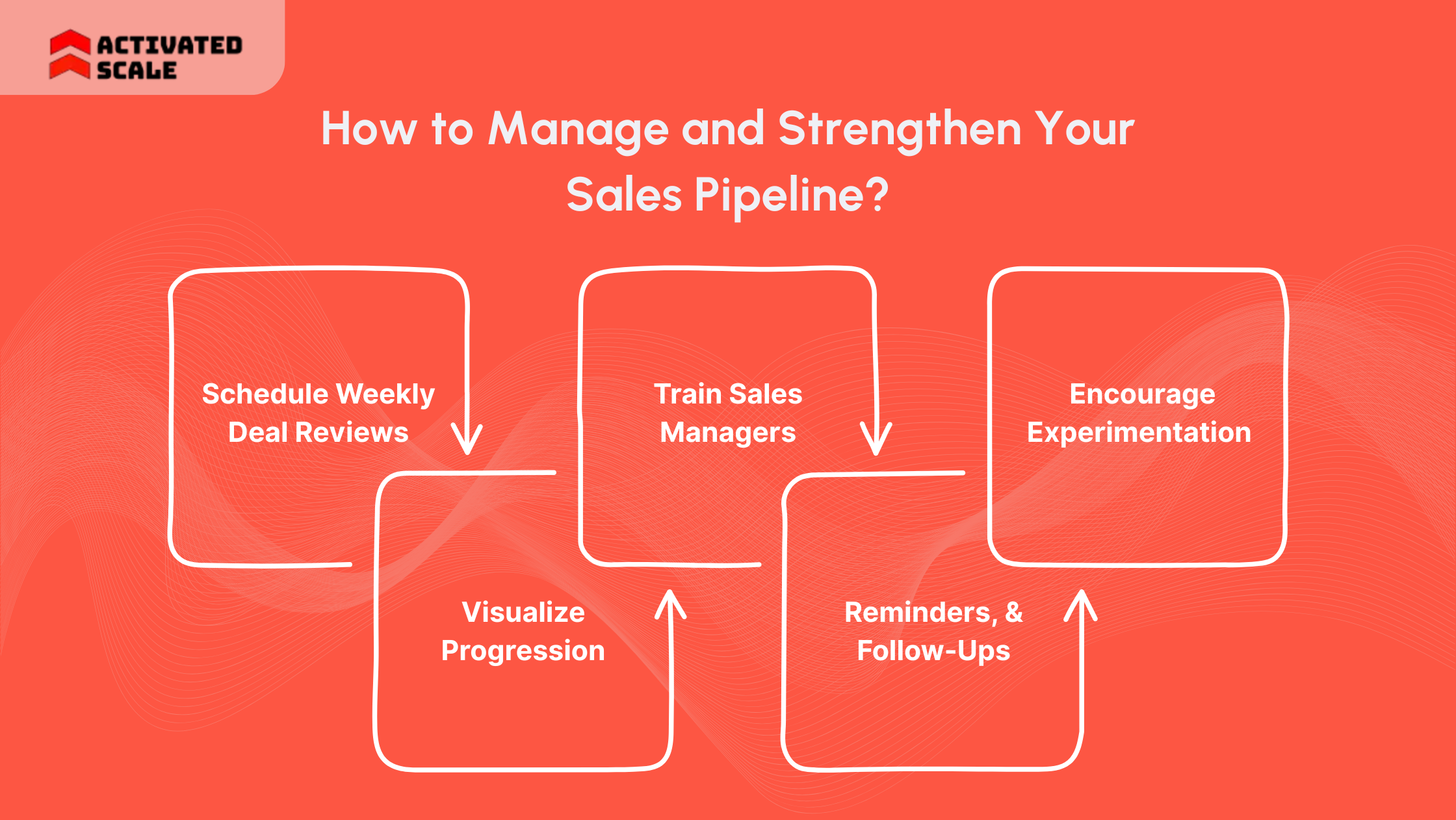
Tracking metrics shows where friction exists; managing the pipeline removes it. Companies that focus on maintaining a high-quality sales pipeline are 2x as likely to surpass their customer acquisition targets.
Below are the key practices and tools that help leaders keep their pipelines active, clean, and revenue-focused.
1. Schedule Weekly Deal Reviews
Short, focused weekly reviews help teams stay aligned. Discuss deals stuck in key stages, identify what’s slowing progress, and decide on concrete next actions. Encourage reps to bring data, not anecdotes, so coaching sessions stay objective.
2. Visualize Progression
Dashboards give sales leaders instant visibility into deal flow and rep activity.
- HubSpot Sales Hub: An AI-powered sales platform with advanced prospect research, outreach, and CRM data management tools. Ideal for teams looking to consolidate lead data from across departments and boost productivity via AI-guided selling and conversation intelligence.
- LeadSquared CRM: Excellent for capturing, routing, and automating leads. It integrates analytics to monitor conversion and velocity metrics across large teams.
- Pipedrive: Visual-first interface for tracking stages and conversations. Perfect for teams needing clear visibility into deal flow and communication history.
- Pipeline CRM: Supports multiple workflows and post-sales tracking, ideal for organizations with complex or service-based offerings.
Each tool focuses on clarity, automation, and collaboration, which are essential for keeping your sales engine predictable and scalable.
3. Train Sales Managers on Data-Driven Coaching
Many managers rely on instinct, but data-backed coaching delivers faster improvement. Use conversion rates, call notes, and deal stage data to personalize coaching plans. A manager’s goal is to help reps focus effort where it counts, not just push for volume.
4. Automate Alerts, Reminders, and Follow-Ups
Manual tracking slows progress. Automation tools can:
- Notify reps when deals stagnate.
- Trigger reminders for upcoming calls.
- Schedule follow-up sequences after demos or proposals.
This keeps deals active without adding administrative load, giving reps more time to sell. Use this quick audit to assess your pipeline’s current state:
- Are stages clearly defined and measurable?
- Are conversion ratios tracked and updated weekly?
- Is your follow-up cadence consistent across reps?
- Are stale deals reviewed or removed regularly?
- Is CRM hygiene actively maintained?
- Is your team aligned on process and messaging?
A consistent management system paired with automation ensures your sales pipeline remains accurate and revenue-ready.
5. Encourage Experimentation and Learning Loops
The best pipelines grow. Test new cadences, adjust messaging, and document what works. Teams that revisit data monthly stay adaptable, even when markets shift.
How Activated Scale Helps Build High-Performance Sales Teams
Building a strong sales pipeline depends on having the right people, the right structure, and the right leadership. That’s where Activated Scale steps in. Here are the services we offer:
Gain access to thoroughly vetted sales professionals without committing to a full-time hire right away. Our contract-to-hire model lets you assess real performance in live selling conditions before extending a permanent offer.
Bridge sales gaps instantly with experienced Sales Development Representatives (SDRs) and Account Executives (AEs). This model gives you access to skilled sellers who can fill your pipeline, run discovery calls, and manage deal flow.
Hire Fractional VPs of Sales to design and execute strategies that accelerate growth. Our leaders build go-to-market playbooks, choose the right tools, and implement partnership programs that align sales with marketing and product. They can deliver measurable outcomes.
Ready to strengthen your sales function from top to bottom? Schedule a demo with Activated Scale to connect with experts who know how to turn your pipeline into a predictable growth engine.
Also Read: Best Sales Tools for Growing Startups in 2024
Final Thoughts
A strong sales pipeline is the result of clear structure, consistent tracking, and disciplined management. Every stage, metric, and follow-up plays a role in turning potential into predictable revenue.
When sales leaders embed data-backed routines, they set the foundation for scalable growth. Still wondering about how to build a strong sales pipeline?
Want a sales pipeline that runs with precision and delivers results quarter after quarter? Partner with the Activated Scale team. Our sales professionals help enterprise sales organizations build repeatable frameworks.
Book a consultation and see how structured sales leadership can accelerate your revenue goals.
FAQs
1. How often should a sales team review its pipeline?
Weekly reviews are ideal. They help sales leaders catch challenges early, adjust strategy, and keep forecasts realistic.
2. What’s the difference between pipeline velocity and win rate?
Win rate measures how many deals close successfully. Pipeline velocity tracks how fast revenue moves through the pipeline, showing both speed and efficiency.
3. How can AI tools improve sales pipeline management?
AI enhances accuracy by scoring leads, predicting deal closure probability, and identifying engagement patterns that boost conversions.
4. What’s the best way to keep a large sales team aligned across multiple pipelines?
Standardize CRM usage, define uniform sales stages, and set shared performance dashboards. Automation ensures consistency even across distributed teams.
The Ultimate Guide to Hiring a Salesperson!
Get the step-by-step guide to hiring, onboarding, and ensuring success!