_edi.png)

Enterprise Sales Engineers don’t earn high compensation by accident. Their pay reflects the growing complexity of enterprise buying, where technical validation often determines whether a deal moves forward or stalls.
According to Glassdoor data, the average total compensation for an Enterprise Sales Engineer in the U.S. is around $236,524 per year, with typical pay ranging broadly depending on company and experience level, and top earners exceeding $300,000+ in total compensation.
As enterprise software becomes more complex and buyers become more technical, sales engineers are no longer support roles. They are central to closing high-value deals. This article breaks down what an enterprise sales engineer's salary looks like in 2026, and what actually drives it upward.
Core takeaways:
- Enterprise Sales Engineer pay reflects deal complexity and revenue impact, not just technical knowledge.
- Average compensation crosses $180K because SEs directly influence large, high-risk buying decisions.
- Salary growth comes from working closer to enterprise deals, not from time spent in the role.
- Flexible, execution-first roles expose SEs to higher-value sales environments faster.
- In 2026, earning more as an SE means proving impact, not just accumulating experience.
What Is a Sales Engineer?
A sales engineer is a technical sales professional who helps customers understand, evaluate, and adopt complex products or services. Unlike traditional sales roles, this position sits at the intersection of engineering knowledge and commercial execution.
Sales engineers work closely with buyers to demonstrate how a product functions, answer technical questions, and address implementation concerns. They often support product demos, solution design, and pre-sales problem solving, especially for software, industrial, or highly technical offerings.
Success in this role depends on the ability to translate technical detail into clear business value. Strong communication, customer-facing skills, and practical technical understanding are essential to building trust and closing complex deals.
How Much Do Enterprise Sales Engineers Make?
Enterprise sales engineers are among the highest-paid roles in B2B sales, reflecting the mix of technical depth and customer-facing responsibility the role demands.
According to the U.S. Bureau of Labor Statistics, the median annual salary for sales engineers is $116,950. That figure provides a reliable baseline, but real-world compensation varies depending on company size, industry, and skill set.
A comparison across major job platforms shows how wide the range can be:
- BLS: $116,950
- Glassdoor: ~$115,305
- Indeed: ~$89,921
- Zippia: ~$93,727
The gap between platforms reflects differences in role scope. Enterprise-focused sales engineers, especially in SaaS and AI-driven companies, typically sit at the higher end of this range.
What Actually Pushes Pay Higher
Companies aren't paying more for titles alone. Compensation increases are closely tied to a few practical capabilities:
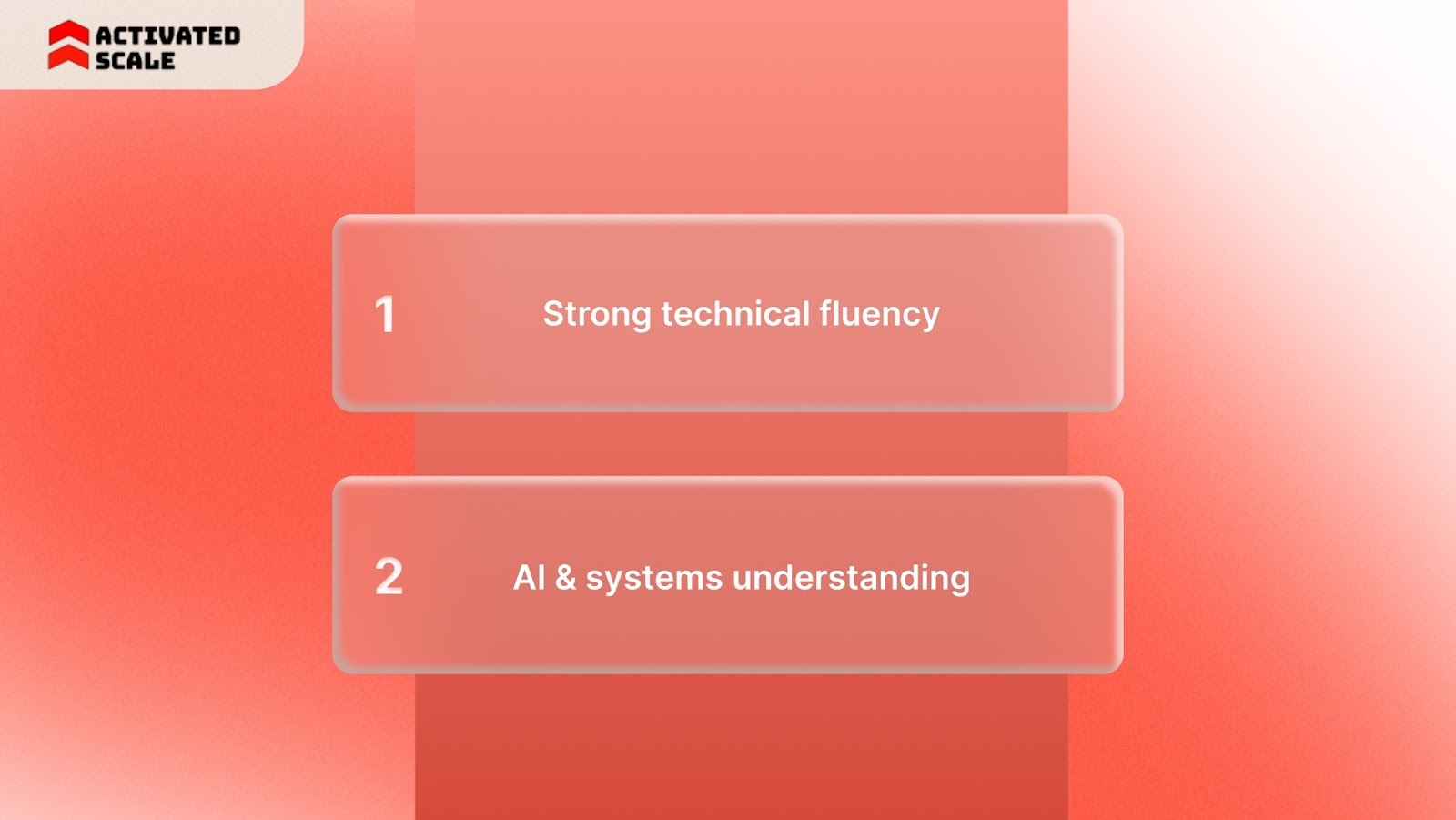
- Strong technical fluency: You don't need to be a developer, but you do need to explain how the product works confidently. Familiarity with platforms like Salesforce, HubSpot, or Gong often meaningfully lifts base offers.
- AI and systems understanding: Employers increasingly value sales engineers who can clearly explain how AI features function, where data comes from, and what outcomes customers can realistically expect. This skill alone can significantly separate higher offers from average ones.
In short, enterprise sales engineer pay isn't just about years of experience; it's about how effectively you translate complex technology into business value.
Also read: 10 Steps to a Stronger International Recruitment Process
Factors That Impact Enterprise Sales Engineer Salary
Enterprise sales engineer salaries vary widely because the role sits at the intersection of technical expertise and revenue impact. What you earn is shaped less by job title and more by how much value you bring to complex sales cycles. Here are the factors that matter most.
Education
Most enterprise sales engineers hold a bachelor’s degree in an engineering discipline, which helps them speak credibly with technical buyers and internal product teams. In enterprise sales, formal education matters less for theory and more for problem framing and solution design during high-stakes conversations.
Average salary by education level:
- Bachelor’s degree: $101,864
- Master’s degree: $105,849
Advanced degrees tend to matter more in highly regulated or deeply technical industries than in general SaaS.
Certifications and Professional Credentials
Certifications don’t automatically increase salary, but they often accelerate trust with enterprise buyers and sales leadership. They’re most valuable when paired with real deal exposure, not in isolation.
Common credentials include:
- Certified Professional Sales Consultant (CPSC)
- Engineer in Training (EIT)
- Professional Certified Marketer (PCM)
In enterprise roles, certifications often help during promotion cycles or role transitions, not initial hiring alone.
Experience
Experience strongly correlates with salary because it signals exposure to larger accounts, longer sales cycles, and more complex stakeholders. Senior enterprise sales engineers are often expected to run demos independently and influence deal strategy.
Average salary by experience:
Years of Experience
Pay growth tends to accelerate once engineers support enterprise or multi-year contracts.
Skills
Certain skills directly impact earning potential because they affect deal velocity and win rates, not just technical accuracy.
Average salaries by skill:
- CRM expertise: $78,885
- Engineering design: $79,586
- Sales engineering: $81,714
- Technical sales: $81,078
- Presentation skills: $85,935
Strong presentation and storytelling skills often differentiate high-earning enterprise sales engineers from technically similar peers.
Commission and Variable Pay
Enterprise sales engineers typically earn significant variable compensation, reflecting their role in closing high-value deals. This is especially true when they support late-stage negotiations or proof-of-concept phases.
Glassdoor reports average additional pay of $84,569, including commissions and bonuses. In enterprise environments, variable pay can sometimes exceed base salary.
Location
Location still matters, even with remote work, because compensation benchmarks often follow regional deal sizes and buyer density.
Top-paying metro areas:
- Boulder, CO: $211,620
- San Jose-Sunnyvale-Santa Clara, CA: $170,080
- San Francisco-Oakland-Hayward, CA: $161,760
- New York-Newark-Jersey City, NY-NJ: $155,050
- Washington-Arlington-Alexandria, DC-VA-MD-WV: $153,630
Markets with dense enterprise customers tend to support higher pay bands.
Industry
Industries selling complex, mission-critical systems pay more because sales engineers play a strategic role in buyer confidence and risk reduction.
Average salaries by industry:
- Computer systems design: $147,990
- Software publishers: $127,400
- Wholesale brokerage: $106,080
- Merchant wholesale: $104,840
- Manufacturing: $102,690
Enterprise software and infrastructure roles consistently sit at the top of the range.
Company
Company pay varies based on deal size, sales motion maturity, and compensation philosophy. Large tech firms often offer higher base pay, while smaller companies may lean more heavily on variable incentives.
Highest-paying employers (Zippia):
- Meta: $149,271
- Google: $145,644
- Apple: $141,380
- Mixpanel: $140,093
- NVIDIA: $138,850
At this level, total compensation is often more influenced by role scope and account ownership than by brand alone.
An enterprise sales engineer's salary is driven by experience, deal complexity, industry, and revenue impact. The closer your role is to closing large, technical deals, the higher your earning potential tends to be.
Enterprise sales engineer pay often grows with exposure to complex deals and diverse sales environments. Experience across products, buyers, and sales motions compounds over time. Activated Scale supports this by connecting experienced sales engineers with flexible roles that keep them close to real enterprise selling.
Learn more about: Top 10 US Companies' Outsourcing Providers in 2026
High-Paying Sales Roles Where $250K+ Is a Realistic Outcome in 2026
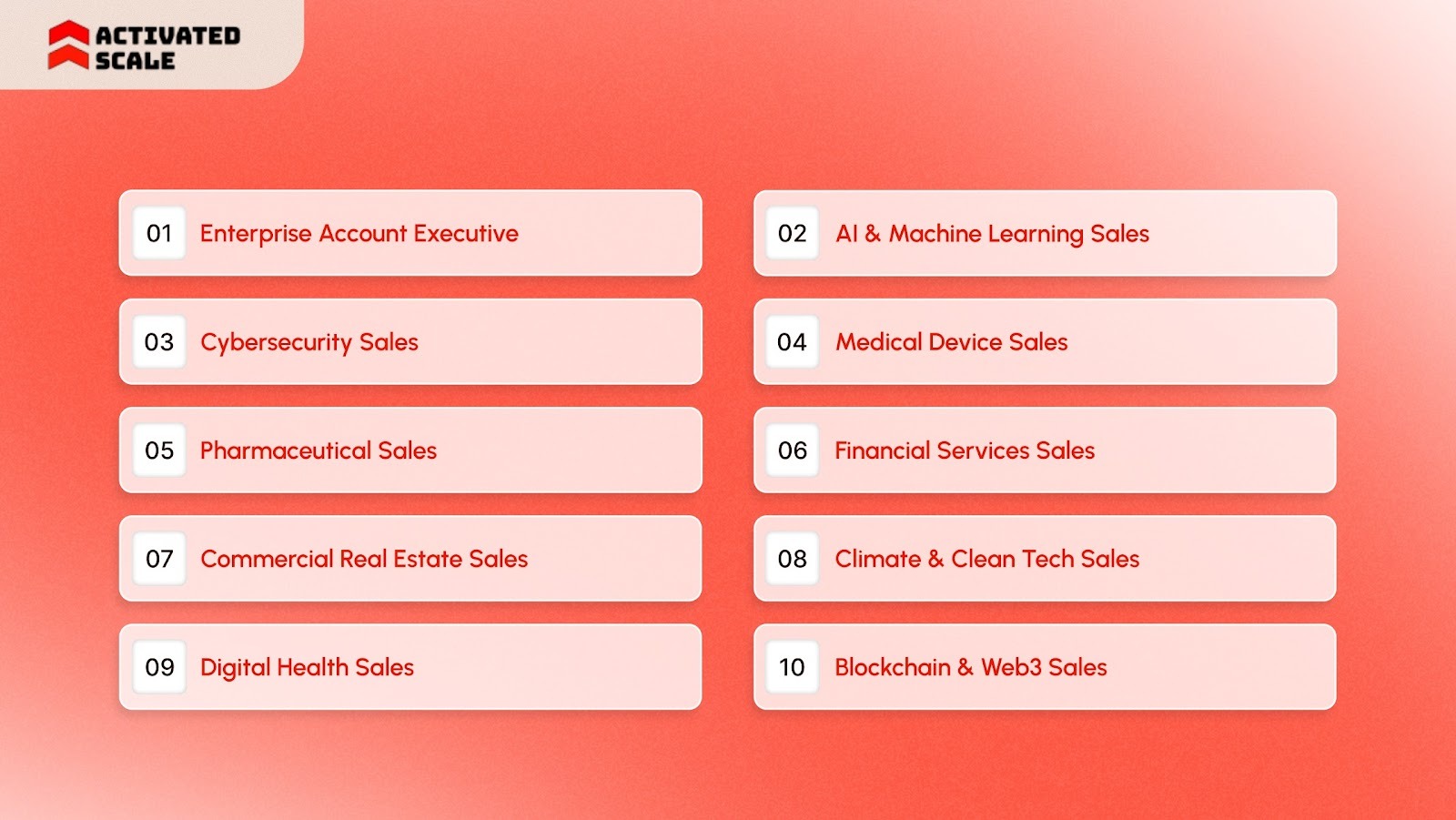
Sales roles that consistently cross the $250K mark are not high-paying by accident. They sit at the intersection of complex buying decisions, high financial risk, and long-term revenue impact. Companies pay more because mistakes are costly, and strong performers directly influence millions in revenue.
Below are sales roles where compensation at this level is structurally built into the job, not dependent on rare luck.
1. Enterprise Account Executive
US: $260K–$500K OTE
Enterprise AEs manage deals that often span 12–24 months, involve procurement, legal, IT, finance, and executive stakeholders, and carry contract values in the seven figures. Compensation reflects deal ownership, not activity volume.
These roles demand:
- Deep discovery and stakeholder mapping
- Commercial negotiation at scale
- Risk management across long sales cycles
Pay is high because a single closed deal can materially change a company’s revenue forecast.
2. AI & Machine Learning Sales
US: $120K–$300K+ OTE
AI sales pays a premium because technical misunderstanding kills deals. Buyers are cautious, skeptical, and often non-technical at the executive level. Sellers who can translate models, data pipelines, and outcomes into business value remove friction from high-stakes decisions.
The premium here comes from:
- Technical fluency combined with commercial skill
- Selling emerging technology with unclear benchmarks
- Educating buyers while progressing deals
3. Cybersecurity Sales
US: $120K–$300K+ OTE
Security sales is driven by risk avoidance, not discretionary spend. Deals are complex because buyers must justify decisions internally and prove compliance externally.
High compensation reflects:
- Regulatory pressure and compliance exposure
- Long-term contracts tied to operational risk
- Buyers prioritizing trust and credibility over price
Reps who understand security frameworks and compliance language consistently outperform.
4. Medical Device Sales
US: ~$195K average
Medical device sales pay well because they sit in a regulated, outcome-critical environment. Sales cycles involve clinicians, procurement, and regulatory approval, and decisions directly affect patient care.
Earnings reflect:
- High barriers to entry
- Technical product mastery
- Relationship-based selling in conservative markets
5. Pharmaceutical Sales (Specialised Areas)
US: ~$160K average
General pharma sales are stable, but compensation spikes in specialized therapeutic areas where expertise is rare. These roles require clinical understanding and credibility with specialists, not just coverage models.
Top earners typically sell:
- Oncology, rare disease, or specialty treatments
- High-value therapies with limited alternatives
6. Financial Services Sales
US: ~$150K average
In financial services, compensation scales with deal size and trust. Senior roles command higher pay because buyers evaluate not just products but also advisors.
What drives earnings:
- Large, recurring deal values
- Regulatory and fiduciary responsibility
- Relationship-driven revenue
7. Commercial Real Estate Sales
US: ~$235K average
This is commission-heavy selling tied to asset scale, not transaction volume. Income varies year to year, but peak earnings are driven by a small number of large, complex deals.
High compensation reflects:
- Long negotiation cycles
- Capital-intensive decisions
- Market timing and deal structuring skill
8. Climate & Clean Tech Sales
US: $90K–$200K+ OTE
Enterprise climate tech sales involve infrastructure, financing, and regulation. Sellers often manage multi-year projects rather than single transactions.
Pay increases with:
- Regulatory knowledge
- Enterprise contract experience
- Ability to sell long-term ROI
9. Digital Health Sales
US: ~$130K average
Digital health sits between healthcare and SaaS, creating complexity on both sides. Sellers must navigate compliance while still driving commercial outcomes.
Compensation grows as reps move into:
- Enterprise health systems
- Regulated markets
- Multi-site deployments
10. Blockchain & Web3 Sales
US: $80K–$275K+ OTE
Earnings vary widely due to market volatility. The most consistent pay is found in roles selling infrastructure, tooling, or enterprise platforms, not speculative products.
Stability comes from:
- Technical sales engineering roles
- Enterprise-facing use cases
- Reduced dependence on token value
The Real Pattern Behind $250K+ Sales Roles
Roles that consistently cross $250K share four traits:
- High decision risk for buyers
- Complex or regulated products
- Large contract values
- Long-term revenue impact
These jobs don’t reward speed or volume, they reward judgment, technical understanding, and commercial discipline.
The Career Timeline Most Sales Pros Learn the Hard Way
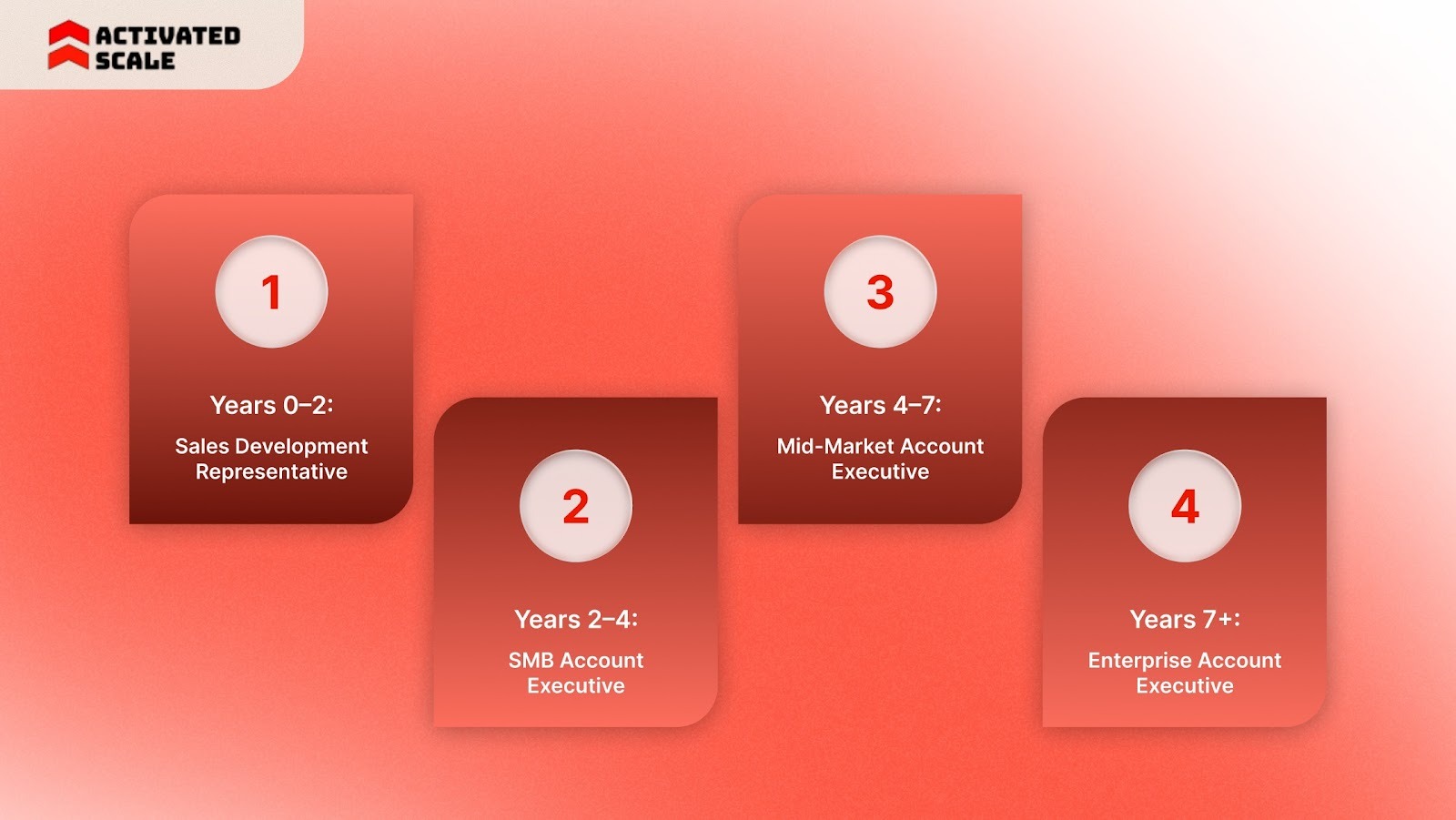
Reaching top-tier sales compensation doesn’t happen overnight. The path is fairly consistent, even if people don’t talk about it openly.
Here’s how it typically plays out:
- Years 0–2: Sales Development Representative (SDR)
Building pipeline, handling rejection, and learning the fundamentals. Compensation usually falls between $55,000 and $75,000.
- Years 2–4: SMB Account Executive
Owning smaller deals, running full sales cycles, and developing closing discipline. Earnings often range from $118,000 to $150,000.
- Years 4–7: Mid-Market Account Executive
Managing more complex deals, longer sales cycles, and multiple stakeholders. Total compensation typically reaches $180,000–$220,000.
- Years 7+: Enterprise Account Executive
Leading high-value, multi-stakeholder deals with long sales cycles. Compensation commonly exceeds $280,000.
Progression isn’t automatic. Sales professionals who move faster tend to:
- Consistently exceed quota
- Join high-growth companies early
- Develop expertise in complex or technical products
The pattern is predictable; the pace depends on performance, timing, and specialization.
Learn more about: The New Rules for Recruiting Salespeople for 2026
How Activated Scale Fits Enterprise Sales Engineer Roles
Enterprise Sales Engineers are hired for impact, not just technical support. Activated Scale reflects this shift in how companies build sales engineering teams.
Activated Scale connects companies with experienced, US-based Sales Engineers who support complex enterprise deals alongside AEs.
Roles often begin as fractional or contract-to-hire, allowing teams to assess real contribution before long-term commitment.
Sales Engineers placed through Activated Scale typically work on:
- Technical discovery and solution design
- Enterprise demos and proof-of-concepts
- Supporting long, multi-stakeholder sales cycles
This model aligns compensation growth with deal complexity, execution quality, and revenue impact, which increasingly defines enterprise sales engineer salary levels.
Conclusion
Enterprise Sales Engineer compensation in 2026 is tightly linked to one thing: impact on revenue. The closer an SE works to complex deals, technical buyers, and enterprise GTM teams, the higher the earning ceiling becomes.
Salary growth isn’t driven by tenure alone. It’s shaped by deal complexity, product depth, and the ability to influence buying decisions across long sales cycles. As companies prioritize execution over headcount, flexible hiring models are also changing how enterprise SE roles are structured and evaluated.
This is where Activated Scale fits naturally. By enabling companies to work with experienced Sales Engineers through flexible, execution-first roles, it aligns compensation with real contribution, not just job titles.
Explore opportunities with Activated Scale that put you closer to complex deals and modern GTM teams.
FAQs
1. What is the average enterprise sales engineer salary in 2026?
In the U.S., average total compensation typically ranges from $180K to $220K+, depending on seniority and deal complexity.
2. What drives higher pay for enterprise sales engineers?
Working on large, technical deals, supporting enterprise buyers, and influencing revenue outcomes.
3. Is enterprise sales engineering higher paid than standard SE roles?
Yes. Enterprise roles command higher compensation due to longer sales cycles and higher deal values.
4. Do Sales Engineers need coding skills to earn more?
Not always. Product depth, technical discovery, and buyer communication often matter more than coding.
5. How does Activated Scale support Sales Engineer career growth?
Activated Scale connects experienced Sales Engineers with flexible, high-impact roles where compensation aligns with real execution.
The Ultimate Guide to Hiring a Salesperson!
Get the step-by-step guide to hiring, onboarding, and ensuring success!