_edi.png)
Late or slow customer payments aren't an occasional nuisance; they're a financial drag for almost every business. In fact, 47% of U.S. small businesses say at least some of their invoices are more than 30 days overdue, and many of those late payments contribute directly to cash flow problems and working capital constraints.
If invoices take too long to be paid, a company may struggle to pay suppliers, invest in growth, or even cover payroll. This is where accounts receivable outsourcing becomes more than a back-office option; it becomes a strategic lever for improving liquidity and operational focus.
Core Insights
- Accounts receivable outsourcing involves delegating invoicing, payment tracking, collections, and dispute resolution to a specialized external partner.
- Companies outsource AR to protect cash flow and reduce Days Sales Outstanding (DSO), especially when internal processes can't keep pace with growth.
- The primary benefits include faster payment cycles, lower fixed overhead, scalable operations, and improved consistency in follow-ups and reporting.
- Pricing varies by model, percentage of collections, per-invoice fees, or monthly retainers, and depends on volume, complexity, and level of service required.
- Strong AR outsourcing requires structured workflows, system integration with your ERP or CRM, clear reporting visibility, and customer-sensitive communication.
- Many businesses apply the same outsourcing logic to other revenue functions, validating execution impact first before committing to long-term fixed headcount.
What Is Accounts Receivable Outsourcing?
Accounts receivable outsourcing is the practice of assigning invoicing and collections to a specialized external partner to maintain predictable cash flow and reduce payment delays.
Accounts receivable (AR) is the money customers owe after you've delivered a product or service on credit. On paper, revenue looks strong. In reality, that revenue only matters when cash actually hits the account.
Managing AR involves:
- Sending invoices accurately and on time
- Tracking payment deadlines
- Following up on overdue accounts
- Resolving billing disputes
- Reconciling payments against records
When any of this slows down, cash flow tightens. Sales may be up, but working capital feels strained.
With AR outsourcing, a third-party provider handles some or all of this workflow. They use structured processes, automation tools, and dedicated collections specialists to ensure invoices are sent on time and follow-ups are consistent.
The goal isn't to give up financial control. It's to remove execution friction so internal teams can focus on higher-impact work while cash flow remains steady.
Why Managing Accounts Receivable Outsourcing Matters
Accounts receivable outsourcing delivers value only when it's managed deliberately. Poor execution can create new risks, data exposure, communication gaps, or collections that prioritize speed over customer relationships. When done right, however, AR outsourcing directly improves cash flow and financial predictability.
Most businesses turn to AR outsourcing to fix specific problems:
- Late and unpaid invoices that strain liquidity
- Inconsistent follow-ups that push DSO higher each month
- Overloaded finance teams juggling collections alongside core accounting work
- Manual billing errors that create disputes and delay payments
- Unstable cash flow that limits planning and growth
Managing AR outsourcing also means keeping pace with evolving collections practices. Many providers now use automation and AI to standardize invoicing, flag overdue accounts earlier, and prioritize follow-ups that improve DSO. At the same time, businesses are moving away from rigid, one-size-fits-all contracts toward flexible AR models that match their billing cycles, customer mix, and growth stage.
AR outsourcing works when it strengthens cash flow discipline without adding complexity. It should create consistency, reduce delays, and scale collections, without burdening internal teams.
Must read: What Affects Sales Training Costs and How To Plan
Benefits of Outsourcing Accounts Receivable for Business
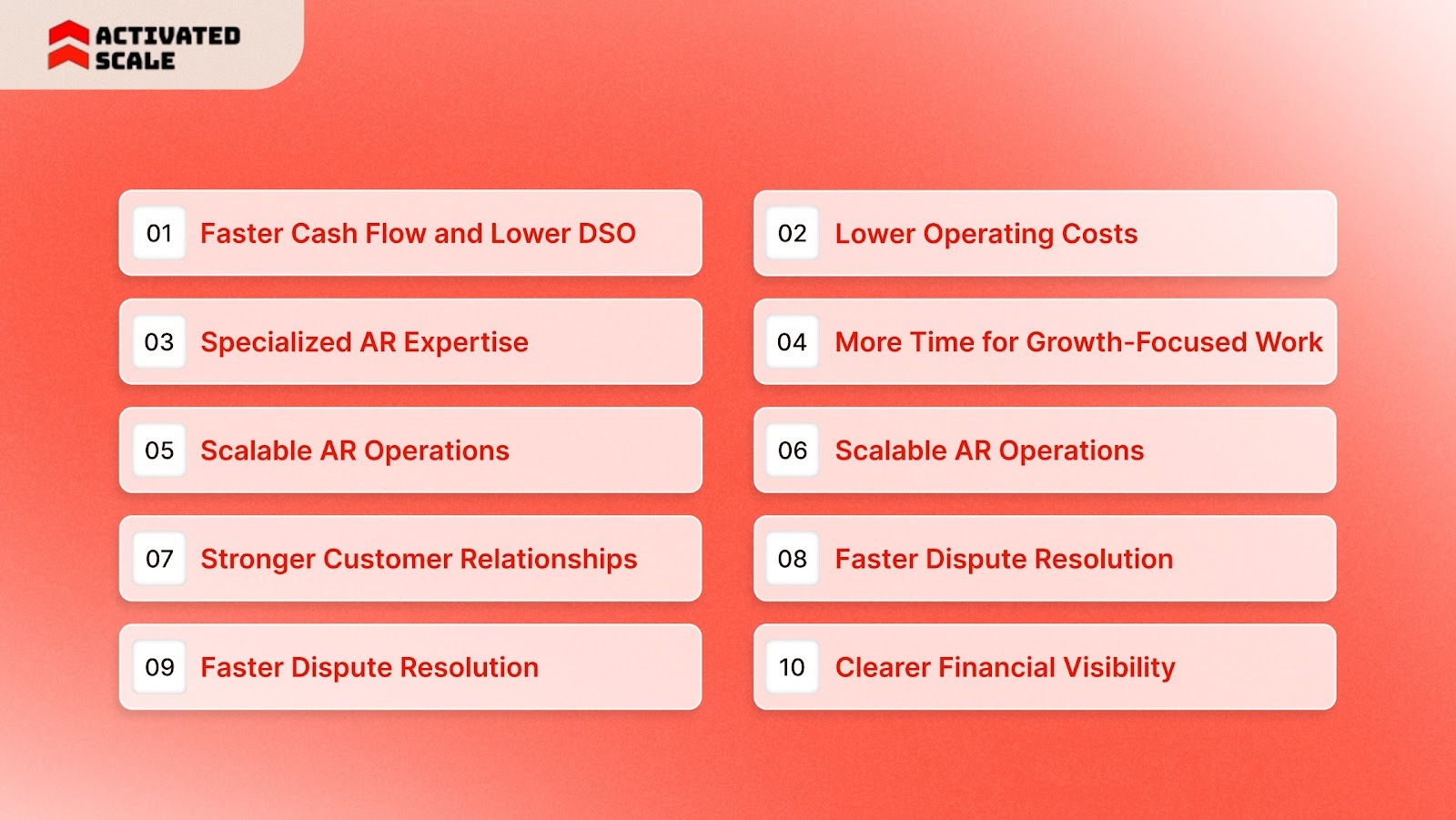
Outsourcing accounts receivable isn't about handing off paperwork. It's about tightening cash flow discipline, reducing DSO, and freeing internal teams from a function that quietly drains time and focus.
1. Faster Cash Flow and Lower DSO
Late payments hurt even profitable businesses. Outsourced AR providers follow structured collection timelines, use automated reminders, and prioritize overdue invoices consistently, something internal teams often struggle to maintain.
The result: invoices are paid faster, DSO declines, and cash becomes more predictable.
2. Lower Operating Costs
Running AR in-house means salaries, training, software, and ongoing process maintenance. Outsourcing consolidates those costs into a predictable fee.
3. Specialized AR Expertise
AR requires more than reminders; it involves dispute handling, customer communication, compliance awareness, and payment optimization.
Outsourced providers bring dedicated collections expertise and automation tools that reduce errors and speed resolution. You get experienced execution without building or managing the function internally.
4. More Time for Growth-Focused Work
AR management quietly consumes hours each week on follow-up, reconciliation, and issue resolution. When outsourced, finance and leadership teams can redirect that time to planning, customer strategy, and growth.
Many businesses report saving up to 10 hours per week by outsourcing accounting-related tasks.
5. Scalable AR Operations
As revenue grows, invoice volume grows with it. Outsourced AR scales without requiring new hires or system upgrades. Whether you're expanding quickly or managing seasonal swings, collections stay consistent without internal strain.
6. Reduced Risk and Better Compliance
AR involves handling sensitive financial data and complying with regulatory obligations. Professional providers maintain data privacy controls, audit trails, and compliance standards that reduce the risk of errors, fraud, or data mishandling.
7. Stronger Customer Relationships
Effective collections aren't aggressive; they're consistent and clear. Outsourced AR teams are trained to follow up professionally, resolve disputes quickly, and maintain goodwill while still enforcing payment terms.
That balance protects long-term customer relationships while improving collection rates.
8. Faster Dispute Resolution
Disputes delay cash more than late payments. Outsourced AR teams investigate issues early, coordinate with customers, and resolve discrepancies before invoices stall indefinitely, keeping revenue from getting stuck in limbo.
9. Better Use of Internal Resources
When AR is outsourced, internal teams stop splitting time between collections and higher-value work. Resources shift back to areas that directly drive revenue and customer retention.
This mirrors how many companies approach other non-core functions. Instead of overbuilding internally, they outsource execution and keep strategy in-house, similar to how teams use Activated Scale to handle sales hiring through flexible, contract-to-hire, or fractional models, while keeping leadership attention focused on growth.
10. Clearer Financial Visibility
With standardized reporting and consistent follow-ups, outsourced AR improves visibility into outstanding balances, payment trends, and risk areas, making forecasting and planning more reliable.
Once the benefits are clear, the real decision becomes who to trust with this function. Choosing the right AR partner determines whether these gains actually show up on your balance sheet or stay theoretical.
Learn more about: How to Hire Overseas Contractors Compliantly in 2026
AR Outsourcing vs In-House AR Team
How to Decide
If your AR volume is predictable and manageable, an in-house team can work well. If growth is accelerating, DSO is rising, or administrative overhead is increasing, outsourcing often delivers faster process discipline and improved cash flow stability.
Leading Accounts Receivable Outsourcing Companies in the U.S.
If you're evaluating accounts receivable outsourcing in the U.S., several established firms offer AR and finance outsourcing services at scale. Below is a quick comparison snapshot to help frame the landscape.
These firms typically serve mid-market to enterprise organizations and offer broader finance transformation capabilities beyond just AR. When comparing providers, consider:
- Level of automation and integration
- Industry specialization
- Scalability
- Reporting transparency
- Control over collections strategy
The right partner depends on whether your priority is cost reduction, automation, cash flow acceleration, or end-to-end finance transformation.
How Much Does Accounts Receivable Outsourcing Cost in the U.S.?
Accounts receivable outsourcing pricing in the U.S. varies based on scope, transaction volume, and service complexity. Most providers use one of three pricing models:
1. Percentage of Collections
Typically ranges from 1% to 5% of collected revenue, depending on volume and industry risk profile. Higher volumes usually mean lower percentage rates.
2. Per-Invoice or Per-Transaction Pricing
Common for companies with predictable billing cycles. Rates often range from $2 to $15 per invoice, depending on complexity and follow-up requirements.
3. Monthly Retainer or FTE-Based Pricing
Used for partial or fully managed AR functions. Costs generally range from $2,000 to $10,000+ per month, depending on workload and service depth. Enterprise-level finance transformation providers may charge higher fees, especially when automation, analytics, and compliance layers are included.
Pricing ranges are based on publicly available benchmarks from finance outsourcing providers and may vary by transaction volume, industry complexity, and service scope.
How to Choose the Right Accounts Receivable Outsourcing Partner
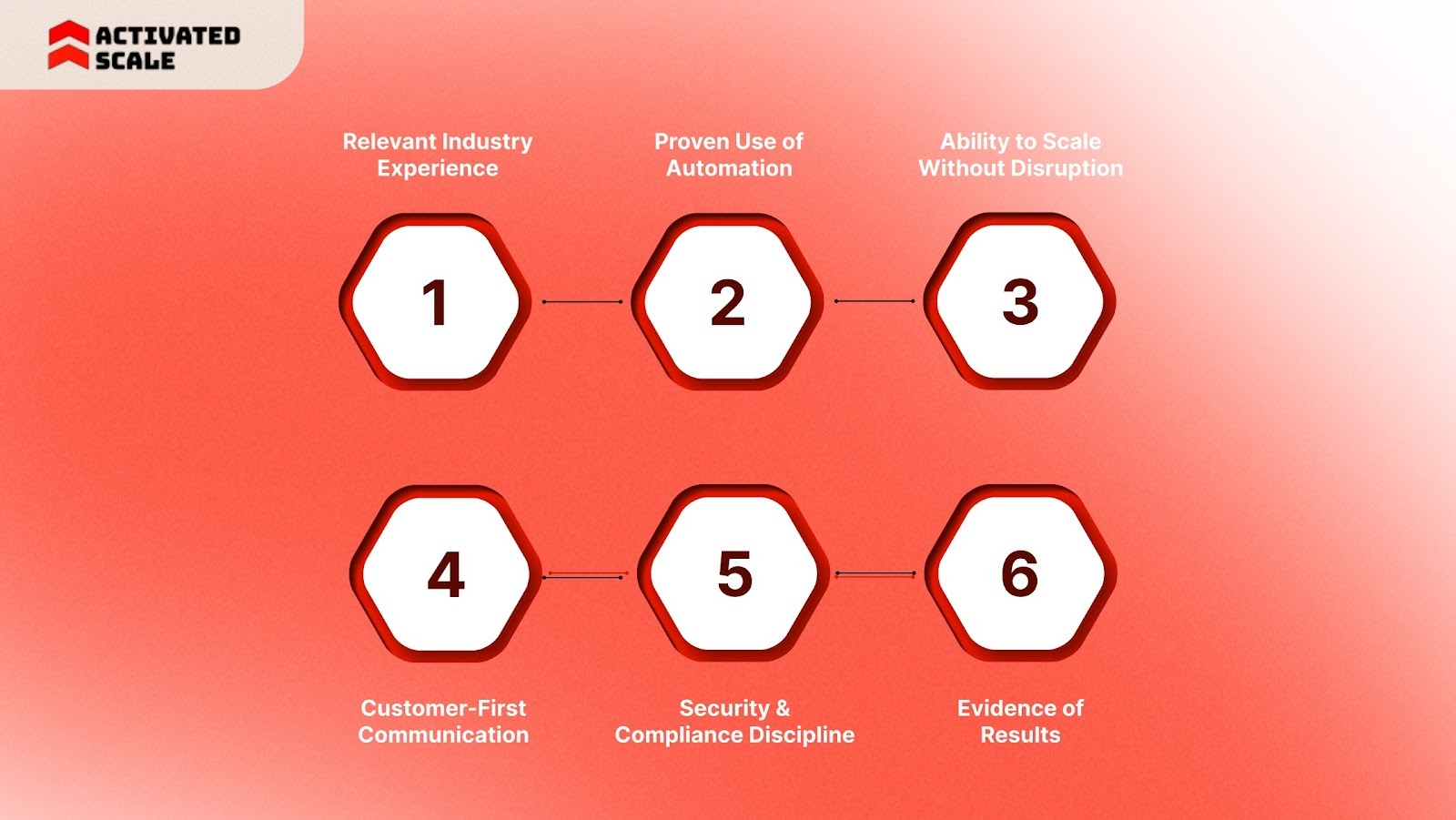
Not all AR outsourcing partners deliver the same results. The difference usually comes down to how well they understand your business model, your customers, and your risk tolerance. Here's how to evaluate partners beyond surface-level promises.
1. Relevant Industry Experience
AR isn't one-size-fits-all. Payment cycles, dispute patterns, and compliance requirements vary widely by industry.
Look for partners with experience in your sector who understand:
- How your customers typically pay
- Common causes of disputes or delays
- Industry-specific compliance requirements
This reduces onboarding time and avoids trial-and-error collections.
2. Proven Use of Automation (Not Just Tools)
Good AR partners don't just "have software", they use automation intentionally.
Ask how they:
- Trigger follow-ups based on invoice age
- Flag high-risk accounts early
- Provide real-time visibility into outstanding balances
The goal is consistency and speed, not just dashboards.
3. Ability to Scale Without Disruption
Your AR workload will change as revenue grows, markets expand, or seasonality kicks in. A strong partner should scale volume and complexity without degrading follow-up quality or customer experience.
If growth requires renegotiating contracts or rebuilding workflows, that's a red flag.
4. Customer-First Communication
Collections affect relationships. Poor tone or inconsistent follow-ups can undo months of sales and account management.
Choose a partner that treats collections as an extension of your brand, professional, clear, and respectful. This is especially important in B2B environments where long-term relationships matter more than one-time payments.
5. Security and Compliance Discipline
AR partners handle sensitive financial and customer data. Security shouldn't be a feature; it should be foundational.
Verify that your partner:
- Uses encryption and secure payment workflows
- Maintains audit trails and access controls
- Understands cross-border or regional compliance, if applicable
6. Evidence of Results
Don't rely on claims; ask for proof.
Strong AR partners can point to:
- Reduced DSO
- Improved collection rates
- Faster dispute resolution timelines
Case studies and references should show measurable improvement, not just activity.
The right AR outsourcing partner doesn't just process invoices. They strengthen cash flow discipline, protect customer relationships, and reduce financial friction as your business scales.
This mirrors how companies evaluate other outsourced functions. Whether it's AR, payroll, or even sales hiring, the best partners don't just execute; they reduce risk while improving outcomes.
The Same Outsourcing Logic Applies to Revenue Teams
Accounts receivable outsourcing works because it shifts execution-intensive work from internal teams while maintaining in-house financial control. Businesses use it to protect cash flow, reduce risk, and stay focused on growth.
That same logic increasingly applies to sales hiring.
Instead of overcommitting to full-time headcount too early, many founders now validate impact first, using flexible models that reduce hiring risk while keeping performance accountable. That's where Activated Scale fits naturally.
Activated Scale helps companies access pre-vetted U.S. based sales talent through:
- Contract-to-Hire Recruiting: Deploy experienced SDRs, AEs, or sales leaders on a contract basis with clear performance metrics. If results meet expectations, transition them to full-time. This reduces hiring risk while proving pipeline and revenue impact first.
- Fractional Selling: Bring in part-time SDRs or AEs to generate pipeline, run outreach, manage deals, or fill temporary gaps. This model supports revenue continuity without adding permanent overhead.
- Fractional Sales Leadership: Engage experienced sales leaders to define go-to-market strategy, build sales processes, improve forecasting, and structure teams. This provides strategic oversight without committing to a full-time executive hire.
Just like AR outsourcing, the goal isn't to relinquish control; it's to outsource execution intelligently so internal teams can focus on strategy and growth.
Conclusion
Accounts receivable outsourcing works when it delivers consistent invoicing, follow-up, and cash flow. Done right, it reduces DSO, limits financial risk, and frees internal teams to focus on higher-impact work instead of chasing payments.
This is the same mindset driving modern operations across functions. Businesses outsource execution-heavy, non-core work while keeping strategy in-house. That's why many founders apply similar thinking to sales hiring, using flexible models to validate impact before committing long-term.
If your finance or sales teams are spending more time on execution than growth, it may be time to rethink what you keep in-house. Let's connect and explore a smarter way to scale.
FAQs
1. What AR tasks should be outsourced, and what should stay in-house?
Most companies outsource invoice delivery, payment follow-ups, ageing reviews, dispute coordination, and collections tracking. Strategic decisions such as credit policy, customer relationship ownership, and escalation authority are typically kept in-house. The goal is to outsource execution while retaining control.
2. Is AR outsourcing useful for growing companies?
Yes. AR outsourcing for growing companies helps maintain cash flow discipline during rapid expansion. As invoice volume increases, internal teams often struggle to maintain a consistent follow-up cadence. Outsourcing ensures scale without sacrificing process control or customer communication standards.
3. Will outsourcing AR damage customer relationships?
It can if handled poorly. A strong provider follows structured, professional, and brand-aligned communication. In many cases, customers respond better to consistent, neutral reminders than to sporadic internal emails sent weeks late.
4. How quickly can AR outsourcing improve cash flow?
Most businesses see measurable improvements within 60–90 days. Faster invoicing, earlier follow-ups, and consistent escalation often reduce overdue balances quickly, leading to lower DSO before long-term gains compound.
5. How do AR providers measure success?
Effective AR outsourcing is measured through operational and financial impact, including:
- Reduction in Days Sales Outstanding (DSO)
- Increase in on-time payment rates
- Faster dispute resolution cycles
- Improved cash flow predictability
If a provider cannot tie performance to these outcomes, that's a red flag.
6. What's the biggest mistake companies make when outsourcing AR?
Choosing based on cost alone. Low-cost providers may lack automation maturity, industry expertise, or customer-sensitive communication processes. The result is minimal DSO improvement and potential strain on client relationships.
The Ultimate Guide to Hiring a Salesperson!
Get the step-by-step guide to hiring, onboarding, and ensuring success!